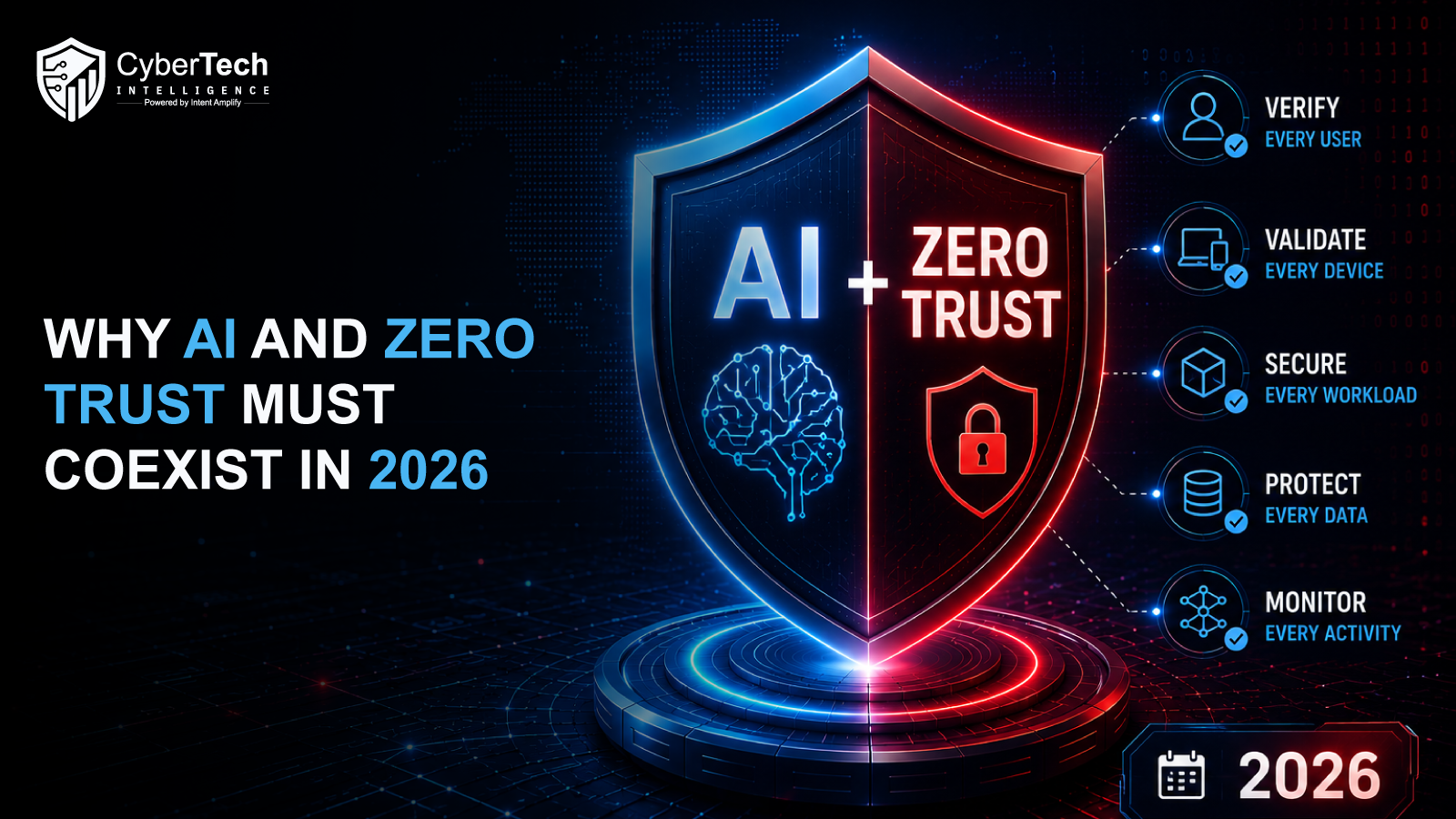
Artificial intelligence and Zero Trust (ZT) are no longer separate cybersecurity conversations. AI is changing how enterprises automate work, analyze data, write code, serve customers, run security operations, and make decisions. Zero Trust, meanwhile, remains one of the most practical security models for reducing implicit trust across users, devices, applications, workloads, identities, and data. In 2026, the two must coexist because AI expands the enterprise trust surface faster than traditional controls can validate it.
This is not simply a technology architecture issue. It is a leadership issue. AI systems are beginning to retrieve sensitive data, interact with SaaS applications, support developers, assist analysts, summarize business records, and, in agentic workflows, take actions across connected systems. A model may be approved, but the data it accesses may not be properly governed. An AI assistant may improve productivity, but the permissions behind it may be excessive. An AI agent may appear useful during a pilot, yet become risky once it touches customer records, source code, security telemetry, or privileged business workflows.
Zero Trust matters because it introduces a disciplined question into every AI-enabled interaction: should this identity, system, model, agent, or workload be trusted in this context, for this data, at this moment?
The need is already visible in the threat landscape. Palo Alto Networks Unit 42 reported in its 2026 Unit 42 Global Incident Response Report that the fastest observed attacks moved from initial access to data exfiltration in approximately 72 minutes, 4 times faster than the prior year. The same report found that 87% of intrusions crossed multiple attack surfaces, including identity, endpoint, cloud, network, and SaaS environments.1
For CISOs, this changes the AI security conversation. AI cannot be secured only at the model layer. It must be governed through identity, access, data classification, policy enforcement, continuous monitoring, and incident response. That is precisely where Zero Trust becomes essential.
AI Expands Trust in Uncomfortable Ways
Enterprise operations have always depended on trust, but AI expands the number of systems, identities, and decisions that require it. Trust is no longer limited to human users accessing applications. It now extends to prompts, APIs, retrieval systems, vector databases, model outputs, autonomous agents, SaaS integrations, and non-human identities. This broader trust surface increases both capability and risk.
Traditional applications typically operate within defined workflows. AI systems often span multiple contexts. A generative AI assistant may summarize confidential documents, answer employee questions, retrieve information from internal repositories, or interact with business systems. A code assistant may influence software quality, security posture, and developer behavior. A security operations tool may prioritize alerts or recommend containment actions. In each case, the organization is relying not only on the tool itself but also on the quality of the underlying data, the access model, the generated output, and the downstream decisions influenced by that output.
Traditional perimeter-based security assumptions become less effective in AI-enabled environments. An internal AI system may depend on external APIs. A trusted SaaS platform may introduce AI features that change how enterprise data is processed. A legitimate user may submit prompts that request information beyond an authorized business purpose. A model may operate safely in one workflow while creating unacceptable risk in another. Effective AI security therefore depends on governing identities, data access, retrieval paths, model behavior, and workflow context rather than relying solely on network or application boundaries.
NIST defines "Zero Trust" as a cybersecurity model that removes implicit trust based on network location and instead focuses on continuous evaluation of users, assets, and resources.2
That principle fits AI because AI security is not about trusting or blocking AI by default. It is about continuously verifying access, context, behavior, and data use.
Identity Becomes the AI Control Point
The convergence of AI and Zero Trust begins with identity. AI systems depend on human identities, machine identities, service accounts, application permissions, API keys, tokens, bots, agents, and workload identities. In many enterprises, these non-human identities already create governance strain. AI intensifies the problem because these identities can retrieve information, trigger actions, or move across connected systems.
The risk is not that every AI system is unsafe. The risk is that organizations often grant broad access for convenience. A productivity assistant becomes more useful when it can search documents, emails, chats, and project systems. An AI coding tool becomes more useful when it can see repositories and development context. A security AI assistant becomes more useful when it can analyze endpoint, identity, and cloud telemetry. Yet every new access path increases the blast radius if credentials are compromised, prompts are manipulated, or integrations are misconfigured.
Zero Trust requires AI-connected identities to be treated as governed identities. This means least privilege, strong authentication, access reviews, credential rotation, session monitoring, anomaly detection, and fast revocation. It also means separating what an AI system can read, summarize, store, recommend, and execute. Those distinctions matter. Reading a document is not the same as exporting it. Recommending a remediation step is not the same as executing it. Summarizing a security incident is not the same as changing a firewall rule or disabling an account.
Microsoft reported in its Microsoft Digital Defense Report 2025 that it processes more than 100 trillion security signals daily, blocks 4.5 million new malware files every day, and analyzes 38 million identity risk detections on an average day.3
These figures show why identity and telemetry are now central to modern security. AI increases the volume and complexity of decisions, while Zero Trust provides the logic for deciding when access should be allowed, limited, challenged, logged, or denied.
Data Is Where AI and Zero Trust Meet
The strongest business value of AI often comes from data access. The strongest business risk comes from the same place. AI systems become useful when they can analyze internal context, but that context may include customer records, financial information, intellectual property, contracts, source code, security logs, regulated data, or strategic business plans.
This creates a practical tension. If access is too restrictive, employees may move to unsanctioned tools. If access is too broad, sensitive information may surface in prompts, outputs, logs, training workflows, or third-party processing environments. Zero Trust offers a middle path: enable AI use, but make every data interaction conditional, observable, and governed.
A Zero Trust data model for AI should classify information, apply least privilege, enforce business-purpose access, monitor retrieval patterns, restrict sensitive outputs, and prevent unmanaged sharing. It should also distinguish between data the AI system can view, data it can summarize, data it can retain, data it can use for training, and data it can pass to other systems.
IBM reported in its Cost of a Data Breach Report 2025 that the global average cost of a data breach was USD 4.4 million, while 97% of organizations that reported an AI-related security incident lacked proper AI access controls. IBM also found that 63% of organizations lacked AI governance policies, and that extensive use of AI in security was associated with USD 1.9 million in cost savings compared with organizations that did not use those solutions.4
AI can improve security economics when implemented with discipline, but poorly governed AI can increase exposure. Zero Trust helps organizations capture the value of AI without allowing data access to become invisible.
AI Pipelines Need Policy Enforcement
Many organizations have Zero Trust programs for users, devices, applications, and networks. Fewer have extended those principles into AI pipelines. That gap is becoming critical.
A modern AI workflow may include a user interface, orchestration layer, model, retrieval system, vector database, plug-ins, APIs, business applications, monitoring tools, and output channels. Each layer can become a policy enforcement point. Access decisions should not happen only when a user logs in. They should also occur when an AI system retrieves data, when a prompt requests sensitive context, when an agent calls a tool, when an output contains protected information, or when an automated action could affect a business process.
CISA’s Zero Trust Maturity Model Version 2.0 organizes Zero Trust around five pillars: identity, devices, networks, applications and workloads, and data. It also identifies visibility and analytics, automation and orchestration, and governance as cross-cutting capabilities.5
These pillars map directly to AI. Identity governs who or what can use the AI system. Devices and workloads define trusted environments. Applications and workloads manage AI-enabled services. Data controls determine what can be retrieved or shared. Visibility and analytics help detect abnormal behavior. Governance ensures AI use aligns with enterprise policy.
The strategic shift is important: Zero Trust can no longer stop at the application boundary. It must extend into the AI workflow itself.
AI Can Strengthen Zero Trust, But Not Without Accountability
The relationship also works in the other direction. AI can strengthen Zero Trust programs by helping security teams analyze access behavior, prioritize risky identities, detect abnormal data movement, summarize policy violations, and recommend segmentation or access changes. This is useful because mature Zero Trust programs generate large volumes of telemetry and policy signals that human teams cannot always interpret quickly.
However, AI-generated recommendations should not automatically become security decisions. A Zero Trust program depends on explainability and accountability. If AI recommends blocking access, revoking a token, isolating a workload, or escalating an identity risk, the organization must know why. It must also define which actions can be automated and which require human review.
Google Cloud Mandiant reported in M-Trends 2026 that the report is based on more than 500,000 hours of frontline incident investigations conducted globally in 2025. It also reported that global median dwell time rose to 14 days, up from 11 days, while internal detection accounted for 52% of first detections, compared with 43% previously.6
These findings reinforce the need for both AI and Zero Trust. AI can help process signals faster. Zero Trust helps determine what those signals should mean in access, containment, and response decisions.
What CISOs Should Prioritize in 2026
CISOs should stop treating AI security as a separate innovation risk and begin treating it as part of enterprise trust architecture. The priority is to identify AI workflows that expand trust. These include AI systems connected to sensitive data, privileged identities, business automation, customer-facing processes, software development, security operations, and third-party platforms.
The second priority is to map those workflows against Zero Trust principles. Security teams should verify identity explicitly, limit access, classify data, monitor behavior, assume compromise, and adjust controls based on risk. This does not mean every AI workflow requires maximum restriction. It means each workflow should receive controls appropriate to its data sensitivity and business impact.
The third priority is to define AI-specific enforcement points. These include model access, prompt handling, retrieval permissions, plug-in usage, output sharing, agent actions, API calls, and evidence logging. Leadership should know which controls prevent misuse, which detect misuse, and which support response when something goes wrong.
Finally, CISOs should communicate AI and Zero Trust as one business trust agenda. Boards do not need a technical lecture on prompt injection or conditional access policies. They need to know whether the enterprise can scale AI without multiplying unmanaged trust.
What Cybersecurity Vendors Should Understand
For cybersecurity vendors, the AI and Zero Trust convergence creates a strong market education opportunity. Buyers are not looking for vague claims. They want clarity on how solutions govern AI identities, control data access, monitor AI workflows, enforce policy, and integrate with existing identity, cloud, endpoint, SaaS, and security operations environments.
The strongest positioning will connect AI and Zero Trust to measurable outcomes: reduced identity risk, better model access governance, stronger data protection, safer AI agents, improved visibility across SaaS integrations, and faster response to abnormal behavior. Buyers will respond to practical control language because it connects emerging AI risk to familiar enterprise priorities.
Where CyberTech Intelligence Helps
CyberTech Intelligence helps cybersecurity teams, vendors, and technology decision-makers interpret the enterprise security shifts shaping buyer priorities. Our work brings together cybersecurity intelligence, market insight, expert-led content, and audience engagement across AI security, Zero Trust, identity security, threat intelligence, cloud security, governance, and security operations.
Through pipeline activation and go-to-market intelligence, CyberTech Intelligence helps cybersecurity brands reach relevant decision-makers with stronger messaging, sharper targeting, and research-backed campaign execution. This is especially important in fast-moving categories where buyers need education before solution evaluation.
CyberTech Intelligence also supports CISO round tables, webinars, expert insights, newsletters, podcasts, blogs, case studies, reports, surveys, whitepapers, ebooks, and strategic consulting.
Explore how CyberTech Intelligence can support your cybersecurity growth, research, and audience engagement goals.
Contact Us
Executive Takeaway
AI and Zero Trust must coexist in 2026 because enterprise trust is being redistributed. Trust is moving from human users to machine identities, from static applications to dynamic workflows, from internal databases to retrieval pipelines, and from manual actions to AI-assisted automation. Without Zero Trust, AI can scale faster than governance. Without AI, Zero Trust programs may struggle to process the volume and complexity of modern security signals.
The future security model will not ask whether AI should be trusted or blocked by default. It will ask whether every AI-enabled interaction can be verified, governed, observed, and explained. That is the real leadership mandate for CISOs: allow AI to move at business speed, but ensure that identity, data, access, and action remain controlled by evidence.
References
-
Palo Alto Networks Unit 42, 2026 Unit 42 Global Incident Response Report, February 17, 2026
https://www.paloaltonetworks.com/blog/2026/02/unit-42-global-ir-report/ -
NIST, SP 800-207, Zero Trust Architecture, August 2020
https://csrc.nist.gov/pubs/sp/800/207/final -
Microsoft, Microsoft Digital Defense Report 2025, 2025
https://www.microsoft.com/en-us/corporate-responsibility/cybersecurity/microsoft-digital-defense-report-2025/ -
CISA, Zero Trust Maturity Model Version 2.0, April 2023
https://www.cisa.gov/sites/default/files/2023-04/zero_trust_maturity_model_v2_508.pdf -
IBM, Cost of a Data Breach Report 2025, 2025
https://www.ibm.com/reports/data-breach -
Google Cloud Mandiant, M-Trends 2026: Data, Insights, and Strategies From the Frontlines, March 24, 2026
https://cloud.google.com/blog/topics/threat-intelligence/m-trends-2026/