
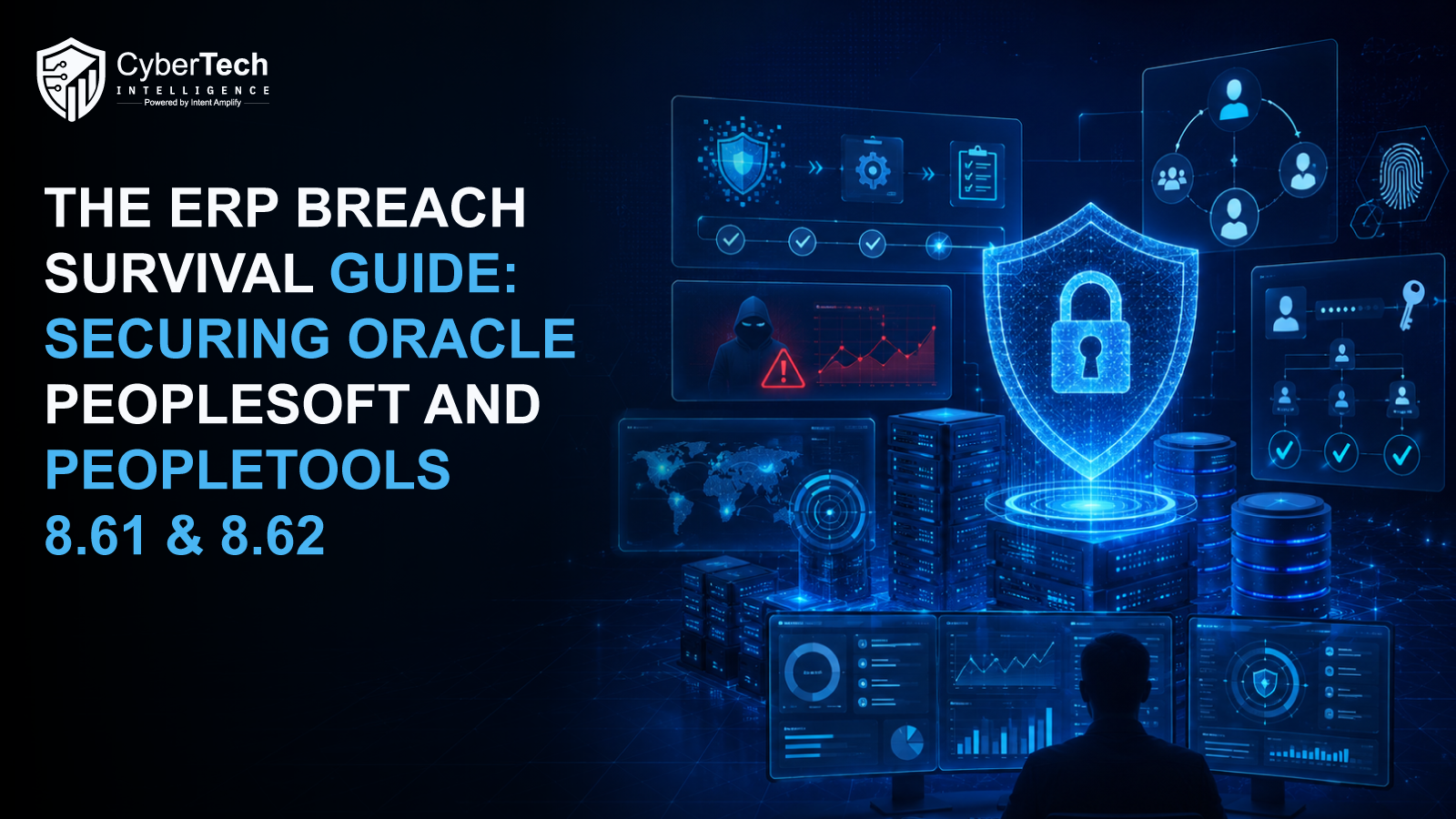
Executive Summary
The Oracle PeopleSoft zero-day has changed the way enterprise leaders should think about enterprise resource planning security. PeopleSoft is not only an administrative application that supports routine back-office work; in many organizations, it carries payroll, human resources, finance, student administration, grants, procurement, supplier records, identity workflows, and regulated data exchange. When this layer becomes exposed, the operational and compliance impact can extend far beyond one vulnerable server.
Oracle confirmed that CVE-2026-35273 affects PeopleSoft Enterprise PeopleTools and is remotely exploitable without authentication. Successful exploitation can result in remote code execution.¹
Google Cloud’s Mandiant and Google Threat Intelligence Group reported that activity linked to UNC6240, associated with ShinyHunters, targeted Oracle PeopleSoft application infrastructure between May 27 and June 9, 2026.²
Rapid7 identified the affected PeopleTools versions as 8.61 and 8.62 and described the flaw as a critical unauthenticated SSRF-to-RCE vulnerability with a CVSS score of 9.8.³
This eBook is written for CISOs, CIOs, security architects, risk leaders, ERP owners, compliance teams, and executive sponsors who need a practical survival guide for closing Oracle PeopleSoft security gaps. The core argument is straightforward: PeopleSoft security can no longer depend only on patch cycles. Enterprises need ERP vulnerability management that combines exposure mapping, privileged access governance, threat intelligence, monitoring, third-party risk control, and board-ready evidence.
IBM’s Cost of a Data Breach Report 2025 found that the global average cost of a data breach reached $4.44 million, while the average U.S. breach cost reached $10.22 million.⁴ Microsoft’s Digital Defense Report 2025 states that Microsoft observes more than 600 million cybercriminal and nation-state attacks every day.⁵ Verizon’s 2026 Data Breach Investigations Report analyzed more than 31,000 security incidents and more than 22,000 confirmed data breaches.⁶ These figures make one point clear for enterprise leadership: ERP security is no longer a quiet application-control issue but a business resilience, breach prevention, and executive governance priority.
CyberTech Intelligence Perspective
CyberTech Intelligence views the Oracle PeopleSoft zero-day as more than a vulnerability event. It is a test of ERP resilience, exposure governance, privileged access control, monitoring readiness, and executive accountability. PeopleSoft environments often support payroll, HR, finance, procurement, student administration, grants, supplier records, identity workflows, and regulated business data. When that layer is exposed, the impact can move quickly from technical risk to operational disruption and board-level concern.
According to CyberTech Intelligence research and analysis, the organizations best prepared for ERP breach scenarios will not be those that only patch faster. They will be those that can identify exposed PeopleSoft assets, validate PeopleTools versions, review privileged and third-party access, preserve monitoring evidence, govern exceptions, and brief executives with defensible risk status.
Why PeopleTools 8.61 and 8.62 Became a Security Priority
PeopleTools provides the underlying application framework for PeopleSoft environments. As a result, vulnerabilities in PeopleTools carry broader enterprise implications than application-layer defects because they affect the platform supporting business-critical functions such as payroll, finance, procurement, human resources, and student administration.
CVE-2026-35273 combines several characteristics that security teams classify as high risk. Oracle confirmed that the vulnerability affects PeopleSoft Enterprise PeopleTools, is remotely exploitable without authentication, and can result in remote code execution.¹ Rapid7 identified PeopleTools versions 8.61 and 8.62 as affected.³
For enterprise leaders, the priority extends beyond determining whether vulnerable versions are present. Organizations need to identify every affected PeopleSoft instance, confirm external reachability, understand which business processes depend on each environment, review privileged and third-party access, and verify that monitoring data is sufficient to reconstruct suspicious activity throughout the exposure window.
Effective ERP security depends on answering these questions in hours rather than days because delayed visibility increases operational, regulatory, and business risk.
The ERP Blind Spot Is an Ownership Problem
The PeopleSoft breach risk is not only technical; it is also organizational. In many enterprises, ERP security ownership is fragmented across application teams, infrastructure teams, identity teams, security operations, procurement, compliance, and business process owners.
That structure creates a dangerous gap. Application teams may understand configuration, infrastructure teams may manage servers, identity teams may control access, procurement may own vendor relationships, and compliance teams may review evidence, yet no single function may hold the complete ERP risk picture.
CyberTech Intelligence’s analyst view is that the ERP blind spot appears when leadership can name the platform but cannot explain the exposure. Knowing that the organization runs PeopleSoft is not the same as knowing where PeopleSoft is reachable, which data it processes, who can administer it, which vendors can connect to it, and how quickly suspicious activity can be investigated.
CyberTech Intelligence Research Desk Observation
The PeopleSoft zero-day should not be read only as a patching event. It should be read as a test of ERP exposure governance.
CyberTech Intelligence sees a recurring weakness in large organizations: ERP systems are treated as stable business platforms, while attackers treat them as high-value breach infrastructure. The gap between those two views creates the blind spot that this campaign has brought into focus.
A CVSS 9.8 vulnerability tells the enterprise that the technical severity is critical. It does not tell the board whether payroll data is exposed, whether privileged accounts were reviewed, whether service accounts are over-permissioned, whether third-party support sessions are logged, or whether the incident response team can reconstruct activity across the PeopleSoft layer. ³
That is why the survival guide must move beyond “apply the patch.” Patching is essential, but the executive question is larger: can the organization prove that PeopleSoft exposure is known, access is controlled, monitoring is active, and exceptions are governed?
The future of ERP security will be measured by evidence, not intention. PeopleSoft resilience depends on whether leadership can prove exposure status, access control, monitoring coverage, exception ownership, and incident response readiness before a critical advisory becomes a business disruption.
CyberTech Intelligence ERP Resilience Operating Model™
The CyberTech Intelligence ERP Resilience Operating Model™ expands the ERP Breach Survival Framework into a reusable governance model for PeopleSoft and other enterprise ERP environments. It helps CISOs, CIOs, ERP owners, identity teams, risk leaders, and compliance stakeholders connect exposure discovery, version validation, business criticality, privileged access, third-party governance, monitoring, patch controls, and executive evidence into one operating discipline. .
|
Resilience Layer |
Core Question |
Security Outcome |
|
Exposure Discovery |
Where is PeopleSoft reachable across production, test, development, and support environments? |
Reduces unknown attack paths and hidden ERP exposure. |
|
Version Validation |
Are PeopleTools versions 8.61 or 8.62 present in the environment? |
Confirms vulnerability relevance and remediation priority. |
|
Business Criticality |
Which workflows, data sets, and operations depend on each PeopleSoft instance? |
Prioritizes systems that affect payroll, HR, finance, procurement, compliance, and regulated data. |
|
Privileged Access |
Who can administer, modify, extract, or move data from the environment? |
Reduces identity-driven blast radius after exploitation. |
|
Third-Party Access |
Which vendors, consultants, MSPs, or support providers can connect? |
Controls external trust paths and support-channel risk. |
|
Monitoring and Logs |
Can suspicious activity be reconstructed across application, identity, database, privileged access, endpoint, and network layers? |
Improves detection, investigation, and breach-scope confidence. |
|
Patch and Compensating Controls |
What remediation, mitigation, segmentation, monitoring, or access restriction is active? |
Reduces exploitable exposure while preserving business continuity. |
|
Executive Evidence |
Can leadership see current exposure, unresolved exceptions, owners, and control evidence? |
Supports governance, accountability, and board-ready risk reporting. |
This operating model should be jointly owned by security, ERP, infrastructure, identity, risk, compliance, vendor management, and business leadership because PeopleSoft security cannot succeed when it sits only inside one application team. ERP resilience requires shared ownership, continuous evidence, and executive visibility.
The PeopleSoft Breach Response Flow
The following response flow gives security and ERP teams a practical sequence for handling critical PeopleTools exposure.
PeopleSoft Critical Advisory Identified
↓
Confirm Affected PeopleTools Versions
↓
Map Internet-Facing, Internal, Test, and Support Exposure
↓
Classify Business Function, Data Sensitivity, and Operational Dependency
↓
Review Privileged, Service, Emergency, and Third-Party Accounts
↓
Apply Oracle Security Update, Mitigation, or Compensating Control
↓
Preserve and Review Logs Across the Exposure Window
↓
Contain Suspicious Access and Protect Evidence
↓
Document Exceptions, Business Owners, Control Evidence, and Deadlines
↓
Report Exposure Reduction and Residual Risk to Executive Leadership
This flow matters because ERP incidents create both technical and business decisions. A security team may know how to investigate a suspicious endpoint, but a PeopleSoft incident can require coordinated action across payroll, finance, HR, legal, compliance, procurement, vendor management, identity teams, and executive communications. The response must protect evidence while also preserving business continuity.
Why ERP Resilience Extends Beyond Patch Cycles
ERP patch management follows a disciplined operational process because PeopleSoft environments support payroll, benefits administration, academic services, procurement approvals, financial reconciliation, tax reporting, employee onboarding, and other business-critical functions. Every update requires careful coordination to preserve operational continuity.
Google Cloud's M-Trends 2026 reported that observed exploitation can occur before public disclosure or patch availability, with the average time to exploit reaching approximately minus seven days in tracked cases.² This operating environment places greater value on continuous exposure awareness, monitoring, and rapid investigation alongside timely patch management.
For PeopleSoft environments, effective vulnerability management combines Oracle security updates with compensating controls, exposure monitoring, log readiness, and threat intelligence-led triage. Together, these capabilities improve visibility throughout the exposure window and strengthen incident response before, during, and after remediation.
CrowdStrike's 2026 Global Threat Report found that malware-free activity accounted for 82% of detections, illustrating how frequently adversaries rely on identity, legitimate administrative tools, and hands-on-keyboard techniques.⁷ For ERP security teams, this reinforces the importance of monitoring administrative activity, HTTP requests, file access, service account behavior, and data movement alongside traditional malware detection.
PeopleSoft Security Gaps to Close First
Gap 1: Unknown PeopleSoft Exposure
The first security gap is incomplete visibility. Some organizations cannot quickly identify every PeopleSoft instance, PeopleTools version, endpoint, administrator console, test environment, development environment, or externally accessible service.
Security teams should build a PeopleSoft exposure register that includes application name, PeopleTools version, hosting environment, external exposure status, business owner, technical owner, data classification, privileged access owner, third-party access paths, patch status, logging coverage, and exception status. This register should be updated continuously rather than treated as an annual audit artifact.
Gap 2: Weak Privileged Access Governance
PeopleSoft environments often include administrators, developers, database administrators, service accounts, integration accounts, vendor accounts, and emergency access accounts. Each account type can expand the blast radius if attackers gain access.
Privileged access management should cover named administrator accounts, shared accounts, service accounts, batch processing accounts, database access, vendor support accounts, emergency access workflows, session logging, and access recertification. For high-risk PeopleSoft environments, privileged accounts should be reviewed after every critical advisory rather than left for scheduled access reviews.
Gap 3: Third-Party Support Paths
ERP platforms often depend on external consultants, managed service providers, implementation partners, cloud hosting teams, and specialized support vendors. These providers may have deep access to PeopleSoft systems, which makes third-party control a direct part of ERP vulnerability management.
Third-party access should be governed through least privilege, time-bound access, approval workflows, session recording, multifactor authentication, logging, and contractual security expectations. The key question is not only “Who is the vendor?” but “What can the vendor reach, when can they reach it, and how can we prove what they did?”
Gap 4: Limited ERP Monitoring
ERP logs are often underused during security monitoring. A PeopleSoft environment may generate useful data across application logs, web server logs, identity systems, database logs, network telemetry, privileged access tools, and endpoint controls.
Security teams should define which log sources are required for PeopleSoft incident response and how long those logs must be retained. Google Cloud’s Mandiant observed PeopleSoft exploitation activity between May 27 and June 9, 2026, which means historical log availability can determine whether an organization can confirm or rule out suspicious activity.²
Gap 5: Patch Exceptions Without Executive Visibility
PeopleSoft patch deployment often follows business-critical operating schedules, particularly during payroll, finance, student administration, and regulatory reporting cycles. Effective governance requires every deferred patch to have a documented owner, business justification, compensating controls, risk rating, review date, and expiry date.
Structured exception governance transforms deferred remediation into a managed business decision. Documented approvals, continuous monitoring, defined review cycles, and time-bound exceptions provide leadership with clear visibility into residual risk while supporting operational continuity.
CyberTech Intelligence ERP Vulnerability Management Maturity Model™
The CyberTech Intelligence ERP Vulnerability Management Maturity Model™ helps leaders assess whether PeopleSoft security is reactive, visible, risk-based, integrated, or resilient. It should be used during active incidents, quarterly governance reviews, and long-term ERP security planning.
|
Maturity Stage |
Current State |
Leadership Priority |
|
Stage 1: Reactive |
Patches are applied only after urgent escalation. |
Build a complete PeopleSoft inventory and assign owners. |
|
Stage 2: Visible |
PeopleSoft assets and PeopleTools versions are tracked. |
Map exposure, data sensitivity, and business criticality. |
|
Stage 3: Risk-Based |
Prioritization considers exploit activity, data sensitivity, and operational impact. |
Add privileged access, third-party access, and compensating controls. |
|
Stage 4: Integrated |
ERP vulnerability data connects with identity, monitoring, third-party risk, and executive reporting. |
Improve automation, evidence preservation, and response playbooks. |
|
Stage 5: Resilient |
Leadership receives continuous ERP exposure, control, exception, and risk reporting. |
Sustain testing, governance, monitoring, and improvement. |
Most organizations will discover they are between Stage 2 and Stage 3. That is not a failure, but it is a signal that PeopleSoft security needs a stronger operating model. A stable ERP environment can still have unmanaged exposure, weak access controls, missing logs, ungoverned vendor access, and limited executive evidence.
Board-Ready ERP Security Scorecard
CISOs need a practical way to brief leadership without overwhelming them with technical detail. The following scorecard converts PeopleSoft risk into executive visibility by showing whether ERP exposure is known, prioritized, governed, and supported by evidence.
|
Executive Metric |
What It Measures |
Why It Matters |
|
PeopleSoft Asset Coverage |
Percentage of known PeopleSoft instances in inventory. |
Shows whether the organization has basic ERP visibility. |
|
PeopleTools Version Confirmation |
Percentage of instances validated against affected PeopleTools versions. |
Confirms exposure relevance. |
|
Critical Vulnerability Response Time |
Time from advisory to exposure decision. |
Measures ERP response readiness. |
|
Privileged Account Review Status |
Percentage of high-risk admin, service, emergency, and vendor accounts recently reviewed. |
Reduces identity-driven blast radius. |
|
Third-Party Access Coverage |
Percentage of vendors and support providers with governed access. |
Reduces external dependency risk. |
|
Logging Coverage |
Percentage of critical ERP log sources retained and searchable. |
Supports investigation and breach-scope confidence. |
|
Patch Exception Count |
Number of unresolved exceptions with business approval, compensating controls, and expiry dates. |
Shows accepted residual risk. |
|
Business Impact Mapping |
Percentage of ERP assets tied to critical workflows and regulated data. |
Supports prioritization and board-level decision-making. |
This scorecard should be reviewed during active incidents and quarterly governance cycles because it gives executives a view of ERP risk that is more useful than patch completion alone. It also helps leadership understand whether PeopleSoft security is improving as a resilience capability, not only as a remediation activity.
The 30-60-90 Day ERP Breach Survival Plan
First 30 Days: Confirm Exposure
During the first phase, organizations should identify affected PeopleSoft assets, validate PeopleTools versions, apply Oracle security updates where possible, document exceptions, and review logs for suspicious activity. Oracle’s advisory confirms the vulnerability is remotely exploitable without authentication, which makes exposure confirmation an immediate priority.¹
Key outputs should include a PeopleSoft inventory, PeopleTools version map, external exposure list, patch and exception status, initial privileged access review, and log review checklist.
Days 31-60: Reduce Blast Radius
The second phase should focus on access and containment. Teams should review privileged users, service accounts, integration accounts, vendor access, and remote support pathways. They should also improve monitoring for PeopleSoft authentication, administrative changes, unusual HTTP activity, file access, and data movement.
Key outputs should include a privileged access remediation plan, third-party access control review, service account risk register, monitoring coverage map, and incident response contact tree.
Days 61-90: Build Governance Evidence
The third phase should convert emergency response into a repeatable ERP security operating model. Security leaders should create executive metrics, assign ownership, update incident response playbooks, define control testing, and establish recurring review cycles.
Key outputs should include an ERP security scorecard, executive risk briefing, PeopleSoft incident response playbook, exception governance process, and quarterly control review plan.
What Security Leaders Should Ask Vendors and Internal Teams
PeopleSoft security extends beyond patch status. Effective governance requires a clear understanding of business dependencies, privileged access, third-party connectivity, monitoring capability, and executive risk visibility.
ERP owners should identify which PeopleSoft applications support critical business functions, which PeopleTools versions are deployed, which instances are externally reachable, and which non-production environments contain sensitive data.
Identity teams should account for privileged administrators, service accounts, multifactor authentication for administrative access, and the governance of emergency access sessions.
Third-party providers should document the accounts they use, the scope and duration of their access, session recording practices, and their ability to support emergency patching and forensic investigations.
Security operations teams should confirm that PeopleSoft logs are centrally collected, searchable across the exposure window, aligned with known exploitation behaviors, and available to support evidence preservation during incident response.
Executive leadership should receive regular reporting on unresolved ERP risks, approved patch exceptions, compensating controls, residual risk, and investment priorities supporting long-term ERP resilience.
From ERP Patch Management to ERP Resilience
Patch management asks whether a fix was installed, while ERP resilience asks whether the organization can withstand, detect, contain, and recover from the compromise of a business-critical platform.
That broader model includes continuous asset discovery, risk-based vulnerability prioritization, threat intelligence integration, privileged access control, third-party access governance, application and database monitoring, incident response readiness, business continuity planning, and executive risk reporting.
This does not replace patching. It makes patching part of a larger control system that is built around business risk.
Closing Perspective
PeopleTools 8.61 and 8.62 are now part of a larger ERP security lesson.³ The PeopleSoft zero-day showed how quickly a business-critical platform can move from operational stability to breach exposure. For organizations that depend on PeopleSoft, the lesson is not only to patch faster, but to understand exposure better.
The enterprise that survives the next ERP breach attempt will not be the one with the longest patch policy. It will be the one that can quickly identify vulnerable assets, isolate exposed paths, review privileged access, validate third-party connections, inspect logs, document exceptions, and brief executives with evidence.
Request an ERP Exposure Assessment
Oracle PeopleSoft security is no longer only a patch management issue. It is an enterprise resilience question involving exposure discovery, PeopleTools version validation, privileged access, third-party support, monitoring evidence, exception governance, and board-level reporting.
CyberTech Intelligence’s position is clear: ERP security must become a continuous governance discipline because PeopleSoft systems hold too much operational value, financial relevance, identity context, and regulated data to remain hidden behind slow patch cycles and fragmented ownership. The organizations best prepared for the next ERP breach attempt will be those that can prove exposure status, access control, monitoring readiness, exception ownership, and executive risk visibility with evidence.
Request an ERP Exposure Assessment to understand where PeopleSoft exposure remains active, who owns the risk, and what evidence supports executive decision-making.
References
- Oracle, Security Alert Advisory: CVE-2026-35273, June 2026
https://www.oracle.com/security-alerts/alert-cve-2026-35273.html - Google Cloud / Mandiant, M-Trends 2026 Report, 2026
https://cloud.google.com/security/resources/m-trends-executive-edition - Rapid7, Active Exploitation of Oracle PeopleSoft Zero-Day CVE-2026-35273, June 2026
https://www.rapid7.com/blog/post/etr-active-exploitation-of-oracle-peoplesoft-zero-day-cve-2026-35273/ - IBM, Cost of a Data Breach Report 2025, 2025
https://www-api.ibm.com/adobe/assets/urn:aaid:aem:607b9590-38e0-4c91-b433-aa8a17f5b5e8/original/as/cost-of-a-data-breach-2025-full-report.pdf - Microsoft, Microsoft Digital Defense Report 2025, 2025
https://cdn-dynmedia-1.microsoft.com/is/content/microsoftcorp/microsoft/final/en-us/microsoft-brand/documents/Microsoft%20Digital%20Defense%20Report%202024%20%281%29.pdf? - Verizon, 2026 Data Breach Investigations Report, 2026
https://www.verizon.com/business/resources/Td15/reports/2026-dbir-data-breach-investigations-report.pdf - CrowdStrike, 2026 Global Threat Report, 2026
https://www.crowdstrike.com/en-us/global-threat-report/


