Executive Summary
Enterprise Software as a Service has moved from operational convenience to strategic infrastructure. In 2026, SaaS platforms support collaboration, sales execution, finance, software delivery, analytics, artificial intelligence workflows, customer engagement, and executive communication. This shift has made organizations faster and more scalable, but it has also created a security environment that many enterprises still struggle to govern.
The challenge is no longer simply SaaS adoption. The challenge is whether leadership teams can see and control the risks created by distributed cloud applications, excessive permissions, unmanaged OAuth authorizations, third-party integrations, machine identities, and AI-enabled tools.
Accenture’s State of Cybersecurity Resilience 2025 found that 90% of companies lack the maturity to counter today’s AI-enabled threats, while 77% lack the foundational data and AI security practices needed to protect critical models, data pipelines, and cloud infrastructure.1
Cisco’s 2025 Cybersecurity Readiness Index reported that only 4% of companies reached the “Mature” stage of cybersecurity readiness, while 70% remained in the bottom two categories of readiness. Cisco also found single-digit maturity in Identity Intelligence at 6% and Cloud Reinforcement at 4%, both directly relevant to SaaS-heavy operating models.2
These numbers help explain why SaaS Security Posture Management, or SSPM, is becoming a strategic enterprise priority. SSPM refers to the continuous discovery, monitoring, validation, and governance of SaaS configurations, identities, permissions, third-party connections, OAuth relationships, and compliance settings.
Cyber Tech Intelligence analysis indicates that SSPM is no longer just a technical monitoring category. It is becoming a governance layer for identity-centric security, Zero Trust execution, AI-risk oversight, third-party access management, continuous compliance validation, and board-level cyber reporting.
For CISOs, CIOs, risk officers, and directors, the issue is practical. If leadership cannot govern distributed SaaS platforms, the organization may face higher exposure across regulation, cyber insurance, resilience planning, investor confidence, and incident reporting.
Leadership Brief
SaaS environments now hold some of the enterprise’s most sensitive operational assets. These include customer records, financial data, intellectual property, employee information, regulated documents, executive communications, and data used by AI-enabled systems. As a result, SaaS exposure has become a board-relevant issue rather than a narrow application-security concern.
The visibility problem is becoming more difficult because the average enterprise SaaS footprint continues to expand. Okta’s Businesses at Work 2025 report found that the global average number of applications per customer topped 100 for the first time, growing 9% year over year.3
Every additional application creates new identity relationships, permission models, administrative settings, third-party connections, and data-sharing paths. When those elements are not continuously monitored, organizations lose operational awareness.
Boards and executive teams should be asking whether the enterprise can identify all active SaaS applications, detect unsanctioned usage, review OAuth authorizations, validate privileged access, monitor AI-enabled applications, and measure remediation progress. The issue is not whether a company has SaaS tools. The issue is whether those tools are governed with the same seriousness as cloud infrastructure, identity systems, and regulated data environments.
Deloitte’s Global Future of Cyber Survey, 4th Edition, based on nearly 1,200 decision-makers across 43 countries and six industries, emphasizes that cybersecurity and business value are increasingly intertwined. The survey states that cyber-mature organizations integrate cyber risk strategies, security practices, and trust-building approaches into business and technology transformation.4
This is the proper lens for SSPM in 2026. SaaS posture is not only an operational control. It is a business-resilience signal.
Key Intelligence Takeaways
Enterprise SaaS expansion is outpacing many security operating models. Business teams are adopting collaboration tools, analytics services, workflow platforms, customer applications, and AI-enabled systems faster than centralized governance processes can evaluate them.
The identity layer is now the primary control plane for SaaS security. Users, administrators, contractors, APIs, service accounts, automation flows, and artificial intelligence systems all influence data access and exposure.
OAuth authorization risk is increasing. Third-party applications may retain persistent access to email, calendars, files, collaboration environments, customer systems, and productivity platforms long after the original business need has changed.
AI adoption is making SaaS governance harder. Netskope’s Cloud and Threat Report: Generative AI 2025 found that nearly 1 in 20 enterprise users were using generative AI applications in 2025, compared with only 1 in 100 enterprise users in its earlier 2023 research. Netskope also reported tracking 317 distinct generative AI applications across more than 3,500 customers.5
Traditional perimeter-centric security models do not provide enough visibility into SaaS-specific exposure. Many critical activities now occur through browsers, federated authentication, cloud sessions, external integrations, and API-based automation.
SSPM is becoming a foundational capability for Zero Trust, identity governance, cloud security, third-party risk management, AI oversight, and executive cyber reporting.
Why SaaS Security Has Become a Governance Priority
The Shift from Infrastructure Security to SaaS Governance
Cybersecurity strategies were historically built around infrastructure. Networks, endpoints, servers, data centers, firewalls, virtual private networks, and segmentation technologies formed the foundation of enterprise defense. While these controls remain essential, they no longer reflect where most business activity takes place.
Today, critical operations occur inside SaaS platforms. Sales teams manage customer relationships through cloud applications. Finance departments process sensitive transactions and documents through digital workflows. Human resources teams maintain employee records in cloud-based systems. Developers collaborate through SaaS repositories and development platforms. Executives communicate through cloud messaging, collaboration, and file-sharing environments. Increasingly, AI assistants and workflow automation tools operate across the same ecosystem.
This shift has fundamentally changed the risk landscape. Enterprise exposure is no longer limited to malware, unpatched vulnerabilities, or network intrusions. Risk can emerge from excessive privileges, dormant accounts, insecure integrations, overshared data, weak SaaS configurations, ineffective identity lifecycle management, and unmanaged third-party access.
The trend is reflected in current threat intelligence. IBM X-Force's Threat Intelligence Index 2025 reported that identity abuse remained the most common initial access vector in 2024, accounting for 30% of observed incidents. The report also identified a 12% increase in infostealer-derived credentials being offered for sale on criminal marketplaces compared with the previous year.
The implications for SaaS environments are significant. When credentials are stolen, sessions hijacked, tokens abused, or identities compromised, attackers can operate with the same permissions and capabilities as legitimate users. In these scenarios, infrastructure defenses alone provide limited protection because the activity occurs within trusted applications and authorized sessions.
At the same time, governance challenges continue to grow. Business units frequently adopt SaaS applications to address immediate operational needs. While these decisions can improve productivity and accelerate innovation, they often outpace security review, identity governance, privacy assessment, procurement oversight, and legal validation. The result is an expanding attack surface that may not be fully understood or consistently governed.
For boards and executive leadership teams, the concern extends beyond cybersecurity. Weak SaaS governance can delay incident response, complicate regulatory disclosures, increase cyber insurance scrutiny, create audit challenges, and expose sensitive business information through preventable access and configuration failures. As SaaS becomes the operating layer of the enterprise, governance becomes a business resilience requirement rather than a purely technical security function.
Understanding the SSPM Visibility Gap
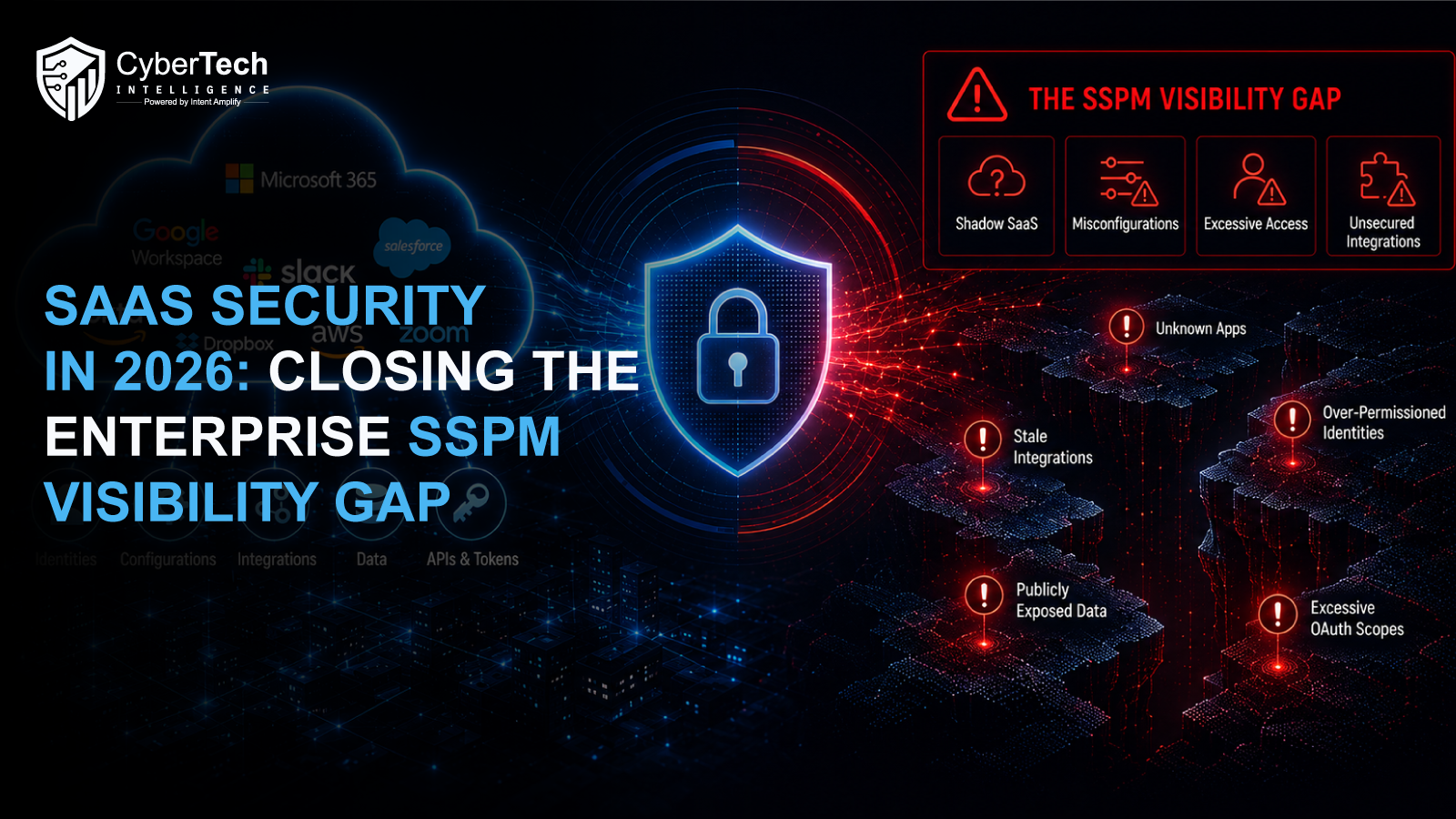
The SSPM visibility gap is the difference between the pace of SaaS adoption and an organization's ability to continuously govern its SaaS environment.
In a mature operating model, leadership should have clear visibility into active applications, application ownership, user access, privileged accounts, third-party integrations, exposed data, configuration settings, and the effectiveness of security controls. This visibility forms the foundation of SaaS governance.
In practice, however, that visibility is often incomplete. SaaS ownership is distributed across business units. Application administrators frequently operate outside the security function. OAuth approvals may occur through user-driven consent workflows. Contractors and temporary users may retain access beyond their intended engagement periods. Machine identities continue to proliferate, often without centralized oversight. At the same time, business teams increasingly adopt AI-enabled tools before governance processes have been established.
Individually, these issues may appear manageable. Collectively, they create meaningful exposure. Organizations can maintain mature endpoint, network, and cloud security programs while remaining vulnerable to SaaS-specific risks such as excessive permissions, dormant accounts, external data sharing, broad OAuth grants, unmanaged plug-ins, and configuration drift.
This challenge is amplified by the pace of digital transformation. Accenture's 2025 cybersecurity research found that only 28% of organizations embed security into transformation initiatives from the outset, while 63% remain in what the firm describes as the "Exposed Zone," lacking both a comprehensive cyber strategy and the capabilities required to execute it.
The SSPM gap emerges when SaaS adoption outpaces governance. Applications are deployed quickly, integrations proliferate, and access expands, while visibility, oversight, and control mature more slowly. The result is a growing layer of risk that often remains hidden until an audit, security incident, or compliance review exposes it.
SSPM addresses this challenge through continuous monitoring of SaaS configurations, identities, permissions, third-party integrations, external collaboration, and compliance controls. More importantly, it transforms fragmented operational data into governance intelligence, enabling organizations to identify risk, prioritize remediation, and maintain control as SaaS environments continue to evolve.
AI, OAuth, and Identity Sprawl
Artificial intelligence is accelerating the urgency of SaaS posture management. Enterprises are rapidly adopting AI copilots, generative assistants, workflow automation platforms, intelligent analytics tools, and embedded AI capabilities inside existing SaaS applications.
Each AI-enabled service can create new access relationships. Some connect to collaboration platforms. Others access customer systems, internal documents, calendars, email environments, development repositories, or data stores. Many integrations rely on OAuth tokens, API connections, service accounts, or persistent authorization models.
This creates a new exposure pattern. A productivity tool may receive broad access to documents. An AI assistant may inherit permissions from an employee account. A workflow automation platform may connect several business-critical systems. Authorization for a third-party plug-in may persist long after the original approver has changed roles or left the organization.
Cisco’s 2025 Cybersecurity Readiness Index found that only 49% of respondents believe employees fully understand AI-related cybersecurity threats. Cisco also reported that 22% of companies allow unrestricted access to publicly available generative AI tools, creating a risk that sensitive company data may be exposed through unapproved usage.2
Identity sprawl compounds this issue. SaaS environments now include human users, privileged administrators, contractors, vendors, APIs, bots, service accounts, machine identities, and AI agents. Each identity represents a possible access path. Each access path needs governance.
The objective is not to slow innovation. Enterprises need SaaS and AI-driven efficiency. The objective is to build a control model that allows innovation to proceed without invisible exposure accumulating in the background.
That requires continuous identity analytics, OAuth review, third-party application monitoring, AI tool governance, privilege reduction, and SaaS configuration validation.
Why Traditional Security Models Are Losing Visibility
Traditional security architectures were designed around more predictable enterprise environments. Employees worked on managed devices. Applications lived inside controlled infrastructure. Traffic passed through monitored networks. Sensitive systems were protected by perimeter defenses.
SaaS-first operations break many of those assumptions.
Critical business activity now occurs through browser sessions, federated identity providers, external applications, cloud collaboration platforms, file-sharing services, API integrations, and AI-enabled tools. Users may access sensitive workflows from multiple locations and devices. Third-party applications may connect directly to core platforms. Business units may onboard new services faster than centralized teams can assess them.
This creates a visibility mismatch. Endpoint tools may show the device. Network tools may show traffic. Identity tools may show authentication. Cloud security tools may show infrastructure. But none of these controls, by themselves, provide a complete view of SaaS configurations, OAuth permissions, external sharing, app-level exposure, or third-party connections.
NIST’s Cybersecurity Framework 2.0 reinforces the importance of governance, identification, protection, detection, response, and recovery as core cybersecurity functions. NIST also highlights updated mappings and implementation resources that support better configuration, reporting, and security-control alignment.7
SSPM aligns with this direction because it gives organizations a continuous way to identify SaaS assets, validate protective controls, detect risky posture changes, support response workflows, and provide governance-level evidence.
For enterprise leaders, the distinction matters. SaaS security cannot be treated as a minor extension of legacy perimeter defense. It requires its own visibility model, governance structure, and executive reporting discipline.
SSPM Maturity Framework for 2026
A practical SSPM maturity model should help leadership understand where the organization stands today and what must improve next.
At a low level of maturity, SaaS discovery is manual, application ownership is unclear, access reviews are infrequent, OAuth permissions receive little attention, and executive reporting is limited. Security teams often react after exposure has already occurred.
At a developing level of maturity, the organization maintains partial SaaS inventory visibility, conducts periodic access reviews, reviews high-risk applications, and uses dashboards for some operational tracking. This improves awareness, but it still leaves gaps when applications, users, integrations, and configurations change quickly.
At an advanced level of maturity, SaaS discovery is continuous, critical applications are monitored in near real time, identity analytics are integrated into security operations, OAuth relationships are continuously validated, AI-enabled SaaS platforms follow formal governance workflows, and leadership receives board-relevant risk metrics.
The most mature organizations treat SSPM as part of a broader cyber-resilience architecture. It connects with identity security, Zero Trust, third-party risk management, privacy governance, compliance operations, incident response, and executive reporting.
The objective is not simply to buy another security tool. The objective is to create operational accountability for SaaS risk.
Financial Services Modernization Scenario
Consider a large financial services organization operating across multiple business units in the United States. By 2025, the institution had rapidly expanded its use of productivity platforms, analytics tools, collaboration environments, customer-facing SaaS applications, and AI-enabled assistants.
The business benefits were clear. Teams moved faster, collaboration improved, and digital workflows became more efficient. Yet security leaders began identifying governance concerns. Dormant privileged cloud identities remained active after role changes. AI-enabled assistants inherited unnecessary access to internal documents. OAuth relationships were approved without centralized review. Collaboration environments contained overshared sensitive information. Third-party analytics tools maintained persistent access to business data. Executive leadership lacked a consistent view of SaaS risk across departments.
The organization responded by launching an SSPM modernization initiative. The program focused on centralized SaaS inventory, continuous OAuth validation, privileged access review, AI application governance, misconfiguration remediation, external sharing review, and executive-level reporting.
Over time, the institution improved visibility into application usage, reduced unnecessary privileges, accelerated remediation workflows, and created clearer accountability between security, compliance, risk, and business technology teams.
The lesson is practical. SaaS risk does not improve through awareness alone. It improves when visibility, ownership, governance, and remediation are connected.
Strategic Priorities for CISOs, CIOs, and Boards
Enterprise leaders should begin by placing identity at the center of SaaS governance. Every user, administrator, contractor, API, service account, automation workflow, and AI agent can influence access to enterprise data. Continuous privilege assessment, lifecycle management, machine-identity oversight, stronger authentication, and third-party access governance should be treated as SaaS security fundamentals.
The second priority is reducing fragmented visibility. Many organizations manage SaaS inventory, identity controls, collaboration tools, third-party integrations, and AI services through disconnected systems. A stronger model brings those signals together so security teams can understand exposure across applications rather than inside isolated dashboards.
The third priority is integrating SSPM into Zero Trust programs. Zero Trust depends on continuous verification, but that verification cannot stop at the network, endpoint, or identity provider. It must extend into SaaS applications where sensitive business activity actually occurs. SSPM strengthens Zero Trust by validating configurations, detecting excessive permissions, monitoring risky integrations, identifying privilege drift, and assessing whether app-level controls remain aligned with policy.
The fourth priority is modernizing third-party access governance. SaaS environments rely on plug-ins, APIs, analytics tools, workflow automation platforms, and AI-enabled services that frequently retain persistent access. Organizations should move beyond point-in-time vendor reviews and establish continuous monitoring for risky integrations, dormant access, excessive permissions, and external data-sharing exposure.
The fifth priority is establishing AI-SaaS governance controls. AI-enabled SaaS platforms introduce data governance, privacy, resilience, and compliance concerns. Enterprises should define review processes for AI tools that connect to sensitive systems, process regulated information, or operate across internal collaboration environments.
Finally, SaaS risk must be translated into executive reporting. Boards do not need raw telemetry. They need risk indicators that show whether exposure is increasing or decreasing. Useful metrics include shadow SaaS exposure, privileged account reduction, misconfiguration remediation velocity, OAuth risk concentration, third-party integration density, and coverage of critical SaaS applications under continuous monitoring.
Executive Roadmap
For the second half of 2026, leadership teams should establish a centralized SaaS inventory and identify the most business-critical applications. This should include sanctioned platforms, unsanctioned usage, high-risk third-party integrations, privileged accounts, machine identities, and AI-enabled services.
During the same period, enterprises should conduct a structured OAuth access review across major business units. This review should identify applications with excessive scopes, dormant authorizations, broad file access, and persistent access to sensitive systems.
By late 2026, organizations should implement quarterly privileged identity validation for SaaS environments and introduce formal review workflows for AI-enabled applications. These workflows should involve security, privacy, compliance, legal, procurement, and business owners where appropriate.
By early 2027, SaaS posture metrics should be incorporated into executive and board-level cyber reporting. The most useful reports will show exposure reduction, remediation velocity, access governance maturity, third-party risk concentration, AI-SaaS exposure, and SaaS coverage across critical business functions.
The goal is to move from reactive SaaS risk management to continuous governance.
Analyst Perspective
The central issue for 2026 is not whether enterprises use SaaS. That decision has already been made by the operating model. The issue is whether security governance has adapted to the volume, sensitivity, and speed of SaaS activity.
SSPM is gaining importance because it addresses a visibility problem that other controls often see only partially. Identity systems may show who authenticated. Endpoint tools may show device behavior. Cloud tools may show infrastructure risk. But the SaaS layer contains its own configuration, sharing, privilege, integration, and compliance realities.
CyberTech Intelligence expects SSPM to become increasingly connected with identity security, AI governance, third-party risk, and Zero Trust programs. As SaaS platforms hold more regulated data and as AI-enabled services connect to more repositories, posture management will become a measurable indicator of cyber maturity.
The strongest programs will not treat SSPM as another dashboard. They will treat it as a control system for business-critical digital operations.
Conclusion
Enterprise SaaS environments have become central to modern business operations. They enable agility, productivity, collaboration, analytics, customer engagement, software delivery, and AI adoption. Yet they also create a rapidly expanding exposure surface that many traditional security models were not designed to govern.
In 2026, the most significant SaaS risks are emerging from fragmented identity oversight, unmanaged OAuth permissions, decentralized application adoption, dormant privileged accounts, AI-enabled integrations, machine-identity growth, and inconsistent configuration control.
The SSPM visibility gap represents one of the most important cyber-resilience challenges facing enterprise leadership. Closing that gap requires continuous SaaS discovery, stronger identity governance, third-party integration monitoring, AI-SaaS controls, configuration validation, and executive reporting.
Organizations that modernize their SaaS security programs will be better positioned to reduce exposure, improve compliance readiness, accelerate remediation, and strengthen board confidence. Organizations that delay may face growing blind spots across some of their most business-critical digital environments.
SSPM is no longer an optional monitoring capability. It is becoming a foundational layer of enterprise SaaS governance and cyber resilience.
About Cyber Tech Intelligence
Cyber Tech Intelligence is a cybersecurity intelligence and market-engagement platform built for security leaders, technology providers, advisory firms, and enterprise decision-makers. Through strategic research, cybersecurity insights, executive engagement, market visibility programs, and thought-leadership content, we help organizations understand emerging security priorities and communicate their value to the right audiences.
How We Can Help
We support cybersecurity vendors and enterprise stakeholders with research-led content, go-to-market positioning, vendor intelligence, executive audience engagement, and demand-generation programs. To learn more about our services or discuss how CyberTech Intelligence can support your cybersecurity visibility and growth goals, visit https://cybertechintelligence.com/ or contact our team.
References
- Accenture, State of Cybersecurity Resilience 2025, June 2025
- Cisco, Cisco Study Reveals Alarming Deficiencies in Security Readiness, May 2025
- Okta, Businesses at Work 2025, 2025
- Deloitte, Global Future of Cyber Survey, Fourth Edition, 2025
- Netskope, Cloud and Threat Report: Generative AI 2025, 2025
- IBM, X-Force Threat Intelligence Index 2025: Attackers Steal, Sell User Identities, 2025
- National Institute of Standards and Technology, Cybersecurity Framework 2.0, 2024


