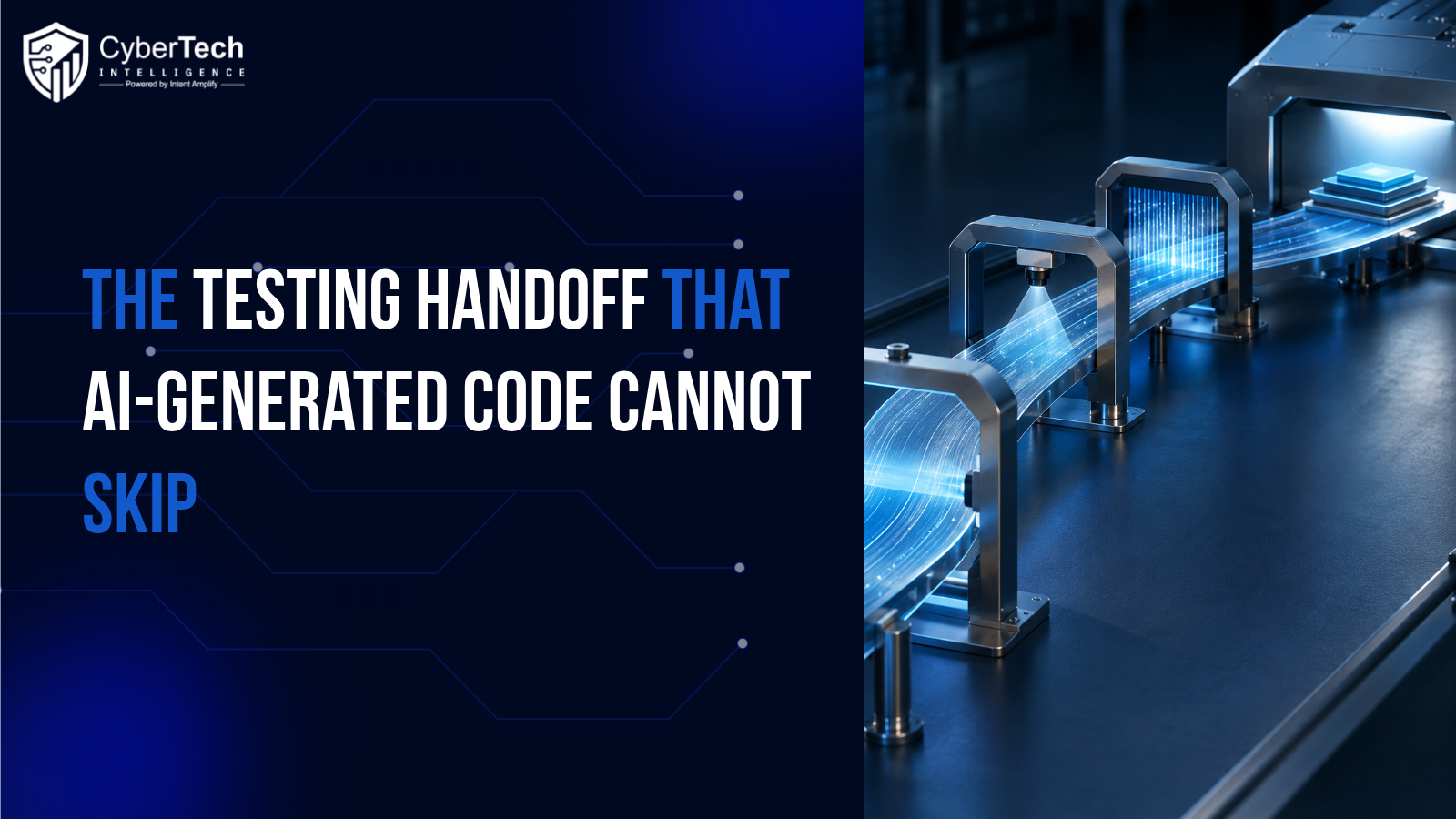
The Strategic Shift: From Tool Output to Release Evidence
A code assistant may help draft a feature, propose a test, or revise a configuration. None of those outputs establishes what actually entered the released product or whether the application satisfied its security requirements. NIST SP 800-204D addresses software supply chain controls within continuous integration and delivery pipelines. [1] Its focus on controlled development and delivery provides a useful foundation for evaluating AI-assisted changes without inventing a new security principle for every automated suggestion.
The essential handoff occurs when a suggestion becomes an accepted change and then a deployable artifact. Each transition needs the correct owner and evidence. Five operating jobs clarify what engineering teams should review and what cybersecurity vendors can credibly communicate to enterprise buyers.
Operating Job 1: Connect the Proposed Change to the Product Boundary
A proposed change must be tied to a defined product function, repository version, integration, and security requirement. The same code pattern may be harmless in a local prototype and sensitive in a customer-facing identity workflow. Before discussing a defect, the assessment should describe where the code is used and which user, data, or system operation could be affected. A code sample detached from its deployment setting cannot establish business impact.
Operating Job 2: Confirm the Provenance of Dependencies and Build Inputs
AI-generated snippets may import dependencies or suggest new build steps. The reviewer should record package sources, versions, approved registries, and dependency exceptions. NIST SP 800-161 Rev. 1, updated in November 2024, provides supply chain risk-management guidance for products and services. [2] That guidance does not say AI-generated code is inherently malicious. It supports asking whether the inputs to a released product can be accounted for and whether suppliers have been assessed under an applicable risk model.
Operating Job 3: Pair Automated Checks With Targeted Review
A static-analysis result may reveal a code pattern, while an authorization test can examine whether a real operation is allowed to the right user. Dynamic testing may reveal a behavior that a source scan cannot observe. The OWASP Web Security Testing Guide offers a methodical body of web application testing practices. [3] A test plan should select methods because they address the product's requirements, not because a dashboard can show a larger count of scans.
A failed test needs a documented triage decision, and a passed test must retain its conditions. A reviewer should distinguish true issues, false positives, accepted exceptions, and untested paths. No single tool report should be reworded as a complete security approval. Coverage means the share of explicitly defined conditions that received meaningful review, not the share of vulnerabilities that were allegedly prevented.
Operating Job 4: Preserve Evidence Across the Release Handoff
After the code is approved, the build should preserve the connection between the reviewed change and the deployed artifact. Teams may use version control, build records, test results, release approvals, and restricted technical logs. NIST's systems security engineering guidance treats assurance as a life-cycle activity rather than a one-time feature assertion. [4] A strong record tells a second reviewer which version was tested, by what method, and under which change authorization.
Operating Job 5: Convert Bounded Assurance Into Market Differentiation
Application security vendors may emphasize code scanning, developer education, dependency review, workflow governance, or independent testing. A competitive comparison should disclose what each product claims to check, where it operates, which prerequisites are required, and what proof is available. The test is not whether a provider mentions AI in its material. The test is whether a buyer's specified review job can be supported by evidence. CyberTech Intelligence describes Vendor Intelligence as a comparative research service for this type of market question. [5]
Compare Evidence, Not Product Adjectives
A category review can assess which supplier claims are source-supported, which validation methods are in scope, and what buyers still need to ask before procurement.
Explore Vendor Intelligence
Five-Job Evidence and Ownership Matrix
|
Operating Job |
Evidence to Preserve |
Responsible Role |
|---|---|---|
|
Define product scope |
Affected code, service and requirement |
Engineering and Product |
|
Inspect dependencies |
Package source, version, build inputs |
Software Supply Chain |
|
Run relevant checks |
Security test, result and exclusions |
Application Security |
|
Link release artifact |
Commit, build, test and approval record |
Release Engineering |
|
Approve market statement |
Exact capability, proof and limitation |
Product Marketing |
CyberTech Intelligence Perspective: Make the Commercial Motion Evidence-Led
Buyer Intelligence can map which audiences are evaluating secure code practices, independent application testing, or software delivery governance. Managed Demand Generation can publish an evidence checklist for Engineering Leaders and executive summaries for Chief Information Security Officers. Market and Competitive Intelligence through Business Consulting can assess competitive positioning against equivalent buyer questions. Pipeline Activation should capture the prospect's actual requirement and accepted conversation, without treating a content click as evidence of procurement intent.
Strategic Recommendations
When a supplier comparison produces apparently conflicting findings, check the test objects before ranking the tools. One product may evaluate source patterns, another may inspect dependencies, and a third may test a running service. Even two tools described as code security platforms may have different language support, deployment requirements, and reporting boundaries. A fair decision record states which buyer requirement each result addresses, which environment was in scope, and whether a technically qualified person confirmed applicability. A difference in output is not necessarily proof that one supplier is unreliable.
Commercial teams should use that same discipline when discussing evidence with prospective customers. A Chief Information Security Officer may want accountability and governance reporting. A VP of Engineering may want integration with existing development processes. An Application Security Leader may be comparing the accuracy and reproducibility of findings in a particular codebase. Market and Competitive Intelligence through Business Consulting can organize public supplier material against those different questions. A single score built from web claims would hide distinctions that procurement should see.
An effective evaluation workshop can start with an agreed test case rather than an unbounded product demonstration. The buyer supplies a permitted, representative requirement and an acceptance criterion. Each supplier explains the scope of its proposed method, the necessary integrations, how results are reviewed, and which activities remain with the customer. The resulting comparison should preserve the distinction between a provider statement and an authorized observation. If no local test has been performed, the output is a source-graded evaluation plan, not a verified benchmark.
For pipeline activation, ask an eligible buyer which of these questions matters now and why. The response may identify a real technical assessment, a longer-term educational need, or no current project. The SDR record should reflect the answer and any agreed next step. This preserves commercial integrity while helping vendors invest in conversations for which their supporting evidence is relevant. It also avoids mislabeling generalized AI interest as a committed purchasing initiative.
Start with one meaningful change and one reviewable business rule. Map what was generated, what was accepted, what tests actually ran, and what was finally deployed. Identify which supplier category helps with each job, then write one defensible product claim for each evidenced capability. If a provider lacks proof for a proposed use case, narrow the statement rather than guessing. Buyer confidence is supported by clarity about what has and has not been established, not by absolute language.
References and Source Boundaries
Numbered sources support the specific statements beside them. Official guidance describes methods and standards, not independent results for named vendors or customers. CyberTech Intelligence service pages describe provider-stated offerings rather than measured campaign results. Source review date: November 17, 2026.
- NIST. SP 800-204D, Software Supply Chain Security in DevSecOps Pipelines. Use in this asset: February 2024 final strategies for supply chain controls within delivery pipelines. URL: https://csrc.nist.gov/pubs/sp/800/204/d/final
- NIST. SP 800-161 Rev. 1, Updated Supply Chain Risk Management. Use in this asset: Final guidance updated November 2024; supports supplier assurance and provenance questions. URL: https://csrc.nist.gov/pubs/sp/800/161/r1/upd1/final
- OWASP. Web Security Testing Guide. Use in this asset: Community security testing methodology for web applications and services. URL: https://owasp.org/www-project-web-security-testing-guide/
- NIST. SP 800-160 Vol. 1 Rev. 1, Engineering Trustworthy Secure Systems. Use in this asset: Systems security engineering principles and evidence-based life-cycle approach. URL: https://csrc.nist.gov/pubs/sp/800/160/v1/r1/final
- CyberTech Intelligence. Vendor Intelligence. Use in this asset: Provider-stated comparative category and buyer intelligence work, not product testing performed for this campaign. URL: https://cybertechintelligence.com/services/vendor-intelligence