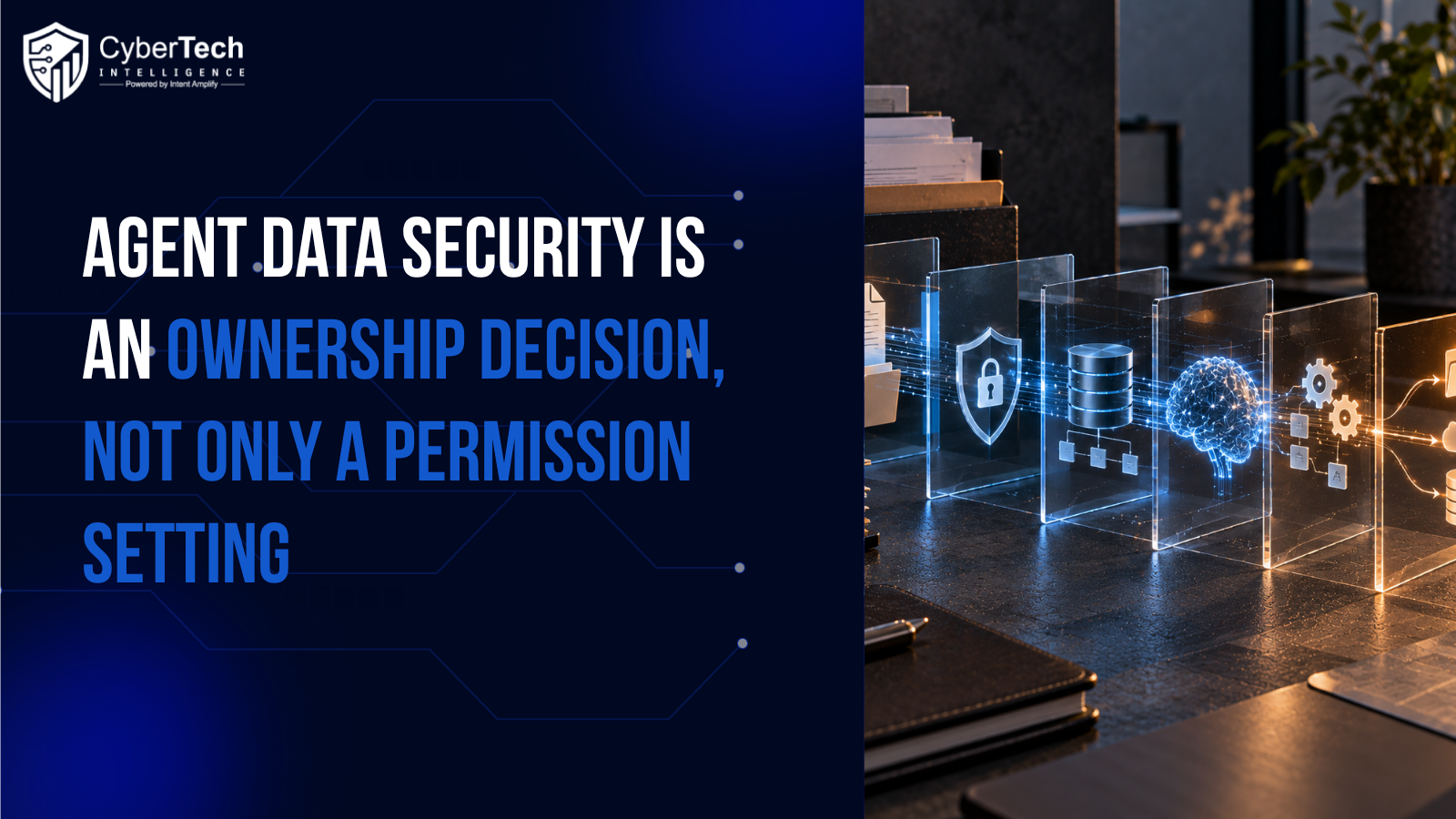
The Real Ownership Question Is Who Approved the Data Use
Agent governance becomes confused when everyone agrees that the agent is useful, but no one can identify who authorized its access to a sensitive source. A platform administrator can grant a role; a data owner can approve use of a record; a business leader can define the task; and the agent may run with a service identity. These are different decisions. Treating a single technical permission as all four decisions can weaken accountability even when the software behaves as configured.
Microsoft recommends that agents have identifiable identities and task-scoped access, with review and revocation paths. [1] CyberTech Intelligence’s view is that the accountable decision must survive automation: for every consequential data read or action, teams should be able to answer whose work it supports, which data it may use, and what would cause that permission to end.
Convenience Is Not an Access Policy
An agent that summarizes a sales account may need notes, recent correspondence, and approved product records. It does not automatically need personnel files, unrelated customer folders, or export access to a third-party destination. There may be a legitimate reason to include another source, but the reason should be assessed before the connector or tool is expanded.
OWASP’s Excessive Agency category identifies excessive functionality, permissions, and autonomy as root causes of harmful agent actions. [2] That language is risk taxonomy, not proof of a weakness in a particular platform. It gives leaders a useful decision standard: justify what the agent may read and write separately, and make broad access an explicit exception rather than the convenient default.
Agent Identity Is Different from End-User Identity
An agent may receive a technical role that enables it to call a model, query a knowledge base, or invoke an action. AWS documentation lists these permissions for Bedrock Agents and describes separate permissions for tools such as action-group Lambda functions. [3] This configuration supports agent operation; it does not by itself prove that the requesting employee is allowed to use every record the service role can read.
Two questions need distinct answers. First: does the platform permit the agent service to contact the tool or source? Second: does the relevant business owner allow this particular request, person, and data use? Conflating the two can lead to a broad service role becoming an unintended way around a narrower human permission.
The Data Owner Must Define the Purpose, Not Just the Label
Sensitive classification is necessary but incomplete. A contract may be available to legal and procurement but not to a general marketing assistant. A support transcript may be useful in a customer escalation and inappropriate as general content for a sales presentation. A privacy-sensitive record may be handled under specific retention or disclosure requirements. These situations call for contextual business approval, not one blanket rule about AI.
NIST’s AI RMF Map function asks organizations to establish intended use, operating context, affected actors, and potential impacts. [4] Applying that thinking to agent data access means naming the audience, action, source, and consequence before technical permissions are finalized. The framework is voluntary risk-management guidance, not a legal authorization for particular data processing.
Decision Rights Must Also Cover the Search Layer
A search index can have its own roles and permissions. Microsoft distinguishes the ability to configure Azure AI Search from the ability to read, write, or query its data plane. [5] These platform permissions are operational controls; they do not settle every original-document access decision. Data owners should specify how source permissions are preserved and how denied results are validated, including when documents move or access groups change.
The strongest governance pattern connects four owners: the business owner of the agent task, the owner of the source data, the owner of the identity and connector, and the person authorized to accept a material exception. Those roles can be held by fewer people in a small organization, but the decisions still need to be separate in the evidence record.
The Six-Decision Agent Data Ownership Test
|
Decision |
Business or data owner asks |
Security or platform owner asks |
Evidence to retain |
|---|---|---|---|
|
Purpose |
Which business decision needs this information? |
Can the role be limited to this purpose? |
Use case, requester, owner, approved source list |
|
Data reach |
Which records may this task access? |
How is user and service access tested? |
Class, policy, denied/allowed test |
|
Retrieval |
Can indexed copies keep source restrictions? |
What does the search filter actually enforce? |
ACL source, refresh, query test |
|
Actions |
May the agent send or change data? |
Are write tools separately scoped? |
Tool grants, destinations, approval |
|
Exceptions |
Who accepts broader access and until when? |
How is the exception restricted and removed? |
Decision maker, scope, expiry, rollback |
|
Review |
Which change reopens permission? |
Can revocation be demonstrated? |
Owner, trigger, audit and closure record |
CyberTech Intelligence Perspective
Data security for AI agents is fundamentally a decision-rights problem. A technical grant can be correct in isolation and still reflect an unapproved business use. Governance is strongest when the team can separate identity from authority, source visibility from permitted disclosure, and automation capability from approval to act. The goal is not to reduce every agent to read-only. It is to make higher-consequence access purposeful, bounded, and reviewable.
Five Actions for Executive Owners
• Publish a short register of active agent tasks, data owners, connected systems, and intended users; tie access to business purpose.
• Review access to sensitive source material with the data owner, not only the agent engineer or application administrator.
• Separate read, write, export, and share permissions; document who can approve each level of consequence.
• Require an exception record for broad connectors, technical shared identities, or cross-team access that cannot be narrowed immediately.
• Make source permission changes, new tools, new data classes, and agent retirement automatic review triggers.
Run the Six-Decision Ownership Check
Choose an existing or proposed agent. For the six decisions above, name the accountable owner, evidence used, duration of permission, and the event that reverses approval. Use any unanswered item as a specific governance action before expanding the agent’s access.
About CyberTech Intelligence
CyberTech Intelligence provides research-led cybersecurity intelligence, executive content, and market engagement programs. This publication is vendor-neutral and intended for education, decision support, and evidence-aware security planning.
Evidence and Citation Note
Public standards and industry guidance inform the control principles discussed here. Vendor documentation is evidence of a described feature or product limitation, not evidence of a specific customer configuration. Illustrative scenarios and CyberTech Intelligence frameworks are analytical models, not findings about a named organization, incident statements, certifications, breach predictions, or guaranteed outcomes.
References
- Microsoft Learn, “Secure agents: Identity, access, and data protection.” Current guidance recommends individual agent identity, least-privilege access, and monitoring. https://learn.microsoft.com/en-us/agents/center-of-excellence/secure-agents
- OWASP Gen AI Security Project, “LLM06:2025 Excessive Agency.” 2025 taxonomy attributes excessive agency to excessive functionality, permissions, or autonomy. https://genai.owasp.org/llmrisk/llm062025-excessive-agency/
- Amazon Web Services, “Create a service role for Amazon Bedrock Agents.” Current vendor documentation describes agent role permissions to models, knowledge bases, and actions. https://docs.aws.amazon.com/bedrock/latest/userguide/agents-permissions.html
- NIST AI Resource Center, “Map: AI RMF Playbook.” Current playbook discusses establishing intended purpose, impacted actors, and operating context. https://airc.nist.gov/airmf-resources/playbook/map/
- Microsoft Learn, “Connect to Azure AI Search using roles.” Current reference distinguishes service control-plane and data-plane permissions. https://learn.microsoft.com/en-us/azure/search/search-security-rbac