
The Future of Enterprise Investigations: AI at Machine Scale, Human Judgment at the End
- CyberTech Intelligence Editorial Desk
- Research Analyst
- 12 Aug, 2026
Interview Introduction
Enterprise investigations have always faced a fundamental constraint: the volume of evidence exceeds the time available to examine it. Claims files can span thousands of pages across medical records, depositions, photographs, invoices, legal filings, and investigative notes—leaving experienced professionals to reconstruct relationships, inconsistencies, and timelines manually.
Valantor is challenging that operating model with FraudX, an AI-powered investigation platform designed to analyze complex insurance claims while keeping human investigators in control of consequential decisions. The platform connects findings to source evidence and supports deployment across cloud, private cloud, VPC, on-premises, and air-gapped environments.
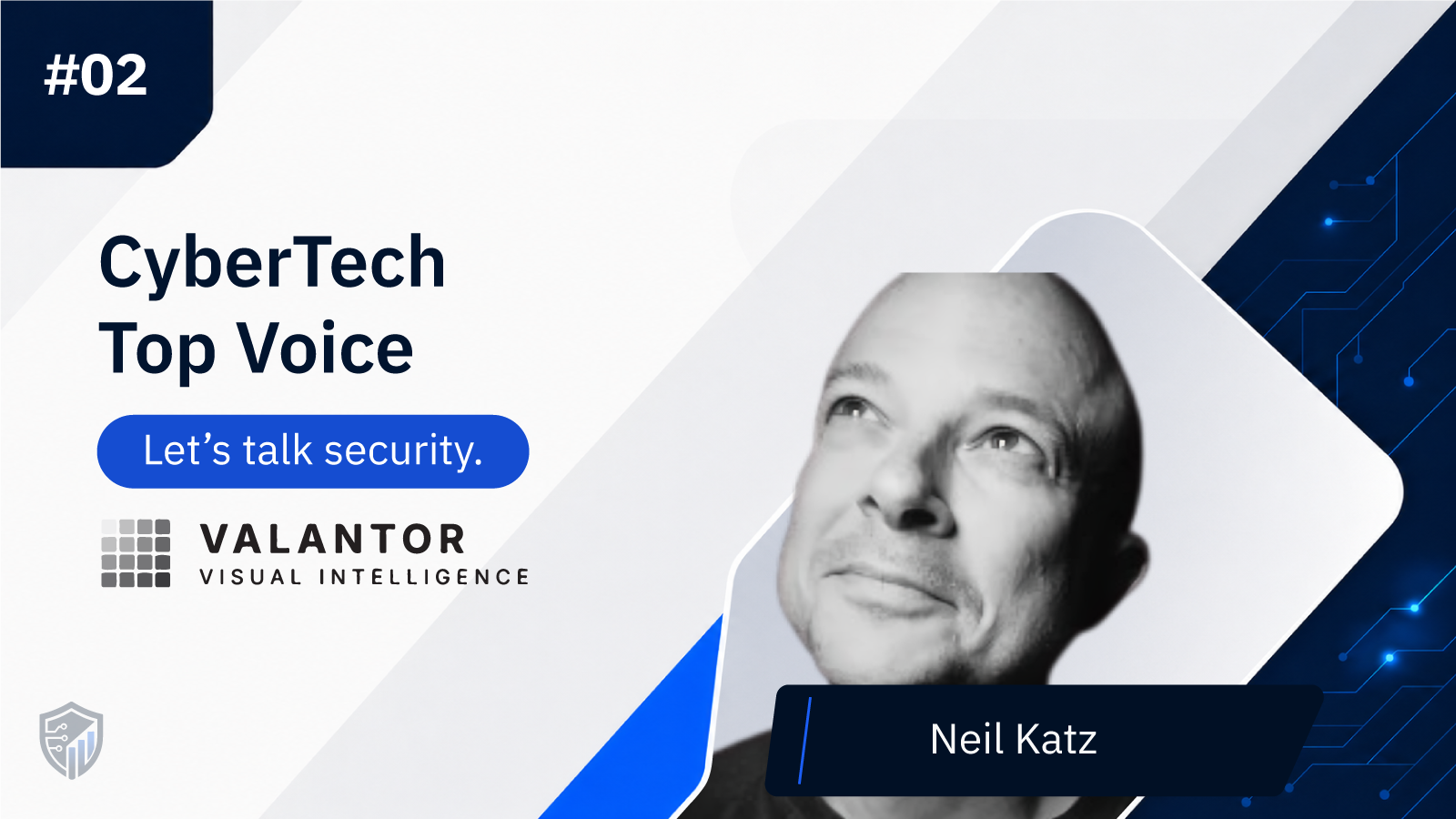
Sudipto Ghosh of CyberTech Intelligence sits down with Neil Katz, Chief Product Officer at Valantor, to discuss what happens when AI becomes the first investigator — but human judgment remains the final authority. The conversation examines investigative reasoning, explainability, data sovereignty, multimodal evidence, AI governance, and whether machine-scale analysis could ultimately move enterprises from selective investigation to examining virtually all available evidence.
Sudipto: Organizations have invested billions in AI assistants, copilots, and automation platforms. Yet investigations remain heavily dependent on manual document review and institutional knowledge. Why has this category been so resistant to transformation?
Neil: Investigation files are fragmented and rarely standardized. A single claim may contain thousands of pages of medical records, depositions, photographs, invoices and handwritten notes. The investigator has to understand how those materials relate, including where facts conflict or events fall out of sequence. Traditional software was never designed to make those connections, leaving experienced professionals to assemble the full picture manually.
Sudipto: Many executives equate investigation speed with automation. You describe something different. Why has enterprise-scale investigative reasoning become practical only now?
Neil: The technology can now approach the same evidence in different ways. Retrieval-augmented generation can answer questions across unstructured claim documents, while a structured knowledge layer extracts entities and events. Deterministic rules, graph analysis and database queries can then test the findings produced through the generative reasoning path. An agentic orchestrator compares those independent perspectives before presenting an answer. This makes it possible to identify where the evidence agrees and where further investigation is required, instead of relying on a single model to interpret an entire case.
Sudipto: The launch of FraudX suggests that AI has reached a point where it can assist with highly sensitive investigations. Which technical advances made investigative AI viable, and why did construction liability, property, and general liability require a purpose-built system rather than a general-purpose large language model?
Neil: Insurance investigations require more than document summaries. FraudX can build medical and claim chronologies, identify inconsistencies and examine relationships among claimants, providers and attorneys. Construction liability, property and general liability claims may combine site photographs with medical records, bills and legal filings collected over a long period. A purpose-built system can organize that evidence around the way investigators work, retain the relationships between different parts of the file and apply checks designed for the domain. A general-purpose language model does not provide that investigative structure on its own.
Sudipto: Organizations often accumulate years of investigative expertise inside individual employees. How can AI preserve institutional investigative expertise without displacing human judgment?
Neil: AI can help preserve institutional expertise by turning repeatable investigative methods into shared workflows. The questions experienced investigators ask, the relationships they examine and the checks they apply can inform structured knowledge layers and rules that support the wider team. That makes established practices easier to use consistently, even as employees change roles or leave the organization. Human judgment remains central because experience also includes context that cannot always be reduced to a rule. AI can organize evidence and apply established investigative checks, while qualified professionals assess the circumstances and make the final decision.
Sudipto: For many CISOs, trust matters more than speed. How do you design an AI investigation platform that produces conclusions investigators are willing to defend?
Neil: Trust depends on giving investigators ways to test the system’s work. FraudX does not rely on one reasoning path. It can analyze unstructured documents and independently compare its conclusions with entities and events held in a structured knowledge layer. Deterministic rules and graph analysis provide further checks. When those approaches agree, the investigator has greater confidence in the finding. When they differ, the system exposes a specific issue for review. That is far more useful than presenting a confident answer without showing where uncertainty remains.
Importantly, every FraudX response produces documentary evidence to back it up. Our job is to provide signals. Human investigators still must decide if there is fraud and if the documentary evidence proves it.
Sudipto: Highly regulated industries demand explainability. How does the platform allow investigators to understand how evidence contributed to recommendations instead of treating AI as a black box?
Neil: FraudX links its findings to the original claim documentation. An investigator can move from a potential fraud indicator or inconsistency to the medical record, deposition, bill or photograph that supports it. Chronologies also show how evidence relates over time. Users can inspect the basis for a finding instead of accepting an unsupported answer.
Sudipto: Enterprise investigations rarely end with a recommendation. They must withstand scrutiny from regulators, auditors, legal teams, and, in many cases, the courtroom, regulatory review, or executive scrutiny. How do you build AI systems whose conclusions can be challenged, verified, and ultimately defended?
Neil: A defensible conclusion needs more than an AI answer. It needs an evidence trail.
In FraudX, for example, the AI doesn't simply tell an investigator that something looks suspicious. It surfaces the specific investigative signal and connects it back to the underlying evidence in the claim file. If FraudX identifies a change in diagnosis, an inconsistency in a medical history or a relationship between entities, the investigator can go directly to the source documents and examine the evidence themselves.
We also don't rely on a single AI reasoning path. The same claim can be analyzed in multiple ways: through retrieval and reasoning over the unstructured documents, through structured extraction of entities and events and through deterministic rules and queries. Those independent views can then be compared and reconciled. It's a form of layered defense against AI error.
Most importantly, the AI doesn't make the final determination. Human investigators remain in control. FraudX surfaces evidence, relationships and investigative signals, while experienced professionals evaluate what they mean and decide what action to take.
That's how you make AI defensible: don't ask people to trust the model. Give them the evidence, preserve the path from source material to conclusion, and make it possible to challenge every important step.
Sudipto: Many enterprises remain cautious about exposing sensitive investigative data to external AI providers. How important was deployment flexibility, including private cloud, VPC, on-premises, and fully air-gapped environments, when designing the platform?
Neil: Deployment flexibility wasn't an afterthought. It was one of the fundamental design requirements.
The world's most important information doesn't live on the public Internet — and never will. Insurance claim files are a perfect example. They can contain sensitive medical, financial, legal, and investigative information that organizations have significant obligations to protect. Many enterprises simply aren't willing or able to send that data to a public AI service.
So we designed FraudX around a different principle: bring AI to the data, not the data to AI.
FraudX can operate in the cloud, private cloud, a customer's VPC, on-premises, or within a fully air-gapped environment. That allows organizations to apply advanced AI to highly sensitive investigative data while maintaining control over where that data resides, which models can access it and how the system is secured.
We believe this extends far beyond insurance. The next major wave of enterprise AI will happen behind the firewall, against the proprietary information companies have spent decades creating and protecting. The infrastructure has to be designed for that reality.
Sudipto: From a product perspective, where should organizations draw the line between AI-assisted investigation and human investigative authority?
Neil: The line is actually pretty clear: AI should expand the investigator's field of vision, not assume the investigator's authority.
AI is extraordinarily good at reviewing enormous evidence sets, reconstructing timelines, connecting facts, and identifying patterns that a human investigator might not have the time or ability to see. In FraudX, that means analyzing thousands of pages of claim documents, surfacing inconsistencies and relationships, and showing investigators the underlying evidence behind those signals.
But a signal is not a verdict. FraudX doesn't determine that a claimant, doctor, lawyer, or other party committed fraud or wrongdoing. Experienced investigators evaluate the evidence, consider the legal and human context, and decide what conclusions are justified and what action, if any, should follow.
We think that's the right division of labor. Let machines operate at machine scale and let humans exercise human judgment. The result isn't autonomous investigation. It's a much more capable investigator.
Sudipto: Insurance may be the starting point, but enterprise investigations exist everywhere. Which industries, particularly cybersecurity, digital forensics, financial crime, and critical infrastructure, stand to benefit most from this investigative AI model?
Neil: Insurance is a great starting point because the problem is so extreme: thousands of pages of evidence, complex relationships, long timelines, and investigators trying to reconstruct what actually happened. We're already seeing with FraudX how AI can turn that fragmented information into a coherent investigative picture in minutes rather than days or weeks.
But that same pattern exists across the enterprise. In cybersecurity and digital forensics, the evidence may be distributed across alerts, logs, incident reports, emails, and forensic records. In financial crime, it's transactions, communications, customer records, and relationships. In critical infrastructure, it could be maintenance records, sensor data, engineering documents, operating procedures and incident reports.
The underlying problem is the same: the evidence exists, but it is fragmented across more information than a human investigator can realistically examine in its entirety.
That's why we think the model behind FraudX extends well beyond insurance. AI can operate at machine scale to reconstruct timelines, extract entities, map relationships, identify inconsistencies, and surface investigative signals while preserving the underlying evidence for human review.
FraudX is our first purpose-built investigative application. We see a much larger opportunity for investigative AI anywhere organizations need to understand what happened, connect evidence across complex information, and make decisions that can withstand scrutiny.
Sudipto: Many enterprises already possess enormous volumes of visual and unstructured information. What prevents them from extracting intelligence from those assets today?
Neil: Many tools still treat document understanding as text extraction. That approach can miss the meaning carried by layout and visual structure, such as the relationship between a table and its surrounding text or an annotation on an engineering drawing. The information may be present, yet the AI receives an incomplete representation of it. Valantor describes this as the data comprehension gap.
Sudipto: Enterprise AI conversations increasingly revolve around governance. What governance principles became non-negotiable while building this platform?
Auditability and continuous oversight became non-negotiable. Organizations need visibility into the information and reasoning components behind a decision. They also need ongoing validation because changes to documents, retrieval processes or models can affect decision quality without causing a conventional system failure.
Sudipto: If an enterprise adopts AI for investigative workflows, what metrics should executives monitor beyond productivity?
Neil: Executives should monitor whether the system continues to produce accurate and trustworthy investigative outcomes. That includes accuracy against known scenarios and the quality of the evidence retrieved to support each finding. Organizations should also track how often independent reasoning methods disagree, how frequently investigators correct the system, and whether performance changes when new documents or models are introduced. An AI application can remain fast and available while its decision quality declines, so uptime and the number of documents processed provide only part of the picture.
Sudipto: When you walk into a board meeting, what conversation do you want enterprise leaders to stop having about AI, and what conversation should replace it?
Neil: I would like leaders to move on from treating model selection as the main AI strategy. The boardroom conversation should focus on whether an AI system produces measurable business outcomes using the organization’s information securely and reliably. A capable model has limited value if it cannot support a production workflow or earn the confidence of the people expected to use its output.
Sudipto: Today AI helps investigators. Five years from now, what responsibilities do you expect AI will assume throughout the investigation lifecycle?
Neil: I think AI is going to fundamentally change the scale of what's possible in investigation and audit.
Today, in many fields, there is simply too much information for humans to examine. So organizations make compromises. In areas like tax or construction audit, that often means sampling a small percentage of the available data and hoping it is representative. In insurance, the problem is different, but the constraint is similar. Claims professionals may be managing more than 100 claims at a time, so the system depends heavily on experienced people recognizing which claims deserve deeper investigation.
AI changes those economics. When machines can review millions of documents, transactions, and data points at a fraction of the cost of human review, we can move from sampling and triage toward something we've never really had before: 100% investigative coverage.
Imagine auditing every transaction rather than 5% of them. Imagine every insurance claim receiving a deep initial investigative review, not just the ones someone had the time or intuition to flag. Imagine continuously examining every maintenance record, inspection report, and engineering document across a major infrastructure project rather than selecting a sample.
And potentially doing all of that for the same cost — or less — than examining a small fraction of the data today.
That's where I think AI takes us over the next five years. It won't simply make individual investigators faster. It will expand the universe of what can be investigated. Humans will still make consequential judgments, but AI will increasingly make it possible for those judgments to be informed by the entire body of available evidence rather than the small fraction we could afford to examine before.
Sudipto: How will enterprise investigations evolve as multimodal AI begins reasoning simultaneously across images, video, documents, diagrams, audio, and structured data?
Neil: We're already doing much of this on the document side, reasoning across text, tables, images, diagrams, and visual structure. Audio is a relatively straightforward extension through transcription.
Video is more interesting because the challenge isn't simply finding the moment an accident happens. It's reconstructing everything around it. Was the scene altered beforehand? Were proper safety procedures followed? Was required equipment being used? Were supervisors present during dangerous work? Were tools stored and maintained correctly?
99.99% of the video may look completely routine, but buried within it are moments that can help establish what happened and ultimately inform questions of liability. The opportunity for AI is to examine all of that footage, find those moments, and connect them with documents, testimony, and other evidence. That's a scale of investigation that simply isn't practical with humans alone.
Sudipto: If every enterprise eventually operates an AI investigation platform, what competitive advantage will distinguish leaders from followers?
Neil: The advantage will come from how well an organization uses its proprietary information. Access to capable AI models will become widespread, but every enterprise has a different body of documents, records, and operational knowledge built over many years. Organizations that make that information understandable and trustworthy for AI will be able to investigate with greater context and draw on knowledge their competitors don’t possess.
Sudipto: Twenty years from now, if enterprise investigations are fundamentally different because of AI, what do you hope Valantor will have contributed to that transformation?
Neil: I hope we helped demonstrate that better investigation can have an impact far beyond the investigation itself.
Take FraudX. On the surface, we're helping insurers find investigative signals in claim files. But insurance fraud doesn't exist in a vacuum. Every fraudulent payout ultimately becomes part of the cost of insurance. Those costs get passed to property owners, businesses, and consumers. They can show up in higher rents, more expensive construction, and even the price of a cup of coffee in the building downstairs. At a time when affordability is a major societal problem, reducing unnecessary costs throughout the system matters.
There's a human dimension too. Some staged construction and auto accidents can involve vulnerable people being pressured or exploited by organized fraud networks. Workers can lose years of productive life, undergo serious medical procedures, and see much of the eventual financial recovery consumed by others in the system.
So twenty years from now, I hope Valantor's contribution isn't remembered simply as helping machines find signals in enormous amounts of data. I hope we helped make systems more accountable, reduced costs that ultimately fall on ordinary people, and contributed to a world where workers are safer and treated with greater dignity. That's a much more meaningful outcome.
Rapid fire
One misconception about enterprise AI you wish would disappear.
That the model is the product. The hardest enterprise AI problems are usually about getting the right proprietary data to the model accurately, securely, and with enough context to reason over it.
One capability every CISO should demand before approving investigative AI.
Sovereignty. Enterprises should be able to define their own AI security boundary — where their data lives, which models can access it and where those models run. That means having the option to run open-source models next to their data in their own VPC, data center, or air-gapped environment rather than being forced to send sensitive information to an external AI provider.
One governance mistake organizations will regret making over the next five years.
Treating AI output as a conclusion rather than evidence that must be traceable, challengeable, and subject to human judgment.
One technology that will redefine enterprise investigations before 2030.
Multimodal reasoning at massive scale — the ability to examine virtually all available documents, images, video, audio, and structured data and reason across them as one body of evidence.
Complete this sentence: "The future investigator will..."
...investigate everything, not just what they have time to look at.
Neil, every technology eventually changes the way organizations make decisions. Let's return to the question we began with. Can AI become the first investigator while human judgment remains the final authority?
Yes. In fact, I think that's where we're headed. AI becomes the first investigator because, for the first time, we can afford to examine everything essentially.
Instead of humans deciding which 5% to audit or which claims deserve deeper review, AI can conduct the first investigation across 100% of the available evidence — reading every document, reconstructing timelines, connecting relationships, and surfacing what deserves attention.
But first investigator doesn't mean "final authority." AI can tell us where to look and show us the evidence. Humans should determine what that evidence means, whether the conclusion is justified, and what action should follow.
That's the future we're building toward: machine-scale investigation with human judgment at the end.
For Interview inquiries, you can write to our CyberTech Intelligence at sales@cybertechintelligence.com