Executive Overview
Hybrid cloud has become the operating foundation for enterprise modernization. It supports AI adoption, SaaS expansion, cloud-native application development, distributed data operations, and digital business continuity. Yet the same architecture that gives enterprises flexibility also increases security complexity.
CISOs are no longer securing separate cloud and on-premises estates. They are governing a distributed environment where identities, APIs, workloads, AI models, SaaS applications, machine credentials, and third-party integrations interact continuously.
The evidence suggests that hybrid cloud security has entered a new maturity phase. Accenture reports that 90% of organizations are unprepared for AI-enabled cyberattacks, while 77% lack mature controls to secure cloud and AI environments.[1]
IBM found that the average cost of a data breach in the United States reached $10.22 million in 2025, the highest reported figure globally. [2]
CyberTech Intelligence Perspective
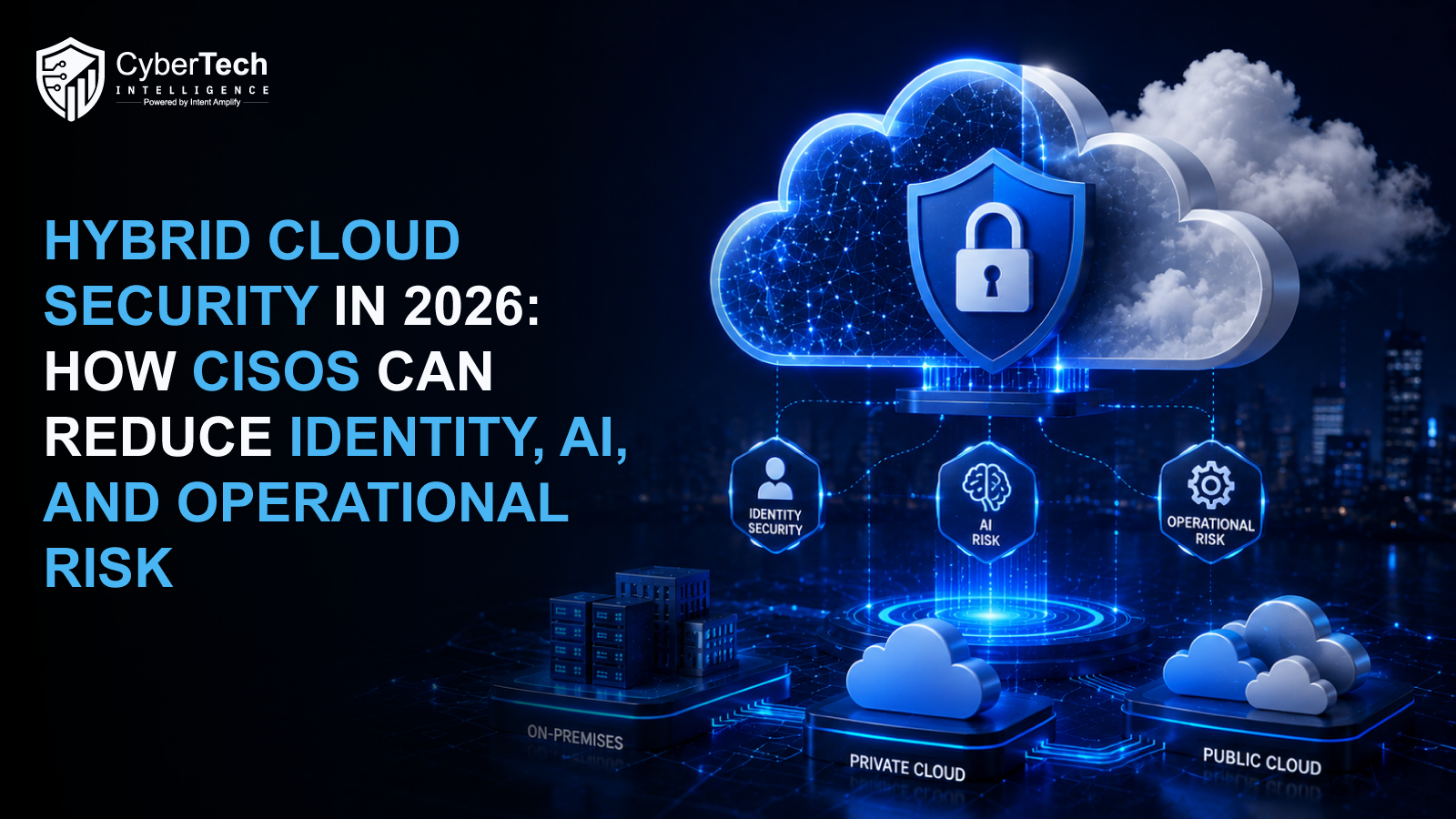
Hybrid cloud security has evolved into the governance of distributed trust. Enterprise risk is no longer concentrated only in infrastructure, networks, or cloud platforms. It now moves continuously across identities, APIs, AI systems, workloads, SaaS applications, machine credentials, third-party services, and operational telemetry.
For CISOs and enterprise security leaders, this changes the security mandate. The priority is not only to protect cloud assets but also to validate that every trust relationship across the hybrid estate is authenticated, authorized, monitored, governed, and resilient. CyberTech Intelligence research and analysis indicates that hybrid cloud security maturity now depends on how consistently organizations can govern identity, runtime visibility, Zero Trust enforcement, AI usage, and operational resilience across distributed environments.
The Hybrid Cloud Security Inflection Point
Hybrid cloud has moved from an infrastructure strategy to a business operating model. Enterprises use it to accelerate AI deployments, modernize legacy applications, integrate SaaS ecosystems, support remote operations, and scale digital services without depending on a single platform architecture.
McKinsey estimates that cloud computing could unlock $3 trillion in global EBITDA value by 2030, with leading organizations reducing costs by more than 20%. This value explains why enterprises continue investing aggressively in cloud modernization. However, the same transition changes the structure of enterprise risk.[4]
CyberTech Intelligence Research Desk Observation: Hybrid cloud security has shifted from infrastructure protection toward continuous trust validation. The most mature organizations are not only securing platforms; they are governing how identities, workloads, APIs, AI systems, SaaS applications, and third-party integrations interact across distributed environments. This shift makes visibility, identity control, telemetry integration, and executive governance central to hybrid cloud resilience.
Why Hybrid Cloud Risk Is Rising
Hybrid cloud environments increase exposure because enterprise assets no longer sit inside a stable perimeter. Workloads move across clouds, data flows through SaaS platforms and AI pipelines, APIs connect internal systems to external services, and machine identities authenticate automated processes at scale. The result is a security model where trust relationships change faster than many teams can validate them.
Palo Alto Networks found that 80% of cloud security exposures involved identity and privilege-management weaknesses, reinforcing the view that identity has become the control plane for hybrid cloud security. APIs are another pressure point. Weak authentication, excessive permissions, incomplete inventory, and insufficient runtime visibility can turn APIs into high-value attack paths.[3]
Identity, AI, and Modern Attack Vectors
Identity is now the primary security boundary in hybrid cloud environments. In many incidents, the attacker does not need to break the cloud platform. They need to become a trusted identity inside it.
Credential theft, privilege escalation, session hijacking, token abuse, and identity manipulation are among the most reliable methods for moving through enterprise cloud infrastructure. IBM reported that breaches involving compromised credentials cost organizations an average of $4.8 million. Identity-based compromises often allow attackers to move laterally, access sensitive data, disable controls, manipulate workloads, and delay detection.[2]
AI adoption intensifies the problem. Enterprises are embedding generative AI, AI copilots, machine learning pipelines, automated decision engines, and AI orchestration systems into cloud environments. These deployments frequently depend on large volumes of enterprise data, privileged API access, and SaaS or cloud-native integration.
Without mature governance, AI creates exposure through prompt injection, data leakage, shadow AI, model poisoning, supply chain compromise, AI-assisted phishing, and unauthorized data use. IBM reported that 13% of organizations have already experienced incidents involving AI applications or models. [2]
For CISOs, the practical challenge is to establish enforceable governance across AI access, data usage, model behavior, third-party AI services, logging, and incident response.
Zero Trust and the End of Perimeter-Centric Security
Traditional perimeter security was built for centralized enterprise networks. Hybrid cloud environments do not operate that way. Users connect from multiple locations. Workloads run across public and private clouds. SaaS applications host business-critical data. APIs exchange information across internal and external services. AI systems perform tasks that may involve sensitive data, privileged workflows, or automated decisions.
This operating model makes implicit trust unsafe. Zero Trust architecture addresses the issue through continuous verification, least-privilege access, segmentation, telemetry, and adaptive policy enforcement. NIST’s publication of 19 operational Zero Trust architecture examples provides practical guidance for organizations modernizing their security models. However, adoption maturity remains uneven.[8]
A mature Zero Trust program should prioritize strong identity verification, least-privilege access, workload segmentation, real-time telemetry, adaptive access controls, and policy consistency. Zero Trust is not a product deployment. It is an architectural discipline requiring identity governance, monitoring, automation, and executive sponsorship.
Misconfiguration and Operational Exposure
Cloud misconfiguration remains one of the most persistent causes of enterprise cloud incidents. The problem is rarely a single mistake. It often reflects fast deployment cycles, decentralized ownership, inconsistent policy enforcement, poor asset inventory, and gaps between DevOps velocity and security validation.
Wiz reported that nearly 80% of cloud breaches originated from preventable issues such as exposed credentials, excessive permissions, and insecure storage configurations. Google Cloud threat intelligence has also identified credential exposure and misconfigured cloud services as recurring enterprise attack vectors. [11]
Common exposure areas include excessive Identity and Access Management permissions, publicly exposed storage, weak API authentication, misconfigured Kubernetes clusters, insecure container images, poor secrets management, unprotected AI workloads, and inconsistent logging. These risks are operational as much as technical. Without policy-as-code, automated validation, runtime protection, and unified visibility, configuration drift becomes difficult to control.
Securing AI and Cloud-Native Environments
AI and cloud-native architectures are now developing together. Enterprises are deploying AI workloads in public cloud, integrating AI into SaaS platforms, and embedding automation across cloud-native applications. This creates a security model in which application security, data security, AI governance, and cloud operations are tightly connected.
Microsoft has reported substantial growth in phishing and social engineering attacks using AI. AI lowers the cost of producing convincing lures, adapting messages to targets, and scaling campaigns. Kubernetes, containers, serverless computing, API-driven architectures, and AI orchestration pipelines also increase the assets that must be discovered, classified, monitored, and protected.
Data Governance and Regulatory Pressure
Hybrid cloud complicates data governance because sensitive information moves across cloud platforms, SaaS applications, AI tools, analytics environments, and third-party ecosystems. Data location, access, retention, encryption, classification, and usage rights are harder to control when business functions operate across distributed systems.
A practical governance model should include data classification, encryption by default, data loss prevention, AI usage controls, access governance, compliance automation, centralized policy enforcement, and audit-ready logging. Enterprises must also demonstrate that controls operate consistently across cloud vendors, SaaS providers, AI platforms, and third-party integrations.
Detection, Response, and Resilience
Prevention remains important, but hybrid cloud security now requires a resilience-first mindset. Enterprises must assume that some attacks will bypass preventive controls. The differentiator is how quickly they detect, contain, investigate, recover, and sustain operations.
IBM found that organizations using AI and automation shortened the attack lifecycle by more than 100 days. [2] That reduction has direct business value because faster detection and containment can reduce breach cost, regulatory exposure, operational downtime, and reputational damage.
This shows why security teams need telemetry that connects identity activity, cloud events, endpoint signals, network behavior, application logs, and API activity.
Key resilience priorities include extended detection and response, cloud-native SIEM, identity analytics, security automation, threat intelligence, real-time telemetry, immutable backups, isolated recovery, and ransomware recovery testing.
Third-Party and Supply Chain Risk
Hybrid cloud environments are deeply dependent on third parties, including SaaS applications, managed service providers, AI platforms, API services, cloud marketplaces, open-source components, software vendors, and integration partners. Each dependency can introduce operational, data, identity, and compliance risk.
Proofpoint has reported increased attacks that exploit trusted relationships with vendors and SaaS applications. These attacks are difficult to manage because they often use legitimate access paths, approved integrations, or trusted communication channels.
CISOs should strengthen vendor assessments, continuous monitoring, SaaS access reviews, API governance, software bill of materials initiatives, secure development requirements, contractual obligations, and incident notification expectations.
CyberTech Intelligence Enterprise Hybrid Cloud Security Maturity Framework
|
Maturity Pillar |
Emerging |
Developing |
Enterprise-Ready |
|
Identity Governance |
Basic MFA and limited privileged access reviews |
Centralized IAM, periodic access reviews, and role-based controls |
Continuous verification across users, machines, APIs, workloads, SaaS access, and privileged identities |
|
Runtime Visibility |
Fragmented monitoring across cloud and on-premises tools |
Centralized dashboards for cloud, endpoint, and identity activity |
Unified telemetry across cloud infrastructure, SaaS, APIs, identities, AI workflows, containers, and workloads |
|
Zero Trust Enforcement |
Limited segmentation and inconsistent access policy |
Policy-based access controls for users and selected applications |
Adaptive enforcement across users, devices, workloads, APIs, SaaS platforms, and high-risk sessions |
|
AI Governance |
Ad hoc restrictions on AI tools and data usage |
Approved-use policies, basic monitoring, and data-access rules |
Integrated controls for AI data access, model usage, third-party AI services, monitoring, and incident response |
|
Operational Resilience |
Reactive response and basic backup processes |
Tested recovery playbooks, incident response workflows, and backup validation |
AI-assisted detection, containment, recovery, resilience metrics, telemetry correlation, and executive reporting |
Organizations in the enterprise-ready category are better positioned to reduce ransomware impact, identity compromise, cloud misconfiguration, AI misuse, regulatory exposure, and operational disruption because security controls are measured across trust relationships rather than isolated platforms.
Board-Level Impact in 2026
Boards are increasingly evaluating cybersecurity through the lens of resilience rather than technical control coverage alone. The central questions are changing. Can the organization keep operating during a cyber incident? Can it protect AI transformation? Can it meet disclosure obligations? Can it contain cloud-based compromise before business disruption escalates?
Primary board-level concerns include AI governance exposure, cloud concentration risk, third-party dependencies, regulatory disclosure obligations, downtime economics, enterprise reputation risk, customer trust, and operational continuity. IBM continues to report that prolonged breach containment increases financial and operational impact. Cybersecurity investment discussions are therefore becoming more closely aligned with continuity, resilience, AI adoption, digital trust, and operational risk reduction.
What CISOs Should Do in the First 90 Days
|
Action |
Primary Owner |
Purpose |
|
Inventory hybrid cloud identities |
IAM / cloud security |
Identify workforce identities, service accounts, API keys, machine credentials, and privileged roles |
|
Map critical APIs and integrations |
AppSec / platform teams |
Identify where systems, SaaS platforms, AI tools, and third parties exchange data |
|
Review cloud misconfiguration exposure |
Cloud security / DevSecOps |
Prioritize excessive permissions, exposed storage, weak secrets management, and insecure workloads |
|
Establish AI usage controls |
CISO / AI governance / legal |
Define approved AI tools, data boundaries, monitoring, and response procedures |
|
Validate logging and telemetry coverage |
SOC/cloud operations |
Ensure identity, API, workload, SaaS, and cloud events can be correlated |
|
Test recovery from cloud compromise |
Incident response/resilience teams |
Confirm containment, backup integrity, isolation, and restoration procedures |
Strategic Priorities for Enterprise CISOs
CISOs should treat identity as the first control layer by centralizing governance across workforce identities, privileged accounts, service accounts, machine identities, API credentials, and cloud access roles. Identity should be measured as an attack surface, not only an access function.
They should advance Zero Trust maturity through continuous verification across users, workloads, APIs, SaaS applications, and AI systems. Security leaders should also build AI governance before adoption scales further by defining policies for data access, model usage, approved tools, monitoring, vendor risk, and incident response.
Hybrid cloud visibility should improve through unified telemetry across cloud infrastructure, endpoints, identities, APIs, applications, SaaS environments, and AI workflows. Automation should support repeatable remediation, policy enforcement, compliance checks, and incident triage.
Conclusion
Hybrid cloud has transformed enterprise technology strategy. It has also raised the security standard. Modern organizations now operate across a fragmented trust environment where identities, APIs, AI systems, SaaS platforms, cloud-native workloads, and third-party services interact continuously.
The old model of perimeter-centered defense is no longer sufficient. Identity-first security, Zero Trust architecture, AI governance, cloud-native protection, unified telemetry, and resilience engineering are becoming core requirements for enterprise security maturity. Organizations that treat security as a late-stage control layer will remain exposed to identity compromise, cloud misconfiguration, AI misuse, API abuse, and third-party risk.
For CISOs, securing the hybrid cloud is now a business leadership priority. It influences operational resilience, regulatory confidence, digital trust, and the long-term success of enterprise transformation. The organizations that lead will be those that treat hybrid cloud not as a collection of platforms, but as a distributed trust environment that must be continuously governed.
Enterprise Hybrid Cloud Security Assessment
Hybrid cloud security now requires more than platform protection. It requires evidence that identity governance, runtime visibility, AI governance, Zero Trust enforcement, cloud resilience, operational telemetry, and executive oversight are working together across distributed environments.
CyberTech Intelligence helps CISOs, CIOs, enterprise architects, cloud security leaders, and risk teams evaluate hybrid cloud security maturity through an Enterprise Hybrid Cloud Security Assessment. The assessment is designed to identify gaps across identity governance maturity, hybrid cloud visibility, AI governance readiness, Zero Trust implementation, cloud resilience, operational telemetry, and executive governance.
For organizations strengthening hybrid cloud security in 2026, this assessment can support board reporting, security roadmap prioritization, cloud modernization planning, risk reduction, and advisory engagement. To discuss hybrid cloud security maturity, Zero Trust progress, AI governance readiness, or cloud resilience priorities, connect with the CyberTech Intelligence team.
About CyberTech Intelligence
CyberTech Intelligence helps cybersecurity leaders, technology providers, and enterprise decision-makers understand the risks shaping modern digital infrastructure. Through research-led analysis, market intelligence, and executive-focused cybersecurity insights, the company supports organizations navigating complex security priorities across cloud, AI, identity, compliance, and operational resilience.
References
-
Accenture (2025) State of Cybersecurity Resilience 2025. Available at: https://www.accenture.com/content/dam/accenture/final/accenture-com/document-3/State-of-Cybersecurity-report.pdf#zoom=40
-
IBM (2025) Cost of a Data Breach Report 2025. Available at: https://www-api.ibm.com/adobe/assets/urn:aaid:aem:607b9590-38e0-4c91-b433-aa8a17f5b5e8/original/as/cost-of-a-data-breach-2025-full-report.pdf.
-
Palo Alto Networks Unit 42 (2025) Incident Response Report 2025. Available at: https://www.paloaltonetworks.com/resources/research/unit-42-incident-response-report-2025.
-
McKinsey & Company (n.d.) Unlocking Cloud Value: Achieving Operational Excellence Through SRE. Available at: https://www.mckinsey.com/capabilities/mckinsey-digital/our-insights/unlocking-cloud-value-achieving-operational-excellence-through-sre.
-
Deloitte (n.d.) Future of Cloud Security. Available at: https://www2.deloitte.com/us/en/pages/risk/articles/future-of-cloud-security.html.
-
CrowdStrike (2025) Global Threat Report 2025. Available at: https://www.crowdstrike.com/global-threat-report/.
-
Microsoft (2025) Digital Defense Report 2025. Available at: https://www.microsoft.com/en-us/security/security-insider/microsoft-digital-defense-report-2025.
-
National Institute of Standards and Technology (NIST) (2025) Zero Trust Architecture Guidance. Available at: https://www.nist.gov/news-events/news/2025/06/nist-offers-19-ways-build-zero-trust-architectures.
-
Google Cloud (n.d.) Threat Intelligence Resources. Available at: https://cloud.google.com/security/resources/threat-intelligence.
-
Proofpoint (n.d.) Threat Research Reports. Available at: https://www.proofpoint.com/us/resources/threat-reports.
-
Wiz (n.d.) Cloud Security Research. Available at: https://www.wiz.io/reports/cloud-threat-retrospective-2026.