Executive Summary
Artificial intelligence has moved from experimentation into the operating fabric of the enterprise as AI systems now support customer service, software development, security operations, analytics, knowledge management, workflow automation, and executive decision-making. They are no longer isolated productivity tools because they now connect to internal data, third-party platforms, cloud services, APIs, plugins, and business applications.
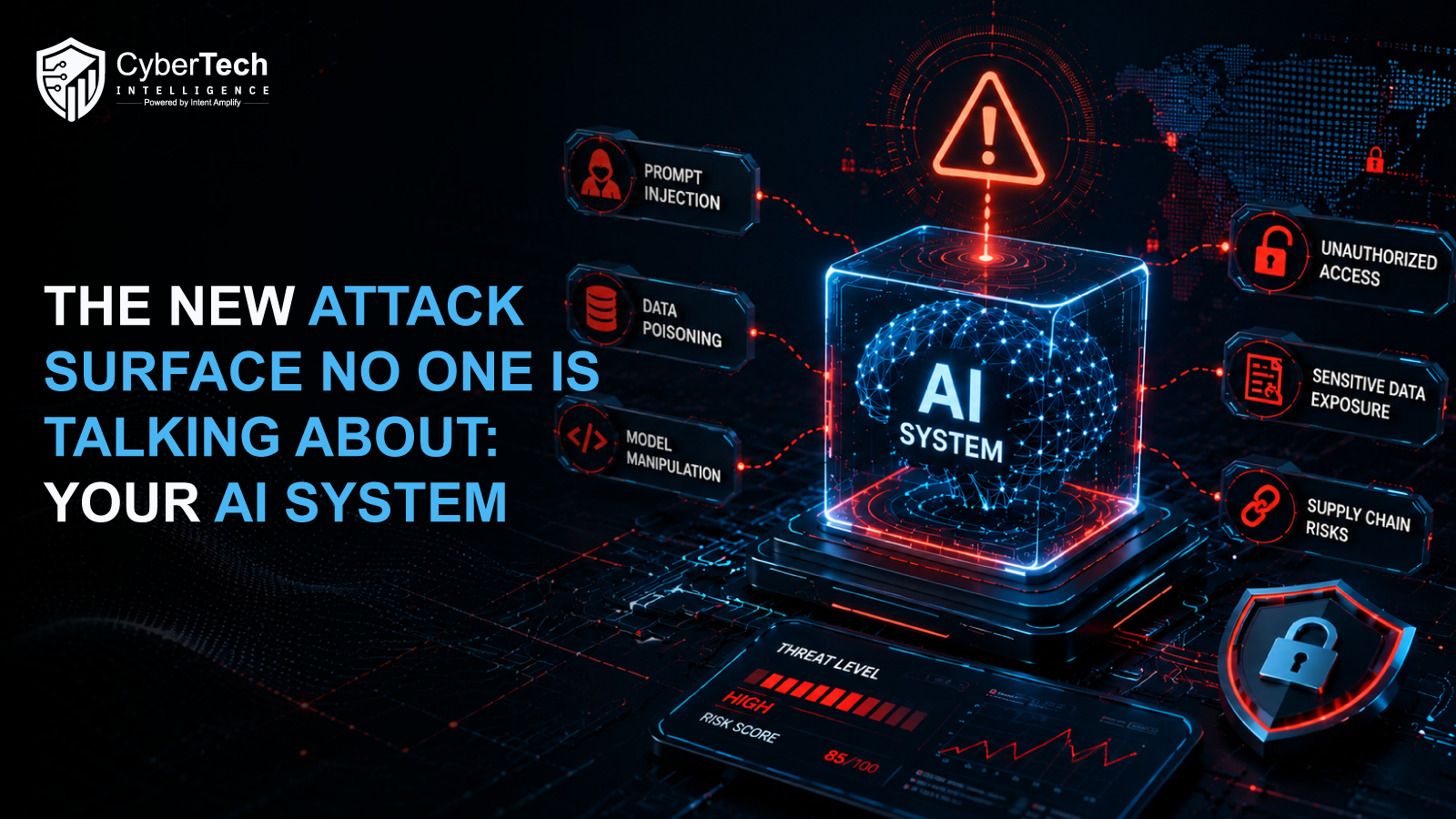
The shift changes the cybersecurity conversation because the enterprise attack surface is no longer limited to endpoints, identities, networks, applications, cloud workloads, and vendors. It now includes prompts, models, training data, embeddings, retrieval pipelines, AI agents, AI-generated outputs, model APIs, and the sensitive information AI systems are allowed to process.
1. AI Has Moved Faster Than the Control Layer
The primary AI security risk is not adoption itself but the speed at which adoption is outpacing governance, oversight, and control mechanisms. Generative AI initially entered enterprises through productivity use cases before expanding into internal search, code generation, customer engagement, compliance review, analytics, and operational automation. Each new deployment created business value while simultaneously expanding the organization's attack surface, data exposure, and governance requirements.
F5’s 2025 State of AI Application Strategy Report found that 96% of organizations are implementing AI models, while only 2% are highly ready to handle the operational demands of AI deployment. The gap reveals the fundamental problem behind AI in cybersecurity. AI is becoming embedded before many enterprises have mature security, governance, and monitoring programs around it. [1]
AI does not behave like a conventional enterprise application. A traditional system executes defined logic while an AI system responds to prompts, context, retrieved content, model behavior, permissions, memory, and tool access, so the risk surface is not only code but also language, data, workflow, identity, and intent.
IBM’s 2025 Cost of a Data Breach research found that 13% of organizations reported breaches involving AI models or AI applications, while 8% did not know whether they had experienced that kind of compromise. The second number may be more revealing than the first because uncertainty itself signals a visibility problem. [2]
If an organization cannot identify where AI systems are deployed, what data they access, and who owns the risk, then AI has already become part of the attack surface, and the organization needs an AI security framework for enterprises that can translate innovation into controlled adoption.
2. Why AI Security Is Different from Traditional Cybersecurity
Enterprise cybersecurity has matured around endpoint compromise, credential theft, application vulnerabilities, cloud misconfiguration, third-party risk, insider threats, and data loss. AI does not replace these categories but creates new pathways between them.
A prompt can become an attack input. A retrieved document can become an instruction source. A model can expose sensitive information through output. A third-party model API can introduce supply chain dependency. An AI agent with tool permissions can move from recommendation to execution.
OWASP’s 2025 Top 10 for Large Language Model Applications places prompt injection at the top of its risk list. OWASP defines prompt injection as a vulnerability where user prompts alter the model’s behavior or output in unintended ways, including cases where the instruction may not be visible to humans but can still be parsed by the model. [3]
Malicious instructions can be embedded within documents, webpages, tickets, emails, code comments, or retrieved knowledge sources. When an AI system treats content as an instruction rather than data, ordinary business information can become part of the attack path.
Effective AI security requires more than governance policies. Organizations need operational controls to govern models, prompts, retrieval pipelines, data access, tool usage, and runtime behavior. Security leaders must be able to understand, monitor, and control the systems to influence how AI makes decisions and executes actions in production environments.
3. Research Signals: The AI Security Readiness Gap
The strongest 2025 industry data points toward one conclusion: AI security maturity is lagging behind AI adoption.
|
Research Signal |
What It Shows |
Why It Matters |
|
AI adoption is widespread |
96% of organizations are implementing AI models |
AI is already part of enterprise infrastructure |
|
AI readiness is low |
Only 2% are highly ready for AI deployment demands |
Governance and security are behind the adoption |
|
AI breaches are emerging |
13% reported AI model or application breaches |
AI compromise is already measurable |
|
Access controls are weak |
97% of organizations with AI-related breaches lacked proper AI access controls |
AI identity and permissions need urgent attention |
|
Shadow AI raises costs |
Heavy shadow AI was linked to $670,000 higher breach costs |
Unmanaged AI creates financial exposure |
|
CISOs feel pressure |
78% of CISOs say AI-powered threats significantly affect their organizations |
AI risk is now a leadership issue |
|
Cloud and AI risk are converging |
34% of organizations with AI workloads reported AI-related breaches |
AI security must connect with cloud risk management |
Source: CyberTech Intelligence Analysis based on referenced reporting.
IBM’s 2025 report states that 97% of organizations that experienced AI-related breaches lacked proper AI access controls, which frames AI risk as an access governance issue and not only a model-security issue. [2]
Cybersecurity Dive coverage of IBM’s 2025 breach findings reported that organizations with heavy shadow AI experienced breaches costing an average of $670,000 more than organizations with little or no shadow AI, giving leaders a financial argument for approved AI environments and stronger governance. [4]
Darktrace’s 2025 State of AI Cybersecurity report found that 78% of CISOs say AI-powered threats are having a significant impact on their organizations, which reinforces why AI threat detection should be evaluated as part of enterprise resilience rather than as another isolated security feature. [5]
Cloud Security Alliance’s 2025 research reports that 34% of organizations with AI workloads already report AI-related breaches, while Verizon’s 2025 DBIR analyzed 22,052 real-world security incidents and 12,195 confirmed data breaches, which shows AI systems are entering an already intense security environment where AI security tools must work beside established controls. [7]
Google DeepMind analyzed more than 12,000 real-world attempts to use AI in cyberattacks across 20 countries, while Proofpoint found that 76% of CISOs anticipate a material cyberattack in the next year, making AI-driven cybersecurity relevant to both attacker activity and board-level planning. [8] [9]
4. Anatomy of the AI Attack Surface
Prompts: The New Input Channel
Prompt injection is one of the clearest examples of AI-specific risk because attackers may attempt to override system instructions, extract sensitive data, manipulate outputs, or redirect model behavior through direct prompts or indirect content that the AI retrieves and treats as trusted context.
For CISOs, prompt injection creates a new incident response problem, while for CTOs and CIOs, it creates an architecture problem around separating trusted instructions from untrusted content.
Data: The Foundation Can Be Poisoned
AI systems depend on training data, fine-tuning data, user inputs, internal documents, embeddings, and retrieved context. Inaccurate, manipulated, over-permissioned, or poorly governed data can derail the AI system, amplifying the problem at scale.
Model and data poisoning are especially concerning because they attack integrity. A compromised AI system may still sound confident while steering decisions in harmful directions.
RAG Pipelines: Where Knowledge Becomes Exposure
Retrieval-augmented generation systems allow AI to work with enterprise knowledge, but they also connect models to internal documents, knowledge bases, policies, tickets, contracts, and records. If access controls are weak, the AI may retrieve sensitive information that a user should not see. If documents contain malicious instructions, the model may treat them as context.
Agents: When AI Stops Answering and Starts Acting
Agentic AI security raises the stakes because the system can call tools, query databases, open tickets, write code, update records, send messages, trigger workflows, and make decisions across connected systems.
The risk shifts from output quality to action control. An AI agent with broad permissions can cause damage even when the underlying model is functioning as designed. For example, an agent connected to customer records, email, and ticketing systems could expose sensitive data, trigger incorrect workflows, or send unauthorized communications if approval gates and permissions are too broad.
That’s why AI agent security must be treated as an identity and access problem as much as a model problem. IAM for AI agents should define what the agent can access, what it can change, which systems it can call, when human approval is required, and how every action is logged.
Vendors, APIs, and Open Source Dependencies
Enterprise AI depends on third-party providers, model APIs, SaaS copilots, open-source components, vector databases, plugins, and cloud infrastructure. Technology leaders need to know what data vendors can access, how outputs are logged, and whether controls are auditable.
5. What This Means for Security and Technology Leaders
For CISOs, the AI attack surface creates a visibility-first problem. Before security teams can protect AI systems, they need to know where those systems exist, who owns them, what data they access, and whether they can act through enterprise tools.
The most urgent priorities include AI asset inventory, access control, data loss prevention for AI inputs and outputs, prompt-injection testing, AI red teaming, model and RAG pipeline monitoring, and incident response playbooks that include AI-specific failure modes.
Board reporting also needs to evolve. Security leaders may be asked whether AI is governed, whether shadow AI exists, whether systems touch regulated data, and whether controls are measurable. The CISO’s role is not to slow AI adoption. It is to make it defensible.
For CIOs, CTOs, Chief Digital Officers, and data leaders, AI security is a scale problem. AI will become part of software development, cloud architecture, customer experience, analytics, operations, and business automation.
Secure architecture is essential. Technology leaders need approved AI environments, clear integration patterns, vendor governance, data classification, API controls, logging, and human approval gates for high-risk actions.
The shared question is whether AI can be deployed in a way that is secure, auditable, compliant, and resilient enough to support enterprise scale. This is where an AI governance and security policy template can help teams standardize ownership and review requirements while still adapting controls to different use cases.
6. From Visibility to Control: An AI Security Operating Model
A practical AI security operating model should begin with discovery through an inventory of approved tools, shadow AI, vendor platforms, internal models, embedded copilots, RAG systems, and agentic workflows.
The next step is classification. Not every AI use case carries the same risk. A writing assistant used for public marketing copy is different from an AI agent connected to customer records, financial systems, code repositories, or regulated data. Classification should consider data sensitivity, business criticality, autonomy, external exposure, vendor dependency, and compliance obligations.
Control follows classification. AI systems should have role-based access, least-privilege permissions, API limits, data loss controls, prompt safeguards, retrieval restrictions, model monitoring, audit logging, and human approval for sensitive actions.
Testing is equally important because AI systems should be evaluated for prompt injection, adversarial manipulation, sensitive information disclosure, excessive agency, supply chain exposure, and unsafe tool use.
Finally, governance must make AI risk visible to leadership. An AI risk management framework 2026 approach should connect risk classification, control ownership, vendor review, monitoring, and board reporting into one operating model.
7. Agentic AI Risks Leaders Should Watch in 2026
Agentic AI security risks explained in practical terms come down to one point. The more autonomy an AI system has, the more important it becomes to define permissions, approvals, monitoring, and rollback paths before the system enters production.
The agentic AI threat landscape 2026 will likely be shaped by systems that can use tools across business environments, interact with other agents, and complete multi-step workflows with limited human supervision.
AI agent privilege escalation attacks may occur when an agent gains access beyond its intended role through misconfigured permissions, chained tool calls, inherited credentials, or weak approval controls. Multi-agent AI security challenges may also emerge when several agents exchange information, assign tasks, or trigger actions across systems while no single control point has full visibility into the workflow.
The practical answer is not to avoid autonomy completely. It is to define how to secure autonomous AI agents through scoped permissions, identity controls, approval gates, transaction limits, activity logging, adversarial testing, and rapid containment procedures.
8. Board-Ready Questions Every Enterprise Should Answer
Security and technology leaders should be able to answer the following questions with evidence, not assumptions. If the answer depends on manual guesswork, AI risk visibility is not mature enough for board-level confidence.
|
Board-Level Question |
Why It Matters |
|
Which AI systems are currently used across the enterprise? |
Establishes visibility |
|
Which systems access confidential, regulated, or customer data? |
Identifies exposure |
|
Which AI tools were deployed without review? |
Surfaces shadow AI |
|
Can any AI system take action through APIs or workflow tools? |
Measures agentic risk |
|
Are prompts, outputs, logs, and embeddings governed as sensitive data? |
Protects hidden data layers |
|
How are AI vendors and model providers assessed? |
Addresses supply chain risk |
|
Does incident response cover AI-specific threats? |
Improves resilience |
|
Who owns AI risk across security, technology, data, and business teams? |
Clarifies accountability |
9. Strategic Outlook: AI Security Is Now Business Resilience
AI adoption will continue because the business value is too significant to ignore. The issue is not whether enterprises should use AI. They already are. The real question is whether AI can be governed and secured before it becomes invisible infrastructure.
The organizations that mature fastest will not be the ones that block AI. They will be the ones who make AI safe enough to scale through shared accountability across security, technology, legal, compliance, data, and business teams.
The new enterprise attack surface may not announce itself through a suspicious login or an exposed server. It may appear as an AI assistant retrieving internal files, a model generating code, a chatbot processing customer data, or an agent taking action across connected systems.
AI security is no longer a future concern. It is now part of cyber resilience, digital trust, compliance readiness, and enterprise risk management. Leaders must ask whether the organization can see AI, govern it, secure it, and explain it when the board asks what changed.
Turn AI Security Insight Into Buyer Engagement
As AI security becomes a defining priority for CISOs, technology leaders, and risk teams, the brands that lead with credible intelligence will be better positioned to shape the conversation. CyberTech Intelligence helps cybersecurity companies connect timely market insight with the audiences actively evaluating risk, governance, security architecture, and emerging technology priorities.
Through Pipeline Activation and Vendor Intelligence, CyberTech Intelligence supports brands in moving beyond awareness and toward meaningful buyer engagement. The focus is not only on reaching security decision-makers but on helping vendors understand what those buyers care about, where demand is forming, and how to activate conversations around the issues shaping enterprise cybersecurity investment.
CyberTech Intelligence supports this through:
CISO Round Tables Webinars
Executive-level conversations designed to build authority and engage senior cybersecurity buyers around urgent market challenges.
Sponsored Research
Original data that your buyers trust, with your brand as the source.
Targeted Content
Persona-led content built to reach the right accounts with the right cybersecurity narrative.
Strategic Consulting
Guidance that helps align messaging, positioning, and campaign strategy with buyer priorities.
For cybersecurity brands ready to turn AI security insight into stronger market influence and pipeline opportunity, connect with CyberTech Intelligence.
References
-
F5 (2025) State of AI Application Strategy Report. Available at: https://www.f5.com/resources/reports/state-of-ai-application-strategy-report.
-
IBM (2025) IBM Report: 13% of Organizations Reported Breaches of AI Models or Applications, 97% of Which Reported Lacking Proper AI Access Controls. Available at: https://newsroom.ibm.com/2025-07-30-ibm-report-13-of-organizations-reported-breaches-of-ai-models-or-applications,-97-of-which-reported-lacking-proper-ai-access-controls.
-
OWASP (2025) LLM01: Prompt Injection. Available at: https://genai.owasp.org/llmrisk/llm01-prompt-injection/.
-
Cybersecurity Dive (2025) Artificial Intelligence Security and Shadow AI Risks. Available at: https://www.cybersecuritydive.com/news/artificial-intelligence-security-shadow-ai-ibm-report/754009/.
-
Darktrace (2025) New Report Finds That 78% of Chief Information Security Officers Globally Are Seeing a Significant Impact from AI-Powered Cyber Threats. Available at: https://www.darktrace.com/news/new-report-finds-that-78-of-chief-information-security-officers-globally-are-seeing-a-significant-impact-from-ai-powered-cyber-threats.
-
Cloud Security Alliance (2025) The State of Cloud and AI Security 2025. Available at: https://cloudsecurityalliance.org/artifacts/the-state-of-cloud-and-ai-security-2025.
-
Verizon (2025) 2025 Data Breach Investigations Report. Available at: https://www.verizon.com/business/resources/T16f/reports/2025-dbir-data-breach-investigations-report.pdf.
-
Google DeepMind (2025) Evaluating Potential Cybersecurity Threats of Advanced AI. Available at: https://deepmind.google/blog/evaluating-potential-cybersecurity-threats-of-advanced-ai/.
-
Proofpoint (2025) 2025 Voice of the CISO Report. Available at: https://www.proofpoint.com/us/newsroom/press-releases/proofpoint-2025-voice-ciso-report.