
Executive Summary
Enterprise resource planning platforms carry the operating truth of modern institutions. Payroll, employee administration, financial aid, supplier workflows, procurement, student records, grants, reporting, tax documentation, and regulatory evidence often pass through systems designed for continuity before they were redesigned for today’s threat velocity. The Oracle PeopleSoft zero-day campaign placed this reality in direct view of executives, boards, compliance leaders, and security teams.
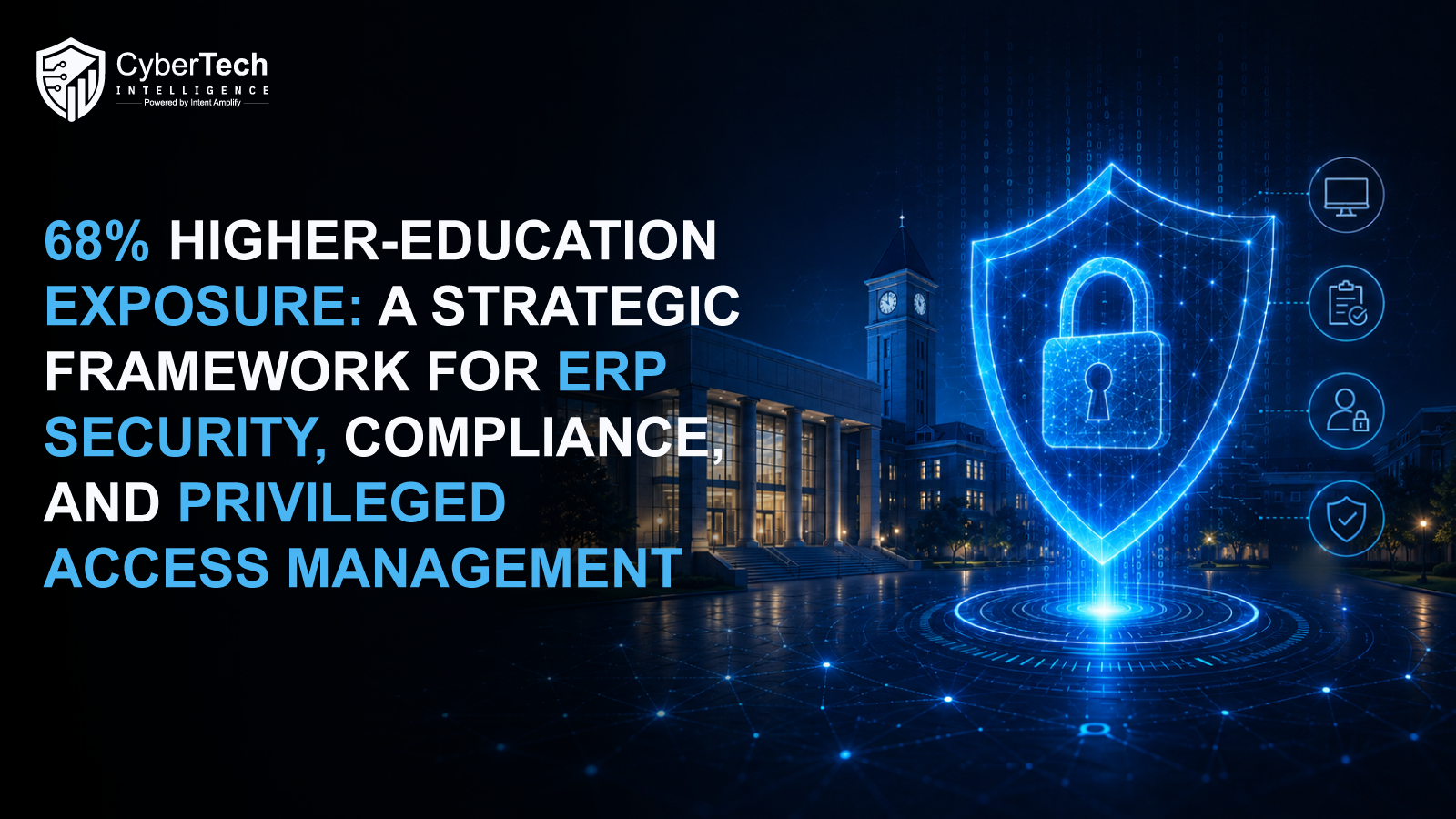
Mandiant and Google Threat Intelligence Group identified an active compromise and extortion campaign attributed to UNC6240, also known as ShinyHunters, targeting Oracle PeopleSoft application infrastructure between May 27, 2026, and June 9, 2026. The activity was consistent with exploitation of CVE-2026-35273, a critical remote code execution flaw in the Environment Management component with a CVSS 9.8 rating. Google also reported that it notified more than 100 global organizations whose IP addresses correlated with potentially vulnerable endpoints; most were based in the United States, and 68% operated within higher education.1
Oracle confirmed that CVE-2026-35273 affects Oracle PeopleSoft PeopleTools, may affect PeopleSoft Enterprise Applications customers, is remotely exploitable without authentication, and may result in remote code execution after successful exploitation.2
Oracle’s June 2026 Critical Security Patch Update contained 245 new security patches across product families and specifically advised PeopleSoft customers to apply the June update because it included the CVE-2026-35273 fix and additional patches.3
The central issue is not whether one vulnerability was dangerous. The deeper question is whether organizations can govern high-value business platforms with the same discipline applied to cloud, identity, endpoint, and customer-facing infrastructure. For higher education, the answer carries additional urgency because institutional operating models combine open access, diverse populations, long-lived records, decentralized ownership, and complex supplier ecosystems.
This whitepaper presents a strategic framework for ERP security, compliance readiness, and privileged access management. Its argument is direct: institutions cannot protect systems of record through patching alone. Resilience now requires exposure visibility, identity governance, administrative control, third-party oversight, application-aware detection, continuous evidence, and tested recovery.
CyberTech Intelligence Perspective
The PeopleSoft campaign should not be interpreted only as an Oracle security event. It should be understood as an enterprise trust event. When attackers reach systems supporting payroll, financial aid, student records, employee administration, supplier payments, or institutional reporting, the breach becomes a governance failure as much as a technical compromise.
CyberTech Intelligence views ERP resilience as a control modernization discipline.
Strong programs begin with visibility by identifying which business platforms are exposed, who can administer them, which vendors retain reach, where sensitive information moves, and how quickly leadership can produce evidence during active exploitation.
Why the PeopleSoft Zero-Day Now Belongs in Enterprise Resilience Planning
ERP platforms were never intended to become silent blind spots. Yet many organizations have allowed core business systems to sit between old operational assumptions and modern adversary behavior. These environments are often difficult to patch, hard to segment, deeply integrated, heavily customized, and governed across several teams. Such complexity creates delay, and delay creates opportunity.
The PeopleSoft campaign demonstrated how attackers can exploit a vulnerable administrative layer before defenders have a public advisory to guide them. Google stated that exploitation of CVE-2026-35273 directly aligned with observed targeting of Environment Management Hub endpoints and predated Oracle’s June 10, 2026 advisory, making the vulnerability a zero-day in the observed campaign.1
This timeline changes how executives should evaluate business-system resilience. Traditional vulnerability programs often assume an advisory-driven workflow: vendor notification, severity review, change approval, testing, maintenance window, implementation, and validation. A zero-day campaign collapses that sequence. In exposed systems of record, the practical response must include compensating controls, emergency governance, forensic readiness, and executive escalation before routine patch cycles can complete.
The PeopleSoft event also showed how intrusion activity can move beyond the initial exploit. Google described attacker staging environments using customized MeshCentral agents disguised as cloud endpoints, administrative command queries, lateral movement scripts, internal configuration reviews, outbound connections, and stolen data published on the ShinyHunters data leak site on June 9, 2026.1
For leadership teams, resilience planning should address two questions together.
- Can the organization close the known flaw quickly?
- Can it also limit attacker progress if exploitation begins before the flaw is publicly known?
Higher Education as the Exposure Signal
Higher education is not simply another industry category in this campaign. It is the exposure signal. Google reported that 68% of notified organizations operated within higher education, including universities and colleges worldwide.1
This concentration matters because colleges and universities combine enterprise-scale technology with unusually open operating models.
A single institution may serve students, applicants, faculty, staff, alumni, researchers, donors, contractors, government agencies, healthcare partners, athletics programs, financial-aid administrators, procurement vendors, cloud providers, managed service firms, and global academic partners. Each group needs access to specific digital processes. Many processes connect back to systems supporting records, finances, identity, or reporting.
This creates a distinct governance challenge. Higher education institutions must protect long-lived student records, payroll information, financial-aid data, research administration, grants, donor files, supplier transactions, and regulatory documentation while supporting a culture built around openness and collaboration. Central IT teams often manage infrastructure, business units own workflows, security teams own detection, and external partners maintain specialized services. Attackers need only one weak path; institutions must govern many.
CyberTech Intelligence Observation
Higher education often discusses cyber exposure through the lens of open networks and diverse users. The PeopleSoft campaign points to a quieter weakness: systems of record may support mature business functions, yet their control evidence, privilege governance, and detection logic may lag behind attacker speed.
Why ERP Security Is More Than Application Hardening
Application hardening remains necessary, but it is not sufficient. ERP platforms function as a business control infrastructure. When these systems are compromised, the impact can affect confidentiality, transaction reliability, operational continuity, audit confidence, workforce privacy, supplier assurance, and institutional trust.
Oracle’s June 2026 Critical Security Patch Update listed 11 new PeopleSoft patches, with 7 vulnerabilities remotely exploitable without authentication.3
This detail reinforces a larger point. Enterprise application portfolios are not static assets. New flaws emerge, old configurations persist, and administrative components may remain reachable longer than intended.
Palo Alto Networks’ 2026 Unit 42 Global Incident Response Report found that identity weaknesses appeared in roughly 90% of investigations, while 65% of initial access was driven by identity-based techniques. The same report found that 87% of intrusions involved multiple attack surfaces.4
These findings explain why ERP defense cannot remain isolated from identity governance, network segmentation, endpoint visibility, privileged session control, cloud monitoring, and third-party oversight. In practice, attackers rarely respect organizational charts. An intrusion may begin in PeopleSoft, move through credentials, reach middleware, access file shares, query databases, touch cloud storage, and involve vendor-maintained components. Security programs that assign each element to a separate team without shared evidence create gaps during the moments when speed matters most.
CyberTech Intelligence Observation
Organizations rarely fail because they lack policies. They struggle because policy language does not automatically produce control evidence. ERP resilience improves when leaders convert ownership, permissions, monitoring, supplier reach, and recovery into measurable operating records.
Compliance, Evidence, and the Speed of Exploitation
Compliance programs often work on schedules. Attackers do not. This difference is becoming one of the defining weaknesses in enterprise cyber governance. Annual audits, quarterly reviews, policy attestations, supplier questionnaires, and cyber insurance renewals are useful, but a zero-day campaign demands current evidence.
Google Cloud’s M-Trends 2026 reported that the mean time to exploit vulnerabilities fell to an estimated minus seven days, meaning exploitation is increasingly observed before a patch becomes available.5
IBM’s 2026 X-Force Threat Intelligence Index reported a 44% increase in attacks beginning with the exploitation of public-facing applications, largely associated with missing authentication controls and AI-enabled vulnerability discovery.6
IBM also reported that vulnerability exploitation accounted for 40% of incidents observed by X-Force in 2025, while large supply chain and third-party compromises nearly quadrupled since 2020.6
“Attackers aren't reinventing playbooks; they're speeding them up with AI,” said Mark Hughes, Global Managing Partner for Cybersecurity Services, IBM. The core issue is the same: businesses are overwhelmed by software vulnerabilities. The difference now is speed. With so many vulnerabilities requiring no credentials, attackers can bypass humans and move straight from scanning to impact. Security leaders need to shift to a more proactive approach, using agentic-powered threat detection and response to identify gaps and catch threats before they escalate.
For PeopleSoft and similar systems of record, these trends shift compliance from documentation to operational proof. Leadership should be able to answer practical questions without waiting for a manual evidence hunt.
- Which endpoints were exposed during the campaign window?
- Which compensating controls were applied?
- Which privileged accounts were active?
- Which vendor sessions occurred?
- Which logs were reviewed?
- Which indicators were investigated?
- Which records were potentially reachable?
- Which business owners accepted exceptions?
The compliance burden has changed from proving that a policy exists to proving that a control worked. This distinction will increasingly shape cyber insurance reviews, regulator discussions, public-sector obligations, customer security assessments, and board reporting.
Privileged Access Management as the Control Layer
Privileged access management has become central to ERP security because administrative authority determines blast radius. PeopleSoft administrators, database teams, middleware engineers, infrastructure operators, emergency users, service accounts, batch scripts, systems integrators, managed service providers, and automation tools may all hold meaningful reach into sensitive functions.
Google’s campaign analysis described attackers executing administrative command queries, inspecting PeopleSoft configuration, examining WebLogic XML files, mapping internal hosts, copying extortion markers, and running propagation scripts using credential-based movement.1. This behavior reinforces a basic leadership principle: elevated permissions cannot be managed as operational convenience.
PAM programs for systems of record should move beyond vault deployment alone. Mature discipline includes named ownership for privileged roles, just-in-time elevation, multifactor authentication, approval workflows, session recording, nonhuman identity governance, service secret rotation, supplier access boundaries, emergency-account reconciliation, and periodic recertification.
Deloitte’s 2026 Cybersecurity Forecast identifies identity protection, cyber defense, platformization, and resilience as major priorities for organizations preparing for the next phase of digital exposure.7
This direction fits ERP environments because administrative authority increasingly spans people, service identities, scripts, APIs, third-party tools, and automated workflows.
CyberTech Intelligence Perspective
Privileged access management is not only a security control. It is a governance system for institutional authority. In ERP environments, elevated permissions should be treated like financial signing authority because both can affect trust, continuity, and accountability.
CyberTech Intelligence Framework: Five Pillars of ERP Resilience
ERP security transformation should be structured around interdependent pillars rather than isolated projects. Each pillar improves one part of resilience, but the full value emerges when the model operates as a single governance system.
|
Pillar |
Executive Question |
Expected Outcome |
|
Exposure Visibility |
Do we know which ERP components, endpoints, integrations, and exports are reachable? |
Current map of business-system attack surface |
|
Identity Governance |
Do we know who, what, and which service identities can reach sensitive functions? |
Reduced entitlement sprawl and clearer ownership |
|
Privileged Access Management |
Are elevated permissions time-bound, monitored, approved, and reviewed? |
Lower blast radius after credential compromise |
|
Compliance Evidence |
Can leaders produce proof of control operation during active exploitation? |
Faster audit, insurer, regulator, and board response |
|
Recovery Readiness |
Can the institution restore trusted operations after compromise? |
Reduced downtime, lower uncertainty, stronger resilience |
Google’s remediation guidance recommended disabling Environment Management Hub in multi-server configurations or removing the PSEMHUB application in single-server configurations. Where disabling is not feasible, organizations should block external access to /PSEMHUB/* and /PSIGW/HttpListeningConnector. Google also recommended reviewing PIA WebLogic access logs for external POST /PSEMHUB/hub and POST /PSIGW/HttpListeningConnector activity, checking for unexpected .jsp files under PSEMHUB paths, inspecting unauthorized staging directories, and monitoring outbound SMB traffic from PeopleSoft servers to untrusted destinations.1
These measures belong inside a broader operating model. Technical controls reduce exposure. Governance turns those controls into repeatable assurance.
A Practical Roadmap for ERP Security Transformation
A credible roadmap begins with visibility, not replacement. Large institutions do not need to rebuild every system at once. They need a disciplined sequence that reduces uncertainty, prioritizes sensitive functions, and produces executive evidence.
During the first 30 days, leaders should run an exposure-discovery sprint. Security, IT, business-system owners, compliance, procurement, finance, HR, and academic administration should build one consolidated map of PeopleSoft components, supported versions, administrative endpoints, external reachability, privileged accounts, service identities, vendor access, database dependencies, export locations, backups, and recovery dependencies. This phase should confirm Oracle June 2026 update status and identify unsupported deployments.3
During the next 30 days, teams should reduce preventable exposure. Priority actions include isolating administrative services, blocking unnecessary external reachability, rotating elevated credentials, removing dormant accounts, vaulting service secrets, narrowing vendor permissions, enforcing multifactor authentication, reviewing WebLogic access logs, inspecting web-tier file systems, and monitoring outbound SMB traffic from PeopleSoft hosts.
During the final 30 days, the organization should institutionalize evidence. The output should be a board-ready ERP resilience pack containing inventory, patch status, emergency-change records, access-review results, supplier attestations, detection coverage, incident-response procedures, backup validation, tabletop results, open exceptions, accountable owners, and target completion dates.
Illustrative Enterprise Scenario
A large U.S. university system operates PeopleSoft for student administration, payroll, financial aid, and research finance. Its ERP environment includes hosted infrastructure, middleware services, supplier-maintained integrations, legacy scripts, batch exports, and multiple administrative teams across campuses. This scenario reflects the higher education exposure pattern identified by Google Cloud Mandiant, which reported that 68% of organizations notified in the PeopleSoft exploitation campaign operated within higher education.¹
After the PeopleSoft zero-day, the CISO and CIO convene a 90-day resilience program rather than limiting response to patch deployment. The first phase produces a single exposure map across applications, endpoints, service accounts, vendor pathways, databases, and reporting exports. The second phase removes unused privileged accounts, restricts administrative routes, rotates service secrets, and narrows supplier reach. The third phase creates board-ready evidence that includes access reviews, remediation records, detection logic, recovery tests, and open exception ownership.¹
CyberTech Intelligence Insight
Organizations rarely need to modernize every ERP control simultaneously. The greater advantage comes from focusing first on systems carrying sensitive records, broad privileges, external reachability, supplier dependencies, and poor detection visibility.
Enterprise Trust After the PeopleSoft Zero-Day
Trust in systems of record is becoming a measurable business asset. Boards, regulators, insurers, public-sector agencies, students, employees, vendors, and customers increasingly expect evidence that sensitive processes are protected and recoverable. After the PeopleSoft campaign, organizations can no longer treat ERP security as a back-office concern.
Enterprise confidence is built on demonstrable preparedness rather than confident assertions. Executives need documented evidence of current exposure, defined ownership, privilege governance, supplier access, incident response readiness, and recovery validation. With that foundation, leadership can communicate cyber resilience in business terms supported by verifiable operational evidence rather than technical abstractions.
Executive teams should be able to answer practical readiness questions with documented evidence.
- Have we completed a current inventory of ERP components, endpoints, and integrations?
- Which sensitive records are stored, processed, or exported through ERP workflows?
- Which administrators, suppliers, and service identities hold elevated permissions?
- Which administrative endpoints remain externally reachable?
- Which PeopleSoft-specific detections are active?
- Can we restore trusted operations after compromise?
- Which executive owns ERP resilience reporting?
Institutional resilience is demonstrated through evidence rather than policy volume. Organizations with the strongest security posture can identify exposed systems, account for privileged access, validate controls that limit attacker movement, detect malicious activity, and restore trusted operations with confidence after compromise.
Conclusion
The Oracle PeopleSoft zero-day moved ERP security into the center of enterprise resilience planning. The campaign showed how a single exposed administrative layer can become a gateway into business-critical systems carrying payroll, financial aid, student records, workforce data, supplier workflows, and institutional reporting.
The hardest challenge is not understanding that CVE-2026-35273 was severe. Oracle’s advisory and Google’s campaign analysis make that clear. The harder work involves building the operating capacity to identify exposure, restrict administrative reach, govern supplier pathways, produce compliance evidence, detect application-layer misuse, and recover trusted operations under pressure.
Executives should treat ERP protection as part of broader digital trust. It safeguards records that institutions depend on, strengthens compliance readiness, reduces third-party uncertainty, and improves operational confidence during active exploitation. The best-prepared organizations will not simply patch faster. They will govern systems of record with the same discipline already expected across cloud, identity, endpoint, and customer-facing infrastructure.
Start with Visibility, Not Replacement
Enterprise-wide platform replacement is rarely the priority. Establishing reliable evidence of exposure, control effectiveness, and operational readiness delivers greater value during the early stages of ERP security transformation.
CyberTech Intelligence supports this process through ERP security readiness assessments, privileged access management reviews, compliance evidence workshops, supplier access reviews, incident response and recovery advisory, and executive strategy briefings. These engagements help leadership identify ERP exposure, prioritize control modernization, and develop a phased resilience strategy aligned with business objectives.
Organizations unable to answer the readiness questions outlined in this whitepaper should establish a structured ERP Security and PAM Readiness Assessment before major modernization initiatives, procurement decisions, or compliance programs proceed.
About CyberTech Intelligence
CyberTech Intelligence helps enterprise technology, cybersecurity, and go-to-market leaders translate complex market shifts into research-led narratives, buyer-focused content, and strategic demand programs. Its work supports organizations operating across cybersecurity modernization, compliance-driven messaging, cyber resilience, identity protection, ERP security, privileged access management, and enterprise technology growth.
For teams developing initiatives around Oracle PeopleSoft security, ERP resilience, compliance readiness, vulnerability management, third-party risk, threat intelligence, incident response, or privileged access management, CyberTech Intelligence can help shape technical urgency into clear enterprise messaging.
Contact us today and connect with our team.
References
- Google Cloud Mandiant, ShinyHunters Targets Education Sector with Oracle PeopleSoft Exploit, June 2026
https://cloud.google.com/blog/topics/threat-intelligence/shinyhunters-targets-education-sector-oracle-exploit - Oracle, Oracle Security Alert Advisory - CVE-2026-35273, June 2026
https://www.oracle.com/security-alerts/alert-cve-2026-35273.html - Oracle, Critical Security Patch Update Advisory - June 2026, June 2026
https://www.oracle.com/security-alerts/cspujun2026.html - Palo Alto Networks Unit 42, 2026 Unit 42 Global Incident Response Report, February 2026
https://www.paloaltonetworks.com/resources/research/unit-42-incident-response-report - Google Cloud Mandiant, M-Trends 2026, March 2026
https://cloud.google.com/blog/topics/threat-intelligence/m-trends-2026/ - IBM, IBM 2026 X-Force Threat Intelligence Index: AI-Driven Attacks Are Escalating as Basic Security Gaps Leave Enterprises Exposed, February 25, 2026
https://newsroom.ibm.com/2026-02-25-ibm-2026-x-force-threat-index-ai-driven-attacks-are-escalating-as-basic-security-gaps-leave-enterprises-exposed - Deloitte, The Current: Cybersecurity Forecast for 2026, 2026
https://www.deloitte.com/us/en/services/consulting/articles/cybersecurity-forecast-for-2026.html


