
1. EXECUTIVE SUMMARY
SaaS applications have become the operational backbone of the modern enterprise. Core business functions, including sales, finance, human resources, customer service, engineering, procurement, marketing, collaboration, analytics, and executive reporting, are increasingly dependent on SaaS platforms.
This dependence has introduced a rapidly expanding security challenge. As SaaS adoption accelerates, organizations face growing exposure to risks that are often distributed across hundreds of applications, identities, integrations, and administrative configurations.
In 2026, three categories of SaaS risk stand out as the most significant sources of enterprise exposure: configuration weaknesses, identity and access governance failures, and OAuth integration sprawl. These risks are highly interconnected. A misconfigured SaaS application can enable excessive privileges, while unmanaged identities can create pathways for unauthorized access. Similarly, stale or overprivileged OAuth integrations can establish persistent third-party access to sensitive data and business-critical systems.
Threat actors increasingly target these gaps because they offer efficient paths to compromise without requiring direct exploitation of the SaaS platform itself. As a result, organizations require continuous visibility, governance, and remediation capabilities to manage SaaS risk at scale and maintain a resilient security posture.
According to Cloud Security Alliance’s State of SaaS Security Report 2025, based on a survey conducted among 420 professionals from the IT and security industry, 55% of employees use SaaS applications without any security considerations, and 57% of companies struggle with fragmented SaaS management.1
According to IBM’s 2026 X-Force Threat Intelligence Index, the top attack vector for cyberattacks in 2025 is the exploitation of vulnerabilities, with the usage of public-facing application exploitation growing by 44% annually.2
As per CrowdStrike’s 2026 Global Threat Report, 82% of attacks in 2025 did not use malware, which means that adversaries leverage credentials, cloud identities, trusted workflows, and authorized access.3
From this information, we can clearly see that a certain operational conclusion needs to be drawn.
SaaS risk changes continuously. Security posture management must also be continuous.
That is the strategic role of SSPM in 2026.
2. THE STATE OF SAAS SECURITY IN 2026: WHAT THE DATA SHOWS
2.1 Enterprise SaaS Exposure Has Outgrown Manual Governance
Enterprise SaaS adoption has reached a scale that many security programs were not built to control.
A large organization may now operate hundreds of SaaS applications across departments, regions, subsidiaries, and business units. Each application has its own configuration options, user roles, data-sharing settings, administrative permissions, API keys, third-party integrations, and compliance requirements.
The challenge is not simply volume. It is fragmentation.
Business units often purchase or configure SaaS independently. Application administration may sit with sales operations, HR operations, finance, engineering, support, or marketing teams. Security teams may be accountable for risk without having direct control over every application.
Security teams may not know every application in use. They may not know which settings have changed. They may not know which users are overprivileged. They may not know which third-party applications hold OAuth access. They may not know which sensitive data is being shared externally.
CSA also found that 63% of organizations identify external data oversharing as a problem, while 56% report employees uploading sensitive data to unauthorized SaaS applications without sufficient enforcement controls.1
These figures describe a structural SaaS governance problem.
Enterprise SaaS has become too distributed, too dynamic, and too integrated to secure through manual review alone.
2.2 Attackers Are Exploiting the Same Gaps Security Teams Struggle to See
Attackers are not guessing where enterprise SaaS is weak. They are targeting the areas where governance is least consistent: exposed applications, weak configurations, valid accounts, cloud identity paths, and third-party integrations.
IBM reported that vulnerability exploitation accounted for 40% of incidents in 2025, making it the leading initial access vector. IBM also reported a 44% year-over-year increase in attacks that began with the exploitation of public-facing applications, largely driven by missing authentication controls and AI-assisted vulnerability discovery.2
CrowdStrike’s 2026 report adds the identity dimension. The detection of malware-free detections being at 82% indicates that threats are now emerging from adversaries using legitimate credentials, trusted systems, and proper tools, not just malware. It is noted by CrowdStrike that the eCrime breakout time in 2025 was reduced to 29 minutes. 3
This speed changes the defensive requirement.
If attackers can move from initial access to lateral movement in minutes, then SaaS security cannot wait for periodic review cycles. Security teams need continuous detection of risky configuration changes, excessive privileges, exposed integrations, and abnormal access behavior.
FIGURE 1: Primary SaaS Attack Vectors Security Teams Must Address
Attack Vector | Key Statistic | Timeline |
Vulnerability exploitation | 40% of IBM X-Force incidents began with vulnerability exploitation | Full year 2025 |
Public-facing application exposure | 44% increase in attacks exploiting public-facing applications | Full year 2025 |
Malware-free intrusion activity | 82% of CrowdStrike detections were malware-free | Full year 2025 |
Attacker breakout speed | Average eCrime breakout time fell to 29 minutes | Full year 2025 |
Shadow SaaS adoption | 55% of employees adopt SaaS without security involvement | January 2025 survey |
Fragmented administration | 57% of organizations report fragmented SaaS administration | January 2025 survey |
3. THE THREE GAPS: A DETAILED EXAMINATION
3.1 Gap One: Configuration Drift and the Limits of Periodic Audits
SaaS configurations are not static.
A setting changes during troubleshooting. A vendor releases a new feature. An administrator enables external sharing. A business owner modifies access rules. An integration adds new permission requirements. A security control is disabled temporarily and never restored.
Over time, the live SaaS environment drifts away from the approved baseline.
This is configuration drift.
The problem is that many organizations still treat SaaS configuration review as a scheduled activity. Quarterly reviews and annual audits may satisfy a compliance requirement, but they cannot reliably detect risk that appears the day after the audit ends.
Misconfiguration is not always dramatic. It may be a sharing control, authentication requirement, administrator role, API permission, external access setting, or data export option.
But small configuration gaps can create large exposure.
IBM’s Cost of a Data Breach Report 2025 placed the global average breach cost at $4.44 million.4
When SaaS applications hold customer records, employee data, financial information, source code, business intelligence, contracts, and regulated data, configuration drift becomes a business risk, not only a technical one.
3.2 Gap Two: Identity and Access Management Weaknesses
Identity is the primary control plane for SaaS.
Network controls cannot fully govern what happens inside a SaaS application after access is granted. Endpoint tools may not detect API-based activity inside sanctioned platforms. Firewalls cannot explain whether a user has excessive administrative rights in Salesforce, Workday, GitHub, ServiceNow, Slack, or Microsoft 365.
That means access governance determines SaaS posture.
The Cloud Security Alliance found that 58% of organizations struggle to enforce least privilege across SaaS environments. CSA also found that 54% lack identity lifecycle automation for SaaS applications, while 46% struggle to monitor non-human identities.1
These findings matter because attackers increasingly prefer valid access.
A dormant account can become an entry point. An overprivileged user can become a privilege-escalation path. A service account can become a persistent foothold. An API key can become a lateral movement tool. A bot identity can hold access that no human owner actively reviews.
Microsoft’s Digital Defense Report 2025 highlights the continued importance of identity abuse, ransomware, extortion, and cloud-based attack paths across the modern threat landscape.5
CrowdStrike’s malware-free detection data reinforces the same defensive lesson: if attackers are operating through legitimate credentials and authorized workflows, SaaS access governance must be treated as a primary security function.3
Identity review must include humans and non-humans.
In 2026, service accounts, API keys, OAuth apps, automations, bots, and integration identities require the same level of scrutiny as privileged users.
3.3 Gap Three: OAuth Integration Sprawl and Third-Party Trust
Every SaaS integration creates delegated trust.
A user authorizes a productivity app. A department connects to a workflow tool. A vendor receives API access. A developer links a repository. A marketing team adds an automation platform. A finance workflow connects to reporting. An AI assistant receives access to company data.
Each connection may create an OAuth grant, token, service account, or API permission.
Over time, the organization creates an expanding web of third-party access.
This is OAuth integration sprawl.
The danger is not integration itself. Business runs on SaaS connectivity. The danger is unmanaged integration.
Security teams require comprehensive visibility into integrated applications, including granted permissions, scope of data access, approving authority, current activity status, and the ability to rapidly revoke access when necessary.
According to CSA’s research on SaaS security, SaaS-to-SaaS integration risk has emerged as one of the fastest-growing areas of the enterprise attack surface.1
Microsoft has also documented how adversaries abuse OAuth and authorization behaviors to deliver phishing, malware, and cloud access attacks without always needing traditional credential theft.6
A stale OAuth grant can outlive the user who created it.
A third-party app can retain more access than the business requires.
A former project integration can continue reading sensitive data.
A compromised vendor can become a path into the customer’s SaaS estate.
This is why SSPM must include OAuth and integration governance as a core capability.
FIGURE 2: The Three SaaS Security Gaps, Exposure Metrics
Gap | Exposure Metric | Timeline |
Configuration drift | 44% increase in public-facing application exploitation | Full year 2025 |
Configuration drift | 40% of IBM X-Force incidents involved vulnerability exploitation | Full year 2025 |
Identity and access | 58% struggle to enforce least privilege across SaaS | January 2025 survey |
Identity and access | 54% lack SaaS identity lifecycle automation | January 2025 survey |
Identity and access | 46% struggle to monitor non-human identities | January 2025 survey |
OAuth integration sprawl | 55% of employees adopt SaaS without security involvement | January 2025 survey |
SaaS governance | 57% report fragmented SaaS administration | January 2025 survey |
Data exposure | 63% identify external data oversharing as a problem | January 2025 survey |
4. THE SSPM FRAMEWORK: CLOSING THE THREE GAPS
The three gaps above share one core characteristic: they are continuous.
Configuration drift occurs continuously.
Identity permissions accumulate continuously.
Dormant accounts appear continuously.
OAuth grants expand continuously.
Third-party integrations change continuously.
Shadow SaaS adoption happens continuously.
A continuous risk landscape cannot be managed with periodic controls.
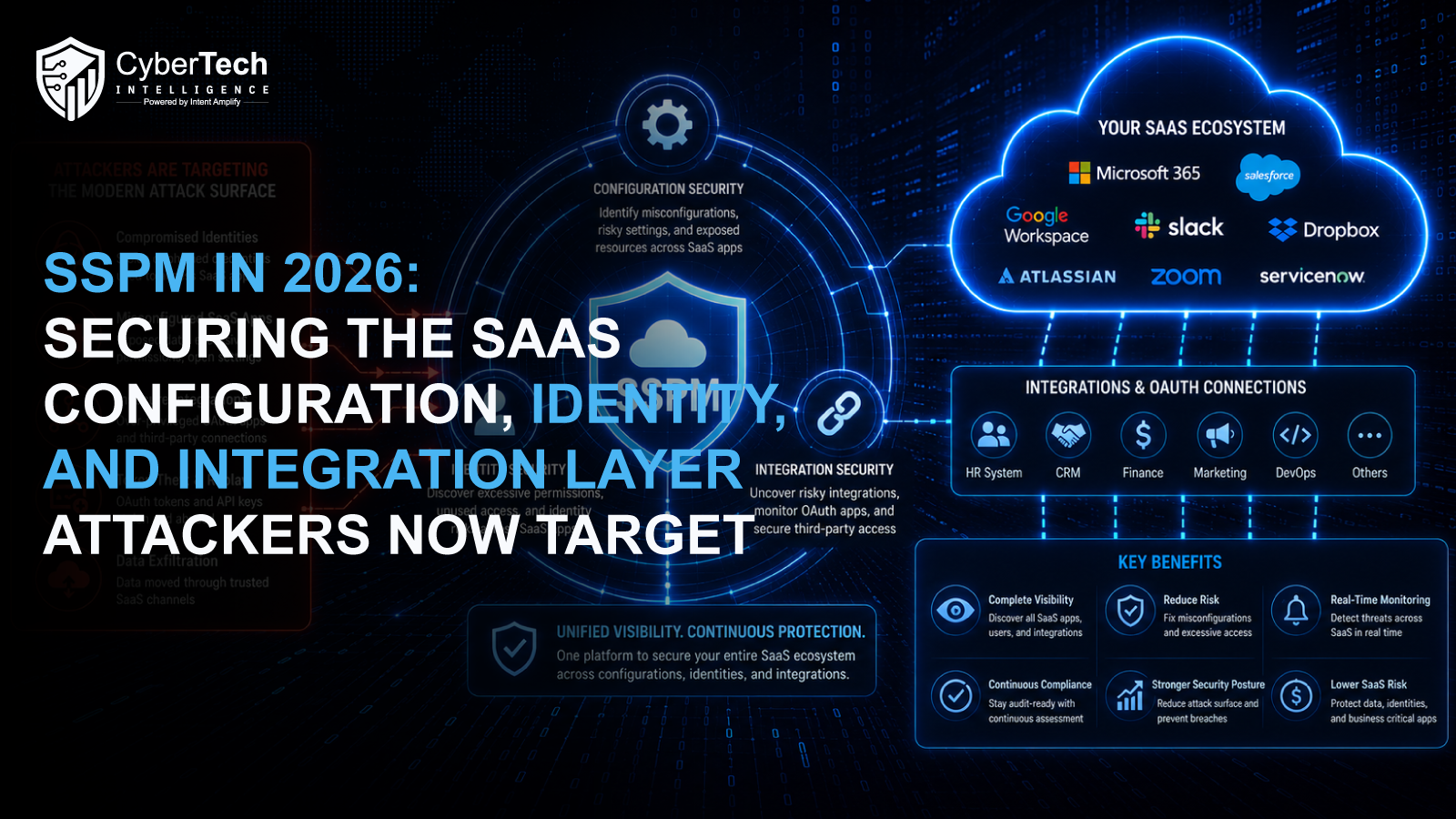
SaaS Security Posture Management (SSPM) addresses this gap by providing continuous visibility into and remediation of SaaS configuration, identity, and third-party integration risks. Through API-based integrations with SaaS applications, SSPM continuously assesses configurations against security policies, identifies misconfigurations and policy violations, detects overprivileged users and excessive access rights, monitors OAuth grants and third-party integrations, and enables rapid remediation to reduce organizational risk.
The value of SSPM is not simply more alerts.
The value is replacing scattered, manual, point-in-time SaaS reviews with persistent operational control.
4.1 Closing the Configuration Gap
The first SSPM requirement is configuration baseline management.
Security teams need to define the approved configuration state for high-risk SaaS applications. This baseline should reflect internal security policies, compliance requirements, data sensitivity, identity controls, sharing rules, authentication standards, and recognized benchmarks.
Once the baseline is defined, SSPM should continuously compare live settings against the approved state.
When drift occurs, teams need clear answers:
What changed?
Who changed it?
When did the change occur?
Which control is affected?
What data or users may be exposed?
What action restores the secure state?
This transforms configuration drift from a hidden risk into an operational event.
Without continuous monitoring, security teams may not discover dangerous changes until the next audit, or worse, after an incident.
4.2 Closing the Identity Gap
The identity governance function within SSPM should focus on four key areas: least privilege, inactive accounts, administrative rights, and non-human identities.
Least Privilege: SSPM helps enforce the principle of least privilege by ensuring users have only the access required to perform their roles. It identifies excessive permissions and privilege creep—the gradual accumulation of access rights over time without the removal of obsolete permissions—thereby reducing the attack surface.
Inactive Accounts: SSPM continuously identifies and remediates dormant accounts that create unnecessary standing access. This includes accounts belonging to former employees, contractors, temporary project users, inactive personnel, and abandoned accounts, helping organizations eliminate avoidable identity-related risk.
Administrative Rights: SSPM provides visibility into privileged and administrative accounts across SaaS environments, enabling organizations to identify excessive administrative access, enforce role-based controls, and reduce the risk associated with privileged account compromise.
Non-Human Identities: SSPM discovers and governs service accounts, API keys, OAuth applications, bots, and other machine identities. It helps ensure these non-human entities maintain only the permissions they require, are actively monitored, and do not become unmanaged sources of excessive access or data exposure.
Administrative access review limits high-impact privileges to users with an active, justified business need.
Non-human identity monitoring extends governance to service accounts, API keys, bot accounts, automation identities, OAuth applications, and integration users.
CSA’s finding that 46% of organizations struggle to monitor non-human identities shows why this control area needs more attention.1
A SaaS identity program that only governs human users is incomplete.
4.3 Closing the Integration Gap
OAuth integration governance begins with inventory.
Security teams need a complete list of active OAuth grants, connected applications, service accounts, API keys, automation tools, and third-party data access pathways.
For each integration, teams should document:
Business owner
Authorizing a user or administrator
Application vendor
Permission scopes
Data access level
Last activity
Risk rating
Revocation method
SSPM should continuously monitor SaaS integrations for excessive permission scopes, inactive or unused connections, anomalous behavior, grants associated with former employees, high-risk third-party applications, and access that no longer aligns with a legitimate business requirement.
This capability is critical because attackers do not always target the SaaS platform itself. Instead, they often exploit weaker links in the trust chain, such as compromised vendors, OAuth applications, access tokens, browser sessions, API keys, or service accounts. By continuously assessing and governing these interconnected access paths, SSPM helps organizations reduce third-party risk, limit unnecessary exposure, and strengthen their overall SaaS security posture.
Integration governance helps reduce that blast radius.
FIGURE 3: SSPM Capability Requirements Mapped to Gap Closure
Security Gap | Required SSPM Capability | Frequency | Primary Risk Reduced |
Configuration drift | Security baseline monitoring | Continuous | Misconfiguration exploitation |
Configuration drift | Change detection and guided remediation | Real time | Undetected risky changes |
Identity and access | Least-privilege enforcement | Continuous | Overprivileged user abuse |
Identity and access | Dormant account detection | Daily or continuous | Stale account compromise |
Identity and access | Non-human identity monitoring | Continuous | API key and service account abuse |
OAuth sprawl | OAuth grant inventory | Continuous | Shadow integration exposure |
OAuth sprawl | Permission-scope monitoring | Continuous | Excessive third-party access |
OAuth sprawl | Automated revocation workflows | Triggered by risk | Persistent unauthorized access |
5. THE FINANCIAL AND STRATEGIC CASE FOR SSPM INVESTMENT
5.1 The Cost of Inaction
SaaS applications hold some of the most valuable data in the enterprise.
CRM systems contain customer and revenue data. HR platforms contain employee records. Collaboration tools contain strategy documents and internal communications. Finance platforms contain payment and transaction data. Developer platforms may contain source code, deployment secrets, and API keys. Analytics platforms contain operational intelligence.
A SaaS breach can therefore create financial, regulatory, operational, and reputational impact.
IBM’s 2025 Cost of a Data Breach Report placed the global average breach cost at $4.44 million.4
CrowdStrike’s 2026 Global Threat Report reported that the average eCrime breakout time fell to 29 minutes in 2025.3
This combination is important.
The cost of breach remains high, while the time available to detect and contain attacks continues to shrink.
Manual SaaS posture checks cannot operate at adversary speed. SSPM investment is therefore not only a compliance or reporting investment. It is a visibility, detection, governance, and response investment.
The business case includes:
Reduced misconfiguration risk
Improved access governance
Faster identification of risky SaaS changes
Better OAuth and third-party visibility
Lower audit burden
Stronger compliance evidence
Improved incident response readiness
More consistent SaaS security operations
5.2 The Market Response
Organizations are responding by prioritizing SaaS security investment.
Cloud Security Alliance reported that 86% of organizations identify SaaS security as a high priority, while 76% report increased SaaS security budgets.1
This shift reflects the new role of SaaS in enterprise risk management.
SaaS is no longer only an application administration issue. It is now central to customer data protection, employee productivity, revenue operations, third-party risk, identity governance, compliance, and business resilience.
SSPM investment is rising because the SaaS control plane has become too important to manage manually.
FIGURE 4: The Financial Case for SSPM Investment
Metric | Value | Timeline |
Global average breach cost | $4.44 million | 2025 |
Vulnerability exploitation share of IBM X-Force incidents | 40% | Full year 2025 |
Increase in public-facing application exploitation | 44% | Full year 2025 |
Malware-free CrowdStrike detections | 82% | Full year 2025 |
Average eCrime breakout time | 29 minutes | Full year 2025 |
Organizations prioritizing SaaS security | 86% | January 2025 survey |
Organizations are increasing SaaS security budgets | 76% | January 2025 survey |
Employees adopting SaaS without security involvement | 55% | January 2025 survey |
6. IMPLEMENTATION PRIORITIES: WHERE TO START
Security programs building or improving SSPM capabilities in 2026 should begin with the areas that deliver the fastest visibility and risk reduction.
Priority 1: Complete SaaS Application Discovery
SSPM cannot protect unknown applications.
Discovery must include sanctioned SaaS, shadow SaaS, department-owned tools, AI applications, browser-connected tools, workflow automation platforms, abandoned integrations, and applications connected by former employees.
CSA’s finding that 55% of employees adopt SaaS without security involvement makes discovery the foundation of SSPM.1
Security teams should start by answering a basic question:
What SaaS applications are actually in use?
Priority 2: Create Security Baseline Configurations for Critical Applications
After establishing visibility into your SaaS portfolio, organizations can establish a set of criteria for prioritizing applications, including data sensitivity, number of users, business criticality, regulatory exposure, external sharing, and integration.
Typical priorities may include identity platforms, CRM, collaboration tools, HR apps, finance systems, developer tools, customer support applications, and analytics solutions.
Security baselines should be established for each priority application and monitored for drift.
Priority 3: Manage Human and Non-Human Access
Identity management must include all types of human access and non-human access through service accounts, bots, API keys, OAuth, and automation access.
Security teams should identify:
Overprivileged users
Dormant accounts
Inactive administrators
Unowned service accounts
High-risk API keys
Non-human identities without clear ownership
Accounts tied to former employees or completed projects
The objective is not only to reduce access. It is to align access with current business needs.
Priority 4: Audit OAuth Grants and Connected Applications
OAuth integration governance should encompass all active grants across business-critical SaaS applications. For each integration, organizations should maintain a comprehensive inventory documenting its business purpose, owner, permission scopes, data access level, recent activity, and revocation procedures.
Inactive or unnecessary integrations, integrations without a designated owner, integrations associated with former employees, and integrations originating from unvetted third-party applications should be promptly revoked or subjected to a formal security review. This approach eliminates unnecessary access paths and reduces exposure to third-party and supply chain risks.
To prevent excessive or inappropriate access, new OAuth grants should be governed by a risk-based approval process that considers data sensitivity, the breadth of requested permissions, and application trustworthiness. Continuous monitoring and periodic revalidation ensure granted access remains aligned with legitimate business requirements over time.
Priority 5: Operationalize Remediation
SSPM should not become another passive dashboard.
Findings should be routed to owners with severity, business context, remediation guidance, and closure tracking. Over time, SSPM data should feed into security operations, compliance evidence, executive reporting, and risk governance.
The goal is not simply to find SaaS risk.
The goal is to close it.
7. THE REGULATORY ASPECT
Regulatory and compliance requirements are becoming increasingly central to SaaS security management. Frameworks and regulations such as SOC 2, ISO 27001, HIPAA, GDPR, NIST Cybersecurity Framework 2.0, DORA, and SEC cybersecurity disclosure rules place significant emphasis on controls governing access, configuration, third-party integrations, continuous monitoring, and incident response.
SSPM supports these requirements by generating auditable evidence across the SaaS environment. It provides documented records of security posture, access changes, integration inventories, remediation activities, administrative actions, policy violations, and historical control states.
This evidence is critical because SaaS environments evolve too rapidly for manual audit preparation to remain effective or reliable. Mature SSPM programs automate evidence collection, strengthen control consistency, improve audit readiness, and reduce the operational burden on security and compliance teams.
8. CONCLUSION: CONTINUOUS POSTURE MANAGEMENT AS OPERATIONAL NECESSITY
The three SaaS security gaps examined in this whitepaper, configuration drift, identity and access weakness, and OAuth integration sprawl, are not theoretical risks. They are active, documented attack paths.
From IBM, CrowdStrike, Microsoft, and even Cloud Security Alliance studies, we get the same message: attackers are abusing fundamental weaknesses, legitimate identities, exposed application interfaces, software-as-a-service connectivity, and cloud trust mechanisms.
This requires a different operating model.
Security teams cannot manage continuously changing SaaS risk through periodic control checks. They cannot govern non-human identities with human-only access reviews. They cannot secure integrations they cannot see. They cannot assume sanctioned SaaS represents the full SaaS environment.
SSPM becomes necessary because SaaS risk is continuous.
The most mature organizations by 2026 will view SaaS security as an operational practice, where they understand which apps are running, what settings have been changed, what identities are overprivileged, what integrations have access to sensitive data, and how fast trust can be withdrawn if there is a risk.
Continuous posture management is no longer a future-state maturity goal.
It is now a baseline requirement for SaaS security.
9. KEY DATA SUMMARY
Statistic | Value | Timeline |
Employees adopting SaaS without security involvement | 55% | January 2025 survey |
Organizations with fragmented SaaS administration | 57% | January 2025 survey |
Organizations reporting external data oversharing | 63% | January 2025 survey |
Employees uploading sensitive data to unauthorized SaaS | 56% | January 2025 survey |
Organizations are struggling to enforce least privilege | 58% | January 2025 survey |
Organizations lacking SaaS identity lifecycle automation | 54% | January 2025 survey |
Organizations are struggling to monitor non-human identities | 46% | January 2025 survey |
Organizations prioritizing SaaS security | 86% | January 2025 survey |
Organizations are increasing SaaS security budgets | 76% | January 2025 survey |
IBM X-Force incidents involving vulnerability exploitation | 40% | Full year 2025 |
Increase in public-facing application exploitation | 44% | Full year 2025 |
Malware-free CrowdStrike detections | 82% | Full year 2025 |
Average eCrime breakout time | 29 minutes | Full year 2025 |
Global average breach cost | $4.44 million | 2025 |
Be Ready for What’s Next
Subscribe to Cyber Tech Intelligence for insightful analysis of the adoption of artificial intelligence and digital transformation powered by data.
10. REFERENCES
Cloud Security Alliance (2026). The State of SaaS Security Report: Trends and Insights for 2025–2026. Cloud Security Alliance, 2026.
IBM (2026) 2026 X-Force Threat Index: AI-Driven Attacks Are Escalating as Basic Security Gaps Leave Enterprises Exposed. IBM Corporation, 2026.
CrowdStrike (2026) 2026 Global Threat Report: AI Accelerates Adversaries and Reshapes the Attack Surface. CrowdStrike, 2026.
IBM (2025) Cost of a Data Breach Report 2025. IBM Corporation, 2025.
Microsoft (2025) Microsoft Digital Defense Report 2025. Microsoft Corporation, 2025.
Microsoft Security Blog (2025) Defending Against Evolving Identity Attack Techniques. Microsoft Corporation, 29 May 2025.


