
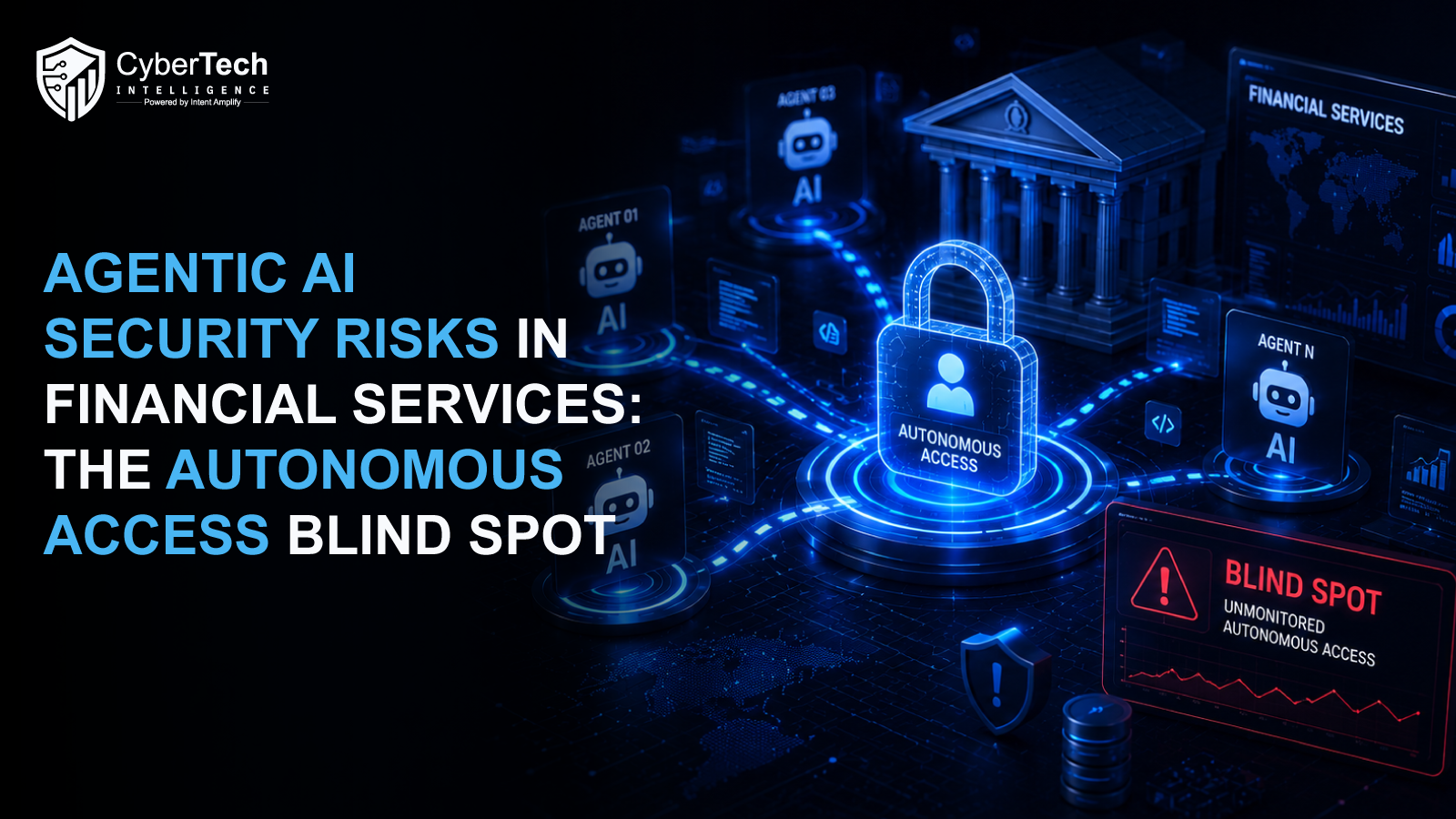
Financial services are entering a new AI cycle. Cloud banking changed where institutions operated. Automation changed how work is done. Agentic AI changes who, or what, can make decisions inside critical financial environments.
Banks, insurers, fintech firms, and capital market institutions are deploying AI systems that can reason through tasks, interact with APIs, execute workflows, and operate with limited human oversight. These are no longer passive copilots waiting for prompts. They are becoming autonomous operators connected to payment systems, fraud engines, customer records, cloud platforms, compliance workflows, and internal data sources. [1]
NVIDIA’s 2026 State of AI in Financial Services survey found that 65% of financial institutions are actively using AI, up from 45% in the prior year; 61% are using or assessing generative AI, and 42% are exploring or deploying agentic AI systems.. [2]
That is the opportunity. The challenge is whether security maturity can keep pace.
Autonomous AI Expands the Banking Attack Surface
Traditional financial systems operate within predefined logic. Agentic AI changes that model because agents can select workflows, call tools, make decisions, and act without constant human intervention.
Deloitte’s 2025 banking analysis notes that agentic AI introduces risks around access, control, privacy, model behavior, regulatory expectations, and systemic bias. Its review of the MIT AI Risk Database identified more than 350 autonomous AI-related risks relevant to banking and financial services. [3]
Once agentic AI connects to financial infrastructure, risk moves quickly. A human analyst may review one queue at a time. An AI agent can execute thousands of actions continuously. That scale is useful until the agent is compromised, manipulated, over-permissioned, or wrong at machine speed.
|
Financial Workflow |
Agentic AI Security Risk |
|
Payments and treasury |
Unauthorized transactions, policy bypass, and privilege misuse |
|
Fraud operations |
Manipulated scoring, missed alerts, false approvals |
|
AML and compliance |
Weak escalation, incomplete summaries, audit gaps |
|
Customer servicing |
Account-data exposure, improper advice, privacy violations |
|
Lending and underwriting |
Biased decisions, corrupted context, explainability failures |
|
Cloud and DevOps |
Unauthorized API calls, configuration changes, and lateral movement |
Agentic AI security in financial services must therefore focus on actions, not just outputs.
Non-Human Identity Is the Control Gap
One of the fastest-growing risks involves non-human identity governance. AI agents need credentials, API permissions, persistent access, and integration rights to do useful work. In financial services, that access often resembles a privileged employee, service account, and workflow automation tool combined.
Without ownership, scope limits, credential rotation, and runtime monitoring, the agent becomes a non-human identity with business authority but weak accountability. Aembit’s 2025 research notes that only 10% of organizations have a well-developed strategy for managing non-human and agentic identities. [4]
That gap matters. A compromised AI agent connected to treasury operations could initiate unauthorized transactions. A manipulated fraud agent could approve suspicious activity. A customer-service agent could expose sensitive account data across systems. IBM has described AI agents as “digital insiders” because their access patterns can resemble trusted internal users rather than ordinary software.
Prompt Injection Now Has Operational Consequences
Agentic AI systems rely on context, memory, reasoning chains, external datasets, and tool integrations. That creates attack paths that do not look like conventional malware.
Deloitte identified prompt injection, opaque reasoning, memory corruption, and runaway autonomous behavior as significant risks for financial institutions. [3] These attacks target the decision process itself. In agentic systems, a manipulated instruction does not merely change an answer; it can change the action the system takes next.
A compliance agent could be manipulated into approving suspicious transactions. An autonomous lending workflow could ingest corrupted context and produce biased credit decisions. A portfolio optimization agent could push customers into unsuitable risk exposure if its objective function is poorly constrained. Research on autonomous agent security has also highlighted memory poisoning, unauthorized tool execution, runtime supply chain attacks, and “viral agent loops,” where malicious behavior spreads between interconnected agents.
Systemic AI Risk Is Becoming a Banking Concern
Agentic AI risk does not stop at one institution’s boundary. If multiple firms rely on similar models, cloud platforms, data pipelines, or agent orchestration patterns, a failure mode in one environment could echo across others. The risk is not only that one bank deploys a flawed agent. It is that many institutions may automate similar decisions using similar infrastructure and similar blind spots.
Governance maturity is still uneven. Enterprise AI governance research indicates that 74% of enterprises plan to deploy agentic AI across multiple departments over the next two years, while many still lack mature oversight systems. [7]
What Financial CISOs Can Do in the Next 90 Days
Financial institutions do not need to stop agentic AI adoption. They need to govern it like a privileged operating layer.
|
Action |
Purpose |
|
Inventory AI agents |
Identify where agents operate, what systems they touch, and who owns them. |
|
Classify permissions |
Separate low-risk assistants from agents accessing payments, data, compliance, or cloud systems. |
|
Apply identity controls |
Require scoped credentials, rotation, authentication, ownership, and access logging. |
|
Monitor runtime behavior |
Detect abnormal tool calls, policy violations, privilege escalation, and unexpected execution. |
|
Red-team workflows |
Test prompt injection, memory poisoning, unauthorized tool use, and failed escalation paths. |
Final Thought
Agentic AI may become one of the most powerful productivity shifts financial services have seen in years. But autonomous systems cannot be secured like ordinary software. They reason, connect, remember, and act.
The $37 billion AI investment wave is already here. The security question is whether financial institutions can govern autonomous intelligence before it becomes an unmonitored insider with machine-speed access to critical systems. In financial services, the next major AI failure may not begin with a hallucination. It may begin with an agent who had permission to act, and no one is watching closely enough.[8]
Agentic AI is moving fast across financial services, but autonomous access needs disciplined oversight. If your organization is evaluating AI agents, non-human identity risk, or runtime security controls, CyberTech Intelligence can help you turn early visibility into a practical governance plan.
Start the conversation with CyberTech Intelligence to assess agentic AI governance, non-human identity risk, and runtime security readiness. https://cybertechintelligence.com/contact-us
References
- IBM (2025) Agentic AI in Financial Services: Ethical Adoption and Governance. Available at: https://www.ibm.com/think/topics/agentic-ai-financial-services.
- NVIDIA (2026) State of AI in Financial Services Survey. Available at: https://blogs.nvidia.com/blog/ai-in-financial-services-survey-2026/
- Deloitte (2025) Agentic AI Risks in Banking. Available at: https://www.deloitte.com/us/en/insights/industry/financial-services/agentic-ai-risks-banking.html.
- Aembit (2025) Agentic AI Cybersecurity Risks and Security Guide. Available at: https://aembit.io/blog/agentic-ai-cybersecurity-risks-security-guide/.
- IBM (2025) Agentic AI Security: Managing Autonomous Enterprise Risk. Available at: https://www.ibm.com/think/topics/agentic-ai-security.
- MIT (2025) AI Risk Database. Available at: https://airisk.mit.edu/.
- arXiv (2025) Enterprise AI Governance and Regulatory Risk Exposure. Available at: https://arxiv.org/html/2604.16338v1.
- Menlo Ventures (2025) 2025: The State of Generative AI in the Enterprise. Available at: https://menlovc.com/perspective/2025-the-state-of-generative-ai-in-the-enterprise/.


Author
CyberTech Intelligence Research Desk
Author