Executive Opening: Enterprise Risk Is Moving Into the Connection Layer
Enterprise defense in 2026 is being reshaped by a shift that many security programs still treat too narrowly. Cloud workloads, APIs, AI systems, machine identities, and third-party integrations no longer operate as separate security domains. They now operate as one connected business fabric, and attackers increasingly exploit the relationships among those systems rather than attacking infrastructure in isolation.
For CISOs, the implication is significant. Security strategy must evolve from protecting individual assets to governing the connection layer where cloud services exchange data, APIs initiate workflows, AI systems interpret context, identities authorize actions, and third-party integrations extend business operations.
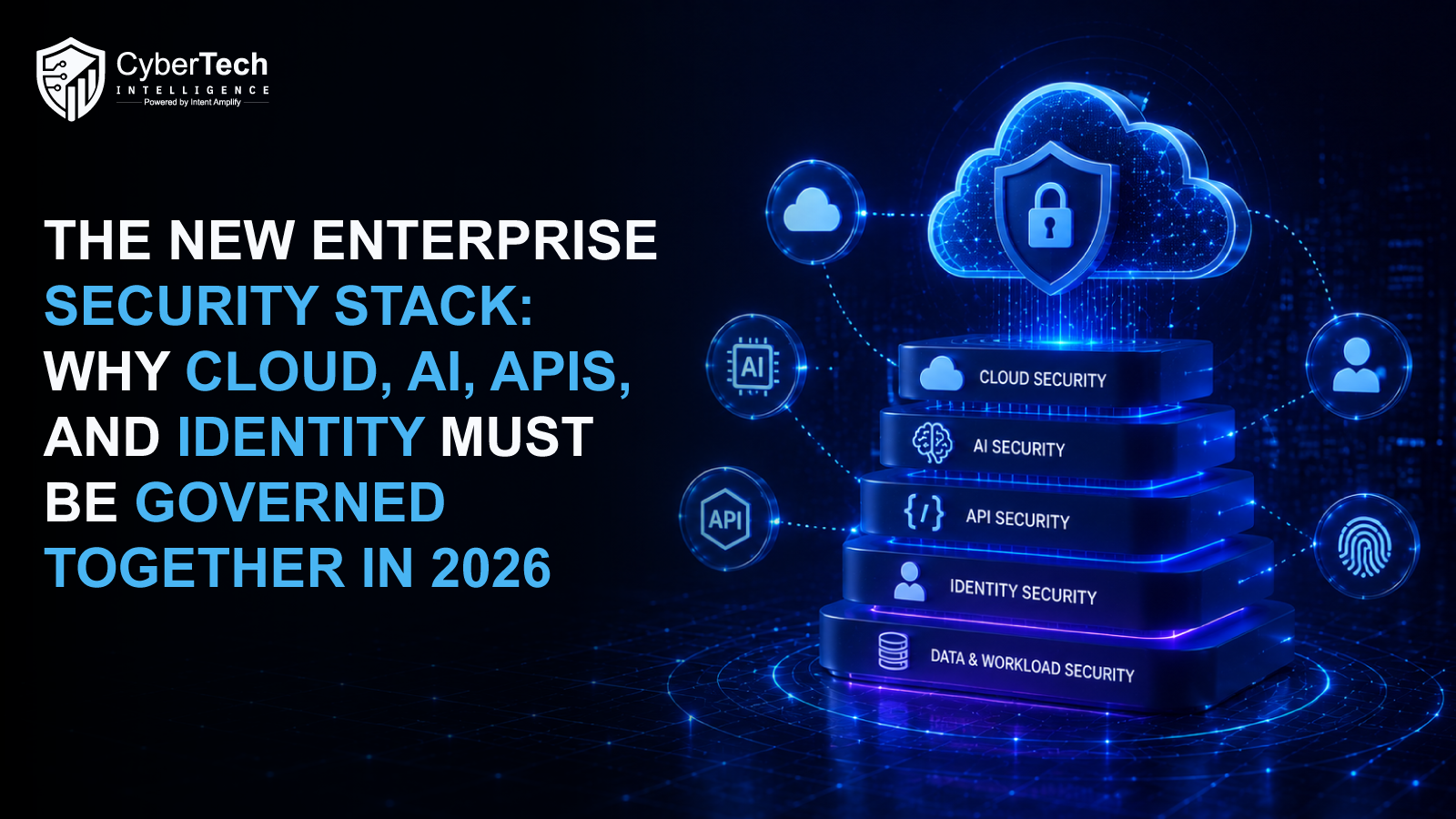
CyberTech Intelligence recommends organizing this shift through five connected pillars: Cloud Governance, API Assurance, Identity Intelligence, AI Governance, and Runtime Resilience.
Google Cloud’s Cloud Threat Horizons Report H1 2026 describes a cloud threat environment shaped by rapid exploitation, identity exposure, and forensic readiness gaps. The report notes that identity compromise underpinned 83% of compromises, while threat actors targeted data in 73% of cloud-related incidents. It also found that third-party software-based entry accounted for 44.5% of observed initial access activity, overtaking weak credentials as the leading vector. 1
IBM’s Cloud Attacks Are Evolving reinforces the same strategic point: defenders must focus on the broader cloud ecosystem, including credentials, integrations, configurations, administrative platforms, and operational dependencies. IBM X-Force observed more than 16 million infected devices with infostealer malware in 2025, highlighting how credential exposure, SaaS access, OAuth grants, API tokens, and hybrid-cloud integrations are expanding the enterprise attack surface. 2
CyberTech Intelligence Perspective
CyberTech Intelligence views enterprise cybersecurity in 2026 as a connection-layer governance challenge. Security programs can no longer be organized only around individual domains such as cloud security, API security, identity security, or AI governance. The real risk increasingly appears in the relationships between cloud platforms, APIs, machine identities, AI services, SaaS ecosystems, third-party integrations, and business workflows.
This shift changes how enterprise leaders should evaluate cyber resilience. An exposed API, overprivileged machine identity, misconfigured cloud workload, unmanaged AI application, and third-party integration may appear as separate issues across different teams. In practice, they can combine into a single business-impacting attack path.
For CISOs and CIOs, the priority is to move from domain-specific control ownership to a unified security operating model that governs how cloud, AI, APIs, identity, and business workflows interact.
Cloud Risk Is Becoming an Ecosystem Problem
Cloud security programs historically focused on infrastructure configuration, workload protection, and compliance posture. Those controls still matter, but the modern cloud attack surface now includes identity providers, software supply chains, APIs, automation pipelines, SaaS integrations, developer tools, and AI-connected services.
This is why cloud compromise often begins outside the core infrastructure layer. An attacker may abuse a service account, steal an access token, exploit an exposed API, manipulate a CI/CD pipeline, or use an overprivileged integration to reach sensitive data.
IBM's 2026 X-Force Threat Intelligence Index finds attackers continue to exploit fundamental security weaknesses while using AI to identify and operationalize vulnerabilities more quickly.³
The strategic challenge extends beyond cloud adoption. As organizations expand across hybrid and multi-cloud environments, they increase the number of interconnected assets, identities, services, and third-party dependencies requiring continuous oversight. This complexity reduces visibility, weakens governance, and slows incident investigations. Security teams need a unified operational view combining asset discovery, identity intelligence, configuration posture, runtime telemetry, and security context. Without this foundation, organizations cannot consistently assess risk, enforce policy, or respond effectively across modern cloud environments.
CyberTech Intelligence Research Desk Observation
Interconnected enterprise architectures have shifted cybersecurity from infrastructure-centric protection to ecosystem resilience. The organizations most exposed in 2026 will not always be those with the weakest individual security tools. They will often be the organizations that cannot clearly connect cloud assets, API behavior, machine identities, AI workflows, SaaS integrations, and third-party dependencies into one operational risk view.
As attackers increasingly move through trusted services and authorized workflows, security maturity will depend on visibility across relationships, not only visibility across assets.
APIs Are Now Business Logic Exposure Points
APIs are the operating language of digital business. They connect mobile applications, payment systems, partner ecosystems, SaaS platforms, logistics operations, healthcare services, cloud environments, and AI-enabled applications. Their business value is undeniable, but their distributed nature makes them difficult to secure using traditional perimeter-based security models.
Cloudflare's Active Defense: Introducing a Stateful Vulnerability Scanner for APIs highlights a critical distinction. Many API vulnerabilities originate from flaws in business logic rather than conventional input validation.⁴ As a result, an API request may appear technically legitimate while bypassing authorization controls, manipulating business processes, accessing unauthorized objects, or violating intended workflow boundaries.
Enterprise security programs should treat API governance as a continuous discipline rather than a point security control. Effective governance requires comprehensive API discovery, schema validation, authentication and authorization assurance, token security, runtime monitoring, rate limiting, and business logic testing. The greatest exposure rarely stems from the size of an organization's API estate. It stems from limited visibility into existing APIs, unclear ownership, unknown data exposure, and poorly understood dependencies across applications, services, and business processes.
AI Is Accelerating Both Attack and Defense
AI has become a force multiplier on both sides of cybersecurity. Defenders are using AI to improve investigation, detection engineering, threat intelligence, and incident response, while attackers are using AI to accelerate phishing, reconnaissance, vulnerability discovery, malware variation, and social engineering.
Google Cloud’s Cybersecurity Forecast 2026 states that adversaries will use AI to increase the speed, scope, and effectiveness of attacks, while defenders will use AI agents to strengthen security operations and analyst workflows.⁵
IBM’s Enterprise Cybersecurity and AI Operations found that 67% of surveyed executives said their organization had been targeted by an AI-enabled cyberattack in the past year, while 61% said their AI models, assets, or data had been compromised.⁶
The defensive opportunity is real, but it introduces a governance challenge. Security teams must protect AI applications, monitor Shadow AI usage, govern model access, inspect prompt and output risks, and control AI agents that interact with enterprise systems. Cloudflare’s AI Security for Apps Is Now Generally Available reflects this shift by making AI discovery available to help organizations identify and secure shadow AI deployments.⁷
Identity Is Becoming the Control Plane for Cloud, APIs, and AI
Identity has become the connective control layer across cloud, API, and AI security because every workload, integration, service account, automation script, and AI agent requires some form of authorization. When identity governance is weak, attackers can move through legitimate access paths while appearing less suspicious than malware-driven activity.
IBM’s The Identity Problem at the Heart of Agentic AI Security describes a new class of machine identities emerging as AI agents operate across enterprise systems.⁸
Cisco’s Identity Elevated: A New Unified Identity Experience in Cisco Cloud Control similarly highlights the need for visibility across human, non-human, and AI agent identities as organizations move toward identity-driven operations.⁹
This means identity teams and cloud security teams can no longer operate independently. Enterprises need unified governance for human accounts, machine identities, API credentials, OAuth grants, AI agents, and workload permissions. The practical goal is to understand not only who accessed a system, but whether that identity, workload, or AI agent should have been able to perform that action in that business context.
CyberTech Intelligence views AI security as part of the broader enterprise security stack, not as a standalone control category. AI systems depend on APIs for tool use, cloud environments for data access, identities for authorization, and third-party integrations for workflow execution. That means AI governance must be integrated with cloud governance, API assurance, identity intelligence, and runtime monitoring before autonomous workflows scale across production environments.
AI-Speed Vulnerability Discovery Raises the Resilience Bar
Vulnerability management is also changing as AI reduces the time between discovery and exploitation. Cisco’s Security in the Post-Mythos Era argues that AI-driven vulnerability discovery is collapsing the time available for traditional triage, patching, and remediation, which makes foundational hardening and proactive detection more important.¹⁰
This creates a difficult operating reality. Patch deployment remains constrained by business testing, downtime windows, vendor dependencies, and legacy systems, while attackers can use AI to move faster during discovery and exploitation. Organizations should therefore strengthen segmentation, exposure management, compensating controls, attack-path analysis, and incident containment rather than relying only on patch velocity.
CyberTech Intelligence Enterprise Security Convergence Framework™
CyberTech Intelligence recommends that enterprise leaders manage cloud, AI, API, and identity risk through a single convergence framework. The goal is not to create separate governance programs for every technology domain. The goal is to understand how risk moves across cloud workloads, APIs, AI systems, identities, third-party integrations, and business-critical workflows.
|
Framework Pillar |
Executive Question |
What Leaders Should Measure |
|
Cloud Governance |
Can we continuously govern cloud workloads, configurations, identities, and integrations? |
Cloud asset visibility, configuration drift, workload exposure, SaaS integration risk, third-party access, and forensic readiness. |
|
API Assurance |
Do we know which APIs expose business logic, sensitive data, and automated workflows? |
API inventory coverage, schema validation, authorization testing, token exposure, runtime behavior, ownership, and lifecycle status. |
|
Identity Intelligence |
Are human, machine, workload, and AI agent identities governed through one control model? |
Service accounts, OAuth grants, API credentials, machine identities, AI agents, excessive permissions, access reviews, and ownership mapping. |
|
AI Governance |
Are AI systems, agents, applications, and data flows controlled before they scale? |
Shadow AI discovery, model access, prompt and output risk, agent permissions, AI-connected APIs, and workflow automation controls. |
|
Runtime Resilience |
Can the organization detect behavior change across cloud, API, AI, and identity environments? |
Runtime telemetry, behavioral analytics, anomalous access, attack-path visibility, recovery readiness, and executive resilience reporting. |
Executive Enterprise Security Stack Scorecard
|
Readiness Area |
Early Stage |
Developing |
Mature |
|
Cloud Governance Maturity |
Cloud assets, configurations, and integrations are reviewed periodically or during incidents. |
Core cloud environments are monitored, but SaaS, hybrid, multi-cloud, and third-party dependencies remain partially visible. |
Cloud workloads, configurations, identities, integrations, logs, and exposure paths are continuously governed across environments. |
|
API Governance Maturity |
API inventory is incomplete, and ownership is unclear. |
Critical APIs are documented, but shadow APIs, legacy APIs, partner APIs, and AI-connected APIs remain partially visible. |
APIs are continuously discovered, classified, assigned owners, tested for authorization logic, and monitored at runtime. |
|
Identity Governance |
Human identities, service accounts, machine identities, and AI agents are managed separately. |
Privileged access reviews exist, but machine identities, OAuth grants, API tokens, and AI agent permissions remain fragmented. |
Human, machine, workload, API, and AI agent identities are governed through a unified ownership, permission, and monitoring model. |
|
AI Governance |
AI applications, AI agents, and shadow AI usage are not fully discovered. |
High-priority AI use cases are reviewed, but controls vary by team, platform, or business unit. |
AI systems are inventoried, access-controlled, monitored, and connected to cloud, API, identity, and data governance. |
|
Runtime Visibility |
Detection depends mainly on static controls, known indicators, or tool-specific alerts. |
Behavioral monitoring exists in selected environments, but cross-domain correlation is limited. |
Cloud activity, API behavior, identity activity, AI workflow activity, and third-party access are monitored together. |
|
Third-Party Integration Governance |
SaaS, OAuth, partner, and vendor integrations are reviewed inconsistently. |
Critical third-party integrations are documented, but permission scope and data flow visibility remain incomplete. |
Third-party integrations are continuously reviewed for access scope, data exposure, ownership, and business dependency risk. |
|
Executive Resilience Reporting |
Leadership reporting focuses mainly on vulnerabilities, alerts, or compliance status. |
Some resilience metrics are reported, but they are not connected across cloud, API, AI, and identity domains. |
Executives receive clear reporting on exposure, control maturity, identity risk, AI governance, third-party dependency risk, and recovery readiness. |
This scorecard helps CISOs, CIOs, enterprise architects, cloud leaders, API security leaders, and identity teams evaluate whether the enterprise security stack is being governed as separate technical domains or as one connected operating model. Mature organizations will show measurable progress across cloud governance, API assurance, identity intelligence, AI governance, runtime visibility, third-party integration governance, and executive resilience reporting.
CISOs should start by integrating Enterprise Security Convergence
The priority is Cloud Governance & API Assurance
The second priority is Identity Intelligence, especially for service accounts, API tokens, machine identities, and AI agents.
The third priority is Runtime Resilience, which can detect behavior change rather than only policy violations.
Security leaders should also focus on Executive Reporting under Runtime Resilience, including API inventory coverage, identity ownership, excessive permissions removed, cloud configuration drift, AI application discovery, exposed token reduction, third-party integration reviews, and recovery readiness. These metrics connect technical control maturity to business continuity, customer trust, and revenue protection.
Assess Your Enterprise Security Stack Readiness
CyberTech Intelligence helps security, cloud, API, identity, and AI governance leaders move from fragmented controls to a connected enterprise security operating model. Through the Enterprise Security Stack Readiness Assessment, organizations can evaluate cloud governance maturity, API governance, machine identity governance, AI operational controls, runtime visibility, third-party integration risk, and executive resilience reporting.
CyberTech Intelligence also supports enterprise teams through:
- Cloud, API & Identity Governance Review
- Machine Identity and AI Agent Risk Assessment
- Runtime Security and Resilience Review
- Executive Security Convergence Briefing
-
Use this blog as the starting point for a structured readiness conversation that connects cloud security, API assurance, identity intelligence, AI governance, third-party risk, and business resilience.
References
-
Google Cloud, Cloud Threat Horizons Report H1 2026, 2026
https://cloud.google.com/security/report/resources/cloud-threat-horizons-report-h1-2026 -
IBM, Cloud Attacks Are Evolving: What 2025 Trends Mean for Defenders in 2026, March 2026
https://www.ibm.com/think/x-force/cloud-attacks-evolving-what-2025-trends-mean-defenders-2026 -
IBM, 2026 X-Force Threat Intelligence Index: Making the Case for Securing Identities, AI-Enhanced Detection and Proactive Risk Management, March 2026
https://www.ibm.com/think/x-force/threat-intelligence-index-2026-securing-identities-ai-detection-risk-management -
Cloudflare, Active Defense: Introducing a Stateful Vulnerability Scanner for APIs, March 2026
https://blog.cloudflare.com/vulnerability-scanner/ -
Google Cloud, Cybersecurity Forecast 2026, 2026
https://cloud.google.com/security/resources/cybersecurity-forecast -
IBM, Enterprise Cybersecurity and AI Operations, March 2026
https://www-api.ibm.com/adobe/assets/urn:aaid:aem:3ecf1021-42b0-49c8-af8b-7dfcedfb763b/original/as/elusive-threats-elastic-defense-report.pdf -
Cloudflare, AI Security for Apps Is Now Generally Available, March 2026
https://blog.cloudflare.com/ai-security-for-apps-ga/ -
IBM, The Identity Problem at the Heart of Agentic AI Security, April 2026
https://www.ibm.com/think/news/identity-problem-agentic-ai-security -
Cisco, Identity Elevated: A New Unified Identity Experience in Cisco Cloud Control, June 2026
https://blogs.cisco.com/security/a-new-unified-identity-experience-in-cisco-cloud-control -
Cisco, Security in the Post-Mythos Era, June 2026
https://blogs.cisco.com/security/security-in-the-post-mythos-era
-
Author
CyberTech Intelligence Research Desk
Author