
How Does AI Scale Initial Access?
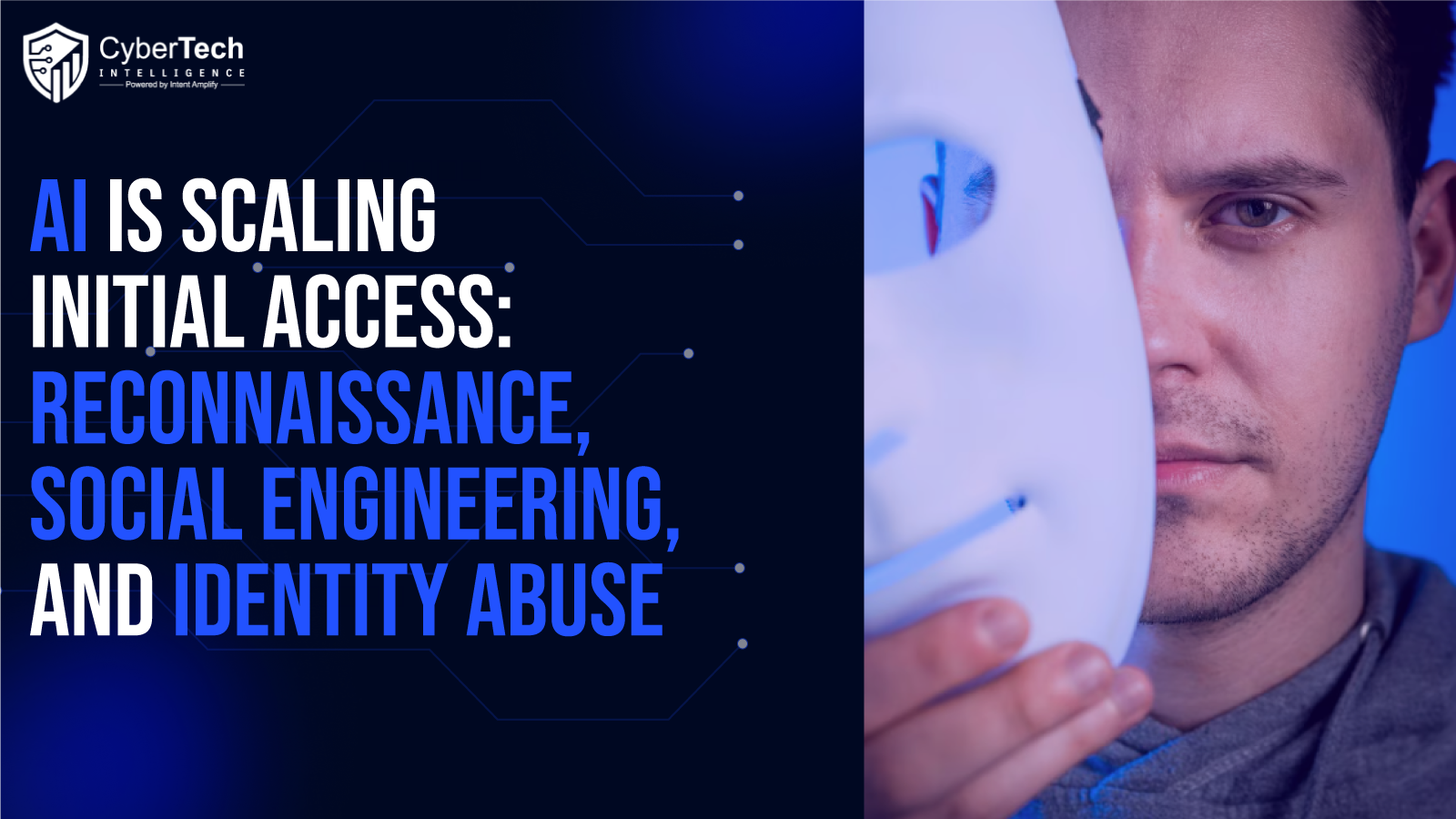
AI scales initial access by reducing the cost of target research, personalization, translation, vulnerability analysis, credential testing, and interaction. Attackers can correlate public information, prepare role-specific lures, adapt conversations, study exposed technologies, and test parallel foothold paths. The visible techniques remain familiar, but more credible attempts can be produced and revised. Defenders should secure the complete trust journey from external exposure and identity proofing to enrollment, privilege, supplier access, and session revocation.
Key Takeaways
-
Reconnaissance becomes more scalable when public data, technology clues, and identity context can be correlated quickly.
-
AI-enabled social engineering attacks processes such as recovery and enrollment, not only employee awareness.
-
Vulnerability exploitation and identity manipulation are parallel routes to a trusted foothold.
-
Supplier and developer access can amplify one successful initial compromise across many environments.
-
The strongest defense is a measurable, end-to-end initial-access control system.
Executive Summary
Initial access is where artificial intelligence may create the broadest operational advantage for attackers. The work before compromise is unusually suited to automation: gathering public information, mapping technologies, identifying likely owners, tailoring messages, translating content, testing exposed services, and revising an approach after failure. None of these activities requires a science-fiction attacker. Together, however, they allow more targets to be assessed and more credible access attempts to be launched with less manual effort.
Recent threat reporting reinforces the shift. Google Threat Intelligence Group described adversarial AI moving from experimentation toward industrial-scale activity and reported AI-assisted vulnerability exploitation and initial-access operations. Mandiant reported that exploits accounted for 32% of initial infection vectors in investigated intrusions and estimated a mean time-to-exploit of negative seven days, indicating that exploitation may begin before a patch is available. Verizon’s 2026 Data Breach Investigations Report stated that 31% of breaches began with software vulnerabilities and that generative AI was strengthening 15% of attack techniques.[1][2][3]
For enterprise leaders, the main lesson is not that phishing, exposed services, or credential abuse are new. It is that the economics and tempo of preparing these attacks are changing. Defenders must protect the complete initial-access system: internet exposure, identity recovery, supplier access, user enrollment, remote administration, and the decisions that connect evidence to containment.
What AI-Accelerated Initial Access Means
An AI-accelerated attack uses artificial intelligence to increase the speed, scale, adaptability, or plausibility of activity that supports unauthorized access. The model may assist one task or many. It may summarize technical documentation, generate reconnaissance code, adapt a message to a target’s role, translate a conversation, review an exploit path, or help organize stolen information.
This definition matters because the visible attack may still look conventional. A user receives a message. A help desk processes a recovery request. A scanner touches an exposed appliance. A supplier account authenticates from an unusual location. The presence of AI may never be proved. The defender still faces a faster, more persistent, and more varied sequence of attempts.
The right question is therefore not, “Was this generated by AI?” The better question is, “Did the attempt exploit a trust decision that can be made safer, faster, or more observable?”
Reconnaissance Is Becoming a Parallel Workflow
Traditional targeted reconnaissance can require substantial manual work. An attacker studies a company’s public footprint, employee roles, technologies, suppliers, hiring activity, documentation, and exposed infrastructure. Generative models can reduce the effort required to collect, classify, and connect that information.
A model can summarize public pages, infer likely technology ownership from job descriptions, translate regional content, organize names and roles, draft queries, and prepare different hypotheses for testing. The attacker can run multiple lines of inquiry at once rather than completing them sequentially.
This does not mean every AI-generated conclusion is correct. Attackers can tolerate errors because reconnaissance is a filtering process. A low-cost system can produce a large candidate list and allow the operator to focus on the most promising targets. The economic advantage comes from reducing the cost of rejection.
Enterprise exposure management should account for this. Publicly visible services, documentation, employee information, code repositories, and supplier relationships may be evaluated together. Security teams should map the information an attacker can combine, not only the individual asset that is exposed.
What Defenders Should Review
Review external assets for ownership, business purpose, authentication method, support status, and telemetry. Remove abandoned services and restrict management interfaces. Track public technical documentation that reveals administrative paths or recovery processes. Monitor leaked credentials and secrets in relation to the systems they can reach. Ensure that exposure findings are routed to a named owner rather than remaining in a central queue.
The objective is not to eliminate public information. It is to prevent public information from becoming a low-friction map to consequential access.
Vulnerability Exploitation Is Entering a Pre-Patch Era
AI-assisted code analysis and exploit development can shorten the time between vulnerability discovery and usable attack capability. Google Threat Intelligence Group reported a zero-day exploit believed to have been developed with AI and described models assisting vulnerability research and exploitation. Mandiant’s negative mean time-to-exploit metric illustrates the operational consequence: some vulnerabilities may be attacked before the enterprise receives a reliable remediation path.[1][2]
This changes the meaning of patch speed. Fast patching remains essential, but it cannot be the only response. Organizations need a pre-patch operating model for high-consequence services.
A pre-patch model should answer:
-
Which exposed services are important enough to receive emergency review?
-
Who owns the service and its business dependency?
-
Which temporary controls can reduce exposure?
-
Who may approve degraded functionality?
-
How will the organization confirm that the restriction works?
-
What telemetry will detect attempted exploitation?
Temporary controls may include source restrictions, segmentation, feature disablement, stronger authentication, rate limiting, virtual patching, application-layer filtering, additional logging, supplier restrictions, or temporary service withdrawal. The correct choice depends on the service, but the decision path should exist before a crisis.
Why Asset Criticality Is Not Enough
Many programs prioritize by vulnerability severity and asset criticality. AI-accelerated exploitation requires additional dimensions: internet reachability, ease of weaponization, identity privilege, exploit evidence, business consequence, availability of compensating controls, and recovery complexity.
A moderate weakness in a directly exposed management appliance may deserve faster action than a higher-scoring flaw in an isolated system. The prioritization model should reflect the attack path, not only the numerical severity.
Social Engineering Is Becoming More Interactive
Generative AI improves the speed and localization of social-engineering preparation. It can tailor language, reference a target’s role, produce regional variants, anticipate objections, and support an operator during a live exchange. Synthetic voice and image tools can add credibility, but the deeper risk is operational persistence: the attacker can change channels and revise the pretext when the first attempt fails.
Mandiant reported interactive voice phishing as an important initial-access vector in 2025 investigations. The significance is not that every call used AI. It is that live, adaptive interaction is a meaningful enterprise access path, and generative systems can reduce the effort required to conduct it at scale.[2]
Organizations often answer this risk with awareness training. Training is necessary but insufficient for high-impact actions. A well-designed identity workflow should remain safe even when the requester sounds credible, knows personal information, and creates urgency.
High-Risk Workflows to Protect
Prioritize privileged account recovery, multifactor-authentication changes, new-device enrollment, payment or banking changes, executive requests, supplier onboarding, domain and DNS changes, API-key creation, and access to code or production systems.
For these workflows, require independent verification through a trusted channel, separation of duties, known approvers, transaction delay where appropriate, and a complete audit trail. Avoid security questions based on public or easily inferred information. Ensure help-desk personnel can escalate suspicious requests without being penalized for slowing a transaction.
The control should verify authority, not conversational confidence.
Credential Abuse Is More Than Credential Theft
Attackers do not always need to steal a password. They may obtain a session token, manipulate enrollment, exploit a recovery process, reuse an API key, compromise a supplier identity, or persuade a user to authorize a malicious application.
AI can assist by identifying likely identity paths and tailoring attempts to the role. It can help operators interpret error messages, revise prompts, or select a different channel. The result is a broader identity attack surface than the login page alone.
Identity security should therefore connect authentication, session behavior, recovery, device trust, application consent, privileged access, non-human identities, and supplier access. A control gap in one path can bypass strength in another.
Defensive Priorities
Use phishing-resistant authentication for privileged and high-impact users. Reduce standing privilege. Bind sensitive sessions to device and context where possible. Review new authentication methods, unusual consent grants, impossible travel, token reuse, and sudden privilege changes. Provide rapid session revocation across SaaS, cloud, VPN, and endpoint systems. Test recovery processes against a realistic, well-informed adversary.
Metrics should include time to revoke access, percentage of privileged identities with strong authentication, recovery exceptions, dormant supplier accounts, and unexplained session persistence after containment.
Suppliers Expand the Initial-Access System
Third parties can provide remote support, software updates, managed services, cloud administration, or business-process access. An attacker may target the supplier because its identity or tooling reaches multiple customers.
AI-assisted reconnaissance can help map these relationships through public references, technical documentation, job postings, and support portals. Social engineering can target a supplier’s help desk or an enterprise employee who manages the relationship. Vulnerability exploitation can target remote-access infrastructure. The initial-access system therefore includes the extended operating ecosystem.
Enterprises should know which suppliers can authenticate, modify configuration, publish software, create accounts, retrieve data, or access production. These privileges should be independently restricted, monitored, and revoked. Contract language should support incident notification, identity assurance, logging, vulnerability response, and secure termination.
A supplier should not retain broad access simply because the business relationship is trusted.
The CyberTech Intelligence Initial-Access Pressure Map
CyberTech Intelligence recommends evaluating initial access through five pressure zones.
Zone 1: Public Discovery
What can an attacker learn about technologies, people, suppliers, processes, and exposed services? Evidence includes external asset inventories, leaked-secret monitoring, public-code review, and ownership coverage.
Zone 2: Exploitable Exposure
Which vulnerabilities or configurations can be reached, and how quickly can exposure be reduced? Evidence includes internet-facing asset age, exploit intelligence, compensating-control options, and pre-patch exercise results.
Zone 3: Human Trust
Which workflows can transfer authority through conversation, urgency, or personal information? Evidence includes recovery controls, independent verification, payment-change governance, and escalation testing.
Zone 4: Machine and Supplier Trust
Which tokens, service accounts, applications, devices, or suppliers can create access? Evidence includes identity inventory, privilege scope, credential lifetime, consent review, supplier paths, and revocation tests.
Zone 5: Containment Readiness
How quickly can the enterprise block a path without unacceptable business harm? Evidence includes pre-authorized actions, owner availability, session revocation, segmentation, and degraded-mode procedures.
The map converts a broad threat topic into business-service decisions. Each consequential service should be evaluated across all five zones.
A Practical Initial-Access Readiness Test
Select one high-value service and conduct a structured test.
Begin with external discovery. Ask a red team or independent reviewer to map the service using only public and commercially available information. Compare the result with the internal asset inventory.
Next, identify the reachable identity paths. Include employees, administrators, applications, service accounts, suppliers, and recovery workflows. Determine whether strong authentication can be bypassed through enrollment, consent, or support processes.
Then simulate a critical vulnerability with no patch. Measure the time required to identify ownership, select a temporary control, obtain approval, implement the restriction, and verify effectiveness.
Finally, run a multi-channel social-engineering scenario that changes approach after one control intervenes. The goal is not to trick an employee for a score. It is to observe whether the workflow remains secure under persistent, informed pressure.
Record where time was lost. Typical causes include unclear ownership, incomplete inventory, missing business context, unavailable approvers, uncertain containment authority, and fragmented evidence.
Metrics for Executives
Executives need measures that show whether initial access is becoming harder and faster to contain.
Useful metrics include:
-
Consequential internet-facing assets without a named owner.
-
Median age of critical external exposure.
-
Time from exploit evidence to an implemented compensating control.
-
Privileged identities without phishing-resistant authentication.
-
High-risk recovery workflows without independent verification.
-
Supplier accounts with standing or excessive privilege.
-
Time to revoke sessions, tokens, and remote access.
-
Percentage of priority services tested through a pre-patch scenario.
-
Percentage of consequential initial-access paths with a pre-authorized containment action.
Report these measures by business service. An enterprise average can conceal the one environment where access is easiest and containment is slowest.
What Not to Do
Do not build the program around AI-content detection. Determining whether a message or script was generated by a model may support analysis, but it does not secure the trust decision.
Do not respond only by buying an AI-branded security tool. Technology can accelerate correlation and response, but it cannot define business ownership, approve degraded operations, or establish recovery proof.
Do not treat all public assets equally. Concentrate on services that provide administrative reach, identity authority, sensitive data access, software distribution, or operational control.
Do not make users the final control for consequential transactions. Strong workflows should withstand a credible request.
Do not measure patching without measuring pre-patch exposure. A vulnerability may become material before remediation is available.
Executive Recommendations
First, define the consequential business services and map all initial-access paths to them. Second, establish a pre-patch control catalogue and decision authority. Third, protect high-risk identity workflows with independent proof. Fourth, reduce standing supplier and machine privilege. Fifth, connect external exposure, identity, vulnerability, and incident evidence by service. Sixth, test containment and recovery under a persistent multi-channel scenario.
These actions do not depend on proving that an attacker used AI. They address the operating advantages that AI provides: scale, speed, personalization, and adaptation.
Executive Conclusion
AI is changing initial access by reducing the cost of preparation and increasing the number of credible attempts an adversary can run. Reconnaissance, vulnerability analysis, social engineering, identity abuse, and supplier targeting can be coordinated more efficiently even when the final access method looks familiar.
The enterprise response should not be a separate AI threat queue. It should be a stronger initial-access system built around visible exposure, resistant trust workflows, rapid containment, and business-service ownership.
Organizations that can restrict vulnerable services before a patch, verify authority independently, revoke access across identity types, and connect evidence to decisions will be better positioned for a faster adversary cycle.
Assess your highest-risk initial-access paths with CyberTech Intelligence and identify where adversary speed exceeds current control speed.
AI-Accelerated Initial Access Defense Map
| Initial-access path | AI acceleration pattern | Defensive control | Useful metric |
|---|---|---|---|
| External reconnaissance | Combines public identities, technologies, domains, and suppliers | Continuous exposure discovery and verified ownership | Time from discovery to owner and risk decision |
| Social engineering | Generates personalized, multilingual, and interactive pretexts | Independent verification and known-channel confirmation | Percentage of high-risk workflows with dual evidence |
| Credential and session abuse | Processes stolen data and tests access at scale | Phishing-resistant authentication and rapid session revocation | Time to revoke password, token, session, and device trust |
| Vulnerability exploitation | Assists code review, testing, and adaptation | Pre-patch controls for reachable high-consequence services | Time to reduce exploitability before remediation |
| Supplier or developer access | Maps trusted relationships and workflow authority | Restricted integrations, short-lived credentials, protected pipelines | Time to suspend third-party or build-system authority |
Building an Initial-Access Control System
Treat initial access as a connected system rather than separate phishing, vulnerability, and identity programs. A public document may reveal a role, a supplier relationship may reveal a process, a leaked credential may enable authentication, and a weak recovery path may convert the attempt into durable access. Security teams should map how evidence moves across these stages and where independent verification is required.
Start with the business processes attackers can exploit conversationally: account recovery, device enrollment, authentication-method changes, supplier onboarding, payment changes, and privilege elevation. Then connect those workflows to external exposure, vulnerable services, session management, cloud access, and monitoring. The objective is to prevent a persuasive or technically valid interaction from becoming uncontrolled enterprise authority.
Initial-access exercises should include adaptation. After the first email is blocked, test a message, phone call, or help-desk route. After one credential is revoked, test whether sessions, tokens, application grants, or devices remain trusted. After an exposed service is restricted, test whether an adjacent supplier or management path remains available. This reveals whether controls protect the journey or only one artifact.
References
[1] Google Threat Intelligence Group, “AI-Assisted Vulnerability Exploitation and Initial Access,” May 11, 2026. https://cloud.google.com/blog/topics/threat-intelligence/ai-vulnerability-exploitation-initial-access/
[2] Mandiant, “M-Trends 2026,” 2026. https://cloud.google.com/blog/topics/threat-intelligence/m-trends-2026
[3] Verizon, “2026 Data Breach Investigations Report.” https://www.verizon.com/business/resources/reports/dbir/
[4] OpenAI, “Disrupting Malicious Uses of AI,” February 25, 2026. https://openai.com/index/disrupting-malicious-ai-uses/
[5] Google Threat Intelligence Group, “Cybersecurity Forecast 2026,” November 5, 2025. https://cloud.google.com/blog/topics/threat-intelligence

Author
CyberTech Intelligence Research Desk
Author