
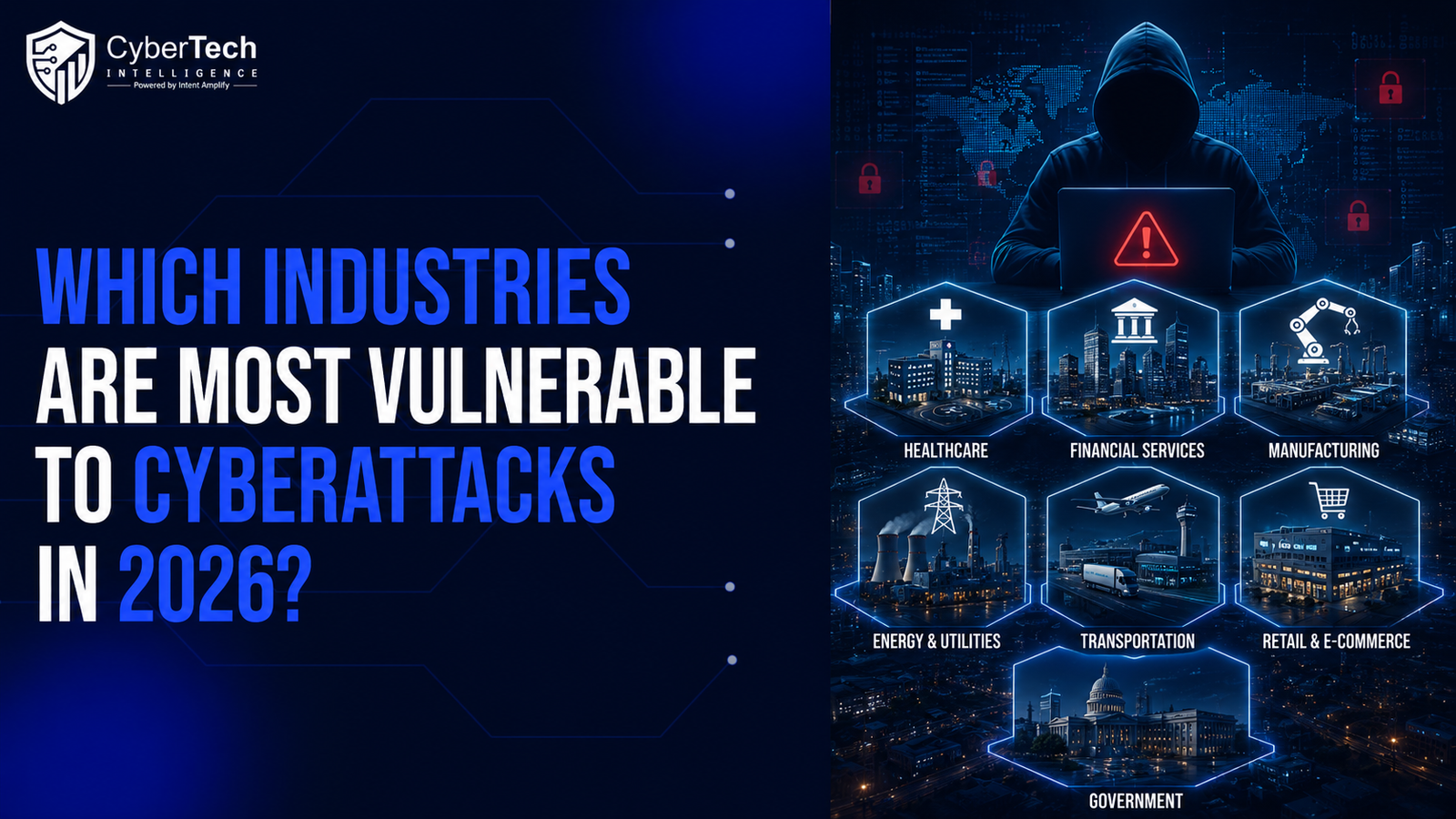
Quick answer: Healthcare, financial services, manufacturing, retail, and technology/SaaS are among the sectors facing significant cyber-risk pressures in 2026. Healthcare remains the costliest sector to breach at $6.64 million per incident; financial services follow at $6.29 million, and AI-enabled attacks — now involved in roughly one in four breaches — are pushing costs higher across every vertical, according to IBM's 2026 Cost of a Data Breach Report. Manufacturing, energy and critical infrastructure, government, and education round out the higher-risk tier, each exposed for a different structural reason: legacy OT, geopolitical value, or thin security budgets.
The rest of this breakdown covers why each sector is exposed, what actually happened in 2026, what a breach costs by industry, and what security and go-to-market teams should be watching next.
At a Glance: 2026 Cyber Risk by the Numbers
● $4.99 million — global average cost of a data breach in 2026, up 12% year-over-year (IBM/Ponemon Institute)
● $11.5 million — average breach cost in the United States, more than double the global figure
● 1 in 4 — malicious breaches now involve AI in some form, a 56% jump from the prior year, adding roughly $1 million to the average cost
● $6.64 million — average healthcare breach cost, the highest of any industry in IBM's 2026 study
● ~2 months faster / ~$2 million cheaper — the recovery advantage for organizations running AI and automation across prevention, detection, and response, versus those running none
Those five numbers tell most of the story: attackers are getting cheaper and faster tools while breaches keep getting more expensive to contain — and the gap is widest in the industries with the most sensitive data or the least tolerance for downtime.
The Industries Facing the Highest Cyber Risk in 2026
1. Healthcare
IBM's 2026 study places healthcare at the top of the industry breach-cost figures cited here. Patient records combine financial data, insurance details, and medical history in a single file — a package that resells for far more than a stolen credit card number. Hospitals also can't take systems offline to investigate an intrusion the way a retailer might; care has to continue, which gives ransomware operators unusual leverage.
Why it's exposed: high-value PII, connected medical devices with long patch cycles, and operational urgency that pressures organizations toward paying rather than stalling.
What it costs: $6.64 million per breach on average (IBM, 2026) — down slightly from 2025's $7.42 million, but still the most expensive sector in the study.
2. Financial Services & Insurance
Banks, insurers, and fintechs sit close behind healthcare on average breach cost in IBM's 2026 study, at $6.29 million per breach. The sector's appeal to attackers hasn't changed: direct access to money, account credentials, and a customer base that can be targeted a second time through fraud once data is stolen. Third-party, API, identity, and credential exposure all create material entry paths that financial institutions should assess in their own environments.
Why it's exposed: direct monetization, sprawling third-party and API ecosystems, and attackers who know financial institutions will pay to avoid transaction downtime.
3. Manufacturing & Industrial (OT/ICS)
Manufacturing remains structurally exposed to ransomware and disruptive cyber incidents: factory-floor systems (OT/ICS) prioritize availability, safety, and deterministic operation, which can make patching and modernization more constrained than in conventional IT. A single ransomware hit on a production line doesn't just cost money in downtime — it ripples through every downstream supplier and customer. IBM's 2026 study reports a $5.5 million average breach cost for the industrial sector; actual downtime impact varies materially by organization and incident.
Why it's exposed: unpatched legacy OT, IT/OT convergence that widens the attack surface, and supply-chain dependencies that turn one breach into many.
4. Retail & E-commerce
Retail faces growing exposure to AI-enabled social engineering and fraud. Deepfake voice and video can be used to impersonate executives, vendors, and customer-service personnel. Point-of-sale systems, loyalty programs, and payment processors give attackers multiple ways in, and security capacity varies widely by retailer, so transaction scale and control coverage should be assessed organization by organization.
Why it's exposed: high transaction volume, seasonal traffic spikes that mask malicious activity, and payment infrastructure that's attractive for both fraud and data theft.
5. Technology & SaaS
Technology companies now sit among the top five most expensive breaches to clean up, averaging $5.5 million — a newer entry to this tier, driven by how much of the economy now runs on SaaS identity and cloud infrastructure. Credentials, API tokens, and over-permissioned service accounts are important cloud and SaaS attack paths alongside software vulnerabilities and other initial-access techniques. A single compromised identity in a cloud environment can move laterally across dozens of connected systems before anyone notices.
Why it's exposed: identity and API sprawl, high-value intellectual property, and a threat model that's shifted from "breaking in" to "logging in."
6. Energy, Utilities & Critical Infrastructure
Energy and utility providers face a different kind of attacker than most industries: not just financially motivated criminal groups, but nation-state and ideologically driven actors looking for geopolitical leverage. Industrial control systems and SCADA environments can include legacy components and constrained maintenance windows; successful attacks can create operational and public-service consequences beyond conventional data loss.
Why it's exposed: aging SCADA/ICS environments, national-security stakes that attract state-sponsored actors, and cascading impact when a single utility goes down.
7. Government & Public Sector
Federal, state, and local government networks are large, fragmented, and often run on infrastructure that predates modern security standards. A vulnerability in widely shared software or services can create correlated exposure across otherwise unrelated agencies. Public-sector technology estates can also face procurement, modernization, and coordination constraints that vary by agency.
Why it's exposed: fragmented and legacy systems across agencies, high-value data (law enforcement, citizen records), and attackers who know public services can't simply go dark.
8. Education
K-12 districts and universities hold large volumes of student and faculty PII, plus — in the case of research universities — valuable, sometimes federally funded IP. Educational environments often balance open access and collaboration with the protection of student, faculty, and research data. Third-party education platforms can also concentrate exposure when a provider serving many institutions is compromised.
Why it's exposed: large PII footprints, comparatively low security maturity, and networks designed for openness rather than containment.
What's Actually Driving Risk Higher in 2026
AI-enabled attacks are now mainstream, not experimental. IBM found that AI played a role in roughly one in four malicious breaches in 2026 — a 56% increase over the prior year — and those breaches cost about $1 million more than average. That shows up as AI-generated malware, deepfake-driven business email compromise, and phishing content tuned to a specific employee's role and writing style rather than generic templates.
Identity has become a critical control plane as infrastructure moves to the cloud. Valid credentials, excessive permissions, and session tokens can enable compromise alongside vulnerability exploitation, so identity telemetry and access governance should be treated as core risk signals.
Shadow AI is a governance blind spot. Employee use of unapproved AI tools tied to security incidents more than doubled year-over-year, and most organizations still lack formal approval processes for deploying AI internally — a gap attackers are starting to exploit directly.
Supply chain exposure keeps compounding. A compromised vendor, MSP, or software platform can expose every downstream customer at once, which is why single incidents increasingly affect hundreds of organizations rather than one.
The defenders who invest in AI and automation are pulling ahead. Organizations using AI and automation extensively across prevention, detection, and response contained breaches roughly two months faster and spent nearly $2 million less than organizations using none of it — one of the clearer ROI signals in this year's data.
2026 Data Breach Cost by Industry
|
Industry |
Avg. Breach Cost (2026) |
Primary Risk Driver |
|
Healthcare |
$6.64M |
Sensitive PII + operational urgency |
|
Financial Services |
$6.29M |
Direct monetization, vendor/API exposure |
|
Manufacturing / Industrial |
$5.50M |
Legacy OT, IT/OT convergence |
|
Technology |
$5.50M |
Identity & API sprawl |
|
Entertainment / Media |
$5.40M |
High-profile data, IP theft |
|
Energy & Utilities |
Rising |
Nation-state interest, legacy SCADA |
|
Government / Public Sector |
Varies by agency |
Fragmented legacy systems |
|
Education |
Below average, high volume |
Large PII footprint, low security maturity |
Source: IBM Cost of a Data Breach Report 2026 (Ponemon Institute), based on 602 breached organizations studied between March 2025 and February 2026.
From Risk Awareness to Pipeline: Why This Matters for Security Vendors, Too
Knowing which industries are most exposed is only half the equation. For cybersecurity vendors and GTM teams, the harder question is who inside those industries is actively evaluating a fix right now — which accounts are showing verified research or engagement signals around relevant security problems and solutions.
That's the gap between generic industry risk data and actual buyer intent: the first tells you where the risk is; the second tells you which accounts show verified evidence of active interest. Platforms built around buyer signal intelligence — mapping verified account-level research and engagement signals and prioritizing accounts using evidence rather than firmographic fit alone — exist precisely to close that gap for vendor marketing, demand gen, and sales teams working in these high-risk sectors.
Key Takeaways
● Healthcare, financial services, manufacturing, retail, and technology each face material cyber-risk pressures in 2026 for different structural reasons.
● The global average breach cost hit a record $4.99 million, with AI-enabled breaches running roughly $1 million higher.
● Identity abuse, shadow AI, and supply-chain exposure are important cross-sector risk categories to monitor.
● Organizations using AI and automation defensively resolve breaches faster and cheaper — a widening gap between security-mature and security-lagging organizations.
● For vendors selling into these sectors, industry-level risk data is a starting point; verified account-level signals can help prioritize GTM execution without assuming buying readiness or pipeline.
CyberTech Intelligence Perspective
Industry risk rankings are most useful when they change a decision. Security leaders should combine sector-level breach economics with organization-specific exposure, identity, supplier, cloud, and OT context before prioritizing controls or investment. CyberTech Intelligence publishes research-driven cybersecurity analysis, threat trend analysis, and executive intelligence to help security leaders evaluate those decisions without treating a broad industry ranking as a prediction of any one organization's likelihood of breach.
Next step
Explore CyberTech Intelligence research and cybersecurity intelligence: https://cybertechintelligence.com/
Authoritative sources
- IBM, Cost of a Data Breach 2026: https://newsroom.ibm.com/2026-07-29-ibm-study-one-in-four-malicious-breaches-are-ai-enabled%2C-costing-companies-6-million-on-average
- Verizon, 2026 Data Breach Investigations Report: https://www.verizon.com/business/resources/reports/dbir/
- CyberTech Intelligence: https://cybertechintelligence.com/
Author
CyberTech Intelligence Research Desk
Author