At a Glance
- Shadow AI and SaaS sprawl are easiest to govern when the organization first knows which external services are actually in use, who owns them, and what data they can reach. [1] [2]
-
NIST CSF 2.0 explicitly calls for inventories of supplier-provided services, including SaaS, APIs, and other externally hosted application services, and for updating the inventory when a new service is used. [1]
-
NIST AI RMF guidance similarly recommends mechanisms to inventory AI systems and assigning a specific person or team to maintain that inventory. [2]
-
CyberTech Intelligence view: policy enforcement works better when discovery, ownership, access, data handling, and exception paths are connected rather than managed as separate projects.
Shadow AI and SaaS Sprawl Share the Same Governance Gap
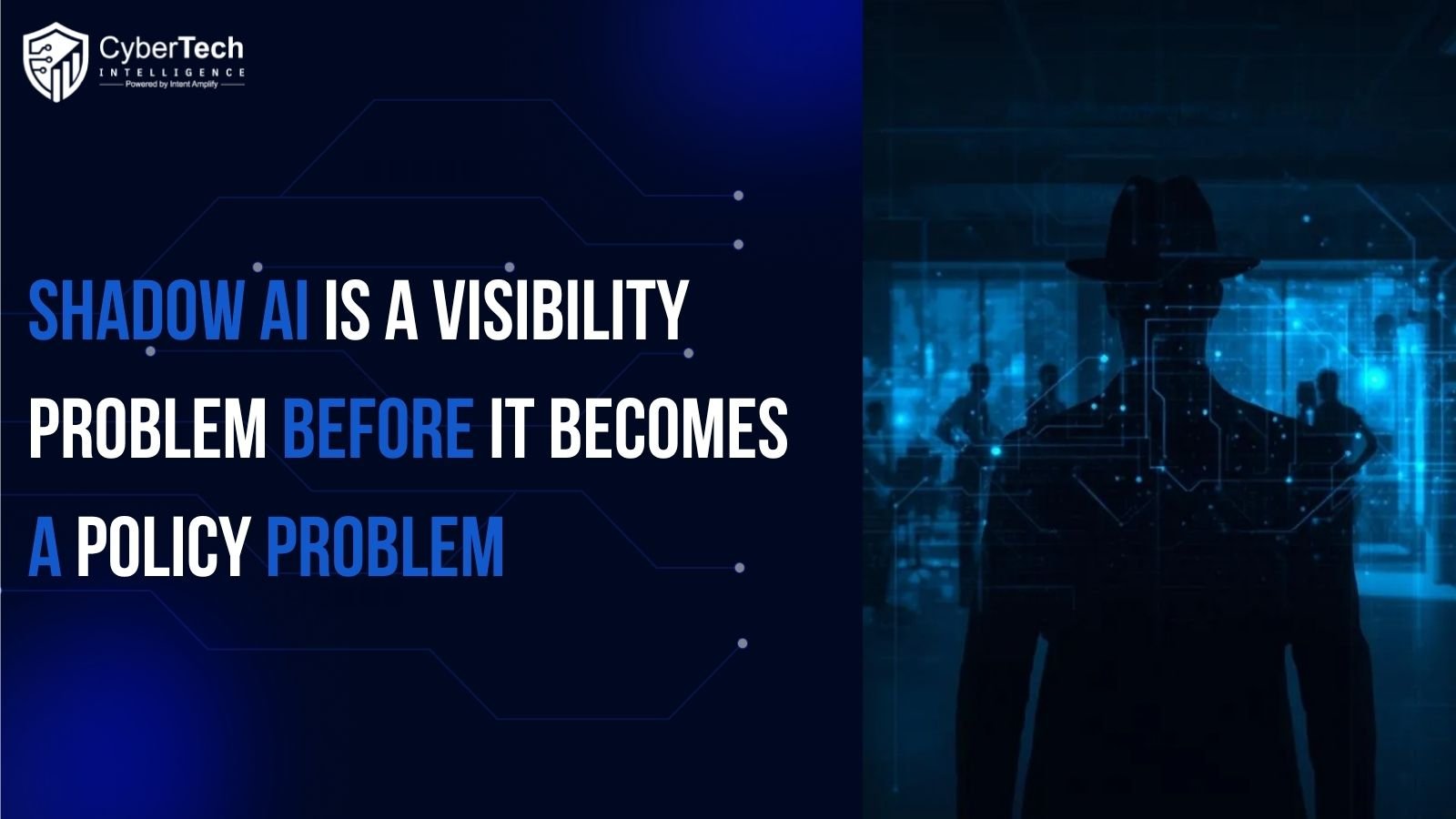
The immediate temptation is to treat shadow AI as a new category that needs a new control stack. In practice, the management problem is familiar. A business user can begin using an external service before security, procurement, privacy, or IT has a complete record of the service. The organization may then lack a clear answer to basic questions: Who approved it? Who owns the relationship? Which identities can access it? What data can be entered or connected? Which integrations remain active?
NIST CSF 2.0 provides a useful starting point because its asset-management outcomes are not limited to software installed on endpoints. ID.AM-04 calls for an inventory of services provided by suppliers and gives SaaS, APIs, and other externally hosted application services as examples. [1] That makes discovery a governance requirement, not merely an IT housekeeping exercise.
Inventory Before You Enforce
A policy cannot reliably govern a service that the organization cannot see. The first operating objective is therefore a current service inventory that combines signals from identity, network, endpoint, browser, expense, procurement, and application administration where those sources are available. The purpose is not to create a perfect master list on day one. It is to create a repeatable way to detect new services, reconcile duplicates, and route each service to a decision.
CIS Critical Security Control 2 uses the same basic logic for software: inventory, track, correct, and prevent unauthorized or unmanaged software from operating unchecked. [5] For cloud services and AI applications, the practical equivalent is to know what is being used, determine whether it is approved, and create a clear path for sanctioning, restriction, or retirement.
Put a Name Next to Every Service
Discovery is incomplete until ownership is visible. NIST AI RMF Playbook guidance for AI inventories recommends defining a specific individual or team responsible for maintaining the inventory and recording useful system attributes. [2] For enterprise SaaS, the same discipline can be extended to at least two roles: a business owner who can explain why the service is needed, and a technical or security owner who can explain how access, configuration, data, and integrations are controlled.
Ownership also creates an exception path. If a useful AI service does not yet meet policy, the business should know who can review it, what evidence is required, and how a temporary decision will be revisited. A blanket block without an alternative often creates workarounds. A clear review path turns policy into an operating process.
Control Data and Access, Not Curiosity
The highest-value controls focus on what can create business exposure: sensitive data, delegated access, privileged integrations, and actions that can change enterprise systems. OWASP guidance on sensitive information disclosure highlights the risk of users unintentionally providing confidential or regulated information to LLM applications and recommends clear use policies and appropriate data controls. [4]
Technology can support that policy. Microsoft documents capabilities in Defender for Cloud Apps and related products to discover, monitor, sanction, warn on, or block generative AI applications. [3] This is a vendor-specific example, not a universal prescription, but it illustrates an important pattern: discovery should feed a decision, and the decision should be enforceable at the point of use.
Use a Discover-to-Control Path
The following CyberTech Intelligence path is an operating model, not an external standard or product rating.
Figure 1. CyberTech Intelligence Discover-to-Control Path
|
Step |
Leadership Question |
Minimum Evidence |
Decision |
|---|---|---|---|
|
1. Discover |
Which AI and SaaS services are actually in use? |
Observed service, user, source signal, first/last seen. |
Add to the review queue. |
|
2. Classify |
What business use and data are involved? |
Purpose, data class, integration scope, user group. |
Approve for assessment or restrict. |
|
3. Own |
Who is accountable for the service? |
Business owner, technical owner, review date. |
Create named decision rights. |
|
4. Control |
Which use is allowed, warned, limited, or blocked? |
Policy, identity and data controls, exception route. |
Enforce the decision. |
|
5. Review |
Is the service still needed and within policy? |
Usage, access, incidents, exceptions, owner confirmation. |
Renew, change, or retire. |
What Good Enforcement Looks Like
-
New external services enter a visible review queue instead of living only in expense records or browser history.
-
Every service has a current business owner, a technical owner, and a review date.
-
Approved and prohibited data uses are understandable to employees without security jargon.
-
High-risk integrations and delegated permissions receive stronger review than low-risk standalone use.
-
Exceptions have an owner, expiry date, and documented reason instead of becoming permanent by default.
-
Retired services have access, tokens, accounts, and stored data addressed as part of closure.
Run the 15-Minute Visibility Check
Pick one business function and compare identity records, expense or procurement data, and observed cloud or browser activity. List every AI or SaaS service that appears in one source but not the others. Use those gaps to start the next ownership review.
About CyberTech Intelligence
CyberTech Intelligence provides research-led cybersecurity intelligence, executive content, and market engagement programs. This publication is vendor-neutral and intended for education, decision support, and claim-safe GTM planning.
Evidence and Citation Note
External sources are used only within their stated scope. Guidance statements are attributed to the issuing organization, survey or telemetry findings are identified as source-specific, and vendor material is used only for that vendor's capabilities or stated observations. CyberTech Intelligence does not infer a current incident, weakness, project, budget, or risk posture for any named organization without direct evidence. Editorial QA control completion: 10/10.
References
- National Institute of Standards and Technology, “Cybersecurity Framework 2.0 Reference Tool,” current reference resource. https://csrc.nist.gov/projects/cybersecurity-framework/filters (Accessed September 21, 2026. Relevance: ID.AM-04 explicitly covers inventories of supplier-provided SaaS, APIs, and other externally hosted application services and calls for inventory updates when new services are used.)
- National Institute of Standards and Technology, “NIST AI RMF Playbook - Govern,” current living resource. https://airc.nist.gov/airmf-resources/playbook/govern/ (Accessed September 21, 2026. Relevance: GOVERN 1.6 recommends mechanisms to inventory AI systems, defined maintenance responsibility, and documented inventory attributes.)
- Microsoft Learn, “Manage generative AI apps for your organization,” current product guidance. https://learn.microsoft.com/en-us/microsoft-365/copilot/manage-generative-ai-apps (Accessed September 21, 2026. Relevance: vendor-specific guidance for discovering, monitoring, warning on, sanctioning, and blocking generative AI applications.)
- OWASP GenAI Security Project, “LLM02:2025 Sensitive Information Disclosure,” 2025. https://genai.owasp.org/llmrisk/llm022025-sensitive-information-disclosure/ (Accessed September 21, 2026. Relevance: community guidance on risks created when sensitive information enters or is exposed through LLM applications and on user/data controls.)
- Center for Internet Security, “CIS Critical Security Control 2: Inventory and Control of Software Assets,” current control page. https://www.cisecurity.org/controls/inventory-and-control-of-software-assets. (Accessed September 21, 2026. Relevance: established inventory and authorization discipline for finding and addressing unauthorized or unmanaged software.)
Author
CyberTech Intelligence Research Desk
Author