
Executive Summary
Enterprise conversations around post-quantum cryptography (PQC) have shifted significantly over the past two years. What was once considered a long-term research topic has evolved into a strategic planning priority for organizations responsible for protecting sensitive information, maintaining digital trust, and ensuring operational resilience.
The publication of the first NIST Post-Quantum Cryptography standards provides organizations with a clear direction for future cryptographic modernization. However, selecting new algorithms represents only one aspect of the challenge. Most enterprises cannot begin migration until they understand where cryptography is currently used, which business services depend on it, who owns those systems, and how changes will affect existing technology investments.
For many organizations, this visibility does not exist today.
Public-key cryptography is embedded throughout modern enterprise environments. Certificates authenticate users and services. Digital signatures validate software integrity. TLS protects APIs and customer portals. VPNs secure remote connectivity. Identity providers establish trust between business applications. Cloud platforms manage encryption keys, while software supply chains rely on signing mechanisms to maintain integrity.
These cryptographic functions span hundreds or even thousands of applications, platforms, devices, cloud services, third-party products, and business processes. Many organizations maintain inventories of servers, endpoints, cloud assets, and applications, yet very few maintain a comprehensive inventory of cryptographic dependencies.
Without this visibility, organizations face several strategic risks:
- Inability to estimate migration scope
- Unknown exposure to future cryptographic threats
- Hidden legacy dependencies
- Vendor-controlled migration timelines
- Unplanned operational disruption
- Increased modernization costs
- Weak executive reporting
- Poor prioritization of security investments
This whitepaper presents a practical framework for establishing an enterprise cryptographic inventory that supports long-term post-quantum readiness. Rather than focusing exclusively on algorithms, it introduces a business-oriented methodology that connects cryptographic technologies with business services, critical data, infrastructure, suppliers, governance, and executive decision-making.
The objective is not to claim that an organization has become "quantum safe." Instead, the goal is to create sufficient visibility to support informed planning, effective governance, controlled modernization, and measurable progress toward future cryptographic resilience.
Why Cryptographic Visibility Matters
Organizations routinely maintain detailed inventories of hardware assets, virtual machines, cloud workloads, identities, software licenses, and network infrastructure. These inventories enable effective governance, operational management, compliance reporting, and lifecycle planning.
Cryptography, however, often remains largely invisible.
Encryption libraries are embedded inside applications. Certificates are automatically deployed by cloud services. Identity systems establish trust relationships across dozens of platforms. VPN appliances rely on cryptographic protocols that administrators rarely modify. Hardware security modules protect enterprise keys while operating independently of broader asset management systems.
As a result, organizations may understand where systems exist without understanding how digital trust is actually established between those systems.
This lack of visibility becomes particularly significant as organizations begin preparing for post-quantum migration.
Migration planning requires answers to questions that traditional asset inventories cannot provide.
Examples include:
- Which applications depend on RSA or elliptic curve cryptography?
- Which APIs authenticate through certificate-based trust?
- Which software signing processes rely on existing PKI infrastructure?
- Which customer-facing services require certificate replacement?
- Which cloud services abstract cryptographic implementation from administrators?
- Which third-party products control migration timing?
- Which certificates protect critical business services?
- Which cryptographic libraries are hardcoded into legacy applications?
Without reliable answers, migration planning becomes speculative rather than evidence-based.
Cryptography Extends Beyond Security Teams
One of the most common misconceptions surrounding post-quantum readiness is the assumption that cryptographic modernization belongs exclusively to information security teams.
In reality, cryptography supports almost every major technology function within the enterprise.
Identity and Access Management teams manage authentication, federation, privileged access, and certificate-based identity.
Infrastructure teams manage VPNs, TLS termination, network appliances, operating systems, and remote access platforms.
Cloud engineering teams manage key management services, cloud certificates, workload identities, and platform encryption capabilities.
Application development teams integrate cryptographic libraries, digital signatures, API authentication, and secure communications directly into software.
Public Key Infrastructure administrators manage certificate authorities, certificate issuance, trust chains, revocation processes, and certificate lifecycle automation.
DevSecOps teams protect software supply chains through code signing, artifact validation, CI/CD pipeline integrity, and release verification.
Procurement and vendor management teams negotiate contracts that determine when commercial products will support future cryptographic standards.
Legal, privacy, compliance, and enterprise risk teams evaluate regulatory exposure associated with long-term protection of sensitive information.
Executive leadership ultimately determines investment priorities, acceptable risk levels, governance responsibilities, and modernization timelines.
Because cryptographic responsibilities are distributed across numerous technical and business functions, no individual department typically possesses complete visibility.
An enterprise cryptographic inventory therefore serves as a coordination mechanism rather than simply a technical database.
The Hidden Cost of Incomplete Visibility
Organizations frequently underestimate the operational complexity of cryptographic modernization because cryptographic dependencies are rarely documented alongside business services.
A single customer portal may involve:
- Load balancers
- API gateways
- Web application firewalls
- Identity providers
- Certificate authorities
- Cloud key management
- Backend application servers
- Database encryption
- Partner integrations
- External authentication providers
Each component may implement cryptography differently.
Some rely on internally managed certificates.
Others inherit encryption capabilities from cloud providers.
Several may depend entirely upon commercial software vendors.
Certain components may use embedded cryptographic libraries that require source-code modifications before migration becomes possible.
Without comprehensive discovery, organizations risk overlooking critical dependencies until late in implementation.
The resulting delays increase project cost, introduce operational risk, complicate change management, and reduce executive confidence in modernization initiatives.
Why Traditional Asset Inventories Are Not Enough
Most enterprise asset management systems focus on identifying infrastructure rather than documenting trust relationships.
Typical inventories answer questions such as:
- Where is the server located?
- Which operating system is installed?
- Who owns the application?
- Which business unit uses the platform?
- What maintenance schedule applies?
These inventories rarely capture:
- Certificate dependencies
- Cryptographic algorithms
- Trust chains
- Digital signature mechanisms
- Key ownership
- Certificate expiration processes
- Software-signing workflows
- Hardware security module usage
- TLS implementation details
- Vendor-controlled cryptographic functions
Consequently, organizations attempting to prepare for post-quantum migration often discover that their existing configuration management databases, cloud inventories, and asset repositories provide only partial visibility.
A dedicated cryptographic inventory complements—not replaces—traditional asset management by documenting how digital trust is established, maintained, and governed across the enterprise.
Business Impact of Cryptographic Blind Spots
Limited cryptographic visibility affects far more than future algorithm replacement. It influences operational resilience, procurement strategy, compliance readiness, incident response, and executive governance.
Common business impacts include:
Delayed Modernization
Projects cannot accurately estimate migration scope because hidden dependencies emerge late in implementation.
Increased Operational Risk
Unexpected certificate replacements or incompatible cryptographic implementations may interrupt critical services.
Vendor Lock-In
Organizations become dependent on supplier roadmaps without understanding contractual leverage or alternative migration options.
Weak Executive Reporting
Leadership cannot accurately answer questions regarding enterprise readiness because supporting evidence remains incomplete.
Higher Migration Costs
Late discovery of cryptographic dependencies frequently results in emergency remediation, duplicated engineering effort, and unplanned infrastructure upgrades.
Compliance Challenges
Regulated industries increasingly require organizations to demonstrate structured governance for cryptographic controls protecting sensitive information.
Defining a Cryptographic Inventory
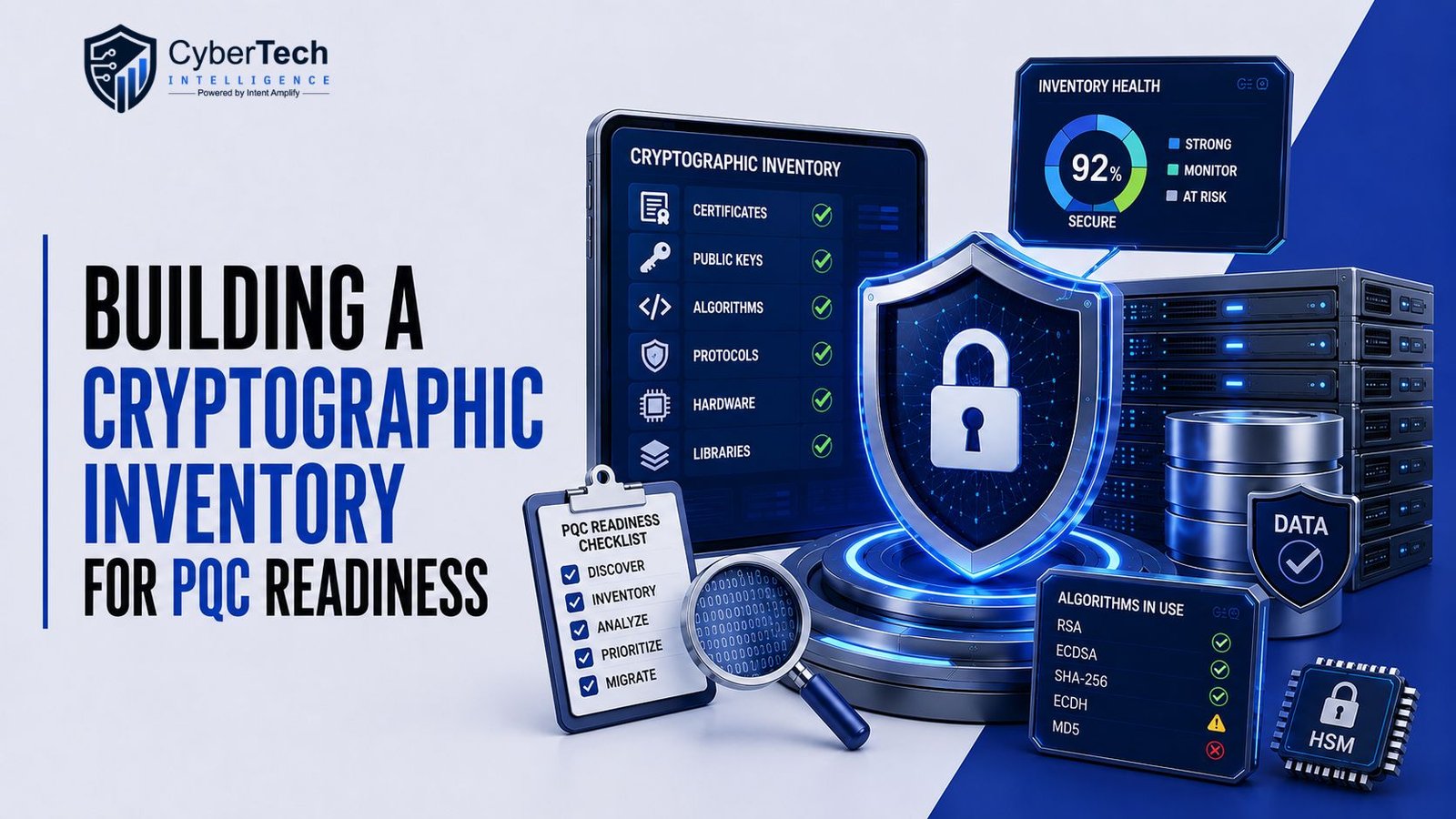
A cryptographic inventory is a structured record of the cryptographic technologies, trust relationships, certificates, keys, algorithms, software libraries, protocols, services, and governance responsibilities supporting enterprise business operations.
Unlike traditional inventories, a cryptographic inventory connects technical implementation with business context.
Each inventory record should answer five essential questions:
- What cryptographic mechanism exists?
- Which business service depends on it?
- Who owns it?
- How difficult will migration be?
- What evidence confirms its existence?
Answering these questions establishes the foundation for informed post-quantum planning rather than reactive migration.
The CyberTech Intelligence Enterprise Cryptographic Discovery Framework™
A cryptographic inventory becomes valuable only when it provides consistent, evidence-based visibility across the enterprise. Simply listing certificates or encryption algorithms does not provide sufficient insight for executive decision-making or migration planning.
CyberTech Intelligence recommends establishing a structured discovery framework that aligns cryptographic assets with business operations, ownership, risk, and future migration complexity.
The CyberTech Intelligence Enterprise Cryptographic Discovery Framework™ (CTI-ECDF) consists of six interconnected discovery layers.
Each layer builds additional context, transforming technical observations into business intelligence that security leaders can use for governance, budgeting, vendor engagement, and modernization planning.
Layer 1 – Cryptographic Asset Discovery
The first objective is identifying where cryptography actually exists.
Most enterprises already maintain inventories for applications, infrastructure, cloud workloads, and endpoints. Those inventories should become starting points—not the final inventory.
Cryptographic discovery should identify:
Public Key Algorithms
- RSA
- Elliptic Curve Cryptography (ECC)
- ECDSA
- ECDH
- Diffie-Hellman
- DSA
- Emerging PQC implementations
Certificates
- Internal certificates
- Public certificates
- Wildcard certificates
- Mutual TLS certificates
- Device certificates
- Code-signing certificates
- Email certificates
- Client authentication certificates
Cryptographic Libraries
Examples include:
- OpenSSL
- BoringSSL
- LibreSSL
- Microsoft CNG
- Java Cryptography Architecture
- WolfSSL
- Botan
- NSS
- Embedded vendor libraries
Security Protocols
- TLS
- DTLS
- SSH
- IPsec
- S/MIME
- HTTPS
- Secure LDAP
- Kerberos integrations
Identity Systems
- Active Directory Certificate Services
- Azure AD
- Microsoft Entra ID
- Okta
- Ping Identity
- ForgeRock
- IAM platforms
- Privileged Access Management
Key Management
- Hardware Security Modules
- Cloud KMS
- Azure Key Vault
- AWS KMS
- Google Cloud KMS
- Enterprise key management platforms
- Certificate authorities
Software Integrity
- Code signing
- Firmware signing
- Container image signing
- Software update validation
- Package signing
- CI/CD signing workflows
Every discovered cryptographic component becomes a candidate inventory record.
Layer 2 – Business Service Mapping
Cryptography has little value in isolation.
Organizations must understand why each cryptographic component exists.
Each inventory record should therefore map to one or more business services.
Examples include:
|
Cryptographic Component |
Business Service |
|
TLS Certificate |
Customer Portal |
|
VPN Certificate |
Remote Workforce |
|
Signing Certificate |
Software Releases |
|
Cloud KMS |
Cloud Applications |
|
API Certificate |
Partner Integrations |
|
Device Certificate |
Manufacturing Systems |
|
Identity Certificate |
Employee Authentication |
Business mapping enables leadership to prioritize systems based on operational impact rather than technical characteristics alone.
For example, two certificates may both use RSA, but one protects an internal testing environment while the other secures an online banking portal.
Their migration priorities are clearly different.
Layer 3 – Ownership and Accountability
One of the most common findings during enterprise discovery exercises is the absence of clearly defined ownership.
Organizations frequently discover certificates that no team claims responsibility for.
Unknown ownership creates operational risk because migration activities require decision-makers.
Every inventory record should identify:
Business Owner
Responsible for the business process.
Technical Owner
Responsible for implementation.
Security Owner
Responsible for governance and policy.
Infrastructure Owner
Responsible for operational support.
Application Owner
Responsible for application changes.
Vendor Owner
Responsible for supplier communication.
Procurement Owner
Responsible for contract negotiation.
Executive Sponsor
Responsible for strategic oversight.
Without ownership, remediation plans frequently stall.
Layer 4 – Data Classification
Not every cryptographic dependency protects information requiring identical confidentiality periods.
Organizations should classify protected information according to business sensitivity.
Typical categories include:
Public Information
Minimal confidentiality requirements.
Internal Information
Operational documentation and routine business information.
Confidential Information
Financial information, customer records, HR data, commercial agreements.
Restricted Information
Healthcare data, payment information, intellectual property, government information, regulated datasets.
Strategic Information
Research, proprietary algorithms, national infrastructure information, classified environments.
Long-life sensitive information should receive higher migration priority because of potential future cryptographic exposure.
Layer 5 – Migration Complexity Assessment
Every inventory item should receive a migration complexity rating.
Factors include:
Technology Age
Older applications typically require greater effort.
Vendor Dependency
Migration depends on supplier product support.
Application Customization
Highly customized software may require code changes.
Infrastructure Constraints
Legacy hardware may require replacement.
Operational Criticality
Business interruption tolerance.
Testing Requirements
Extent of validation required before deployment.
Regulatory Constraints
Industries requiring certification or regulatory approval.
Organizations often discover that migration complexity—not cryptographic weakness—determines implementation order.
Layer 6 – Evidence Confidence
Executive decisions should never rely upon assumptions.
Every inventory record should include an evidence confidence rating.
Verified
Evidence supported through:
- Configuration reviews
- Certificate discovery
- Architecture documentation
- Source-code analysis
- Network inspection
- Vendor documentation
- Automated discovery
Confirmed by Owner
Validated by responsible technical teams.
Partial
Some evidence exists but requires additional validation.
Assumed
Reasonable expectation without supporting evidence.
Assumptions should never drive migration planning.
Unknown
No reliable evidence available.
Unknown findings become priority investigation items.
Enterprise Cryptographic Discovery Methodology
A successful discovery program combines automated tooling with structured stakeholder engagement.
Technology alone rarely provides complete visibility.
CyberTech Intelligence recommends a five-phase discovery methodology.
Phase 1 – Preparation
Objectives include:
- Define program scope.
- Appoint executive sponsor.
- Assign discovery owners.
- Identify participating business units.
- Define evidence standards.
- Select discovery tools.
- Establish reporting cadence.
Primary deliverables:
- Discovery charter
- Governance model
- Scope document
- Initial stakeholder map
Phase 2 – Automated Discovery
Organizations should leverage existing enterprise tooling wherever possible.
Potential discovery sources include:
- Certificate scanners
- Vulnerability management platforms
- Cloud asset inventories
- CMDB
- Endpoint management
- Container security platforms
- PKI monitoring
- Network discovery
- API inventories
- Identity platforms
- Source-code repositories
- CI/CD pipelines
Automated discovery accelerates coverage but rarely identifies complete business context.
Phase 3 – Business Validation
Technical findings should be validated with business owners.
Validation workshops typically include:
Application owners
Infrastructure teams
Cloud architects
Identity administrators
PKI administrators
Security architects
Vendor managers
Business stakeholders
Workshop objectives:
- Confirm ownership.
- Validate dependencies.
- Identify undocumented integrations.
- Review operational criticality.
- Identify modernization constraints.
Phase 4 – Risk Prioritization
After discovery, inventory records should receive standardized scoring.
CyberTech Intelligence recommends evaluating:
- Business criticality
- Data sensitivity
- External exposure
- Migration complexity
- Vendor dependency
- Operational impact
- Regulatory exposure
- Recovery difficulty
This creates a risk-ranked migration portfolio.
Phase 5 – Executive Reporting
Discovery should conclude with evidence-based executive reporting.
Recommended reporting metrics include:
Coverage
- Percentage of applications assessed
- Percentage of certificates identified
- Percentage of PKI documented
- Percentage of cloud workloads reviewed
Ownership
- Records with assigned owners
- Records missing ownership
- High-risk orphaned certificates
Risk
- High-priority cryptographic dependencies
- Long-life sensitive data exposure
- Legacy platform concentration
- Vendor-controlled migration dependencies
Readiness
- Crypto-agility maturity
- PKI modernization status
- Discovery completeness
- Pilot readiness
The outcome of discovery should not simply be a spreadsheet.
It should become a strategic decision-support capability that enables executive leadership to understand where cryptographic risk exists, which modernization activities deserve priority, and how post-quantum migration can be integrated into broader digital transformation initiatives.
Assessing Enterprise Crypto Agility
Cryptographic inventory establishes visibility, but visibility alone does not ensure readiness. Organizations must also evaluate how easily cryptographic mechanisms can be modified without introducing unacceptable operational risk.
This capability is commonly referred to as crypto agility—the ability to replace cryptographic algorithms, certificates, keys, protocols, and trust mechanisms in a controlled, repeatable, and low-risk manner.
For many enterprises, crypto agility will determine the speed and success of future post-quantum migration.
Organizations with centralized governance, modern PKI, automated certificate management, and modular application architectures will be significantly better positioned than organizations relying on manual processes and legacy systems.
Why Crypto Agility Matters
Historically, cryptographic algorithms remained unchanged for many years. Consequently, many applications embedded cryptographic implementations directly into source code or depended upon fixed third-party libraries.
This approach created little operational concern when cryptographic standards changed infrequently.
The transition toward post-quantum cryptography changes this assumption.
Future cryptographic standards may continue evolving, requiring organizations to adapt multiple times over the coming decade. Enterprises therefore need infrastructure capable of supporting cryptographic change as an ongoing operational capability rather than a one-time migration project.
Crypto agility minimizes future disruption by enabling organizations to:
- Replace algorithms without extensive software redevelopment
- Modernize certificates with minimal downtime
- Upgrade cryptographic libraries through standardized processes
- Support hybrid cryptographic deployments during transition periods
- Validate interoperability before production deployment
- Reduce dependence on manual certificate management
- Respond more effectively to future cryptographic vulnerabilities
Indicators of Low Crypto Agility
During discovery exercises, CyberTech Intelligence frequently observes characteristics that increase migration complexity.
Common indicators include:
Hardcoded Cryptography
Applications directly specify cryptographic algorithms within application code.
Changing algorithms requires software redevelopment and testing.
Legacy PKI
Certificate authorities operate using outdated infrastructure with limited automation.
Manual Certificate Management
Certificates are renewed manually across hundreds of systems.
Ownership is inconsistent.
Expiration tracking is incomplete.
Embedded Vendor Libraries
Applications depend upon proprietary cryptographic implementations that cannot be independently upgraded.
Fragmented Key Management
Different business units manage keys using unrelated processes and technologies.
Limited Testing Environments
Organizations lack isolated environments capable of validating cryptographic changes before production deployment.
Unknown Ownership
No individual or team is accountable for certificate lifecycle management or cryptographic modernization.
Characteristics of High Crypto Agility
Organizations demonstrating mature crypto agility typically exhibit several common capabilities.
Centralized PKI Governance
Certificate policies are standardized across business units.
Ownership responsibilities are clearly defined.
Automated Certificate Lifecycle Management
Certificate issuance, renewal, revocation, and replacement are largely automated.
Standardized Cryptographic Policies
Approved algorithms, key lengths, certificate lifetimes, and implementation guidance are centrally managed.
Modular Application Design
Applications can adopt updated cryptographic libraries without extensive architectural redesign.
Centralized Key Management
Hardware Security Modules and cloud-based key management services provide consistent governance across workloads.
Change Automation
Cryptographic updates integrate into existing DevSecOps and infrastructure-as-code workflows.
Continuous Monitoring
Organizations continuously monitor certificate health, key usage, trust relationships, and cryptographic policy compliance.
These capabilities significantly reduce future migration effort.
CTI Crypto Agility Assessment Framework
CyberTech Intelligence recommends evaluating crypto agility across seven operational domains.
|
Domain |
Key Assessment Question |
|
PKI Governance |
Is certificate governance centralized? |
|
Certificate Lifecycle |
Is lifecycle management automated? |
|
Application Architecture |
Can algorithms be replaced without major redevelopment? |
|
Key Management |
Are keys centrally governed? |
|
Vendor Dependency |
How dependent is the organization on supplier timelines? |
|
Testing Capability |
Can cryptographic changes be validated safely? |
|
Governance |
Are ownership, policies, and reporting formally established? |
Each domain should be scored using a maturity scale ranging from Initial to Optimized.
Third-Party and Vendor Readiness
Enterprise cryptographic modernization increasingly depends upon commercial technology vendors.
Identity providers, firewall vendors, cloud platforms, certificate authorities, hardware security module vendors, SaaS providers, networking vendors, endpoint security vendors, and software publishers all influence migration timing.
Consequently, vendor readiness should become an integral component of enterprise PQC governance.
Organizations should avoid assuming vendor readiness based solely on marketing announcements.
Instead, they should request product-specific evidence.
Vendor Assessment Objectives
Each supplier assessment should determine:
- Which products support post-quantum standards?
- Which software versions are affected?
- Whether hybrid cryptographic implementations are available
- Required licensing changes
- Required hardware upgrades
- Performance implications
- Compatibility considerations
- Customer migration responsibilities
- Product roadmap timelines
- Available testing guidance
This information should be maintained within the enterprise cryptographic inventory.
CTI Vendor Evidence Classification
CyberTech Intelligence recommends classifying supplier readiness using four evidence categories.
Strong Evidence
The vendor provides:
- Product-specific documentation
- Supported standards
- Version information
- Deployment guidance
- Customer testing documentation
- Known limitations
- Upgrade procedures
Moderate Evidence
The vendor has published roadmap information, but implementation guidance remains limited.
Weak Evidence
Only general marketing statements exist.
No product-level documentation is available.
Unknown
No reliable public information or customer guidance exists.
These suppliers should receive higher governance attention because migration timing cannot yet be estimated accurately.
Vendor Risk Register
Each critical supplier should be documented using a standardized register.
Recommended fields include:
- Vendor
- Product
- Business Service Supported
- Current Cryptographic Dependency
- PQC Roadmap Status
- Product Version
- Upgrade Requirement
- Hardware Requirement
- Licensing Requirement
- Migration Complexity
- Business Criticality
- Evidence Source
- Internal Owner
- Next Review Date
Maintaining this register enables procurement, security, architecture, and executive leadership to coordinate modernization planning.
Integrating Vendor Readiness into Procurement
PQC readiness should become part of routine technology procurement.
Organizations evaluating new technology investments should include questions addressing:
- Cryptographic roadmap
- Crypto agility capabilities
- Certificate management
- Standards compliance
- Algorithm flexibility
- Key management
- Interoperability
- Upgrade support
- Long-term roadmap
- Product lifecycle
Including these requirements early reduces future modernization costs.
Enterprise PQC Inventory Maturity Model
CyberTech Intelligence recommends evaluating enterprise readiness using a five-level maturity model.
Level 1 – Limited Visibility
Characteristics:
- No cryptographic inventory
- Unknown certificate ownership
- Manual certificate management
- Limited executive awareness
- No migration planning
Primary objective:
Establish governance and begin discovery.
Level 2 – Initial Discovery
Characteristics:
- Partial inventory
- Initial ownership mapping
- High-level business service identification
- Vendor engagement begins
- Executive sponsorship established
Primary objective:
Improve inventory coverage.
Level 3 – Managed Visibility
Characteristics:
- Risk-ranked inventory
- PKI documented
- Vendor evidence collected
- Business ownership confirmed
- Migration priorities identified
Primary objective:
Develop implementation roadmap.
Level 4 – Operational Readiness
Characteristics:
- Crypto agility assessed
- Pilot environments established
- Automated certificate management
- Governance integrated into enterprise architecture
- Executive reporting standardized
Primary objective:
Execute controlled modernization.
Level 5 – Adaptive Enterprise
Characteristics:
- Continuous inventory updates
- Mature crypto agility
- Automated governance
- Procurement integration
- Continuous vendor monitoring
- Executive metrics
- Repeatable modernization capability
Organizations at this level are positioned to respond efficiently not only to post-quantum migration but also to future cryptographic evolution.
90-Day Enterprise Implementation Roadmap
Organizations should avoid attempting enterprise-wide migration immediately.
Instead, CyberTech Intelligence recommends a phased readiness initiative.
Days 1–30 — Establish Visibility
Objectives:
- Appoint executive sponsor
- Assign program owner
- Define scope
- Identify critical business services
- Launch cryptographic discovery
- Select inventory platform
- Establish governance
Deliverables:
- Governance Charter
- Discovery Plan
- Stakeholder Register
- Initial Inventory
Days 31–60 — Build Evidence
Objectives:
- Expand inventory
- Validate ownership
- Assess PKI
- Identify long-life sensitive data
- Review vendor readiness
- Score migration complexity
- Assess crypto agility
Deliverables:
- Risk-ranked Inventory
- Vendor Register
- Crypto Agility Assessment
- PKI Gap Analysis
- Executive Risk Summary
Days 61–90 — Prepare for Modernization
Objectives:
- Select pilot candidates
- Validate interoperability
- Define procurement requirements
- Build executive dashboard
- Estimate budget
- Align modernization initiatives
- Establish quarterly reporting
Deliverables:
- Pilot Plan
- Executive Dashboard
- Modernization Roadmap
- Procurement Standards
- Governance Metrics
- Budget Recommendations
Executive Dashboard Metrics
CyberTech Intelligence recommends monitoring the following KPIs:
|
Category |
KPI |
|
Discovery |
Applications assessed (%) |
|
Discovery |
Certificates inventoried |
|
Governance |
Assets with confirmed owners (%) |
|
Risk |
High-risk cryptographic dependencies |
|
Vendor |
Critical vendors with validated PQC roadmap (%) |
|
PKI |
Automated certificate coverage (%) |
|
Crypto Agility |
Average maturity score |
|
Migration |
Pilot-ready systems |
|
Compliance |
Critical systems with evidence validation (%) |
|
Executive |
Overall enterprise readiness score |
These indicators provide measurable evidence of organizational progress and support informed executive decision-making.
Executive Readiness Assessment Checklist
An enterprise cryptographic inventory provides value only when it enables better executive decision-making. Senior leadership should be able to determine whether the organization understands its cryptographic exposure, has established appropriate governance, and is prepared to support future modernization initiatives.
CyberTech Intelligence recommends using the following readiness assessment during quarterly governance reviews, technology steering committee meetings, and cybersecurity strategy planning.
Governance
Evaluate whether the organization has established the leadership, accountability, and decision-making structure necessary to support a multi-year PQC readiness program.
Assessment Questions
- Has an Executive Sponsor been formally assigned?
- Has a Program Owner been appointed?
- Are cryptographic governance responsibilities documented?
- Are business units participating in governance reviews?
- Are responsibilities clearly defined for PKI, Identity, Infrastructure, Cloud, Applications, Procurement, and Risk teams?
- Does the organization maintain a documented decision-making process for cryptographic modernization?
- Are executive reports reviewed on a recurring schedule?
Success Indicator
Governance responsibilities are documented, understood, and supported by executive leadership.
Cryptographic Visibility
Organizations cannot modernize what they cannot identify.
Assessment Questions
- Have all critical business applications been reviewed?
- Have certificates been inventoried?
- Have software-signing processes been documented?
- Have PKI environments been identified?
- Have hardware security modules been documented?
- Have cryptographic libraries been identified?
- Have cloud cryptographic services been mapped?
- Have identity platforms been reviewed?
- Have external trust relationships been documented?
- Is inventory evidence verified?
Success Indicator
Leadership has confidence that enterprise cryptographic dependencies are understood and continuously maintained.
Business Risk
Migration priorities should align with business impact rather than technology alone.
Assessment Questions
- Have critical business services been identified?
- Has long-life sensitive data been classified?
- Have cryptographic dependencies been mapped to business services?
- Are customer-facing systems prioritized?
- Have operational dependencies been evaluated?
- Are recovery objectives documented?
- Are regulatory obligations considered?
Success Indicator
Migration priorities reflect business value, regulatory requirements, and operational resilience.
Crypto Agility
Future readiness depends on an organization's ability to adapt cryptographic controls with minimal disruption.
Assessment Questions
- Are certificates centrally managed?
- Is certificate lifecycle automation implemented?
- Are cryptographic policies standardized?
- Can applications replace cryptographic libraries without major redevelopment?
- Are testing environments available?
- Are rollback procedures documented?
- Are cryptographic changes incorporated into DevSecOps pipelines?
Success Indicator
The organization can safely introduce cryptographic changes through standardized operational processes.
Third-Party Readiness
Commercial technology vendors will significantly influence migration timelines.
Assessment Questions
- Have strategic suppliers published PQC roadmaps?
- Have product versions been reviewed?
- Have testing capabilities been confirmed?
- Are contractual dependencies understood?
- Have vendor upgrade requirements been documented?
- Are procurement standards updated?
- Are roadmap reviews performed annually?
Success Indicator
Supplier readiness supports enterprise modernization objectives rather than delaying them.
Operational Preparedness
Modernization should proceed through controlled implementation rather than large-scale disruption.
Assessment Questions
- Have pilot environments been selected?
- Are migration success criteria documented?
- Have interoperability requirements been identified?
- Are performance benchmarks established?
- Are rollback procedures validated?
- Are operational teams trained?
Success Indicator
Pilot deployments can proceed with manageable operational risk.
CyberTech Intelligence Perspective
Post-quantum readiness begins with evidence, not algorithm selection. An enterprise cannot build a credible migration roadmap until it can identify the cryptographic mechanisms supporting critical business services, determine who owns them, assess the longevity of the protected data, validate supplier dependencies, and estimate the operational effort required for change. A cryptographic inventory is therefore not a technical catalog; it is a decision system for governance, investment, sequencing, and risk reduction.
CyberTech Intelligence Research Desk Observation
The primary weakness in many cryptographic discovery efforts is not insufficient tooling. It is the failure to connect technical findings with business impact and evidence confidence. A list of certificates, keys, or libraries has limited executive value unless each item is tied to a business service, accountable owner, data classification, supplier dependency, migration constraint, and verifiable source. This whitepaper should be used as the portfolio's definitive implementation methodology for inventory creation; other campaign assets should refer to its principles without repeating its full discovery process.
CyberTech Intelligence Recommendations
Based on enterprise advisory engagements and industry best practices, CyberTech Intelligence recommends that organizations adopt the following priorities during the first year of PQC readiness planning.
1. Treat PQC as an Enterprise Transformation Initiative
Post-quantum readiness should not be managed as a standalone security project. It should be integrated with cloud modernization, Zero Trust, identity modernization, application modernization, PKI transformation, and third-party risk management programs.
2. Prioritize Cryptographic Discovery Before Migration
Organizations should resist the temptation to begin replacing algorithms before establishing a complete understanding of enterprise cryptographic dependencies.
Comprehensive discovery significantly reduces migration risk and improves investment planning.
3. Modernize Public Key Infrastructure
Many organizations discover that certificate management processes are fragmented, manually maintained, and difficult to scale.
Modernizing PKI improves operational resilience while supporting future cryptographic flexibility.
4. Build Crypto Agility into Enterprise Architecture
Future cryptographic change should become a repeatable operational capability rather than an exceptional engineering effort.
Application architectures should support configurable cryptographic libraries, standardized certificate management, and centralized governance.
5. Strengthen Vendor Governance
Technology procurement should evaluate suppliers based on cryptographic roadmap transparency, standards support, interoperability, lifecycle management, and long-term modernization commitments.
6. Establish Executive Metrics
Leadership should monitor measurable indicators including:
- Inventory coverage
- Ownership completeness
- Crypto agility maturity
- Vendor readiness
- PKI modernization
- Pilot readiness
- Migration progress
- Executive risk exposure
Conclusion
Preparing for post-quantum cryptography begins long before organizations deploy new algorithms.
The first and most important step is establishing visibility.
A comprehensive cryptographic inventory enables security leaders to understand where trust is established, how sensitive information is protected, which business services depend upon existing cryptographic implementations, and what operational challenges may affect future modernization.
Organizations that invest in cryptographic visibility today gain several long-term advantages.
They reduce uncertainty surrounding migration planning.
They improve executive decision-making.
They strengthen digital trust governance.
They modernize certificate and key management practices.
They engage suppliers more effectively.
Most importantly, they establish a sustainable foundation for adapting to future cryptographic change.
Post-quantum readiness should therefore be viewed as an ongoing enterprise capability rather than a one-time technology upgrade.
Organizations that combine structured governance, comprehensive discovery, crypto agility, vendor collaboration, and evidence-based reporting will be significantly better positioned to navigate the transition to post-quantum cryptography while maintaining operational resilience and customer trust.
Executive Assessment
Is Your Organization Ready for Post-Quantum Cryptography?
CyberTech Intelligence offers an Enterprise PQC Readiness Assessment designed to help organizations evaluate cryptographic visibility, governance maturity, crypto agility, supplier readiness, and migration priorities.
The assessment includes:
- Enterprise cryptographic inventory review
- PKI maturity assessment
- Crypto agility evaluation
- Vendor readiness analysis
- Business risk prioritization
- Executive governance recommendations
- 90-day implementation roadmap
- Strategic modernization guidance
Whether your organization is beginning its PQC journey or advancing existing modernization initiatives, a structured readiness assessment provides the evidence needed to prioritize investments, reduce uncertainty, and support informed executive decision-making.
Contact CyberTech Intelligence to schedule an Enterprise PQC Readiness Assessment and begin building a resilient foundation for the future of enterprise cryptography.
References
- National Institute of Standards and Technology (NIST). Post-Quantum Cryptography Project.
https://csrc.nist.gov/projects/post-quantum-cryptography - NIST. FIPS 203: Module-Lattice-Based Key-Encapsulation Mechanism Standard (ML-KEM).
https://csrc.nist.gov/pubs/fips/203/final - NIST. FIPS 204: Module-Lattice-Based Digital Signature Standard (ML-DSA).
https://csrc.nist.gov/pubs/fips/204/final - NIST. FIPS 205: Stateless Hash-Based Digital Signature Standard (SLH-DSA).
https://csrc.nist.gov/pubs/fips/205/final - National Cybersecurity Center of Excellence (NCCoE). Migration to Post-Quantum Cryptography Project.
https://www.nccoe.nist.gov/applied-cryptography/migration-to-pqc - NCCoE. Migration to Post-Quantum Cryptography Fact Sheet. https://www.nccoe.nist.gov/publications/fact-sheet/migration-post-quantum-cryptography-fact-sheet
- Cybersecurity and Infrastructure Security Agency (CISA). Post-Quantum Considerations for Operational Technology.
https://www.cisa.gov/resources-tools/resources/post-quantum-considerations-operational-technology - NIST. Considerations for Achieving Crypto Agility (CSWP 39).
https://csrc.nist.gov/pubs/cswp/39/final - NIST. Special Publication 800-227: Recommendations for Key-Encapsulation Mechanisms.
https://csrc.nist.gov/pubs/sp/800/227/final - NIST. Post-Quantum Cryptography Standards and Publications.
https://csrc.nist.gov/projects/post-quantum-cryptography/publications