
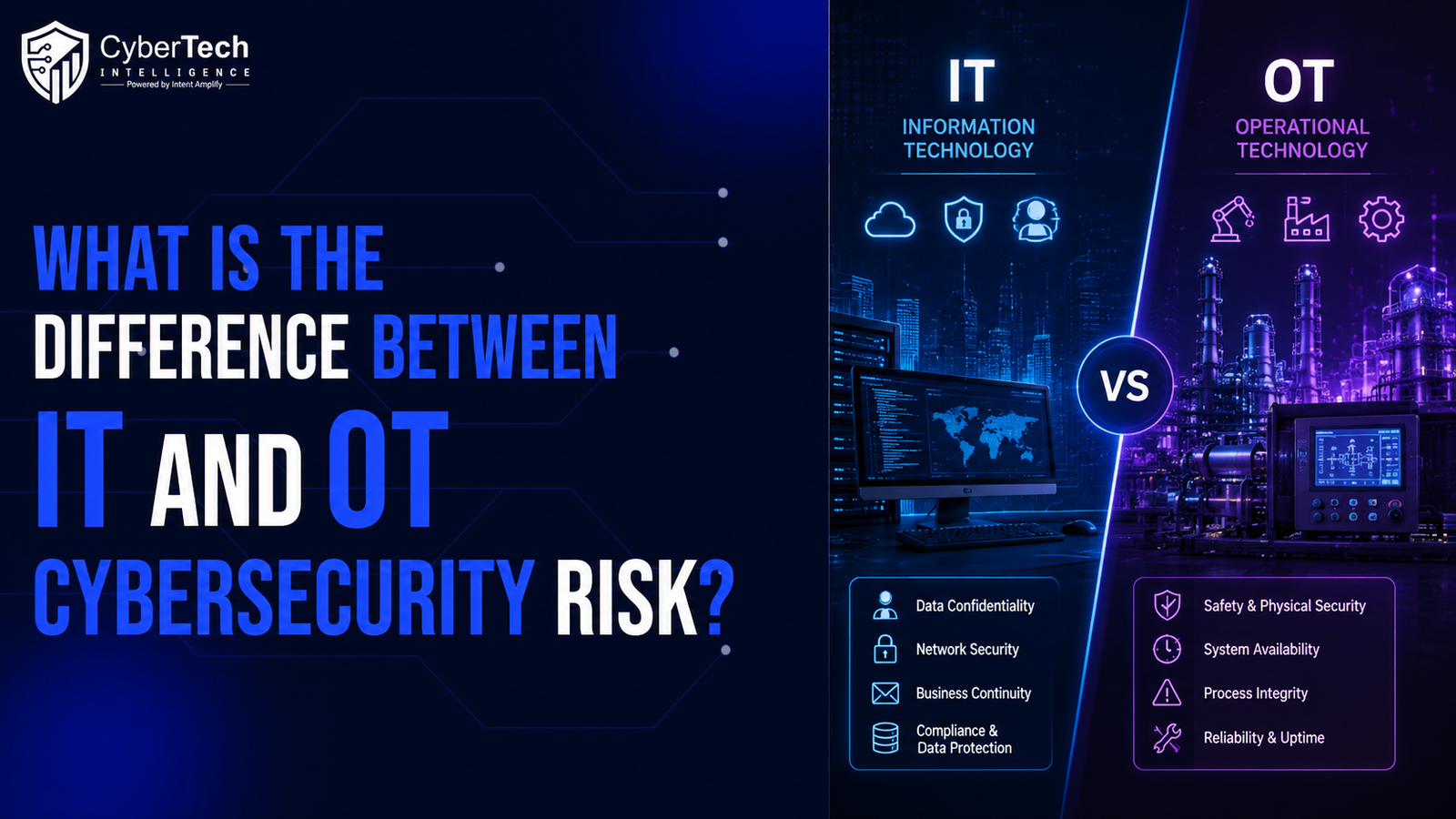
Quick answer: IT cybersecurity risk is about data — the threat of theft, exposure, or manipulation of information in systems like email, databases, and cloud platforms. OT cybersecurity risk is about physical consequences — the threat of a cyberattack disrupting or damaging real-world equipment like turbines, valves, conveyor lines, and grid controllers, with human safety as the top concern. The simplest way to tell them apart is by consequence: an IT incident usually shows up as a data or service problem, while an OT incident can add downtime, equipment damage, environmental fallout, or risk to people.
That's the short version. The longer version matters more, because IT and OT risk differ in what they protect, what constrains how you prevent and recover from an incident, and — increasingly — in how much a "successful" attack actually costs.
IT vs. OT Cybersecurity Risk at a Glance
|
IT Risk |
OT Risk |
|
|
Primary concern |
Confidentiality, integrity, availability of data |
Physical safety, process integrity, uptime |
|
What's protected |
Servers, cloud platforms, databases, apps |
PLCs, SCADA, sensors, control networks |
|
Worst case |
Data theft, fraud, reputational damage |
Equipment destruction, environmental harm, injury, or loss of life |
|
Patching |
Regular enterprise patch cycles |
Constrained by safety, vendor sign-off, planned outage windows |
|
System lifespan |
Follows platform/vendor support cycles |
Assets often run for decades — replacement is a capital project, not a ticket |
|
Connectivity |
Broadly interconnected across enterprise, cloud, users |
Mix of isolated segments and remote/vendor/IIoT/cloud links |
|
Detection |
Signature and behavior-based (EDR, SIEM) |
Protocol-aware anomaly detection (Modbus, DNP3, etc.) |
|
Recovery |
Restore, rebuild, redeploy, reset credentials |
Safety validation, process retesting, vendor coordination |
|
Governing standards |
GDPR, HIPAA, PCI-DSS, ISO/IEC 27001 |
NERC CIP, IEC 62443, NIST SP 800-82 |
Why the Risk Calculus Is Different, Not Just the Systems
It's easy to think of OT risk as "IT risk, but for factories." That undersells it.
IT environments have a lot of digital doors — endpoints, SaaS identities, email, applications, cloud services. When one of those doors gets forced open, the fallout is usually data loss, fraud, service disruption, or a regulatory headache, and severity swings a lot depending on the incident and the organization. A good chunk of that damage can be undone: patch the hole, restore from backup, rotate credentials, move on.
OT is a different animal because the thing being attacked isn't information — it's a physical process. Push the wrong command to a controller,r and you're not looking at a data-recovery problem; you're looking at a safety incident, an environmental release, or a production line that's now offline for reasons no backup can fix. That's why OT security programs sit closer to safety and process engineering than to a typical SOC, while IT programs stay centered on identity, applications, and data.
And the price tag reflects that split. According to IBM's 2025 Cost of a Data Breach Report, the average breach across all industries runs $4.88 million, but breaches that touch OT systems average $4.56 million on their own — and that figure doesn't count the production time lost while a plant is offline. Manufacturers report unplanned downtime costing them somewhere around $260,000 an hour on average, and for some automotive and heavy-industry lines the number runs into the tens of thousands per minute. Those aren't hypothetical figures on a slide — they're the reason OT risk has become a boardroom conversation rather than a plant-floor one.
IT, OT, and IoT Aren't the Same Thing
Before going further, it's worth untangling three terms that get used almost interchangeably and shouldn't be:
-
OT (Operational Technology) is hardware and software that directly monitors or controls physical equipment and processes — think PLCs, SCADA, and DCS systems running a refinery or a water treatment plant.
-
IoT (Internet of Things) is the broad universe of internet-connected devices, most of which are consumer or enterprise gadgets — smart thermostats, badge readers, connected cameras — with no direct role in an industrial process.
-
IIoT (Industrial IoT) sits in between: internet-connected sensors and devices deployed inside industrial environments (a wireless vibration sensor on a pump motor, for example) that feed data back for monitoring, but that may or may not have write access back into the control process.
The reason this distinction matters for risk: IIoT devices are frequently the least-secured, most internet-facing things on an OT network, which makes them a common bridge between the IT and OT worlds — and a favorite entry point in the incidents below.
Real Incidents That Show the Difference
Stuxnet (2010). Malware infected the control systems at an Iranian nuclear facility and caused centrifuges to spin themselves apart — physical destruction, triggered entirely through code, with no data "stolen" in any conventional sense.
Ukraine power grid attack (2015). Attackers manipulated ICS software to cut power to roughly 230,000 people. The breach wasn't about data. It was about who got to flip the switch.
Colonial Pipeline (2021). Ransomware hit the company's IT network, not the OT systems that actually run the pipeline. The operator shut the physical pipeline down anyway, as a precaution, because it couldn't confirm the ransomware had stayed out of the operational side. This is convergence risk playing out in real time: an IT-only incident with an OT-scale consequence.
Poland energy sector attack (December 2025–January 2026). Attackers got in through exposed, internet-facing edge devices, then deployed wiper malware that damaged remote terminal units at renewable energy plants and a combined heat and power facility. CISA's February 2026 advisory on the incident calls it out as a textbook case: OT-specific damage, reached through an IT-style entry point — unsecured internet exposure — rather than anything exotic.
Four incidents, sixteen years apart, and the same underlying lesson: the entry point is often ordinary IT hygiene, but the consequence lands on the physical side.
The Real Driver of 2026 Risk: IT/OT Convergence
IT and OT used to sit further apart. Industrial IoT, remote monitoring, vendor access, and cloud-connected operational tools have steadily built more bridges between the two — and every bridge is a potential attack path.
Convergence risk is now well-documented territory in OT guidance: remote access, exposed edge devices, compromised identities, vendor connectivity, and thin segmentation can all carry an attacker from an enterprise or internet-facing system straight into an operational one. The Poland advisory above is 2026's clearest working example of exactly that path.
The core problem is that org charts don't stop attackers. Just because IT and OT report up through different teams doesn't mean a compromise respects that boundary. Governance, network architecture, and incident response all need to account for the connections that actually cross it — not the ones drawn on a slide.
A Quick Way to Check Your Own Exposure
You don't need a full audit to get a rough read on where you stand. Ask these five questions:
-
Can you name every path between your IT and OT networks right now — not the ones in the network diagram, but the ones actually in use, including vendor VPNs and remote-access tools?
-
Do any OT devices have a direct or indirect route to the public internet — including sensors, historians, or remote terminal units that were never meant to be internet-facing?
-
Would an OT incident get its own response plan, or would it default to the same playbook your team uses for a phishing incident or a ransomware hit on a laptop?
-
Can your monitoring actually read industrial protocols (Modbus, DNP3, and similar), or does OT traffic mostly go unseen because your tools were built for IT?
-
If a vendor's remote-access credentials were compromised today, would you know — and would that access be limited to what that vendor actually needs?
If more than one or two of these give you an uneasy answer, that's usually where a deeper OT risk assessment should start.
How Organizations Manage Both Risk Types Together
A handful of practices show up again and again in organizations that handle this well:
Segment, don't merge. IT and OT networks stay logically separate, with monitored conduits between them — often mapped to the Purdue Model, a reference framework that organizes industrial networks into layers (from plant-floor sensors and controllers at the bottom, up through supervisory and operations systems, to enterprise IT at the top). The point of the model isn't the diagram — it's making sure a breach on one layer doesn't have a free path to the next.
Monitor OT on its own terms. Conventional IT tools weren't built to understand industrial protocols. Protocol-aware monitoring and OT-specific intrusion detection — vendors like Nozomi Networks, Dragos, and Claroty specialize here — pick up anomalies (an unexpected command to a PLC, unusual Modbus traffic) that a standard SIEM would miss entirely.
Know what you actually have. A current inventory of OT assets, connectivity, remote-access paths, and internet-facing edge devices, before anything else. You can't secure what you don't know is there, and in most environments, that list is longer and messier than people expect.
Plan incident response for physical consequences. OT incident response has to account for worker safety and process continuity, not just data recovery — which means an IT playbook can't just be copy-pasted onto an OT incident and called done.
Unify governance, not necessarily tooling. IT and OT will keep using different specialist tools. What needs to be shared is ownership and escalation — someone with a full view of cross-domain risk and dependencies, so a gap doesn't fall between two teams that each assume the other has it covered.
Key Takeaways
-
IT risk centers on confidentiality, integrity, and availability of information; OT risk adds physical safety, process integrity, and uptime on top of that.
-
The clearest way to tell them apart is consequence: OT incidents can add safety, environmental, and equipment damage to whatever digital and business impact IT incidents already carry.
-
OT-related breaches average $4.56 million, and industrial downtime runs roughly $260,000 an hour — this is a financial conversation, not just a technical one.
-
IT/OT convergence is 2026's defining risk: enterprise-style intrusions increasingly create operational consequences wherever connectivity, identity, or vendor access crosses the IT/OT boundary.
-
Segmentation, protocol-aware monitoring, asset visibility, converged incident response, and unified governance are the practices that consistently show up in organizations managing this well.
CyberTech Intelligence Perspective
The IT/OT distinction isn't a reason to run two disconnected security programs. It's a reason to keep their different safety and operational requirements intact while still correlating the paths that cross between them — remote access, identity, vendor connectivity, exposed edge devices, cloud-connected industrial services. For security leaders, the real decision point isn't "IT or OT" — it's whether a given control closes a credible cross-domain attack path without introducing unsafe operational change.
Next step: Explore CyberTech Intelligence research at cybertechintelligence.com
Sources:
-
CISA, Cyber Activity Targeting Critical Infrastructure in Poland
-
NIST SP 800-82 Rev. 3, Guide to Operational Technology Security
-
IBM, Cost of a Data Breach Report 2025
Author
CyberTech Intelligence Research Desk
Author