

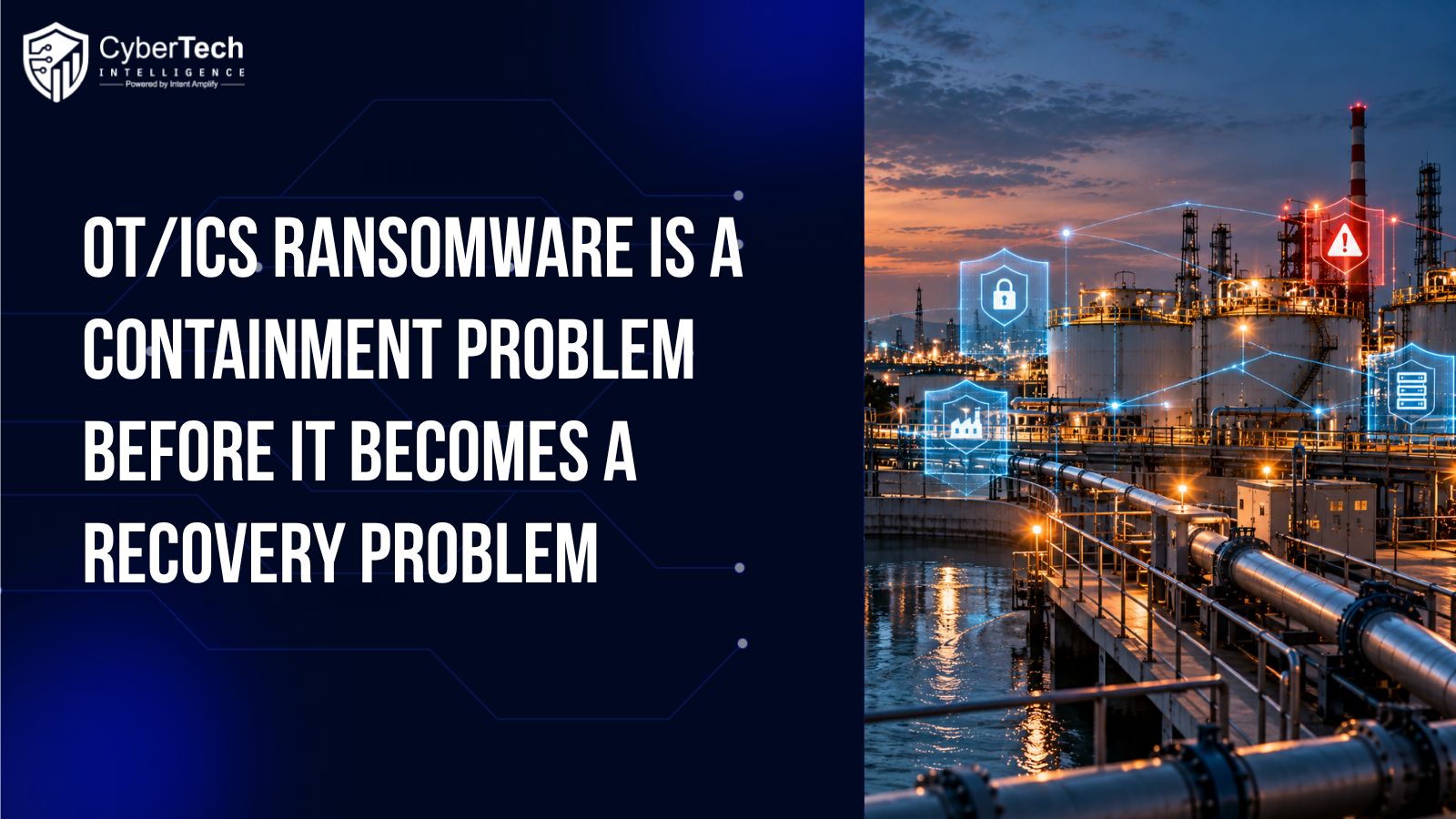
At a Glance
-
CISA recommends maintaining separation between information technology (IT) and operational technology (OT) and using logical or physical network segmentation. CISA states that segmentation can help contain the impact of an intrusion and prevent or limit lateral movement. [1]
-
NIST SP 1339, published in June 2026, states that effective OT backup management includes creating backups regularly, testing them, and reviewing them during recovery exercises. [2]
-
The UK NCSC's 2026 secure-connectivity guidance for OT identifies zoned or segmented network architecture as an effective way to reduce the impact of compromise by containing threats within the zone where they originate. [3]
-
CyberTech Intelligence view: industrial ransomware resilience depends on more than a firewall boundary. Leaders need a current map of required communications, a safe isolation plan, trusted recovery evidence, and clear authority for the decisions that can interrupt or restore production.
Segmentation Has to Preserve Operations, Not Just Block Traffic
In OT, segmentation is not simply a technical exercise in creating more network zones. Every permitted connection can support a production dependency, a safety function, a vendor workflow, a historian, or an engineering task. Effective segmentation therefore starts by documenting what must communicate, why it must communicate, and what operational consequence follows if that path is interrupted.
CISA's ransomware guidance pairs IT/OT separation with network diagrams and data-flow awareness because segmentation works only when required paths and dependencies are understood. A design that blocks an unsafe path but also removes visibility, control, or an essential process dependency can create a different operational problem. [1]
Containment Decisions Need an OT View of Consequence
When ransomware pressure reaches an industrial environment, the fastest technical action is not always the safest operational action. Isolating a workstation, remote-access path, engineering station, or plant network can reduce attacker reach, but the same action may affect monitoring, quality, maintenance, or safe operation. The decision should therefore connect cyber evidence to the process consequence before broad isolation is executed.
The NCSC's 2026 OT guidance recommends layered defenses, strong boundary controls, restricted traffic between zones, and segmentation designed around function. That supports a containment model in which the response team can narrow an attack path without treating every OT asset as interchangeable. [3]
Recovery Begins Before Ransomware Arrives
OT recovery depends on more than copying files. Teams may need controller logic, configurations, engineering workstations, historian data, network-device settings, vendor documentation, safety requirements, and the credentials required to rebuild or validate the environment. Recovery planning should therefore be tied to change management and to the systems that make the physical process observable and controllable.
NIST SP 1339 recommends regular backup creation, backup testing, and review during recovery exercises. It also highlights engineering documentation as part of layered recovery preparation. The practical lesson is that a backup is useful only when the organization can trust it, understand what it restores, and use it within the operational recovery sequence. [2]
Internet-Exposed Control Devices Change the Urgency
A July 2026 FBI and EPA public-service announcement warned that malicious actors were targeting internet-facing programmable logic controllers in the U.S. water and wastewater sector and reported operational degradation at some affected utilities. The agencies recommended removing direct internet exposure, using secure gateways and firewalls, setting strong unique passwords, and restricting communications to authorized devices. [4]
The alert is a reminder that segmentation begins at the boundary. A control device that is directly reachable from the internet can bypass assumptions about layered defenses. Dragos’ 2026 OT cybersecurity research separately describes ransomware-related operational disruption within the industrial environments it observes; that vendor dataset is used here only within its stated methodology. [5] Asset owners should verify external exposure, remote-access routes, shared configurations, and third-party connectivity before an incident forces those questions into an emergency response.
Use a Five-Step Segmentation and Recovery Check
The following CyberTech Intelligence path is an operating model, not an external standard, certification, product rating, or prediction of incident outcome. It is designed to connect segmentation decisions to operational consequence and recovery evidence.
Figure 1. CyberTech Intelligence Segmentation and Recovery Action Path
|
Step |
Leadership Question |
Minimum Evidence |
Decision |
|---|---|---|---|
|
1. Prepare |
Which critical services and OT zones must remain available? |
Critical services, process dependencies, network diagrams, safety constraints, minimum viable operations. |
Define required communications and the operational boundary for containment. |
|
2. Segment |
Which communications are truly required between IT, OT, vendors, and zones? |
Approved data flows, protocols, remote-access routes, owners, exceptions, third-party connections. |
Allow only necessary paths and document why each exception exists. |
|
3. Contain |
What can be isolated safely if ransomware or suspicious access is detected? |
Current process state, safety impact, alternate control, isolation route, stop authority, rollback plan. |
Isolate the narrowest effective scope while preserving process safety and evidence. |
|
4. Recover |
What trusted information and configurations are required to restore priority operations? |
Tested backups, controller logic, configurations, engineering documents, clean credentials, recovery sequence. |
Restore by process priority and validate integrity before expanding connectivity. |
|
5. Verify |
What evidence proves the recovered zone can return to service safely? |
Identity state, configuration integrity, expected communications, monitoring, owner approval, residual risk. |
Reconnect gradually, monitor for re-compromise, and record the decision evidence. |
What Good OT/ICS Ransomware Readiness Looks Like
-
Current network and data-flow diagrams show the connections required for critical operations.
-
Segmentation rules are tied to named owners, approved business needs, and reviewable exceptions.
-
Isolation actions have been tested with engineering and operations, not only with IT.
-
Critical services have a defined minimum viable operating state and a recovery sequence.
-
OT backups, logic, configurations, and engineering documents are tested as part of recovery exercises.
-
Return-to-service decisions record what was verified, what remained uncertain, and who accepted residual risk.
Run the 20-Minute Segmentation and Recovery Walkthrough
Choose one critical industrial service. Map the IT, OT, vendor, and remote-access connections it depends on. Identify which path could be isolated first, what production or safety effect that isolation would create, and which backups or engineering records would be required to restore the service. Any answer that depends on assumption rather than current evidence becomes a resilience action for the next review.
About CyberTech Intelligence
CyberTech Intelligence provides research-led cybersecurity intelligence, executive content, and market engagement programs. This publication is vendor-neutral and intended for education, decision support, and claim-safe GTM planning.
Evidence and Citation Note
External sources are used only within their stated scope. Government guidance is treated as control and recovery guidance; threat-intelligence and incident data remain limited to the populations observed by the publisher. CyberTech Intelligence does not infer that a named organization has suffered an OT/ICS ransomware incident, has weak segmentation, lacks recovery capability, or has an active buying project without direct evidence.
References
- Cybersecurity and Infrastructure Security Agency, "#StopRansomware Guide," current guide. https://www.cisa.gov/stopransomware/ransomware-guide (Accessed September 28, 2026. Relevance: U.S. government ransomware guidance covering IT/OT separation, network segmentation, network diagrams, lateral-movement containment, and response practices.)
- National Institute of Standards and Technology, "SP 1339, OT Backup Quick Start Guide," June 2026. https://csrc.nist.gov/pubs/sp/1339/final (Accessed September 28, 2026. Relevance: final NIST guidance on OT backup creation, testing, change-management integration, recovery exercises, and engineering-document preparation.)
- UK National Cyber Security Centre, "Secure connectivity principles for operational technology (OT) - Principle 6: Limit the impact of compromise," January 14, 2026. https://www.ncsc.gov.uk/collection/operational-technology/secure-connectivity/principle-6 (Accessed September 28, 2026. Relevance: current OT guidance on zoned architecture, segmentation, boundary controls, and containment of compromise.)
- Federal Bureau of Investigation and Environmental Protection Agency, "Malicious Cyber Actors Targeting Water and Wastewater Sector Internet-Facing Programmable Logic Controllers, Causing Operational Disruptions," July 30, 2026. https://www.fbi.gov/investigate/cyber/alerts/2026/malicious-cyber-actors-targeting-water-and-wastewater-sector-internet--facing-programmable-logic-controllers-causing-operational-disruptions (Accessed September 28, 2026. Relevance: observed U.S. water-sector PLC targeting and recommended controls for internet exposure and authorized communications.)
- Dragos, "2026 OT Cybersecurity Year in Review," 2026. https://www.dragos.com/ot-cybersecurity-year-in-review (Accessed September 28, 2026. Relevance: OT/ICS threat research based on Dragos observations, including ransomware-related operational disruption and visibility limitations; used only within the report's stated methodology.)
Author
CyberTech Intelligence Research Desk
Author