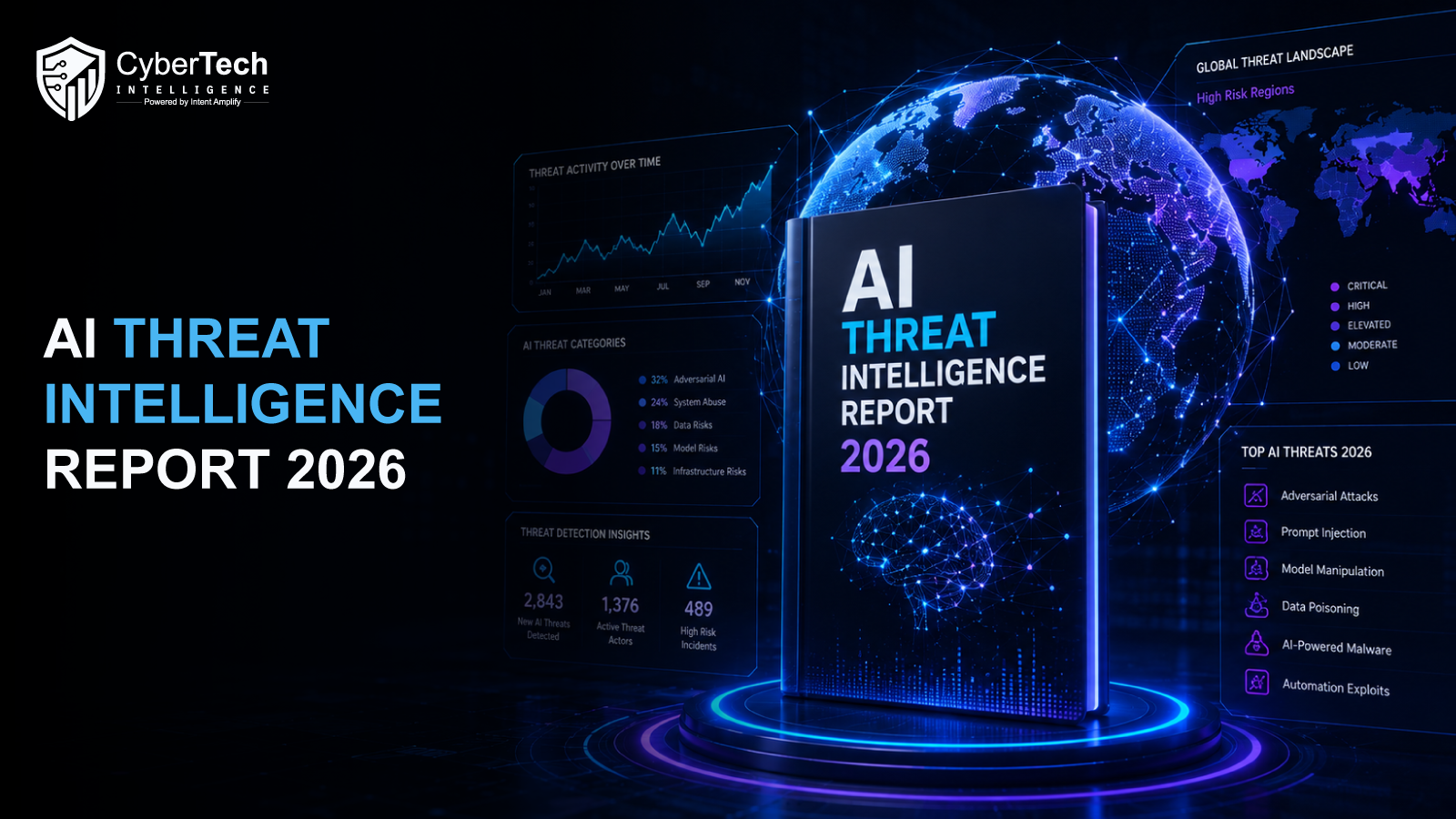
Executive Summary
AI cyber attacks are not creating an entirely new threat universe. The more immediate change is narrower and more commercially important: AI is reducing the time, cost, and skill required to execute familiar attack patterns across reconnaissance, social engineering, vulnerability exploitation, credential theft, cloud intrusion, prompt injection, and post-compromise automation.
For cybersecurity marketers, sales leaders, and product teams, this changes the reportable value of AI threat intelligence. Enterprise buyers are not asking whether AI security matters. They are asking which risks are measurable, which controls reduce exposure, and which cybersecurity providers can turn AI threat intelligence into faster operational decisions.
The evidence supports a shift from broad “AI-powered security” claims toward control-specific positioning. IBM reported that the global average cost of a data breach was $4.4 million in 2025, while organizations using AI and automation extensively in security saw $1.9 million in cost savings compared with organizations that did not use those capabilities. IBM also found that 97% of organizations reporting an AI-related security incident lacked proper AI access controls, and 63% lacked AI governance policies. [1]
Threat activity shows the same pressure from the adversary side. CrowdStrike reported an 89% increase in attacks from AI-enabled adversaries, while 82% of detections were malware-free, and zero-day vulnerabilities were exploited. [2]
Microsoft reported that attackers sought to steal data in 80% of cyber incidents investigated by its teams and that at least 52% of known-motive incidents were driven by extortion or ransomware. [3]
The strategic implication is clear: AI threat intelligence must become operational intelligence. Leaders who present AI as a feature will struggle to differentiate. Teams that show how AI threat intelligence improves identity threat detection, AI vulnerability exploitation management, prompt injection prevention, cloud threat intelligence, and AI security operations will have a stronger story for executive buyers.
Industry Overview
The AI security market is entering a more disciplined phase. Enterprise buyers have moved beyond curiosity toward measurable control outcomes. The strongest commercial narratives in 2026 will not describe AI as a standalone capability. They will explain how AI changes attacker behavior, where exposure increases, and which controls reduce operational risk.
This matters because AI-enabled attack activity crosses several security domains. A single intrusion path may include public research on a target, AI-generated social engineering, stolen credentials, exploited edge infrastructure, cloud misuse, and data theft. In enterprise AI environments, attackers may also target prompts, retrieval pipelines, connected tools, model-access permissions, and sensitive data stores.
The United States remains the primary commercial market because it concentrates cybersecurity leaders, enterprise AI adoption, and board-level risk scrutiny. The United Kingdom adds a strong, secure-by-design and operational resilience lens through NCSC guidance. Canada brings a pragmatic emphasis on safe generative AI use, access control, and organizational readiness. A strong GTM narrative should reflect these differences instead of treating North America and the UK as one generic market.
Current Market Landscape
The AI security market is best understood as a set of overlapping control planes: identity, cloud, vulnerability management, security operations, and enterprise AI applications.
Identity is the most urgent control plane. Microsoft reported that identity-based attacks increased by 32% in the first half of 2025 and that more than 97% of identity attacks were password attacks. The implication is not simply that organizations need stronger authentication. AI-powered credential theft, synthetic identity abuse, deepfake-enabled help desk manipulation, and session-token theft make identity a central detection and response priority. [3]
Cloud exposure is changing as well. Google Cloud Mandiant reported that exploits remained the most common initial infection vector at 32% of identified cases, while voice phishing rose to 11% and email phishing declined to 6%. The shift indicates that attackers are combining technical exploitation with more interactive social engineering, which can be harder for conventional email and endpoint controls to interrupt. [4]
Vulnerability management is becoming more intelligence-dependent. Recorded Future reported 23,667 CVEs in the first half of 2025, a 16% increase from H1 2024. Of 161 actively exploited vulnerabilities, 42% had public proof-of-concept exploit code, nearly 69% required no authentication, and 30% enabled remote code execution. These figures strengthen the case for exploitability-based prioritization rather than scan-volume reporting. [5]
Enterprise AI applications introduce a newer exposure layer. Check Point reported that 1 in 80 GenAI prompts exposed sensitive data to attackers and that 7.5% of prompts included sensitive or private details. Prompt injection, data leakage, retrieval abuse, model manipulation, and unsafe tool use are not only model-security issues. They are workflow, data governance, and access-control issues. [6]
Key Findings
1. AI Is Accelerating Known Attack Paths
The evidence does not suggest that AI has replaced conventional cyber tradecraft. It suggests that AI makes existing methods faster and more scalable. Attackers can use AI to improve reconnaissance, generate believable lures, summarize stolen data, support multilingual deception, and automate parts of malware or exploit development.
CrowdStrike’s finding that 82% of detections were malware-free reinforces the point. The most difficult activity to detect often resembles legitimate access rather than traditional malware execution. [2]
2. Identity Risk Is Becoming the Center of AI Defense
Adversaries are not abandoning identity. They are improving the economics of identity compromise. Password attacks, credential leaks, session theft, and social engineering remain attractive because they are cheaper than complex exploitation when identity controls are weak.
The stronger positioning opportunity is to frame Identity Threat Detection as a defense against AI-assisted access abuse. Product teams can connect this to privileged accounts, service accounts, cloud identities, third-party access, and non-human identities.
3. Prompt Injection Is Moving Into Enterprise Risk Management
OWASP defines prompt injection as the manipulation of model responses through inputs that alter behavior, including attempts to bypass safeguards. NIST’s Generative AI Profile places prompt injection and related GenAI risks within broader AI risk management practices. [7] [8]
As large language models connect to enterprise applications, data, and autonomous workflows, prompt injection becomes a business systems risk. Security teams need controls for prompt monitoring, retrieval, isolation, tool permissioning, output validation, and human review for high-impact actions.
4. AI Security Operations Must Prove Operational Value
IBM’s breach-cost findings support the business case for AI security operations, but only when interpreted carefully. The value is not that AI automatically improves security. The value comes from faster triage, stronger enrichment, better prioritization, reduced analyst load, and more consistent containment. [1]
A more defensible GTM narrative would emphasize measurable operating outcomes: lower alert fatigue, faster investigation, stronger incident context, reduced dwell time, and clearer executive reporting.
5. Governance Gaps Are Becoming Security Gaps
AI governance cannot remain a policy artifact. IBM’s findings on missing AI access controls and governance policies show that weak governance can become an attack-surface problem. [1]
NIST’s AI Risk Management Framework, UK NCSC secure AI development guidance, and Canadian Cyber Centre generative AI guidance all point toward lifecycle security, risk-based governance, and practical control maturity.
CyberTech Intelligence Perspective
CyberTech Intelligence assesses AI threat intelligence as a core capability for understanding how adversaries compress the attack lifecycle. AI accelerates reconnaissance, credential targeting, vulnerability analysis, social engineering, and post-compromise activity, reducing the time available for detection and response.
This represents an operational risk shift. AI-enabled attacks place greater pressure on identity controls, cloud telemetry, vulnerability prioritization, prompt injection defenses, and SOC workflows. The value of AI threat intelligence extends beyond monitoring; it helps security teams identify the exposures most likely to be exploited and prioritize the controls that require immediate attention.
Analysis
The AI threat intelligence market in 2026 will favor cybersecurity vendors that connect three operational layers: adversary behavior, enterprise exposure, and buyer action.
Adversary behavior explains how AI changes attack execution. AI accelerates reconnaissance, phishing, exploit research, malware refinement, synthetic media generation, and operational support for less sophisticated threat actors. It also enables attacks against enterprise AI through prompt injection, retrieval manipulation, data leakage, and unsafe agentic behavior.
Enterprise exposure identifies where those attacks are most likely to succeed. Security teams need visibility into identities, cloud assets, internet-facing systems, AI applications, datasets, autonomous agents, and third-party integrations. Broad claims of AI-powered protection provide little value without exposure context.
Buyer action converts intelligence into measurable risk reduction. Security leaders need control-specific outcomes: block a suspicious sign-in, isolate an exposed workload, prioritize an exploitable vulnerability, restrict a model connector, quarantine a malicious prompt, or contain an intrusion before lateral movement expands.
Four Operational Challenges for AI Threat Intelligence
Attack-Speed Asymmetry
AI enables adversaries to accelerate reconnaissance, generate convincing social engineering campaigns, analyze exposed systems, and test intrusion paths at greater speed and scale. Security operations that depend on delayed investigation or fragmented telemetry risk losing valuable response time before initial access progresses to privilege abuse or data theft.
Identity Exposure
Many AI-assisted attacks rely on stolen credentials, session tokens, impersonation, and social engineering rather than sophisticated malware. Identity behavior, access governance, privileged account oversight, and session monitoring therefore become central to detecting and disrupting these campaigns.
Enterprise AI Application Risk
As large language models connect to enterprise data, knowledge repositories, APIs, and workflow platforms, prompt injection and unsafe model actions become operational security risks. Exposure extends beyond the model to the systems it can access, the information it can retrieve, and the actions it can execute.
Governance Execution
Policies establish intent, but governance depends on operational controls. Organizations benefit from maintaining AI asset inventories, enforcing access controls, monitoring prompts, evaluating third-party AI services, collecting security telemetry, and integrating AI-enabled scenarios into incident response. Without these capabilities, AI threat intelligence provides visibility but limited operational advantage.
Opportunities
Predictive, Risk-Based Prioritization
AI threat intelligence enables security teams to identify the assets, identities, vulnerabilities, cloud services, and AI applications most likely to be targeted. This shifts threat intelligence from passive monitoring to risk-based prioritization, helping defenders focus resources where exploitation is most probable.
Identity-Centric Defense
Many AI-assisted attacks rely on credential abuse, session theft, impersonation, and social engineering rather than sophisticated malware. AI threat intelligence strengthens identity behavior analytics, privileged access monitoring, phishing-resistant authentication, and account risk scoring to reduce exposure across the identity layer.
Intelligence-Led Vulnerability Management
AI accelerates exploit research and vulnerability analysis for attackers. However, it also enables defenders to prioritize vulnerabilities based on active exploitation, public proof-of-concept availability, remote code execution potential, and business impact. This improves remediation decisions by aligning them with operational risk rather than severity scores alone.
Enterprise AI Application Protection
As large language models connect to business data, APIs, workflow platforms, and knowledge repositories, AI threat intelligence helps identify prompt injection attempts, excessive tool permissions, sensitive data exposure, and weaknesses in model access controls before they become high-value attack paths.
Security Operations Modernization
AI threat intelligence enriches investigations with faster triage, stronger identity and cloud correlation, improved incident context, and earlier detection of anomalous behavior. The outcome is not a higher volume of alerts but better operational decisions about what to investigate, contain, and escalate.
CyberTech Intelligence Research Desk Observation
CyberTech Intelligence Research Desk observes that AI threat intelligence is moving from a technical intelligence discipline into a broader enterprise security requirement. As AI-assisted attacks become faster and more adaptive, security teams need more than threat feeds or generic AI risk awareness. They need intelligence that explains attacker behavior, exposes control gaps, and assesses likely business impact.
The most important development is the convergence of AI-enabled threats with existing enterprise weaknesses. Credential abuse, exploitable vulnerabilities, cloud misconfigurations, weak access governance, and unsafe GenAI workflows remain familiar risks. AI changes its velocity and scale. This means the strongest security response will come from connecting AI threat intelligence to practical control decisions across identity, vulnerability management, cloud security, AI application security, and incident response.
Executive Transformation Scorecard
|
Priority Area |
Executive Question |
Practical Control Priority |
|
AI Threat Intelligence |
How are adversaries using AI to accelerate known attack paths? |
Map AI-enabled tradecraft to detection, response, and control validation. |
|
Identity Threat Detection |
Which accounts, service identities, and privileged paths create the greatest exposure? |
Monitor abnormal access, privilege misuse, and identity-based lateral movement. |
|
AI Vulnerability Exploitation |
Which exposed systems could be exploited faster than current remediation cycles allow? |
Combine exploit intelligence, asset criticality, and compensating control validation. |
|
Prompt Injection |
What can AI systems access, retrieve, or trigger if manipulated? |
Limit permissions, isolate context, monitor outputs, and require approval for high-impact actions. |
|
AI Security Operations |
Where does the attacker's speed exceed current investigation capacity? |
Improve correlation across endpoint, identity, cloud, SaaS, and data telemetry. |
Move From AI Threat Visibility to the CyberTech Intelligence AI Threat Intelligence Framework
The scorecard shows where AI threat intelligence must become more operational: identity risk, prompt injection prevention, vulnerability prioritization, cloud threat intelligence, and AI security operations. For cybersecurity teams and GTM leaders, the next step is not only identifying these risk areas but organizing them into a repeatable framework that connects threat evidence to security priorities, control maturity, buyer education, and executive decision-making.
The CyberTech Intelligence AI Threat Intelligence Framework™ provides that structure. It helps security leaders evaluate how AI-enabled threats affect enterprise exposure, where existing controls are under pressure, and which operational priorities should guide investment, messaging, and market education.
Use the framework to connect AI threat signals to five execution areas: adversary behavior, identity exposure, AI application risk, vulnerability exploitation, and security operations maturity.
Access the CyberTech Intelligence AI Threat Intelligence Framework
Conclusion
AI cyber attacks are changing the economics of adversary activity. The core risks are familiar, but the speed and scale are different. Attackers can research faster, deceive more convincingly, exploit more efficiently, and operate across identity, cloud, vulnerability, and AI application surfaces with less friction.
For cybersecurity leaders and vendors, the opportunity is substantial but not automatic. The market does not need another broad AI security narrative. It rewards intelligence that explains enterprise exposure, attacker behavior, control priorities, and measurable security outcomes.
AI Threat Intelligence Executive Assessment
CyberTech Intelligence helps cybersecurity vendors and enterprise security teams convert AI threat intelligence into executive-ready market narratives, research assets, and demand-generation programs. The focus is not simply explaining AI cyber attacks. It is helping leaders connect threat evidence to control priorities, buyer urgency, operational maturity, and measurable security outcomes.
The AI Threat Intelligence Executive Assessment evaluates how well an organization’s narrative, research, and market education strategy addresses AI-enabled attacker behavior, identity risk, prompt injection exposure, cloud threat intelligence, vulnerability exploitation, AI security operations, and governance maturity.
CyberTech Intelligence supports this through:
- Executive briefings that translate AI threat intelligence into CISO- and board-relevant narratives.
- Content syndication assets that position AI cyber attacks, adversarial AI, and AI vulnerability exploitation around measurable buyer pain points.
- Market education programs that explain prompt injection prevention, identity threat detection, and AI security operations without hype.
- Demand-generation messaging that connects threat evidence to product categories, urgency signals, and sales follow-up logic.
- GTM content strategy that aligns AI security themes with buyer expectations
Build an Evidence-Led AI Threat Intelligence thought leadership with CyberTech Intelligence
References
- IBM (2025) Cost of a Data Breach Report 2025. Available at: https://www.ibm.com/reports/data-breach.
- CrowdStrike (2026) Global Threat Report. Available at: https://www.crowdstrike.com/en-us/global-threat-report/.
- Microsoft (2025) Extortion and Ransomware Drive Over Half of Cyberattacks. Available at: https://blogs.microsoft.com/on-the-issues/2025/10/16/mddr-2025/.
- Google Cloud Mandiant (2026) M-Trends 2026 Report: Executive Edition. Available at: https://cloud.google.com/security/resources/m-trends-executive-edition.
- Recorded Future (2025) H1 2025 Malware and Vulnerability Trends. Available at: https://www.recordedfuture.com/research/h1-2025-malware-and-vulnerability-trends.
- Check Point (2025) AI Security Report 2025. Available at: https://engage.checkpoint.com/2025-ai-security-report.
- OWASP (2025) LLM01: 2025 Prompt Injection. Available at: https://genai.owasp.org/llmrisk/llm01-prompt-injection/.
- NIST (2024) Artificial Intelligence Risk Management Framework: Generative Artificial Intelligence Profile. Available at: https://nvlpubs.nist.gov/nistpubs/ai/NIST.AI.600-1.pdf.