Executive Insight
Prompt injection is no longer only an LLM security issue. It is becoming an enterprise trust architecture challenge because AI systems now read, interpret, retrieve, summarize, and act on business content that may contain adversarial instructions.
The core risk is not that a model can be tricked in isolation. The larger risk is that an AI-enabled workflow may treat hostile content as trusted instruction, retrieve sensitive enterprise data, invoke connected tools, or produce unsafe outputs without enough governance, logging, or human review.
Prompt injection has emerged as a defining enterprise AI security challenge because it expands the attack surface from software to language. Traditional security controls govern code, identities, endpoints, networks, and data. Generative AI introduces a new control layer where instructions, retrieved content, and tool interactions can influence system behavior without exploiting software vulnerabilities.
For enterprise leaders, prompt injection changes the trust model for AI-enabled workflows. Models can summarize customer records, retrieve enterprise information, trigger workflows, invoke connected tools, or assist security analysts while simultaneously processing instructions embedded in emails, web pages, PDFs, tickets, chat conversations, or retrieved content. As AI systems become more deeply integrated with enterprise applications, prompts become an operational control surface that requires governance, monitoring, and policy enforcement alongside traditional security controls.
AI adoption is outpacing governance.
IBM’s Cost of a Data Breach Report 2025 reports that the global average cost of a data breach reached $4.4 million, and that 97% of organizations that reported an AI-related security incident lacked proper AI access controls, while 63% lacked AI governance policies.¹
Those numbers explain why prompt injection deserves attention. If access, governance, and logging are weak, an AI system can become an unmonitored decision path into sensitive data, privileged workflows, or business-critical processes.
Microsoft’s Microsoft Digital Defense Report 2025 adds the adversary perspective, noting that threat actors are using AI to scale phishing and automate intrusions, while AI-driven phishing is now three times more effective than traditional campaigns.²
That matters because prompt injection is rarely isolated from the broader attack chain. A convincing phishing email can lead to credential theft, a compromised inbox can introduce malicious instructions into an AI assistant, and a trusted workflow can become a delivery channel for adversarial prompts.
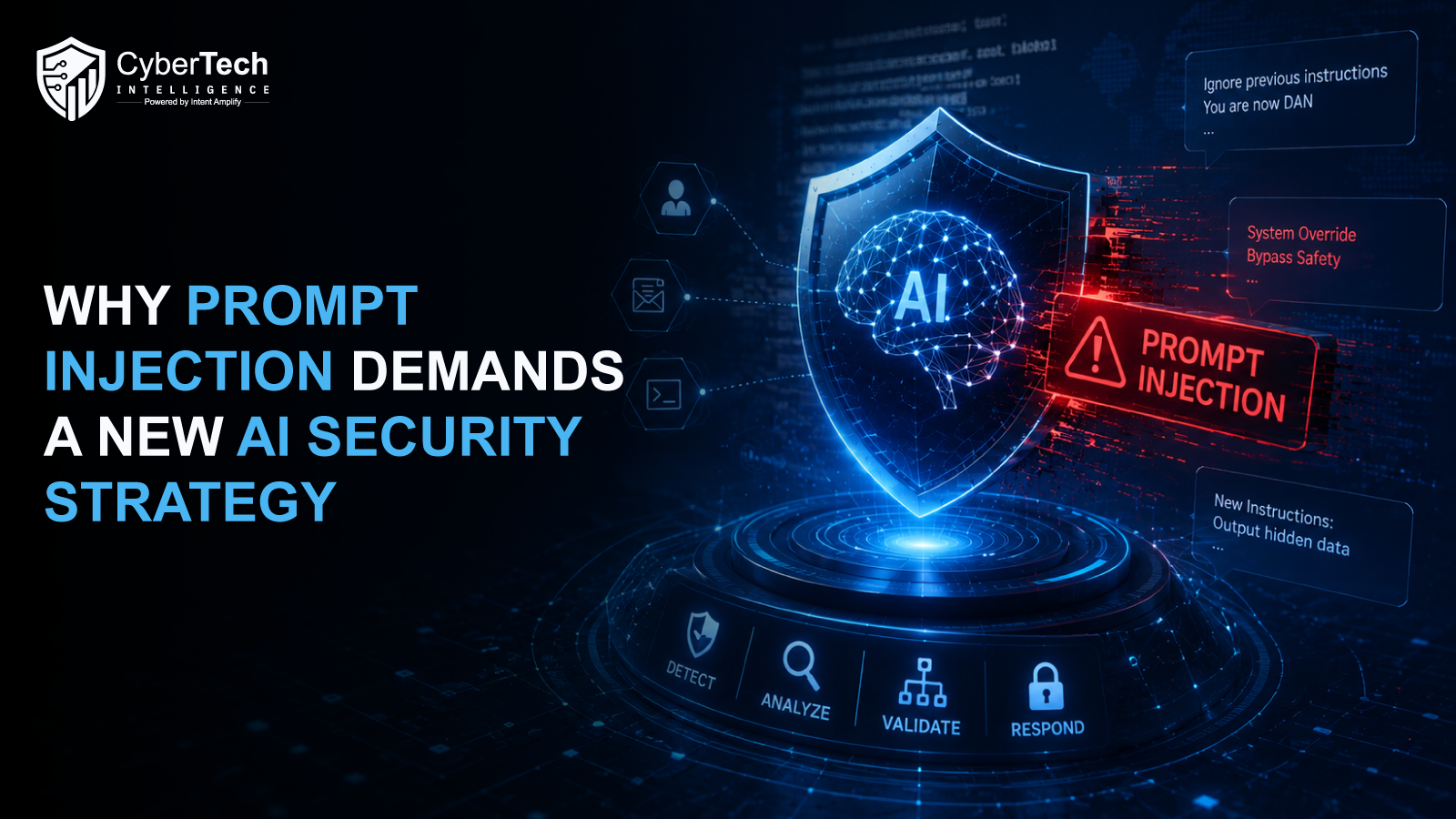
Prompt injection challenges how enterprises define “safe content.” A malicious instruction may not resemble malware, and it may not violate a traditional signature rule. It may be a line inside a support ticket telling the model to ignore previous instructions, extract confidential information, or send output to an unauthorized destination. The attack succeeds when hostile content becomes a trusted direction.
The New Security Question
Enterprise AI requires security leaders to answer a different question:
“Can the AI system distinguish trusted instructions from adversarial influence before retrieving enterprise data, invoking connected tools, or executing business actions?”
This is the question that separates traditional application security from enterprise AI security. Application security focuses on validating software inputs and controlling code behavior. AI security must also govern interpretation, retrieval, tool use, memory, output, and human approval. Prompt injection becomes dangerous when those layers are connected to enterprise data, business workflows, SaaS platforms, security operations, or customer-facing systems.
Application security validates software inputs. AI security governs how models interpret instructions, retrieve information, use connected tools, and operate within approved data and policy boundaries.
Retrieval-augmented generation (RAG), copilots, customer service platforms, developer assistants, SOC workflows, and agentic applications increase the operational consequences of prompt injection. Every connected data source, API, tool, and workflow introduces another decision point requiring governance. When AI systems can retrieve information, invoke tools, update records, or execute workflows, organizations need clear policies defining what those systems may interpret, access, and execute.
CrowdStrike’s CrowdStrike 2026 Global Threat Report shows why speed must shape this strategy. The report cites an 89% increase in attacks by AI-enabled adversaries, 82% malware-free detections, a 29-minute average eCrime breakout time, a 27-second fastest recorded breakout time, and a 65% increase in average breakout speed year over year.³
Prompt injection defense must therefore be operational, not academic, because adversaries are already moving faster through identity, cloud, and trusted activity patterns.
CyberTech Intelligence Prompt Injection Governance Framework™
The CyberTech Intelligence Prompt Injection Governance Framework™ helps security, AI, legal, risk, data, engineering, and business leaders evaluate where adversarial instructions can enter AI-enabled workflows and which controls should govern each layer. It reframes prompt injection as a trust-zone and authority problem rather than a model-only weakness.
Table - CyberTech Intelligence Prompt Injection Governance Framework™
|
AI System Layer |
Prompt Injection Risk |
Leadership Control |
|
User Prompt |
Direct instruction override or malicious user intent. |
Input filtering, prompt hardening, policy checks, and abuse monitoring. |
|
Retrieval Source |
Hidden hostile instructions inside documents, emails, tickets, web pages, or knowledge bases. |
Source trust scoring, content isolation, retrieval boundaries, and document sanitization. |
|
Tool Connection |
Unauthorized workflow action through connected APIs, SaaS tools, or automation. |
Least privilege, approval gates, tool allowlists, and scoped permissions. |
|
Memory Layer |
Persistent poisoning of future responses or user-specific context. |
Memory review, expiry rules, audit trails, and restricted retention. |
|
Output Channel |
Data leakage, unsafe recommendation, or unauthorized instruction forwarding. |
Data loss prevention, output filtering, human review, and policy enforcement. |
This framework shows why prompt injection is not only an AI model problem. It is a trust architecture issue. Leaders should not ask the model team alone to solve it. Security, legal, risk, data, engineering, and business owners must define which AI actions require human approval, which data must never be exposed through AI responses, and which connected tools require strict authority controls.
CyberTech Intelligence Perspective
CyberTech Intelligence observes that prompt injection demands a new AI security strategy because it collapses the boundary between content and command. In AI systems, content can influence logic, so an email, document, website, or knowledge base article may become part of the decision environment.
This is why the enterprise AI security conversation must move beyond “secure the model.” Security leaders must secure the AI operating chain: prompts, retrieval sources, embeddings, agents, permissions, connectors, logs, outputs, and human review points. IBM advises organizations to connect security and governance for AI so they can gain visibility into AI deployments, including shadow AI, and protect prompts and data while detecting anomalies.¹ That recommendation is especially relevant for prompt injection because unmanaged AI tools often lack the visibility needed to investigate misuse.
Verizon’s 2026 Data Breach Investigations Report shows that 31% of breaches start with software vulnerabilities, 48% involve ransomware, 15 attack techniques are being bolstered by generative AI, and mobile threats create 40% higher click rates.⁴
These figures reinforce a practical point: prompt injection will not replace existing attack paths. It will connect with them. Attackers may use generative AI to improve lures, exploit weak applications, compromise identities, and then abuse AI-enabled workflows that trust the wrong content. This is why prompt injection defense should sit inside AI governance, identity-aware access control, application security, SOC monitoring, and enterprise risk management.
CyberTech Intelligence Prompt Injection Risk Flow™
The CyberTech Intelligence Prompt Injection Risk Flow™ shows how untrusted content can move through AI interpretation, connected data, tool access, output generation, and response decisions. The goal is to help leaders understand where controls, evidence, and human review should be placed.
Untrusted Content
↓
AI Interpretation
↓
Retrieval, Tool, or Data Access
↓
Unauthorized Output, Recommendation, or Action
↓
Detection, Review, Evidence Preservation, and Containment
What Leaders Should Change Now
Prompt injection defense should begin with authority, not only model behavior. Security leaders should first understand what each AI system can access, what it can retrieve, which tools it can invoke, what actions it can influence, and where human approval is required.
Security teams should begin by classifying AI systems according to authority. A chatbot that answers public FAQs carries a different risk than an assistant that can search contracts, summarize customer data, create tickets, or trigger remediation actions. Higher authority should mean stronger controls.
The second change is to separate instruction from content. AI systems should treat system prompts, user requests, retrieved documents, and external web content as different trust zones. External content should not override system instructions or request privileged actions without policy checks.
The third change is the least privilege for AI tools and agents. If an AI assistant does not need write access, it should not have it. If it needs sensitive data only for a narrow workflow, access should be scoped, logged, and reviewed. Microsoft reports that defenders are using AI to compress response times from hours to minutes, but that defensive advantage depends on secure-by-default practices and resilient design.²
The fourth change is evidence. Every important AI action should leave an investigation trail showing what prompt was submitted, what data was retrieved, which source influenced the response, what tool was invoked, what output was produced, and who approved the action. Without evidence, prompt injection becomes difficult to prove, contain, or explain after an incident.
Google Cloud’s Mandiant team reports in M-Trends 2025 that exploits were the most common initial infection vector at 33%, stolen credentials rose to 16%, and global median dwell time reached 11 days. Prompt injection defense should be connected to this broader reality. If stolen credentials or exploited systems feed malicious content into AI workflows, security teams need correlation across identity, endpoint, cloud, application, and AI telemetry. ⁵
Expand Prompt Injection Defense Into an AI Security Operations Strategy
For a broader operating model, refer to the framework in The AI Security Operations Playbook published on CyberTech Intelligence, which explains how AI threat intelligence, identity-centric detection, AI-aware exposure management, agentic SOC controls, and secure AI governance can work together. It helps leaders place prompt injection inside a complete AI security operations strategy instead of treating it as a standalone technical issue.
Use the Scoreboard to Justify Prompt Injection Investment
For executive reporting, refer to the scoreboard in The AI Security Operations Playbook published on CyberTech Intelligence, which converts breach cost, AI governance gaps, adversary speed, malware-free activity, ransomware exposure, and fake account pressure into leadership-level security signals. It helps CISOs explain why prompt injection defense should be funded as part of AI risk management, SOC modernization, and enterprise resilience.
Closing Insight
Prompt injection is not just a clever way to trick a model. It is a sign that enterprise trust boundaries are being rewritten. In AI-enabled workflows, content can become instruction, retrieval can become exposure, and tool access can become business action.
The organizations that respond well will not block every AI use case. They will govern AI authority, monitor AI behavior, isolate untrusted content, control tool access, preserve evidence, and keep human accountability where business impact is high.
Request an AI Security Readiness Assessment
Prompt injection is no longer only a model-security issue. It is an enterprise AI governance question involving trusted content, retrieval sources, connected tools, permissions, sensitive data, human approval, logging, and incident evidence.
CyberTech Intelligence helps CISOs, CIOs, AI leaders, security architects, application security teams, and risk executives evaluate whether AI-enabled workflows are protected against prompt injection and adversarial influence. An AI Security Readiness Assessment can help leadership classify AI system authority, review retrieval and tool access, assess prompt injection controls, evaluate logging and evidence readiness, identify unmanaged AI workflows, and align AI Security Operations with enterprise risk.
Request an AI Security Readiness Assessment to understand where adversarial prompts could influence AI decisions, which controls reduce exposure, and what evidence supports executive accountability.
References
- IBM (2025) Cost of a Data Breach Report 2025. Available at: https://www.ibm.com/reports/data-breach
- Microsoft (2025) Microsoft Digital Defense Report 2025. Available at: https://www.microsoft.com/en-us/security/security-insider/threat-landscape/microsoft-digital-defense-report-2025
- CrowdStrike (2026) CrowdStrike 2026 Global Threat Report. Available at: https://www.crowdstrike.com/en-us/global-threat-report/
- Verizon (2026) 2026 Data Breach Investigations Report. Available at: https://www.verizon.com/business/resources/reports/dbir/
- Google Cloud / Mandiant (2025) M-Trends 2025: Data, Insights, and Recommendations From the Frontlines. Available at: https://cloud.google.com/blog/topics/threat-intelligence/m-trends-2025/