AI Governance Is Leaving the Policy Room
AI governance can no longer remain inside the policy room. Policy approval establishes intent, but runtime behavior proves whether that intent remains valid after deployment. As AI workloads move into production cloud environments, governance must follow them into live data access, cloud identities, APIs, containers, Kubernetes clusters, developer pipelines, and multi-cloud infrastructure.
The executive question is no longer only “Was this AI workload approved?” It is “Can we prove how this AI workload behaves while it is running?”
Runtime introduces a different governance challenge. A model can pass a governance review and still create runtime exposure. An AI workload can be deployed in a compliant cloud account and still call an unexpected API, access sensitive data, inherit excessive permissions, or trigger downstream actions that were never part of the original risk assessment.
CrowdStrike’s 2026 Global Threat Report shows why this matters. The report found a 266% increase in cloud-conscious intrusions by state-nexus threat actors, while 40% of vulnerabilities exploited by China-nexus adversaries targeted edge devices. It also reported a 42% increase in zero-day vulnerabilities exploited before public disclosure, along with an 89% increase in attacks by AI-enabled adversaries in 2025.¹
These figures show a cloud threat environment where attackers move across identity, edge, cloud, and runtime blind spots rather than following one predictable intrusion path.
AI Cloud Security Has Become a Runtime Discipline
AI cloud security is becoming more complex because AI workloads are not static applications. They process prompts, retrieve context, call APIs, generate outputs, interact with tools, and increasingly operate inside semi-automated workflows. Once those workloads run in cloud environments, governance must become continuous.
IBM’s Cost of a Data Breach Report 2025 reported a global average breach cost of USD 4.4 million. More importantly for AI governance, IBM found that 97% of organizations that reported an AI-related security incident lacked proper AI access controls, while 63% lacked AI governance policies to manage AI or prevent shadow AI. IBM also stated that integrated security and governance can help organizations gain visibility into AI deployments, mitigate vulnerabilities, protect prompts and data, and use observability to detect anomalies.²
Runtime security supplies the operational evidence that governance alone cannot provide. Governance policies establish intent. Posture assessments validate configuration. Model registries confirm approved deployment. Runtime security verifies whether AI workloads continue operating within approved behavioral, identity, tool-use, and data-access boundaries after deployment.
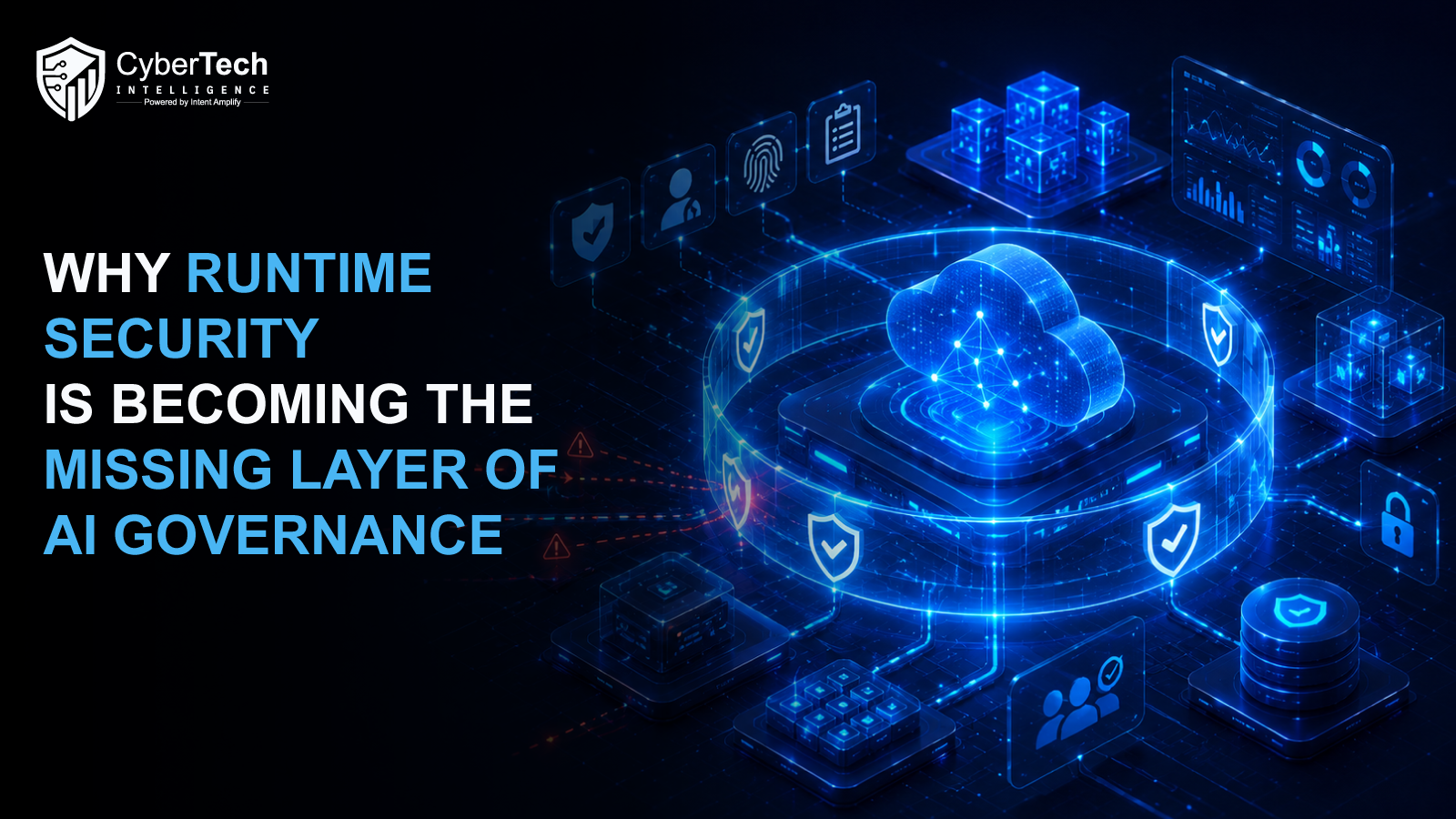
This is why runtime security is becoming the missing layer of AI governance. It connects policy intent with production reality.
Cloud-Native Security Must Account for AI Behavior
Cloud-native security has always involved moving parts: containers, Kubernetes, infrastructure as code, CI/CD pipelines, service accounts, APIs, secrets, workloads, and cloud permissions. AI introduces autonomous execution into an already complex cloud environment. These can now interpret inputs, generate instructions, connect to enterprise knowledge, and initiate actions.
Verizon’s 2026 Data Breach Investigations Report found that 31% of breaches now start with software vulnerabilities, while 48% of breaches involve ransomware. It also stated that 15% of attack techniques are now being bolstered by generative AI, and mobile threats show 40% higher click rates than traditional email phishing.³
For cloud and AI leaders, the implication is practical. AI workloads are being deployed into an environment where attackers are already accelerating discovery, exploitation, social engineering, and extortion.
Traditional cloud security programs often separate posture, runtime, identity, data, and development risk into different views. AI does not stay inside those boundaries. An AI workload may begin as code, run inside a container, authenticate through a service account, query a data store, interact with a SaaS platform, and expose output through an API. That chain cannot be governed through configuration review alone.
CSPM Shows Exposure, but Runtime Shows Active Risk
Cloud Security Posture Management (CSPM) remains a critical foundation. It helps identify misconfigured storage, excessive permissions, exposed workloads, weak encryption, risky network paths, and compliance drift. However, CSPM is strongest at identifying potential exposure. AI governance increasingly needs to understand active behavior.
A static finding may show that a service account is over-permissioned. Runtime security can show whether that identity is being used unusually, whether the workload is communicating with unexpected services, whether a container process has changed, whether secrets are being accessed at abnormal times, or whether data is moving outside the expected flow.
Google Cloud Threat Intelligence Group’s analysis of the Salesloft Drift campaign reported that UNC6395 used stolen OAuth and refresh tokens connected to Salesforce integrations to access customer environments between August 8 and August 18, 2025. The activity included searches for AWS access keys, passwords, Snowflake tokens, and other sensitive material.⁴
The incident reinforces a wider cloud governance lesson: trusted integrations and tokens can become live attack paths when runtime behavior, identity activity, and data access are not monitored together. CSPM can show where exposure exists, but runtime security shows whether that exposure is being exercised through active behavior.
Runtime Security Is the Evidence Layer AI Governance Needs
Runtime security matters because it turns governance from intent into evidence. It helps security leaders see process execution, workload behavior, network activity, API calls, privilege use, identity behavior, container drift, and data movement after deployment.
For AI workloads, that evidence is essential. A model endpoint exposed to business users may handle sensitive prompts. A retrieval-augmented generation workflow may connect to internal documents. An AI agent may call tools. A Kubernetes-hosted inference service may use secrets, storage buckets, GPUs, and cloud roles. Without runtime visibility, security teams may only know what the workload was supposed to do, not what it actually did.
Zscaler’s 2025 VPN Risk Report found that 56% of organizations experienced VPN-related breaches, while 92% expressed concern that VPNs could compromise security because of ransomware and malware exposure. It also reported that 81% planned to implement Zero Trust within 12 months, and 65% planned to replace VPN services within a year.⁵
For AI workloads in the cloud, broad trust is no longer defensible. Security teams need visibility into service accounts, tokens, API calls, cloud permissions, data access, and workload behavior. Runtime access must be specific, observed, risk-aware, and revocable so that anomalous activity can be contained before business impact expands.
CyberTech Intelligence Perspective: Runtime Is Where AI Risk Becomes Real
CyberTech Intelligence observes that many AI governance programs still over-index on pre-deployment controls. Review boards, model approval workflows, risk classifications, acceptable use policies, and documentation requirements are necessary, but they do not cover the moment when an AI workload begins interacting with live cloud infrastructure.
That is where AI risk becomes operational. Runtime is where prompts meet data, service accounts use cloud permissions, containers interact with Kubernetes policies, APIs trigger downstream workflows, and governance intent is either proven or exposed as incomplete.
Runtime determines whether governance remains effective under production conditions. It is where prompt activity meets data access, where service accounts meet cloud permissions, where containers meet Kubernetes policies, and where approved models begin operating under changing business conditions.
Palo Alto Networks Unit 42’s 2026 Global Incident Response Report found that weak identity controls contributed to 90% of cyber incidents, identity-based attacks were the initial access point in 65% of cases, and 87% of breaches involved at least two attack surfaces.⁶
For AI workloads, this is especially relevant because cloud runtime incidents rarely stay in one layer. A single issue can move across identity, workload, network, application, data, and governance domains. Runtime assurance gives leaders the evidence needed to understand the movement before it becomes business impact.
The CyberTech Intelligence Runtime Assurance Framework™
The CyberTech Intelligence Runtime Assurance Framework™ evaluates AI cloud security through six layers: inventory, behavior, identity, data, attack path, and evidence. It is designed to help leaders connect AI governance with operational security, so policy, posture, runtime, identity, and evidence operate as one control system rather than separate programs.
|
Runtime Assurance Layer |
Core Question |
Required Capability |
Executive Outcome |
|
Inventory |
Where are AI workloads running? |
AI asset discovery, model endpoint mapping, container and Kubernetes visibility |
Reduces shadow AI exposure |
|
Behavior |
What is the workload doing after deployment? |
Runtime monitoring, process analysis, API behavior, network inspection |
Detects abnormal activity |
|
Identity |
Which permissions does the workload use? |
Service account governance, least privilege, secrets control, cloud IAM review |
Limits privilege misuse |
|
Data |
Which information can the workload reach? |
Data access mapping, prompt and output protection, sensitive data monitoring |
Reduces leakage risk |
|
Attack Path |
How could risk move across layers? |
Cloud attack path analysis, exposure correlation, workload-to-data mapping |
Prioritizes material risk |
|
Evidence |
Can governance be proven? |
Runtime alerts, policy logs, investigation records, enforcement history |
Supports audit and board confidence |
The framework answers six executive questions: where is AI running, what is it doing, which permissions does it use, what data can it reach, how can risk move across layers, and can governance be proven? These questions convert runtime security from a technical control into a board-ready governance model.
NIST’s AI Risk Management Framework is designed to help organizations manage AI risks and improve trustworthiness across the AI lifecycle.⁷
OWASP’s Top 10 for Large Language Model Applications identifies major LLM application risks such as prompt injection, insecure output handling, sensitive information disclosure, insecure plugin or tool design, excessive agency, model denial of service, supply chain risks, and overreliance. ⁸
These frameworks reinforce the same point: AI governance must follow the system into production, where the workload’s real behavior can be measured.
AI Workload Security Must Start Before Runtime and Continue Through It
AI Workload Security should begin in development, but it cannot end in CI/CD. Code review, dependency scanning, infrastructure-as-code checks, container image scanning, secrets detection, and policy-as-code enforcement remain important. Still, runtime is where assumptions are tested.
A container image may be clean at build time and drift later. A service account may appear acceptable during review and become dangerous when connected to sensitive data. A Kubernetes role may seem limited until combined with network access, exposed secrets, and an AI workload that can call tools. This is why runtime context is becoming central to cloud-native security.
A 2025 arXiv preprint analyzing public GitHub repositories adds another cautionary signal for DevSecOps leaders. The study examined 7,703 files explicitly attributed to major AI tools and identified 4,241 CWE instances across 77 vulnerability types. It also reported higher vulnerability rates in Python, between 16.18% and 18.50%, compared with JavaScript and TypeScript in the analyzed files.⁹
For DevSecOps leaders, this reinforces the need for secure development controls and runtime detection to work together.
Cloud Attack Path Analysis Prioritizes Executive Risk
Cloud security programs generate thousands of findings. Executive priorities depend on identifying which combinations of exposures create exploitable paths to material business impact.
A vulnerable AI service, exposed endpoint, excessive cloud permission, long-lived secret, misconfigured Kubernetes role, and sensitive data store may appear as isolated findings. Cloud Attack Path Analysis correlates these conditions into an exploitable path, while runtime evidence establishes which workloads are active, which identities are operating, which data paths are reachable, and which exposures present immediate operational risk.
CNAPP, runtime security, cloud detection and response, Kubernetes security, DevSecOps security, and AI governance deliver the greatest value when they operate as a unified control model. Enterprise AI risk is determined by the relationships among cloud identities, workloads, APIs, data, runtime behavior, and attack paths rather than by individual findings viewed in isolation.
For executives, this changes the reporting model. The priority is not the total number of findings. The priority is which attack paths can reach sensitive data, disrupt operations, or create material governance risk.
Apply the Cloud-Native AI Security Playbook
Use the framework in The Cloud-Native AI Security Playbook: A Practical Guide to Runtime Protection, AI Governance, and Multi-Cloud Security, published on CyberTech Intelligence, to connect runtime visibility, AI workload behavior, cloud identity control, Kubernetes Security, attack path analysis, multi-cloud exposure, and governance evidence into leadership-level security priorities.
The eBook helps CISOs, CIOs, cloud security leaders, DevSecOps teams, AI engineering leaders, and risk teams connect runtime protection, workload identity, attack-path analysis, Kubernetes security, and multi-cloud governance to measurable resilience.
Read the full eBook: The Cloud-Native AI Security Playbook: A Practical Guide to Runtime Protection, AI Governance, and Multi-Cloud Security
Use the Research Scoreboard to Strengthen AI Cloud Security Investment
The scoreboard in The State of AI in the Cloud 2026: Runtime Security, Attack Paths, and Cloud-Native Resilience, published on CyberTech Intelligence, translates AI workload exposure, cloud identity risk, runtime threat activity, Kubernetes misconfiguration, multi-cloud visibility gaps, attack path pressure, and governance evidence gaps into measurable executive security signals.
It gives CISOs, CIOs, cloud platform leaders, security operations teams, AI engineering leaders, and board-facing risk teams a clearer way to connect runtime security with governance evidence, attack-path prioritization, identity control, cloud resilience, and board-level accountability.
Read the full research report: The State of AI in the Cloud 2026: Runtime Security, Attack Paths, and Cloud-Native Resilience
Conclusion: Runtime Security Turns AI Governance into Operational Control
AI governance cannot remain a promise made before deployment. It must become a control system that follows AI workloads into production. That means monitoring behavior, limiting privilege, protecting data paths, correlating attack paths, preserving evidence, and proving that approved use remains safe under real operating conditions.
CyberTech Intelligence believes runtime security is becoming the missing layer of AI governance because it connects policy intent with production reality. It shows where AI workloads are running, what they are doing, which identities they use, what data they can reach, how risk can move across layers, and whether governance can be proven.
The organizations that lead in AI cloud security will be those that can demonstrate that AI workloads are visible, governed, monitored, restricted, and resilient while actively running. Runtime assurance turns AI governance from documentation into operational control.
About CyberTech Intelligence
CyberTech Intelligence helps cybersecurity leaders, cloud security teams, technology vendors, and enterprise decision-makers understand the security shifts that matter most. Through analyst-led research, executive insights, market intelligence, and practical frameworks, CyberTech Intelligence turns complex cloud and AI risk into clear business direction across AI security, cloud-native security, runtime protection, Cloud-Native Application Protection Platform (CNAPP), Kubernetes Security, Zero Trust, and governance.
Request an AI Runtime Assurance Readiness Assessment
AI governance is only as strong as the evidence it can produce after deployment. CyberTech Intelligence helps CISOs, cloud security leaders, DevSecOps teams, AI engineering leaders, and enterprise risk teams evaluate whether AI workloads are visible, monitored, restricted, and governed in production.
An AI Runtime Assurance Readiness Assessment can help leadership evaluate AI workload inventory coverage, machine-identity risk, runtime telemetry maturity, data-access visibility, material cloud attack paths, containment readiness, and governance-evidence completeness.
Request an AI Runtime Assurance Readiness Assessment to understand where runtime visibility is missing, where AI workload risk can move across layers, and what evidence supports executive decision-making.
References
- CrowdStrike, 2026 Global Threat Report, 2026.
https://www.crowdstrike.com/en-us/resources/reports/global-threat-report-executive-summary-2026/ - IBM, Cost of a Data Breach Report 2025, 2025.
https://www.ibm.com/reports/data-breach - Verizon, 2026 Data Breach Investigations Report, 2026.
https://www.verizon.com/business/resources/reports/dbir/ - Google Cloud Threat Intelligence Group, Widespread Data Theft Targets Salesforce Instances via Salesloft Drift, 2025.
https://cloud.google.com/blog/topics/threat-intelligence/data-theft-salesforce-instances-via-salesloft-drift - Zscaler ThreatLabz, 2025 VPN Risk Report, 2025.
https://www.zscaler.com/resources/industry-reports/threatlabz-vpn-risk-report-2025.pdf - Palo Alto Networks Unit 42, 2026 Global Incident Response Report, 2026.
https://www.paloaltonetworks.com/resources/research/unit-42-incident-response-report - NIST, Artificial Intelligence Risk Management Framework, 2023.
https://www.nist.gov/itl/ai-risk-management-framework - OWASP, OWASP Top 10 for Large Language Model Applications, 2025.
https://owasp.org/www-project-top-10-for-large-language-model-applications/ - Schreiber, Maximilian, and Tippe, Pascal, Security Vulnerabilities in AI-Generated Code: A Large-Scale Analysis of Public GitHub Repositories, 2025.
https://arxiv.org/abs/2510.26103