
Most enterprise leaders no longer need convincing that AI is already inside the business. The harder issue is whether anyone can explain, with evidence, who owns each AI system, what data it can reach, which decisions it influences, which vendors support it, and how the organization would reconstruct its behavior after a failure.
That is where AI governance becomes a security and assurance problem rather than a policy exercise. Enterprise AI is now embedded in SaaS tools, customer workflows, software development environments, employee productivity platforms, analytics systems, and security operations. The larger problem is that AI is becoming operational before many organizations have defined decision rights, access boundaries, evidence requirements, and escalation paths.
IBM’s 2025 Cost of a Data Breach research found that 63% of researched organizations had no AI governance policies in place to manage AI or prevent shadow AI, while 97% of breached organizations that experienced an AI-related security incident lacked proper AI access controls. IBM also reported that high levels of shadow AI added USD 670,000 to the global average breach cost. [1]
Unmanaged AI is no longer a theoretical exposure. It is becoming a security visibility gap and a cost multiplier. When teams adopt AI tools outside formal review, sensitive prompts, internal documents, customer records, source code, and operational data may move through systems the enterprise has not approved or monitored. The breach-cost increase suggests that shadow AI weakens containment because security teams may not know which tools were used, what data was moved, or who had authority over the workflow.
F5’s 2025 State of AI Application Strategy Report found that 96% of organizations are implementing AI models, but only 2% rank as highly ready to scale, secure, and sustain AI deployments. [2]
This is not an adoption gap. It is an operating maturity gap. Enterprises are not waiting to deploy AI, but readiness is not keeping pace with deployment. The strategic concern is that many organizations are building AI capability before building the AI security framework that enterprises need to support it.
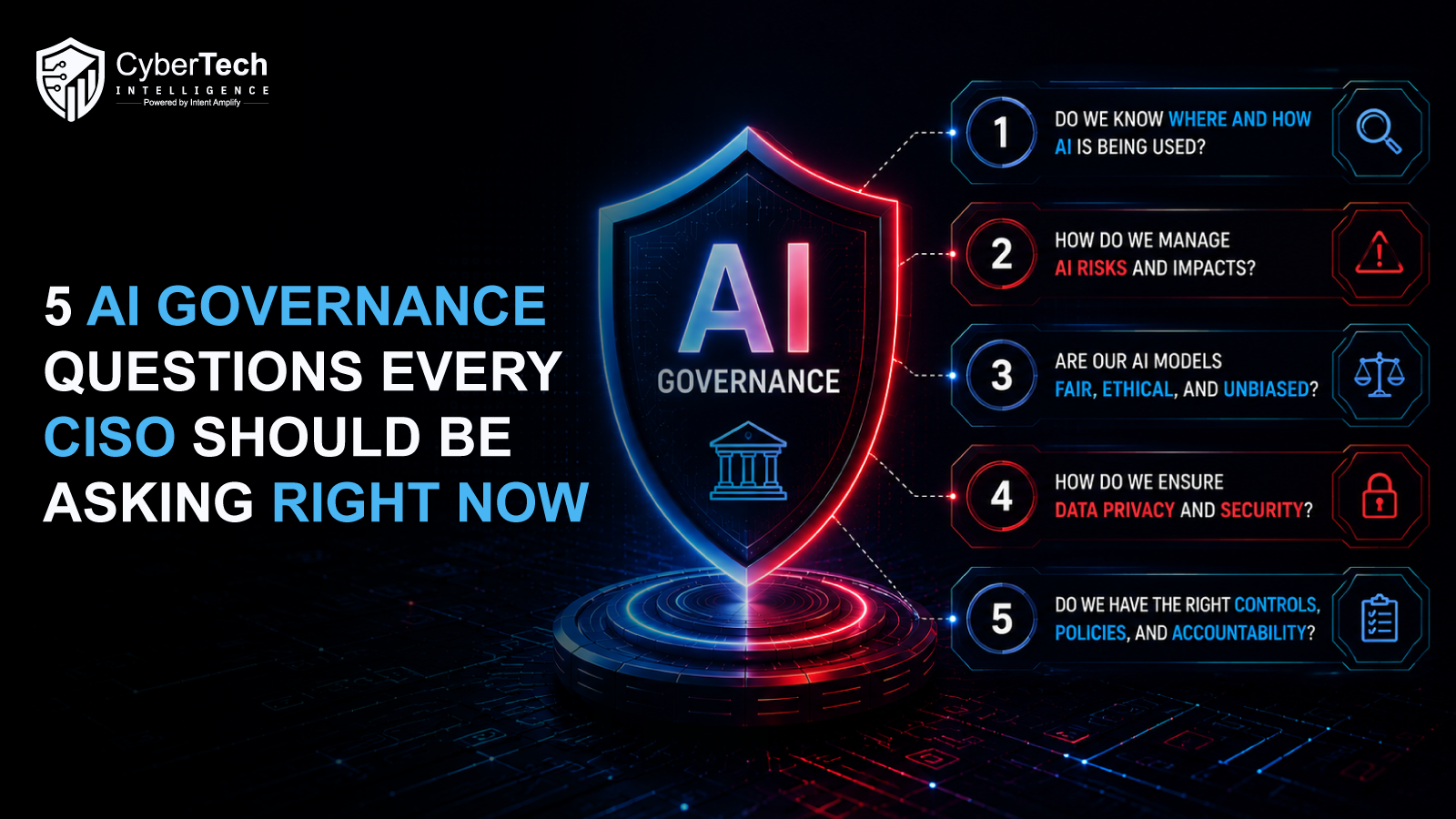
1. Who Owns AI Decisions Before Deployment?
AI programs become fragile when ownership is distributed across too many teams, but authority is assigned to none. Every material AI use case needs defined decision rights before deployment. That includes who approves the use case, who classifies the risk, who reviews data exposure, who validates vendor terms, who monitors performance, and who can pause the system if risk moves outside tolerance.
This matters because AI incidents often unfold across functions. A data issue may begin in a business workflow, move through a vendor platform, involve a legal obligation, and require a security response. If ownership is clarified only after something fails, the organization has already lost time. Mature AI governance starts with control of ownership and not committee language.
2. What Data Can AI Access, Retrieve, and Retain?
For enterprise AI, data risk is no longer limited to employees pasting sensitive information into public tools. The more complex exposure comes from connected systems. AI tools may retrieve information from customer relationship management platforms, ticketing systems, code repositories, collaboration tools, document stores, internal knowledge bases, and workflow applications.
That changes the control question. The issue is not only what users submit. It is what the AI system can reach on their behalf. A model connected to a poorly segmented knowledge base can generate restricted information even when the prompt looks harmless. In that sense, AI becomes an access pathway as much as an application.
Security teams should evaluate AI data access as an entitlement problem. Data classification, role-based access, prompt logging, retention limits, regional storage, vendor reuse policies, and retrieval boundaries need to apply inside AI workflows. Responsible AI security practices should answer four questions with precision: what can the system see, what can it remember, what can it produce, and where can it send the result?
3. Can the Organization Reconstruct AI Behavior?
A policy states what an AI system is expected to do. Evidence shows what it actually did. Strong programs need records of prompts, outputs, model versions, data sources, user activity, tool calls, approval steps, exceptions, and overrides.
If an AI system gives harmful guidance, exposes restricted data, or triggers an unauthorized workflow, leaders need a defensible timeline. They need to determine whether the problem came from the prompt, the model, the retrieval layer, the permission structure, the vendor environment, or the downstream integration.
AI incident response playbooks should cover prompt injection, unauthorized data retrieval, unsafe tool calls, model output manipulation, vendor-side compromise, and sensitive data exposure. The playbook should also define who can disable an AI workflow while an investigation is underway.
4. Are AI Vendors and Embedded Agents Covered by Risk Review?
Traditional third-party risk management was not designed for foundation models, embedded AI features, AI APIs, open-source large language models, or autonomous agents. Team8’s 2025 CISO Village Survey found that nearly 70% of enterprises already have AI agents in production, with another 23% planning deployments in 2026. It also reported that one in four respondents experienced an AI-generated attack in the past year. [4]
The implication is that AI vendor risk is expanding beyond obvious AI platforms. This is also where AI agent security becomes a serious access-control issue. If an embedded AI agent can retrieve records, summarize restricted content, initiate workflows, or call APIs through delegated permissions, the enterprise needs the same level of accountability it would expect from a privileged non-human identity.
IAM for AI agents should define which systems an agent can access, which actions it can perform, whose authority it acts under, how its activity is logged, and when permissions expire. Vendor reviews should examine model training practices, prompt retention, breach notification, output ownership, API security, open-source model provenance, embedded AI functionality, and contractual responsibility for AI-related failures.
5. Can AI Risk Be Explained as a Business Decision?
Boards do not need a technical explanation of tokens, embeddings, or prompt injection. They need a clear view of exposure, maturity, investment priorities, unresolved gaps, and business impact. Leaders should be able to explain which AI systems are approved, which are high risk, which touch sensitive data, which are customer-facing, which vendors are involved, and which controls remain incomplete.
Cisco’s 2025 AI Readiness Index found that only 24% of organizations can control AI agent actions with proper guardrails and live monitoring, compared with 84% of AI pacesetters. This finding separates AI ambition from AI operating maturity. Organizations may be deploying agents, but many still cannot prove that those agents operate within defined limits. [5]
Board reporting should include approved AI systems, unreviewed tools, high-risk use cases, sensitive data exposure, vendor dependencies, audit-log coverage, unresolved gaps, AI agent permissions, and alignment with frameworks such as the NIST AI Risk Management Framework. [6]
What Mature AI Governance Looks Like
The strongest organizations will not be the ones that deploy the most AI systems. They will be the ones who can explain how those systems are owned, limited, monitored, evidenced, and improved over time.
AI governance should function as an operational capability that connects data access, security architecture, vendor assurance, auditability, and executive oversight. The differentiator will be confidence: confidence that AI systems can scale without unmanaged exposure, confidence that incidents can be reconstructed, and confidence that leaders can defend decisions before regulators, auditors, customers, or the board.
The point is not to slow AI adoption. It is to make AI adoption secure enough, explainable enough, and accountable enough to survive real enterprise scrutiny.
CyberTech Intelligence brings expert cybersecurity research, market intelligence, and executive-level analysis together to help technology organizations decode emerging cyber risks, buyer priorities, and enterprise security trends.
Our work supports sponsored research, CISO engagement, vendor intelligence, demand intelligence, and pipeline activation programs that help cybersecurity brands build authority, influence market conversations, and engage high-intent decision-makers.
Connect with us to strengthen your market positioning around AI security, governance, and enterprise cyber resilience.
References
- IBM (2025) Cost of a Data Breach Report 2025. Available at: https://www-api.ibm.com/adobe/assets/urn:aaid:aem:607b9590-38e0-4c91-b433-aa8a17f5b5e8/original/as/cost-of-a-data-breach-2025-full-report.pdf.
- F5 (2025) 2025 State of AI Application Strategy Report: AI Readiness. Available at: https://interact.f5.com/rs/653-SMC-783/images/report_SOAS-2026.pdf?version=0&mkt_tok=NjUzLVNNQy03ODMAAAGiJ_eIZeMCewlppVvlnjkuhSE-052ag-t4vmmuZi1tUtm1DwNxawU4wS3t8LW4fYesePgggUaBrgSYrv-bvUI0-qwJ795Kd9bDmNv8Cx4amQjjbfXq7aI&_gl=1*1bx3gql*_gcl_au*MTk3MjI1MTUwNy4xNzgyMTIyNjUz.
- Proofpoint (2025) Voice of the CISO Report 2025. Available at: https://www.proofpoint.com/us/newsroom/press-releases/proofpoint-2025-voice-ciso-report.
- Team8 (2025) AI, Risk, and the Road Ahead: Key Findings from the 2025 CISO Village Survey. Available at: https://team8.vc/ciso-village-survey-2025/.
- Cisco (2025) AI Readiness Index 2025. Available at: https://www.cisco.com/c/m/en_us/solutions/ai/readiness-index.html.
- National Institute of Standards and Technology (NIST) (2024) Artificial Intelligence Risk Management Framework: Generative Artificial Intelligence Profile. Available at: https://www.nist.gov/publications/artificial-intelligence-risk-management-framework-generative-artificial-intelligence.


Author
Prabhanshi Singh
Author