
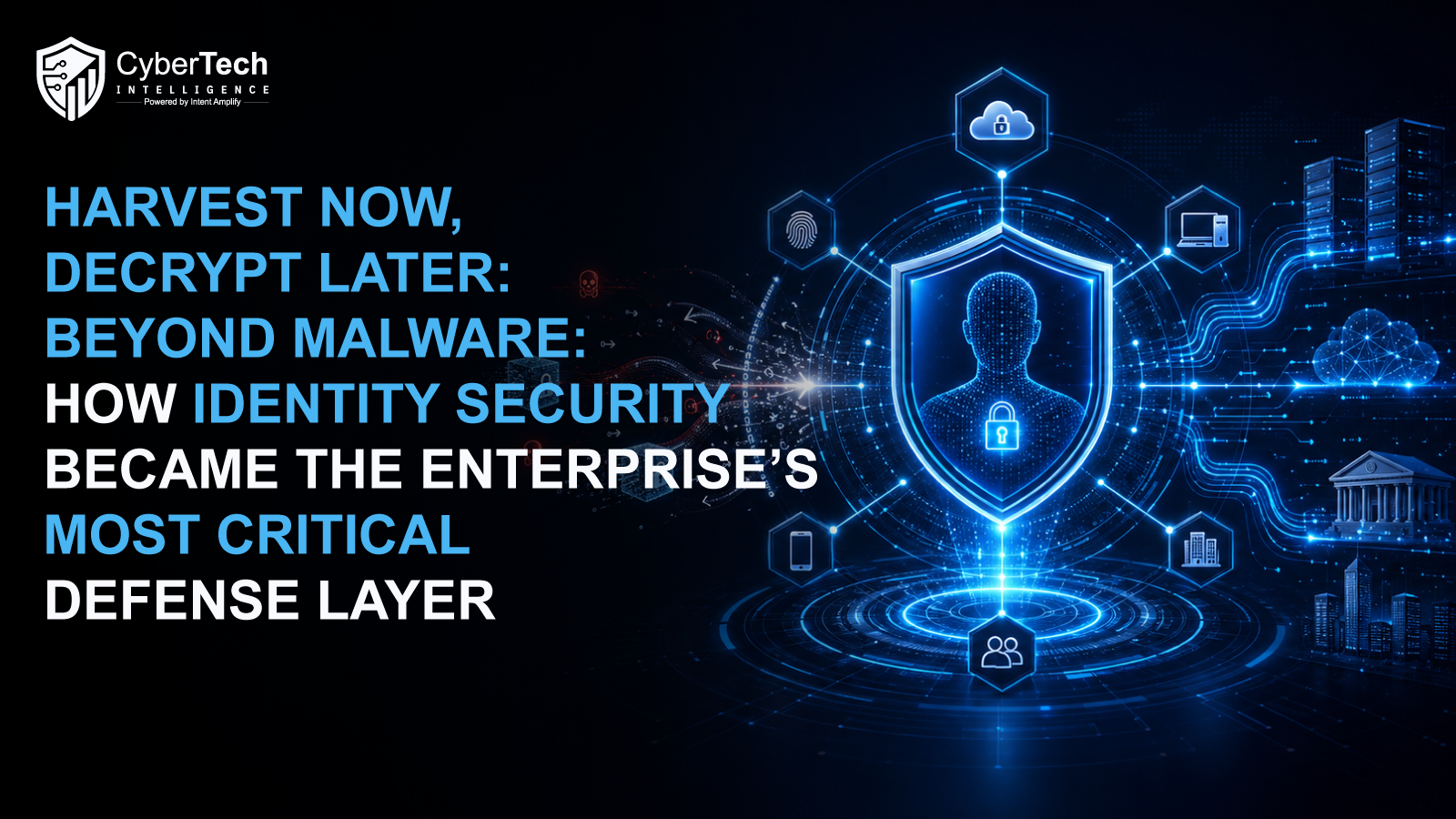
Modern cyberattacks often begin without malware. A stolen credential, an active session, an OAuth consent grant, a compromised SaaS connector, a cloud access token, or an over-privileged service account can provide sufficient access to sensitive enterprise systems.
This operating model extends the Harvest Now, Decrypt Later challenge beyond cryptography. Long-term data theft depends on access. Adversaries cannot collect enterprise information for future decryption without first establishing a trusted path into the environment. Increasingly, that path is built from legitimate identities, approved applications, and authorized connections used outside their intended purpose.
For U.S. enterprise executives, the governance question centers on visibility rather than compliance alone. Organizations need continuous awareness of which users, workloads, service accounts, SaaS applications, and privileged sessions can access sensitive information, together with the ability to validate those trust relationships before they are abused.
CrowdStrike's 2026 Global Threat Report found that 82% of detections were malware-free, reflecting adversaries' increasing reliance on valid accounts, trusted administrative tools, and approved workflows instead of conventional malware.¹ The implication for enterprise defense is clear: protecting data requires continuous governance of identities, permissions, and trust relationships alongside traditional endpoint and network security.
CyberTech Intelligence Perspective
Identity security is best understood as the control layer of modern cyber resilience, not as an administrative function inside identity and access management. It governs who can act, what can connect, which data can move, how cloud systems are reached, how SaaS platforms are controlled, and how quickly unauthorized trust can be revoked.
Palo Alto Networks Unit 42 reported in its 2026 Global Incident Response Report that identity weaknesses played a material role in nearly 90% of investigations, while preventable gaps contributed to more than 90% of incidents.2
That should concern executives because malware-free intrusions often look operational at first. A login succeeds. A token works. A SaaS export runs. An administrator opens a cloud console. A workload calls an API. The system may see normal authentication while the business is already exposed.
The board-level conclusion is direct. Endpoint, cloud, network, and data protection remain necessary. Yet their effectiveness increasingly depends on whether the enterprise can govern the access layer with precision, context, and speed.
The Enterprise Problem: Attackers Are Borrowing Trust
Attackers have always searched for leverage. Today, leverage often comes from credentials, federated access, OAuth grants, SaaS permissions, API keys, machine accounts, and cloud roles.
CrowdStrike reported that average eCrime breakout time fell to 29 minutes, while the fastest recorded breakout was only 27 seconds.1
That pace breaks traditional response assumptions. Many organizations still rely on ticket-based escalation, manual approvals, periodic entitlement reviews, and tool-specific alerts. Those processes were not built for intrusions where access can be obtained, expanded, and converted into data movement within the same executive briefing cycle.
Palo Alto Networks Unit 42 found that the fastest cases reached data exfiltration in 72 minutes, down from 285 minutes the prior year.2
Attack speed is only part of the challenge. Enterprise trust models often span identities, service accounts, cloud workloads, APIs, SaaS integrations, and machine credentials that evolve faster than governance processes can validate them.
Effective containment depends on immediate visibility into access relationships. Security teams need to identify which accounts accessed which systems, which tokens authorized downstream activity, which SaaS integrations interacted with regulated data, and which privilege changes expanded the organization's attack surface. Delays in answering these questions extend investigation timelines, slow containment, and increase enterprise exposure.
Why SaaS, OAuth, and Cloud Access Became the Breach Path
SaaS platforms now hold customer records, financial data, contracts, employee communications, support cases, analytics, source code, and executive workflows. OAuth grants and third-party integrations make this environment more productive, but they also extend delegated power beyond traditional perimeter controls.
Google Cloud’s Cloud Threat Horizons H1 2026 report found that identity compromise underpinned 83% of observed cloud compromises, with token theft, credential harvesting, and third-party SaaS exposure contributing to cloud intrusions.3
This makes OAuth security a board-relevant issue. A compromised consent grant can persist after a password reset. A long-lived token can bypass familiar authentication checks. A SaaS integration can pull information through approved APIs. A service account can operate without the visibility expected for a human executive.
Microsoft’s Secure Access in the Age of AI research found that organizations use an average of 5 identity access solutions and 4 network access solutions, while 32% of access management tools are viewed as duplicative and 40% of organizations say they have too many vendors.4
That fragmentation creates a practical gap. Endpoint teams may see one signal. Cloud teams may see another. SaaS administrators may hold separate logs. IAM teams may observe authentication without business context. By the time these views are reconciled, the adversary may already have moved from access to collection.
CyberTech Intelligence Research & Analysis Observation: Identity security is becoming the connective tissue between malware-free intrusion defense, SaaS governance, cloud access control, and post-quantum readiness. The organizations most prepared for Harvest Now, Decrypt Later risk will not be those that treat identity, cloud, SaaS, and data protection as separate programs. They will be the ones that can continuously prove who and what can reach long-life sensitive information, how that access is governed, and how quickly unauthorized trust can be revoked.
Harvest Now, Decrypt Later Starts with Authorization
Harvest Now, Decrypt Later describes a long-term adversary strategy: collect encrypted data now, store it, and decrypt it later when quantum capabilities mature. The concept is usually discussed through post-quantum cryptography. That lens is essential, but it does not cover the full risk chain.
NIST stated in September 2025 that organizations should begin planning migration to post-quantum cryptography to protect high-value, long-lived sensitive data.5
NIST also states that three post-quantum encryption standards are ready for implementation.6
The access layer decides whether sensitive information becomes harvestable in the first place. If an attacker can compromise a cloud key vault, backup administrator, privileged SaaS role, identity synchronization bridge, developer token, or storage administrator, future cryptographic readiness may arrive after the data is already gone.
McKinsey's Quantum Technology Monitor 2026 reported that more than 300 global companies have dedicated quantum initiatives, while quantum computing companies generated more than $1 billion in revenue during 2025.⁷
These developments place greater emphasis on the governance of long-life sensitive records. Enterprise resilience depends not only on adopting quantum-resistant cryptography, but also on controlling access to information that could be captured today and decrypted as quantum capabilities mature. Effective governance therefore combines cryptographic modernization with disciplined identity controls, data protection, and continuous monitoring of high-value information.
CyberTech Intelligence Identity Security Blueprint™
The CyberTech Intelligence Identity Security Blueprint™ helps enterprise leaders move from access administration to measurable resilience against malware-free intrusions, credential theft, OAuth abuse, SaaS compromise, cloud identity threats, and non-human identity exposure.
For the full framework, readers can refer to The Identity Security Blueprint: Building Resilience Against Malware-Free Attacks and Cloud Identity Threats, published by CyberTech Intelligence. The ebook expands on how enterprises can structure identity threat detection, privileged access management, OAuth security, SaaS governance, cloud controls, non-human identity oversight, and board-ready evidence for modern intrusion defense.
To explore the full operating model, read CyberTech Intelligence’s ebook, The Identity Security Blueprint: Building Resilience Against Malware-Free Attacks and Cloud Identity Threats.
Executive Identity-First Readiness Scorecard
Readiness should be measured through evidence, not broad confidence. For a deeper maturity view, readers can refer to Identity-First Security 2026: Enterprise Readiness for Credential Theft, OAuth Abuse, and Malware-Free Intrusions, published by CyberTech Intelligence. The report expands on how CISOs, heads of IAM, Zero Trust leaders, SaaS security teams, and security architecture executives can assess credential exposure, OAuth risk, cloud governance, privileged identity maturity, lateral movement detection, and regulatory evidence readiness.
For a deeper maturity view, download CyberTech Intelligence’s research report, Identity-First Security 2026: Enterprise Readiness for Credential Theft, OAuth Abuse, and Malware-Free Intrusions.
What Enterprise Leaders Should Prioritize
First, measure containment speed against real intrusion timelines. If the fastest observed exfiltration cases can occur within 72 minutes, access revocation, token invalidation, privilege removal, and SaaS containment must be tested against that window.2
Second, elevate non-human identities. Service accounts, workload identities, OAuth apps, automation bots, API keys, certificates, and AI agents should be governed with the same seriousness as executive accounts.
Third, consolidate identity threat detection with security operations. Authentication signals, device posture, endpoint telemetry, SaaS logs, cloud activity, and data-security events must feed one investigative model. Fragmented visibility creates avoidable dwell time.
Fourth, link Zero Trust identity with quantum readiness. Crown-jewel data, long-retention archives, cryptographic assets, backups, and key-management systems should be governed as one risk domain.
Fifth, require board-ready evidence. Executives should expect measurable answers: which high-risk grants were revoked, which privileged roles were removed, which tokens were shortened, and how quickly unauthorized sessions can be contained.
Identity Security Is Becoming a Board-Level Trust Test
Identity security will increasingly shape how customers, regulators, insurers, investors, and partners evaluate cyber resilience. Procurement reviews will ask about SaaS controls. Insurance assessments will examine privileged access. Board committees will expect evidence of containment speed. Regulators will focus on materiality, scope, governance, and disclosure timing.
EY’s March 2026 cybersecurity leadership study found that 96% of senior security leaders view AI-enabled cyberattacks as a significant threat, while 48% estimate that at least one-quarter of past-year incidents involved AI.8
Agentic AI adds further complexity. Gartner’s June 2026 security summit coverage predicts that through 2029, more than 50% of successful attacks against AI agents will exploit access control issues through prompt injection.9
That is not a distant AI governance concern. It is an authorization problem. Enterprises will need to supervise autonomous activity, validate delegated reach, constrain agent permissions, test abnormal behavior, and maintain audit evidence.
Enterprise Identity Security Readiness Assessment
Harvest Now, Decrypt Later requires more than a cryptographic roadmap. It requires evidence that the enterprise can govern access to long-life data before adversaries collect it. Malware-free intrusions require more than endpoint detection. They require visibility into trust paths, behavior, SaaS integrations, cloud privileges, machine accounts, and data movement.
CyberTech Intelligence helps enterprise cybersecurity and technology leaders translate identity-first risk into research-led narratives, executive-ready frameworks, buyer-focused insights, and strategic demand programs. Across identity security, cloud protection, Zero Trust, SaaS security, threat intelligence, SIEM, XDR, AI security operations, post-quantum readiness, and cyber governance, CyberTech Intelligence supports organizations working to connect emerging risks with executive decision-making.
For U.S. enterprises, the message is clear. The breach that matters tomorrow may begin with a credential accepted today. Organizations that build authorization discipline, OAuth security, cloud access governance, behavioral detection, non-human identity oversight, and regulatory evidence now will be better positioned to protect enterprise trust in a Harvest Now, Decrypt Later world.
Request an Enterprise Identity Security Readiness Assessment
Identity-first security now requires more than MFA deployment, periodic access review, or IAM policy documentation. It requires evidence that the enterprise can govern credentials, OAuth grants, SaaS integrations, privileged roles, cloud identities, non-human identities, and access to long-life sensitive data.
CyberTech Intelligence helps security, IAM, Zero Trust, cloud, SaaS security, risk, and executive teams evaluate these capabilities through an Enterprise Identity Security Readiness Assessment. The assessment examines credential exposure, OAuth risk, SaaS access governance, privileged identity maturity, non-human identity oversight, cloud identity controls, containment speed, and board-ready evidence.
For organizations strengthening resilience against malware-free attacks, credential theft, OAuth abuse, cloud identity threats, and Harvest Now, Decrypt Later exposure, this assessment can support executive reporting, campaign strategy, buyer education, and identity-first security planning.
Request an Enterprise Identity Security Readiness Assessment: Contact Us for more information.
References
- CrowdStrike, 2026 Global Threat Report, 2026
https://www.crowdstrike.com/en-us/global-threat-report/ - Palo Alto Networks Unit 42, 2026 Global Incident Response Report, 2026
https://www.paloaltonetworks.com/resources/research/unit-42-incident-response-report - Google Cloud, Cloud Threat Horizons Report H1 2026, 2026
https://services.google.com/fh/files/misc/cloud_threat_horizons_report_h12026.pdf - Microsoft, Secure Access in the Age of AI, 2026
https://cdn-dynmedia-1.microsoft.com/is/content/microsoftcorp/microsoft/bade/documents/products-and-services/en-us/security/secure-access-in-the-age-of-ai-final-2026.pdf - NIST, New Draft White Paper on PQC Migration Mappings to Risk Framework Documents, September 2025
https://www.nist.gov/news-events/news/2025/09/new-draft-white-paper-pqc-migration-mappings-risk-framework-docs - NIST, Post-Quantum Cryptography, 2026
https://www.nist.gov/pqc - McKinsey & Company, Quantum Technology Monitor 2026, 2026
https://www.mckinsey.com/capabilities/mckinsey-technology/our-insights/mckinsey-quantum-technology-monitor-2026-a-commercial-tipping-point - EY, Cybersecurity Leaders Investing in AI and Agentic Defenses to Combat Escalating AI-Enabled Threats, March 2026
https://www.ey.com/en_us/newsroom/2026/03/cybersecurity-leaders-investing-in-ai-and-agentic-defenses-to-combat-escalating-ai-enabled-threats - Gartner, Gartner Security and Risk Management Summit 2026: National Harbor Day 2 Highlights, June 2026
https://www.gartner.com/en/newsroom/press-releases/2026-06-02-gartner-security-and-risk-management-summit-2026-national-harbor-day-2-highlights
Author
Yash Lad
Author