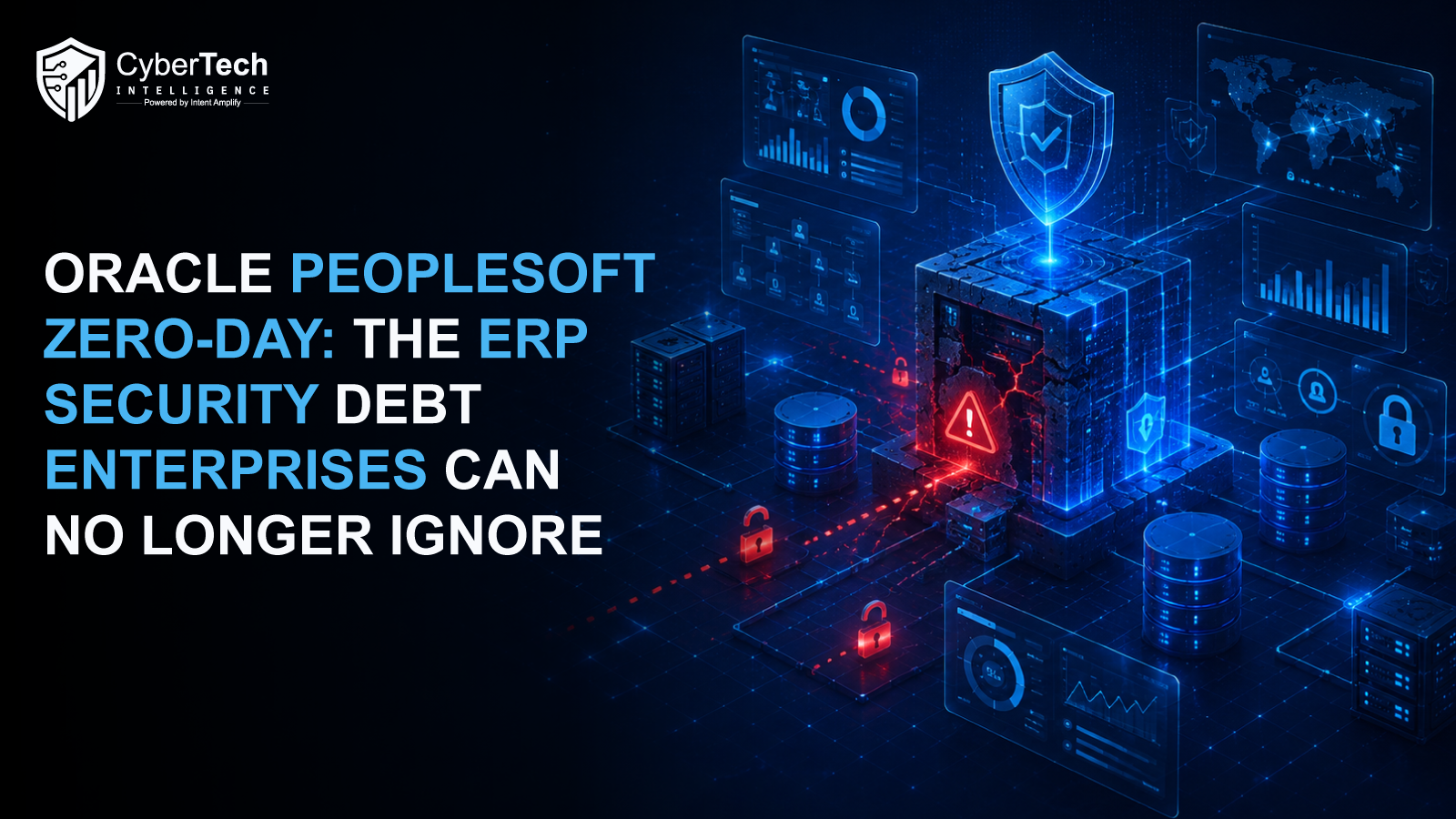
Enterprise resource planning systems were built to keep businesses moving. Payroll closes. Students receive aid. Suppliers get paid. Employees update records. Finance teams reconcile numbers. Executives rely on reporting. In most organizations, these workflows run quietly enough to be overlooked until a security event turns them into a board-level issue.
The Oracle PeopleSoft zero-day did exactly that.
Mandiant and Google Threat Intelligence Group (GTIG) confirmed an active compromise and extortion campaign attributed to UNC6240, also known as ShinyHunters, targeting Oracle PeopleSoft application infrastructure between May 27, 2026, and June 9, 2026. The activity aligned with the exploitation of CVE-2026-35273, a critical remote code execution vulnerability in the Environment Management component with a CVSS 9.8 rating. Google also reported notifications to more than 100 global organizations whose IP addresses correlated with potentially vulnerable endpoints, with 68% concentrated in higher education.1
For U.S. enterprise leaders, the lesson is not limited to Oracle, PeopleSoft, or higher education. The larger issue is ERP security debt. Many systems of record remain deeply integrated, highly privileged, difficult to patch, dependent on third-party access, and insufficiently monitored. When attackers reach these platforms, the exposure can quickly move from technical compromise to business disruption, regulatory pressure, legal review, supplier concern, and reputational risk.
CyberTech Intelligence Perspective
ERP environments are often treated as stable business infrastructure. CyberTech Intelligence views them differently. These platforms are trust engines. They hold the records, permissions, integrations, and workflows that allow institutions to operate with confidence.
The PeopleSoft campaign shows why security programs must move beyond patch compliance. Strong ERP defense begins with visibility: which administrative endpoints are exposed, which privileged accounts exist, which vendors retain access, where sensitive exports move, and whether abnormal activity can be detected before extortion pressure begins.
Why This Was More Than a Software Vulnerability
Oracle confirmed CVE-2026-35273 affects PeopleSoft PeopleTools, may affect PeopleSoft Enterprise Applications customers, is remotely exploitable without authentication, and may result in remote code execution after successful exploitation.2
Oracle’s June 2026 Critical Security Patch Update contained 245 new security patches across product families and advised PeopleSoft customers to apply the June update because it included the CVE-2026-35273 fix plus additional updates.3
A security alert became an enterprise concern because PeopleSoft often supports sensitive operational processes. In higher education, the platform may touch student records, payroll, financial aid, grants, procurement, workforce administration, and reporting. In corporate settings, similar ERP environments support finance, HR, supplier management, compliance evidence, and executive decision-making.
This is where business risk begins. A vulnerable endpoint may be the technical entry point, but the real damage comes from what sits behind it: trusted records, administrative scripts, service accounts, file transfers, databases, reporting exports, and third-party integrations.
The Visibility Problem Comes First
The first phase of ERP readiness is not replacement. It is discovery.
Many enterprises can produce a cloud inventory faster than they can explain ERP exposure. A PeopleSoft estate may include PeopleTools, WebLogic, Integration Broker, Environment Management Hub services, process schedulers, database connections, middleware, custom reports, batch jobs, supplier connections, and historical exports. Each component may carry a different owner, control path, and remediation constraint.
Google’s analysis described attackers staging environments using customized MeshCentral agents masquerading as cloud endpoints, administrative command queries, lateral movement scripts, outbound connections, staging directories, and forensic artifacts across PeopleSoft paths.1
This matters because the campaign was not a single exploit request. It reflected an intrusion sequence: establish access, inspect configuration, map internal paths, move laterally, stage material, compress data, and connect activity to extortion infrastructure.
CyberTech Intelligence Research and Analysis Observation
Most organizations do not suffer from a shortage of ERP policies. They suffer from a shortage of current evidence. If leaders cannot identify exposed services, active privileges, vendor pathways, sensitive exports, and detection coverage during an active campaign, policy language offers limited protection.
Zero-Day Speed Has Outgrown Traditional Patch Cycles
Traditional remediation assumes a manageable sequence: advisory review, severity assessment, testing, change approval, deployment, validation, and documentation. Zero-day exploitation compresses that sequence. For systems of record, the delay can create business exposure before the organization knows which patch to apply.
Google Cloud’s M-Trends 2026 reported that the mean time to exploit vulnerabilities fell to an estimated seven days, meaning exploitation is increasingly observed before a patch becomes available.4
IBM’s 2026 X-Force Threat Intelligence Index reported a 44% increase in attacks beginning with exploitation of public-facing applications, largely associated with missing authentication controls and AI-enabled vulnerability discovery. IBM also found vulnerability exploitation accounted for 40% of incidents observed by X-Force in 2025.5
These figures change the executive standard. Patching remains essential, but it cannot be the only line of defense. ERP security now requires pre-disclosure exposure reduction, compensating controls, privileged access review, network isolation, forensic logging, supplier coordination, and tested recovery.
Privileged Access Defines the Blast Radius
Privileged access management is central to ERP resilience because administrative authority determines how far an attacker can move. PeopleSoft administrators, database teams, middleware engineers, infrastructure operators, service accounts, emergency users, batch scripts, systems integrators, managed service providers, and automation tools may all hold meaningful reach into sensitive business functions.
Palo Alto Networks’ 2026 Unit 42 Global Incident Response Report found identity weaknesses appeared in roughly 90% of investigations, while 65% of initial access was driven by identity-based techniques. The same report found 87% of intrusions involved multiple attack surfaces.6
These findings help explain why a PeopleSoft compromise can become a broader institutional event. Once attackers obtain useful credentials, inspect configuration files, or reach administrative scripts, the incident no longer belongs to one application owner. It becomes an identity, network, supplier, and governance problem.
A mature ERP privileged access program should answer five questions. Who can administer production systems? Which service accounts retain broad authority? Which vendors have standing access? Are emergency accounts monitored? Can privileged sessions be reviewed after suspicious activity?
CyberTech Intelligence ERP Trust & Resilience Framework™
The CyberTech Intelligence ERP Trust & Resilience Framework™ gives executive teams a structured model for evaluating whether systems of record can be governed, monitored, and recovered with the same discipline expected across cloud, identity, endpoint, and customer-facing infrastructure.
Table: CyberTech Intelligence ERP Trust & Resilience Framework™
|
Readiness Area |
Executive Question |
Business Outcome |
|
Exposure Visibility |
Which ERP components, endpoints, integrations, and exports are reachable? |
Clearer attack-surface control |
|
Privilege Governance |
Which human, service, vendor, and emergency accounts hold elevated permissions? |
Smaller blast radius |
|
Detection Coverage |
Can security teams detect abnormal PeopleSoft, WebLogic, PSEMHUB, or outbound traffic behavior? |
Faster investigation |
|
Supplier Control |
Which third parties can access ERP systems or data flows? |
Lower inherited exposure |
|
Recovery Evidence |
Can the organization restore trusted operations after a compromise? |
Stronger resilience |
This framework keeps the focus where leadership needs it: visibility, privileged access control, supplier governance, operational evidence, and continuity.
Third-Party Risk Is Embedded Inside ERP Operations
ERP environments rarely operate alone. Payroll providers, benefits administrators, banks, procurement platforms, cloud services, analytics tools, systems integrators, auditors, student portals, tax systems, identity providers, and managed service partners may all connect to core workflows.
IBM reported that large supply chain and third-party compromises nearly quadrupled since 2020.5
For ERP leaders, this trend should trigger a practical shift. Supplier access cannot be reviewed only during procurement. It should be time-bound, purpose-limited, logged, segmented, periodically reapproved, and revoked quickly when the business reason ends.
CISA added CVE-2026-35273 to its Known Exploited Vulnerabilities catalog on June 12, 2026, based on evidence of active exploitation.7
Known exploitation changes the governance burden. Executive teams need documented action, not broad assurance. Evidence should include patch status, access reviews, log analysis, supplier attestations, exception ownership, incident response records, and recovery validation.
The Practical Next Step: Begin With Evidence
A credible ERP response does not require immediate platform replacement. It requires evidence.
In the first 30 days, organizations should map PeopleSoft components, supported versions, exposed endpoints, privileged accounts, service identities, vendor pathways, databases, file exports, and recovery dependencies. This phase should confirm the Oracle June 2026 update status and identify unsupported deployments.3
During the next 30 days, teams should reduce preventable exposure. Priorities include isolating administrative services, blocking unnecessary external reachability, rotating elevated credentials, removing dormant accounts, vaulting service secrets, narrowing supplier permissions, enforcing multifactor authentication, reviewing WebLogic logs, inspecting web-tier file systems, and monitoring outbound Server Message Block traffic from PeopleSoft hosts.
During the final 30 days, leadership should institutionalize evidence. The output should be a board-ready ERP resilience pack containing asset inventory, patch status, emergency-change records, access-review results, supplier attestations, detection coverage, incident-response procedures, backup validation, open exceptions, and accountable owners.
Deloitte’s The Current: Cybersecurity Forecast for 2026 identifies identity protection, cyber defense, platformization, and resilience as priorities for organizations preparing for the next phase of digital exposure.8
This direction fits ERP modernization. Systems of record need the same governance maturity already expected across cloud, identity, endpoint, and customer-facing applications.
Final Thought
The Oracle PeopleSoft zero-day exposed a difficult truth. Many institutions depend on ERP platforms more than their security models acknowledge. These systems carry sensitive records, operational authority, supplier workflows, and compliance evidence. Attackers understand this value.
The strongest response is not panic. It is disciplined visibility.
Enterprise leaders should ask whether core business systems are mapped, whether elevated permissions are controlled, whether third-party access is measurable, whether application-layer misuse is detectable, and whether trusted operations can be restored after compromise.
Organizations best prepared for the next zero-day will not simply patch faster. They will know where critical business platforms are exposed, who can reach them, which controls reduce the blast radius, and how quickly evidence can be produced when pressure arrives.
Request an ERP Security Readiness Assessment
ERP security readiness now requires more than patch validation or periodic access review. It requires evidence that the organization can identify exposed systems, govern privileged access, control supplier pathways, detect application-layer misuse, and restore trusted operations after compromise.
CyberTech Intelligence helps enterprise security, IT, compliance, risk, and business-system leaders evaluate these capabilities through an ERP Security Readiness Assessment. The assessment reviews ERP exposure visibility, privileged access governance, supplier access controls, detection coverage, compliance evidence, and recovery readiness.
For organizations responding to Oracle PeopleSoft risk, ERP security debt, privileged access concerns, or third-party ERP exposure, this assessment can support executive reporting, remediation prioritization, board communication, and phased resilience planning.
Request an ERP Security Readiness Assessment
References
- Google Cloud Mandiant, ShinyHunters Targets Education Sector with Oracle PeopleSoft Exploit, June 2026
https://cloud.google.com/blog/topics/threat-intelligence/shinyhunters-targets-education-sector-oracle-exploit - Oracle, Oracle Security Alert Advisory - CVE-2026-35273, June 2026
https://www.oracle.com/security-alerts/alert-cve-2026-35273.html - Oracle, Critical Security Patch Update Advisory - June 2026, June 2026
https://www.oracle.com/security-alerts/cspujun2026.html - Google Cloud Mandiant, M-Trends 2026, March 2026
https://cloud.google.com/blog/topics/threat-intelligence/m-trends-2026/ - IBM, IBM 2026 X-Force Threat Intelligence Index: AI-Driven Attacks Are Escalating as Basic Security Gaps Leave Enterprises Exposed, February 25, 2026
https://newsroom.ibm.com/2026-02-25-ibm-2026-x-force-threat-index-ai-driven-attacks-are-escalating-as-basic-security-gaps-leave-enterprises-exposed - Palo Alto Networks Unit 42, 2026 Unit 42 Global Incident Response Report, February 2026
https://www.paloaltonetworks.com/resources/research/unit-42-incident-response-report - CISA, CISA Adds One Known Exploited Vulnerability to Catalog, June 12, 2026
https://www.cisa.gov/news-events/alerts/2026/06/12/cisa-adds-one-known-exploited-vulnerability-catalog - Deloitte, The Current: Cybersecurity Forecast for 2026, 2026
https://www.deloitte.com/us/en/services/consulting/articles/cybersecurity-forecast-for-2026.html
Author
Yash Lad
Author