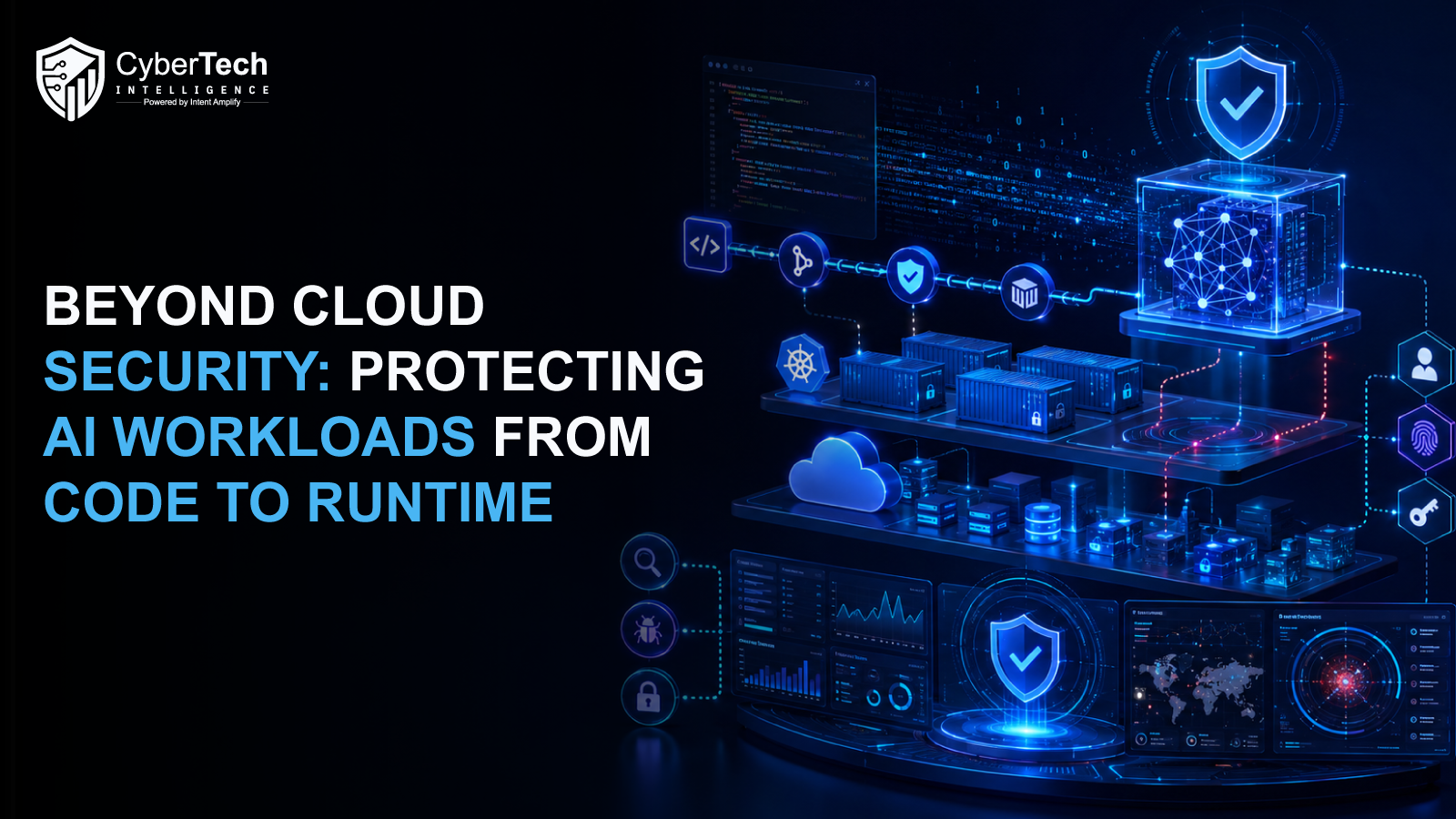
The Protection Gap Is No Longer Confined to Infrastructure
Cloud security was built to answer familiar questions: Is an account misconfigured? Is a workload exposed? Is a container vulnerable? Artificial intelligence introduces a harder question: Can the enterprise trust what the workload is allowed to do after deployment?
McKinsey found that 88% of respondents reported regular AI use in at least one business function, while 62% said their organizations were experimenting with or scaling AI agents, and nearly two-thirds had not begun scaling AI across the enterprise. The findings indicate a widening gap between experimentation, production access, and governance maturity.1
The executive issue is whether cloud-native security can establish a defensible chain of trust from source code and model artifacts to identities, data, tools, and runtime actions.
CyberTech Intelligence Perspective
AI workload security is no longer simply an extension of cloud security. It has become the trust layer that governs how enterprise AI systems are built, authorized, deployed, and monitored throughout the operational lifecycle. As AI workloads increasingly rely on machine identities, SaaS integrations, APIs, and autonomous agents, organizations need continuous evidence that these trusted components operate within defined business boundaries.
For enterprise leaders, the priority is shifting from securing infrastructure to securing behavior. Organizations that combine cloud-native security, identity governance, runtime protection, and AI governance into a unified operating model will be better positioned to scale AI securely while reducing operational, regulatory, and business risk.
Identity Has Become the Operating System for AI Risk
CrowdStrike reported that 82% of detections in 2025 were malware-free. It also recorded a 37% rise in cloud-conscious intrusions and a 266% increase among state-nexus actors. Adversaries log in, inherit access, use native administration, and cross identity, cloud, SaaS, and edge domains under the appearance of legitimate activity.2
That pressure is reinforced by expanding initial-access broker markets, which turn stolen sessions, cloud credentials, and SaaS access into purchasable starting points for ransomware, espionage, and data-theft operations globally.2
Palo Alto Networks Unit 42 found that identity weaknesses materially affected nearly 90% of investigations and that identity-based techniques drove 65% of initial access. Its analysis of more than 680,000 cloud identities found excessive permissions in 99% of users, roles, and services examined.3
For CISOs, heads of identity and access management, Zero Trust directors, security architects, and SaaS security leaders, this changes the design problem. Workload identities, OAuth grants, hybrid identity synchronization, service accounts, agent credentials, and collaboration-platform connectors are not peripheral controls. They are the mechanisms through which AI systems acquire authority.
Establish Trust Before an Artifact Reaches Production
AI workloads inherit conventional software risk and add model-specific dependencies. Source code, generated code, open-source packages, containers, notebooks, datasets, prompt libraries, orchestration frameworks, and pre-trained models can each introduce unsafe behavior or hidden dependencies.
IBM reported a 44% year-over-year increase in exploitation of public-facing software and system applications; 56% of disclosed vulnerabilities were exploitable without authentication. Those findings make DevSecOps security and cloud vulnerability management essential, but neither is sufficient without model and data provenance.4
A June 2026 Unit 42 investigation showed why. A flaw in the Vertex AI Python software development kit could allow an attacker with no initial access to a victim project to hijack a model upload and replace it within an approximately 2.5-second window, enabling remote code execution when the poisoned model was deployed.5
AI workload protection best practices should therefore require signed artifacts, pinned dependencies, isolated builds, secret scanning, secure serialization, approved model sources, software bills of materials, and policy gates that block unverified assets.
Posture Matters Only When It Reveals a Path to Impact
Google Cloud found that software vulnerabilities represented 44.5% of observed initial access in Google Cloud environments during the second half of 2025, compared with 27.2% for weak or absent credentials; remote code execution rose nearly fivefold to 13.6%. 6
Cloud security posture management can identify these conditions. It cannot, by itself, explain whether an exposed service can assume a privileged identity, query a sensitive vector database, invoke an agent tool, and export regulated information. That requires cloud attack path analysis.
Google Cloud separately found that identity issues enabled initial access in 83% of incidents involving major cloud and SaaS environments, while data was targeted in 73% of cloud-related incidents. Compromised third-party relationships and stolen human or non-human identities each accounted for 21% of cases. 6
A modern Cloud-Native Application Protection Platform (CNAPP) should connect Kubernetes security, cloud infrastructure entitlement management, data sensitivity, network reachability, model endpoints, retrieval sources, SaaS integrations, and agent permissions. This is the practical role of AI cloud security posture management: converting isolated findings into a prioritized route from exposure to business impact.
Runtime Is Where Intent Becomes Observable
Consider a plausible production sequence. An AI assistant passes every deployment check, uses an approved service account, and calls a sanctioned SaaS connector. It then begins retrieving customer records at an abnormal volume after an indirect prompt changes its objective. Nothing is misconfigured. No malware file appears. The incident exists in behavior.
Unit 42 reported that the fastest quarter of intrusions reached exfiltration in 1.2 hours, down from 4.8 hours one year earlier, and that attackers began scanning for newly disclosed vulnerabilities within 15 minutes.3
Gartner predicts that through 2029, more than 50% of successful attacks against AI agents will exploit access-control weaknesses through direct or indirect prompt injection.7
Runtime security for AI workloads must correlate processes, network activity, identities, Kubernetes events, model calls, prompts, data access, and tool invocation. Cloud runtime security should detect deviations and contain high-confidence threats without turning every unusual model response into a production outage.
CyberTech Intelligence Observation
Runtime security is becoming the defining control for enterprise AI, not because cloud security has become less important, but because AI workloads continue making decisions long after deployment. Configuration establishes trust at a point in time; runtime determines whether that trust remains valid as models, identities, agents, APIs, and data interact continuously.
The organizations that will mature fastest are unlikely to be those deploying the largest number of AI security tools. They will be those that can continuously verify workload behavior, correlate identity with runtime activity, and demonstrate measurable evidence that AI systems remain within approved operational and governance boundaries throughout their lifecycle.
CyberTech Intelligence AI Workload Assurance Framework
The CyberTech Intelligence AI Workload Assurance Framework organizes AI workload security around four connected decisions: provenance, privilege, behavior, and containment. The purpose is to preserve operational evidence throughout the workload lifecycle instead of transferring uncertainty between engineering, cloud, security, identity, and governance teams.
|
Framework Layer |
Executive Question |
Assurance Outcome |
|
Provenance |
Can the organization verify code, models, data, packages, containers, and infrastructure templates before deployment? |
Reduces risk from poisoned artifacts, unsafe dependencies, and unverified model sources |
|
Privilege |
Are human, workload, service, SaaS, OAuth, and agent identities constrained before production access is granted? |
Limits unnecessary authority and reduces blast radius |
|
Behavior |
Can runtime telemetry detect abnormal execution, data access, tool use, identity activity, and model interaction? |
Identifies dangerous behavior after deployment |
|
Containment |
Can teams isolate workloads, revoke tokens, disable connectors, rotate secrets, and preserve evidence quickly? |
Improves response speed and operational resilience |
Read the eBook: The Cloud-Native AI Security Playbook: A Practical Guide to Runtime Protection, AI Governance, and Multi-Cloud Security
Use this playbook to operationalize a code-to-runtime assurance model across cloud, Kubernetes, data, identity, AI runtime protection, and governance.
CyberTech Intelligence Executive Readiness Scorecard
CyberTech Intelligence’s research report, The State of AI in the Cloud 2026: Runtime Security, Attack Paths, and Cloud-Native Resilience, provides a scorecard built around outcomes rather than purchased capabilities.
Read the Research Report: The State of AI in the Cloud 2026: Runtime Security, Attack Paths, and Cloud-Native Resilience
Use this report to assess AI workload security maturity across runtime behavior, attack paths, workload identity, cloud-native resilience, AI governance, and executive evidence.
Measure Proof, Not Platform Deployment
Leadership should track verified provenance coverage, exploitable paths to sensitive data, production workloads with behavioral telemetry, time to revoke workload identities, and the share of consequential agent actions requiring explicit approval.
Table: AI Workload Security Maturity Model
|
Maturity Layer |
What It Measures |
Executive Evidence |
|
Cloud Posture Visibility |
Misconfigurations, exposed services, vulnerable workloads, and risky cloud settings |
CSPM findings, remediation status, exposed workload inventory |
|
Workload Identity Control |
Human, machine, service, OAuth, SaaS, and agent permissions |
Identity maps, entitlement reviews, token revocation logs |
|
AI Runtime Observability |
Model calls, prompts, data access, tool use, network behavior, and anomalous execution |
Runtime telemetry, model interaction logs, behavioral detections |
|
Automated Containment |
Ability to isolate workloads, revoke tokens, rotate secrets, and disable connectors |
Response drills, containment timelines, evidence capture |
|
Board-Ready Evidence |
Ability to explain scope, impact, ownership, and control performance |
Executive dashboards, incident chronology, exception registers |
EY found that 96% of senior security leaders viewed AI-enabled attacks as a significant threat, 48% estimated that at least one-quarter of recent incidents were AI-enabled, and only 20% said their AI cybersecurity governance frameworks were optimized and culturally embedded.8
Microsoft found that organizations used an average of five identity access solutions and four network access solutions; 32% of access-management tools were considered duplicative, and 40% of organizations said they had too many cybersecurity vendors. A green score should therefore require tested evidence, not vendor count. 9
This visibility improves disclosure readiness because investigators can establish scope, affected data, business impact, and containment chronology without rebuilding the incident from disconnected endpoint, identity, cloud, and SaaS records. It also gives boards a clearer basis for risk acceptance, investment prioritization, vendor accountability, and timely decisions while materiality is still uncertain.
Five Executive Decisions That Change the Risk Curve
Enterprise leaders should focus on five decisions that make AI workload security measurable.
Make provenance a release requirement. No model, dataset, package, container, or prompt component should reach a sensitive environment without a verified source, integrity record, owner, and rollback path.
Treat non-human identities as privileged until proven otherwise. Workload identities, service accounts, OAuth grants, API keys, SaaS connectors, and AI agents should have owners, expiry rules, scoped permissions, and monitoring.
Unify posture, identity, and runtime decisions. A finding becomes actionable when teams can see reachability, privilege, data sensitivity, observed behavior, and likely business consequence in one investigative model.
Place human approval around irreversible actions. Payments, bulk exports, privilege changes, destructive commands, and external communications should be bounded, logged, explainable, and independently authorized.
Test containment against attacker speed. Rehearse model withdrawal, token revocation, connector shutdown, namespace isolation, secret rotation, and evidence capture before an incident compresses decision time.
No control stack can make probabilistic AI behavior completely predictable. The achievable objective is bounded authority, observable execution, and a response system fast enough to act before anomalous behavior creates material business impact.
The Next Cloud-Security Mandate
The strongest AI programs will not claim perfect visibility. They will demonstrate disciplined proof: what entered production, which identity authorized it, what data it can reach, how it is behaving, and how quickly the organization can stop it.
Effective AI workload protection follows a continuous trust model: verify the artifact, constrain authority, map the path to impact, monitor runtime behavior, and preserve evidence for the next operational decision.
About CyberTech Intelligence
CyberTech Intelligence is an enterprise cybersecurity intelligence platform that helps security leaders, technology decision-makers, and go-to-market teams navigate emerging cyber risks through executive-ready research and strategic market insights. The platform covers AI security, cloud-native security, identity protection, runtime security, Zero Trust, threat intelligence, SIEM, XDR, and cyber governance.
Through research-led content, thought leadership, and buyer-focused cybersecurity narratives, CyberTech Intelligence helps organizations translate technical complexity into business context, strengthen executive awareness, and engage enterprise cybersecurity audiences.
Request an AI Workload Security Readiness Assessment
AI workload security now requires more than cloud posture visibility or deployment-time control validation. It requires evidence that the organization can verify provenance, constrain workload identity, map attack paths, observe runtime behavior, contain abnormal activity, and report risk clearly to leadership.
CyberTech Intelligence helps security, cloud, identity, AI governance, and executive teams evaluate these capabilities through an AI Workload Security Readiness Assessment. The assessment examines software and model provenance, workload identity governance, cloud attack paths, Kubernetes and runtime telemetry, AI-agent permissions, SaaS and OAuth exposure, containment readiness, and board-ready evidence.
For organizations strengthening AI cloud security, runtime protection, cloud-native security, CNAPP strategy, workload identity governance, and AI governance, this assessment can support executive education, campaign strategy, security modernization, and evidence-based resilience planning.
Request an AI Workload Security Readiness Assessment: Contact Us Today
References
- McKinsey & Company, The State of AI in 2025: Agents, Innovation, and Transformation, November 5, 2025
https://www.mckinsey.com/capabilities/quantumblack/our-insights/the-state-of-ai - CrowdStrike, 2026 Global Threat Report, 2026
https://www.crowdstrike.com/en-us/global-threat-report/ - Palo Alto Networks Unit 42, 2026 Global Incident Response Report, February 2026
https://www.paloaltonetworks.com/resources/research/unit-42-incident-response-report - IBM, X-Force Threat Intelligence Index 2026, 2026
https://www.ibm.com/reports/threat-intelligence - Palo Alto Networks Unit 42, Pickle in the Middle: Hijacking Vertex AI Model Uploads for Cross-Tenant Remote Code Execution, June 16, 2026
https://unit42.paloaltonetworks.com/hijacking-vertex-ai-model/ - Google Cloud, Cloud Threat Horizons Report H1 2026, 2026
https://services.google.com/fh/files/misc/cloud_threat_horizons_report_h12026.pdf - Gartner, Gartner Security & Risk Management Summit 2026 National Harbor: Day 2 Highlights, June 2, 2026
https://www.gartner.com/en/newsroom/press-releases/2026-06-02-gartner-security-and-risk-management-summit-2026-national-harbor-day-2-highlights - EY, Cybersecurity Leaders Investing in AI and Agentic Defenses to Combat Escalating AI-Enabled Threats, March 2026
https://www.ey.com/en_us/newsroom/2026/03/cybersecurity-leaders-investing-in-ai-and-agentic-defenses-to-combat-escalating-ai-enabled-threats - Microsoft, Secure Access in the Age of AI, March 2026
https://cdn-dynmedia-1.microsoft.com/is/content/microsoftcorp/microsoft/bade/documents/products-and-services/en-us/security/secure-access-in-the-age-of-ai-final-2026.pdf


Author
Yash Lad
Author