Executive View
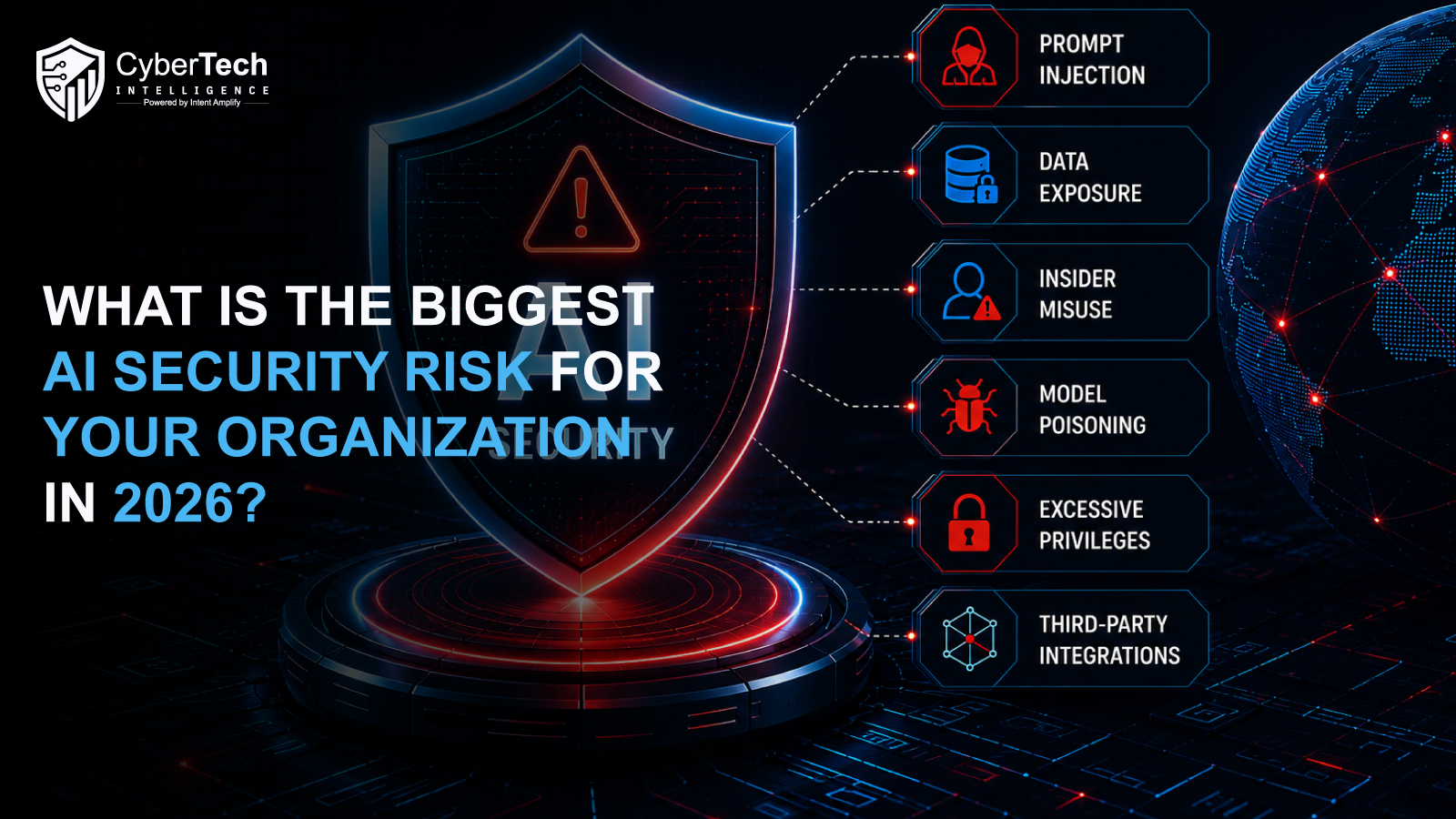
The most significant AI security risk facing enterprises in 2026 is not the model itself but the expansion of autonomy without corresponding governance. AI systems, agents, and AI-enabled workflows are increasingly receiving access to enterprise data, applications, and operational processes before identity controls, monitoring capabilities, approval mechanisms, and governance frameworks are mature enough to manage that authority.
For security leaders, the issue is becoming more urgent as AI adoption moves from experimentation to operational integration. AI capabilities are now embedded within security operations, cloud environments, software development workflows, customer-data platforms, SaaS applications, knowledge repositories, identity systems, and business processes. Once a system can retrieve information, invoke tools, execute actions, and influence decisions, the risk extends beyond prompt quality or hallucination into the broader enterprise control plane.
Recent threat intelligence supports that conclusion. CrowdStrike’s 2026 Global Threat Report states that attacks by AI-enabled adversaries increased by 89%, the fastest recorded eCrime breakout time reached 27 seconds, and 82% of detections in 2025 were malware-free.¹ IBM’s 2026 X-Force Threat Intelligence Index reports a 44% year-over-year increase in exploitation of public-facing software or system applications, 300,000 AI chatbot credentials observed for sale on the dark web, and a 49% increase in active ransomware groups compared with the prior year.² Google Cloud’s Mandiant M-Trends 2026 Report is grounded in over 500,000 hours of incident investigations in 2025 and highlights attacker abuse of AI inside compromised environments, SaaS integration abuse, edge-device exploitation before patches are released, and ransomware handoffs collapsing to seconds.³
For CISOs, CIOs, CTOs, risk leaders, SOC managers, and AI/ML security engineering teams, the strategic question is direct: which AI systems are allowed to act, what can they access, who approved those permissions, and how quickly can the organization detect or reverse unsafe behavior?
Why Autonomy Has Become the Core AI Security Risk
Conventional AI use often centers on content generation, summarization, classification, or analysis. Agentic AI and AI-connected automation change the risk profile because they allow software to interpret context, select tools, execute workflows, and operate through delegated access. That shift creates efficiency, but it also creates new paths for privilege misuse, data exposure, and workflow manipulation.
The risk is especially significant because AI systems rarely operate in isolation once they move into production. A security copilot may connect to SIEM data, endpoint telemetry, identity logs, and ticketing systems. A developer assistant may interact with source code, build pipelines, secrets, and cloud infrastructure. A customer support AI tool may retrieve records, summarize account histories, and update case information. A business-process agent may access contracts, approvals, payment workflows, or employee data.
When those systems are governed poorly, attackers do not always need to compromise the model. They may target the surrounding identity, API, SaaS integration, prompt context, retrieval source, or workflow permission. That is why the biggest AI security risk in 2026 is not simply “AI misuse.” It is the gap between AI autonomy and enterprise control maturity.
The Threat Pattern: Speed, Identity, and Connected Workflows
Three forces are shaping the AI security landscape in 2026: faster attacker movement, identity-based intrusion, and the spread of AI into operational workflows.
CrowdStrike reports that the average eCrime breakout time dropped to 29 minutes, representing a 65% increase in speed from 2024, while the fastest recorded eCrime breakout time reached 27 seconds.¹ These figures make manual-only detection and response models less defensible, particularly for organizations where escalation, enrichment, and containment still depend on sequential handoffs.
At the same time, CrowdStrike states that 82% of detections in 2025 were malware-free.¹ This means adversaries increasingly rely on valid credentials, legitimate tools, remote access pathways, cloud services, and living-off-the-land techniques rather than traditional malware payloads. AI systems intensify this pattern because they often use non-human identities, API tokens, OAuth grants, cloud roles, SaaS permissions, automation credentials, and privileged workflow access.
IBM’s finding that 300,000 AI chatbot credentials were observed for sale on the dark web should be read as an early warning about AI account exposure.² A compromised AI account may reveal prompts, uploaded files, source code snippets, business context, customer data, or connected tool access, depending on how the environment is configured.
The strategic implication is uncomfortable but necessary: organizations may be introducing AI-enabled privilege paths faster than they can inventory, monitor, and govern them.
Figure 1: AI Autonomy Risk Path
Untrusted Input, Stolen Credential, or Exposed API
↓
AI Tool, Agent, or Connected Workflow Receives the Request
↓
Prompt Context, Retrieval Source, or Tool Permission Is Manipulated
↓
SaaS Query, Cloud Action, Ticket Update, Code Change, or Data Retrieval Occurs
↓
Sensitive Data Exposure, Privilege Misuse, Workflow Abuse, or Lateral Movement
↓
Fraud, Extortion, Disruption, Compliance Failure, or Recovery Denial
This risk path shows why AI security cannot sit only with AI engineering teams. Once an AI system can act across enterprise platforms, security ownership must include IAM, SOC, cloud security, application security, GRC, data protection, and business process owners.
Table 1: Biggest AI Security Risks for 2026
|
Risk Area |
Why It Matters |
Executive Question |
|
AI agent identity |
Agents may hold tokens, service accounts, OAuth grants, or privileged SaaS access. |
Which non-human identities belong to AI systems, and who owns them? |
|
Prompt injection |
Untrusted content can influence tool use or workflow behavior |
Can external content cause an AI system to take an unsafe action? |
|
RAG security |
Retrieval systems may expose sensitive, stale, or poisoned information |
Which repositories can AI systems retrieve from, and how are they classified? |
|
Shadow AI |
Employees may use unsanctioned tools with enterprise data |
Can the organization detect AI tool usage outside approved platforms? |
|
Public-facing application exposure |
Internet-facing applications and APIs may connect to AI workflows |
What downstream actions can exposed applications trigger? |
|
Autonomous SOC response |
AI can accelerate containment, but unsafe automation can disrupt business operations. |
Which response actions require human approval and rollback controls? |
|
AI credential theft |
Compromised AI accounts may expose prompts, files, data, and connected applications. |
Are AI accounts protected under enterprise identity governance? |
Why Prompt Injection Is a Business Risk, Not Only a Technical Issue
Prompt injection is often discussed as a model-level vulnerability, but its business impact depends on what the AI system can access and do. A prompt injection attempt against a basic chatbot may produce an inaccurate response. The same technique against an AI agent connected to ticketing, email, cloud infrastructure, or security tooling may influence business workflows, expose data, or trigger unauthorized actions.
This is why prompt injection attack prevention should be evaluated alongside tool governance, data classification, approval logic, and runtime monitoring. The organization should separate system instructions from retrieved content, label untrusted inputs, restrict tool permissions, and require human review for high-impact actions.
Retrieval-augmented generation creates a related concern. RAG security risks and mitigations become critical when AI systems retrieve from legal documents, customer records, security logs, software repositories, financial data, or internal knowledge bases. If the retrieved content is sensitive, outdated, poisoned, or poorly classified, the AI system may generate unsafe recommendations or expose information to the wrong user.
What Security Leaders Should Do First
The priority is not to block AI adoption. Blocking AI without providing governed alternatives usually pushes usage into shadow channels, where visibility is weaker, and policy enforcement becomes harder. A better approach is to classify AI systems by autonomy level, access sensitivity, and business impact.
Table 2: AI Security Priority Model
|
Priority |
What to Assess |
Recommended Action |
|
1 |
AI systems with privileged access |
Inventory agents, service accounts, tokens, plugins, and connected tools |
|
2 |
AI workflows touching sensitive data |
Apply data classification, retrieval restrictions, and logging |
|
3 |
AI systems that can trigger actions |
Require approval gates, rollback procedures, and change records |
|
4 |
Shadow AI usage |
Use SaaS discovery, DLP, browser controls, and employee guidance |
|
5 |
AI security testing |
Conduct AI red teaming for prompt injection, tool misuse, RAG abuse, and data leakage |
|
6 |
SOC integration |
Define which investigation and response actions can be automated safely |
The practical test for leadership is whether the organization can answer five questions without a manual investigation: which AI systems are in use, what data they can access, which tools they can call, which identities they operate under, and which logs prove what happened.
Cyber Tech Intelligence Perspective
As organizations integrate AI agents and AI-powered workflows across security, cloud, SaaS, development, customer operations, and business processes, understanding the associated risks becomes a strategic priority. The challenge is separating theoretical concerns from operational realities and ensuring security investments are aligned with actual exposure.
Cyber Tech Intelligence helps security and technology leaders make informed, executive-ready decisions through Demand Intelligence, Sponsored Research, Vendor Intelligence, GTM Strategy, Executive Roundtables, Webinars & Panels, Pipeline Activation, Targeted Content, and Strategic Consulting. Our research-driven approach helps organizations evaluate AI security risks, assess control effectiveness, prioritize remediation efforts, and develop practical roadmaps for secure AI adoption.
Whether you're evaluating AI security platforms, autonomous SOC workflows, AI-driven threat detection, AI agent security, IAM for AI agents, prompt injection defenses, AI red teaming, RAG security, or governance frameworks, Cyber Tech Intelligence provides the intelligence and strategic guidance needed to align security, business, and compliance objectives.
Planning to deploy AI agents or AI-connected workflows? Contact Cyber Tech Intelligence to identify which AI risks are operationally material, prioritize the controls that matter most, and build a resilient AI security strategy before autonomy scales. Contact Us
Conclusion
The biggest AI security risk for 2026 is unmanaged autonomy. As AI systems gain access to enterprise data, identities, tools, and workflows, the organization’s risk depends less on the model alone and more on the controls surrounding it.
Security leaders should focus on the areas where AI intersects with privilege, sensitive data, external inputs, operational actions, and business-critical workflows. That is where attackers will look for leverage, and it is also where governance failures are most likely to create a material impact.
AI can improve resilience when it is deployed with strong controls, clear ownership, reliable monitoring, and disciplined human oversight. Without those foundations, it becomes another high-speed pathway through which identity abuse, data exposure, SaaS compromise, and workflow manipulation can reach the business.
References
- CrowdStrike (2026) 2026 Global Threat Report. CrowdStrike, 2026. Available at:https://www.crowdstrike.com/en-us/blog/crowdstrike-2026-global-threat-report-findings/
- IBM (2026) 2026 X-Force Threat Intelligence Index. IBM Corporation, 2026. Available at: https://www.ibm.com/reports/threat-intelligence
- Google Cloud and Mandiant (2026). Mandiant M-Trends 2026 Report. Google Cloud and Mandiant, 2026. Available at: https://cloud.google.com/security/resources/m-trends