
EXECUTIVE SUMMARY
The 2026 enterprise breach model no longer depends solely on malware, zero-day exploits, or brute-force attacks. Increasingly, compromise begins through a trusted integration, an OAuth grant, a service account, or an API credential that already possesses legitimate access to enterprise systems.
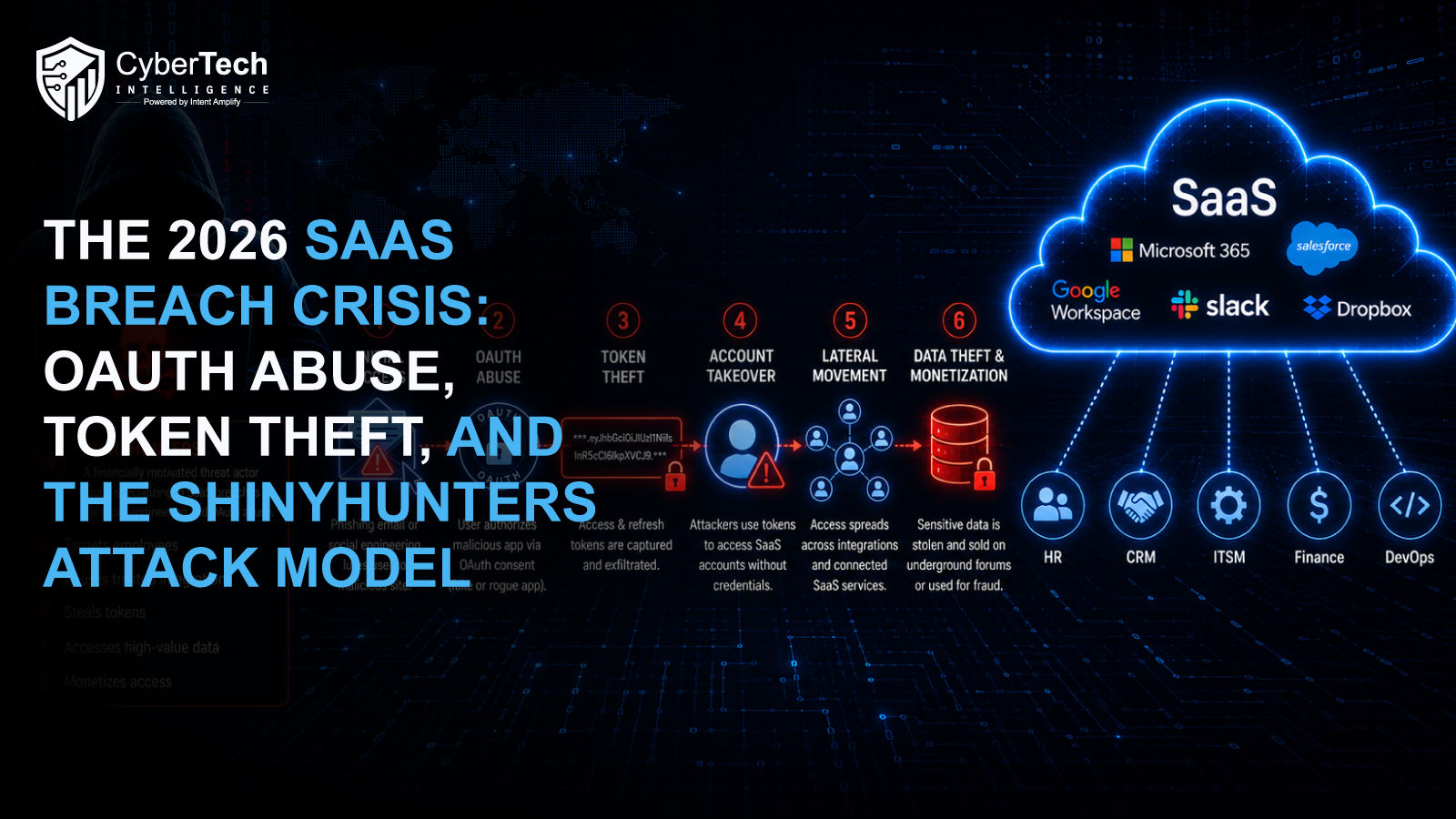
The August 2025 Salesloft-Drift incident demonstrated how a single compromised third-party integration could affect more than 700 organizations through stolen OAuth tokens connected to Salesforce environments, often bypassing additional authentication challenges and operating within established trust relationships.
The underlying issue is not a particular vendor or an isolated control failure. It is the rapid expansion of the trust layer across enterprise SaaS ecosystems.
Organizations have created extensive networks of delegated access spanning Salesforce, Microsoft 365, GitHub, Snowflake, Slack, Workday, NetSuite, and hundreds of other platforms. OAuth tokens, API keys, refresh tokens, service accounts, and federated identity sessions now serve as the connective tissue of modern business operations. While these mechanisms enable productivity and integration at scale, they also create persistent and often opaque pathways into sensitive systems and data.
Threat actors have adapted accordingly. Rather than attacking applications directly, they increasingly target the trust relationships connecting them.
The SaaS breach epidemic is therefore not simply a problem of compromised applications. It is fundamentally a problem of compromised trust.
SECTION 1: HOW ENTERPRISE TRUST BECAME THE NEW ATTACK SURFACE
1.1 The SaaS Layer Is Now the Perimeter
Modern enterprises have grown beyond traditional frameworks with a clearly defined AI-based security perimeter. Nearly every business function now depends on SaaS platforms. Sales teams rely on Salesforce, engineering teams operate in GitHub, finance functions run through NetSuite, and HR processes are managed in Workday. Collaboration, analytics, customer support, legal, and marketing teams each introduce additional SaaS dependencies.
These platforms are interconnected through OAuth applications, APIs, third-party integrations, browser extensions, service accounts, and identity providers. While this interconnected ecosystem has accelerated productivity and business agility, it has also expanded the enterprise attack surface.
Organizations now manage hundreds of cloud applications, many of which are unsanctioned, insufficiently governed, or only partially visible to security teams. As SaaS ecosystems grow, so does the complexity of the trust relationships connecting them.
Every integration introduces delegated access. Every token grants authority. Every unreviewed connection creates a potential pathway to sensitive data and critical business systems. Permissions to read, write, export, modify, or synchronize information routinely extend beyond the visibility of traditional security controls.
The challenge is no longer securing individual applications. It is governing the expanding web of trust that connects them.
Microsoft’s 2025 Digital Defense Report emphasized the scale of identity-based risk, showing how attackers increasingly rely on credentials, tokens, consent abuse, and cloud identity paths rather than traditional infrastructure exploitation.3
The enterprise perimeter has not disappeared. It has moved into the identity and authorization layer.
1.2 Why Tokens Create a Different Security Problem
OAuth tokens are not passwords in the traditional sense. They are authorization artifacts that allow applications to act on behalf of users or services after access has already been granted.
That distinction matters.
Once an OAuth token is issued, the attacker does not necessarily need to defeat MFA again. The authorization has already occurred. A valid token can allow access through APIs, integrations, and connected apps while appearing to behave like legitimate application activity.
The Salesloft-Drift campaign illustrates this risk clearly. The initial compromise reportedly began months before the August 2025 exploitation window, with stolen Drift OAuth tokens later used to access downstream Salesforce environments.4
A single compromised integration became a route into hundreds of customer environments.
Obsidian Security’s February 2026 analysis warned that supply chain token theft can create a far larger blast radius than a direct compromise of one SaaS platform.4
That is the core risk. A token is not only a credential. In the SaaS ecosystem, it can become a master key.
SECTION 2: THE SHINYHUNTERS PLAYBOOK, OPERATIONAL ANALYSIS
ShinyHunters is not typically described as a nation-state operation. It is a financially motivated cybercriminal group that has developed a repeatable model for turning SaaS trust relationships into breach opportunities. 5
The group’s campaigns show a consistent sequence: social engineering, identity takeover, SaaS pivoting, secret harvesting, and extortion.
2.1 Step One: Social Engineering the Door Open
ShinyHunters rarely need to break through a firewall. More often, the group targets the human layer.
Vishing, help desk fraud, resetting single sign-on credentials, and impersonating employees are still popular avenues. The attack in March 2026 on Aura saw attackers gaining access to an employee account for about an hour by using voice phishing, resulting in the theft of around 900,000 customer data files.6
The message is straightforward. Security strategies may employ EDR, SIEM, MFA, and networking techniques but still fail when it comes to identity validation processes.
Why is social engineering successful? Because it exploits time-sensitive situations, trust, and process failures.
No firewall flags a convincing phone call. No endpoint alert automatically triggers when an employee is persuaded to approve access. That makes identity-proofing and help desk verification essential defensive controls.
2.2 Step Two: Turn One SSO Account Into Many SaaS Doors
Once attackers control an SSO-backed account, the next move is expansion.
SSO was designed to simplify access and improve user experience. But if a single SSO identity is compromised, every connected SaaS application becomes part of the potential blast radius.
In several ShinyHunters-linked campaigns, the attackers reportedly used access to connected applications to expand into Salesforce, Snowflake, cloud storage, collaboration tools, and customer data environments.5
The risk is structural.
An enterprise may treat SSO as an authentication improvement. Attackers treat it as a map.
If security teams do not know which applications a compromised identity can access, they cannot quickly determine what data may have been exposed.
2.3 Step Three: Search Every Environment for More Secrets
A SaaS breach is rarely the final destination.
Once inside, attackers search for anything that extends access: AWS keys, GitHub tokens, Snowflake credentials, refresh tokens, API keys, customer secrets, admin notes, support exports, and configuration files.
In the Salesloft-Drift campaign, attackers reportedly used tools such as TruffleHog to identify secrets in GitHub before leveraging stolen OAuth tokens against downstream environments.7
This makes each SaaS breach a reconnaissance operation for the next breach.
A compromised CRM may reveal cloud keys. A support platform may reveal customer credentials. A GitHub repository may expose deployment secrets. A marketing integration may expose access tokens. A Snowflake credential may unlock sensitive data at scale.
The modern SaaS breach is chained.
2.4 Step Four: Extortion Replaces Encryption
ShinyHunters does not need to encrypt data to create pressure. Its leverage is disclosure.
In the Rockstar Games case, attackers allegedly claimed access through Anodot-related Snowflake credentials and threatened public exposure if demands were not met.8
This creates a different kind of crisis than ransomware.
There is no decryption key to recover. There is no locked server to restore. The data has already left the environment.
SECTION 3: THE SCALE OF SAAS EXPOSURE
3.1 The Breach Frequency Problem
The SaaS breach problem is no longer isolated to a few high-profile victims.
ShinyHunters has claimed more than 1,000 organizations across Salesforce-related campaigns, not including the larger ecosystem of Snowflake and third-party credential abuse incidents.7
Publicly reported victims and claimed targets have included organizations across education, gaming, hospitality, media, technology, retail, and consumer services.7
This is not a narrow vertical campaign. It is an opportunistic exploitation of SaaS trust across sectors.
CrowdStrike’s 2025 reporting found that 82% of detections were malware-free, showing that adversaries increasingly rely on valid accounts, credentials, and legitimate administrative tools. The same report placed the average attacker breakout time at 29 minutes.9
That timing matters.
If an attacker can move laterally in less than half an hour, quarterly SaaS access reviews and delayed incident triage are not enough.
3.2 The Financial Impact of SaaS Trust Failure
The cost of SaaS breach exposure is not limited to notification, legal response, and incident remediation.
The factors involved include operational interruption, customer loss, regulations, forensic investigation, brand reputation, contract risk, and challenges associated with future sales.
According to the Cost of a Data Breach Report 2025 released by IBM, the total global cost of a data breach has been found to be $4.44 million, from $4.88 million in the year 2024. On the other hand, the cost of a data breach in the USA is twice that at $10.22 million.10
Additionally, IBM found that data breaches related to stolen or compromised credentials had an average cost of roughly $4.50 million. Third parties were involved in breaches in 15% of cases in 2024, compared to 30% in 2025. 11
SaaS companies also continue to face API-related risk, with API vulnerabilities reported as a contributing factor in a large share of security incidents.12
The economics are clear. Weak SaaS trust governance is expensive.
3.3 The Infostealer Pipeline Behind Token Theft
The SaaS breach economy is supported by a mature credential market.
Microsoft identified Lumma Stealer as a major contributor to observed infostealer infections between October 2024 and October 2025.13
Credential theft has become a scalable commodity, while SaaS environments provide an expanding set of targets. As credentials, session cookies, access tokens, and authentication artifacts become easier to obtain and trade, the cost of entry for attackers continues to decline.
At the same time, limited visibility into OAuth grants, third-party integrations, service accounts, and delegated access relationships increases the potential value of a successful compromise. An attacker who gains access to a trusted identity or integration often inherits the permissions and trust associated with it, enabling lateral movement across interconnected SaaS environments.
This imbalance creates a favorable economic model for attackers: low acquisition costs, broad access opportunities, and high potential returns. As a result, visibility and governance of SaaS trust relationships have become critical components of enterprise risk management.
SECTION 4: THE TECHNICAL ANATOMY OF OAUTH ABUSE
4.1 Device Code Phishing: MFA Without Protection
Device code phishing abuses a legitimate OAuth flow.
The attacker generates a device code and persuades the victim to authenticate it. The victim completes the real Microsoft authentication process, including MFA. But the authorization is applied to the attacker-controlled session.
That is why this attack is dangerous. It does not always require a fake login page. The victim may be interacting with a legitimate Microsoft page.
According to the Cloud Security Alliance, OAuth device code phishing impacted over 340 Microsoft 365 companies between 2025 and early 2026.14
Moreover, according to Microsoft Threat Intelligence, device code phishing was carried out by Storm-2372, which operates with Russian backing. It targets government, defense, non-governmental organizations, energy sector companies, and the like.15
Conclusion: MFA alone won’t help, as attackers can deceive the user into logging in the wrong session.
4.2 Consent Phishing and Supply Chain Token Theft
Consent phishing works differently. Instead of stealing a password, attackers trick users into granting permissions to a malicious or compromised application.
Once consent is granted, the attacker may retain access through the approved permissions. Password resets do not necessarily remove the authorization.
Microsoft documented continued growth in identity-based attack techniques in 2025, including attacks that abuse OAuth, consent flows, and cloud access models.13
Supply chain token theft remains even more damaging because the victim organization may not be the original point of compromise.
The Vercel breach reported in 2026 followed a similar structural pattern: a third-party compromise reportedly exposed employee records, API keys, GitHub tokens, and NPM tokens. 16
The most dangerous integration is often the one nobody is watching.
FIGURE 3: OAuth Attack Vectors, Technical Taxonomy
Attack Vector | MFA Bypass Risk | Real-World Pattern | Timeline |
Device Code Phishing | Yes, the victim authenticates the attacker's session | Storm-2372 and Microsoft 365 targeting | 2025–2026 |
Consent Phishing | Yes, access is granted by user consent | Microsoft Entra ID abuse patterns | Ongoing |
Supply Chain Token Theft | Yes, the token is already authorized | Salesloft-Drift Salesforce campaign | March–August 2025 |
Refresh Token Persistence | Yes, the session remains authorized | Long-lived SaaS token abuse | 2025–2026 |
Infostealer Session Harvesting | Yes, an authenticated session is stolen | Lumma and similar infostealer ecosystems | 2024–2026 |
Source: CyberTech Intelligence Analysis based on referenced reporting.
SECTION 5: THE DEFENSE ARCHITECTURE SECURITY TEAMS NEED NOW
5.1 Visibility, Token Hygiene, and Stronger Verification
The most consistent failure across SaaS breaches is not always missing MFA or a lack of endpoint tooling. It is missing visibility.
Security teams cannot defend OAuth grants they do not know exist. They cannot revoke stale tokens they cannot see. They cannot investigate vendor exposure quickly if they do not understand which third-party applications hold access to critical SaaS platforms.
A Microsoft Entra ID hardening effort described in 2025 identified and removed 1,100 unused app grants, eliminating two OAuth persistence paths that had existed without generating meaningful alerts.17
That example matters because it shows that visibility itself reduces risk.
Token management should now be treated with the same seriousness as privileged access management. Organizations should enforce refresh token expiration policies, review sensitive scopes, require administrative approval for high-risk integrations, and revoke unused grants.
Device code flow should be restricted or blocked where there is no documented business need.14
Help desk workflows also need stronger controls. Every SSO reset, MFA change, privilege elevation, or account recovery request should require verification through pre-approved channels.
The attacker’s favorite control bypass is urgency.
Defenders need process discipline that does not collapse under pressure.
5.2 Third-Party SaaS Risk Assessment
The Salesloft-Drift, Gainsight, and Anodot-linked incidents show that organizations can be exposed through vendor trust even when their own core platform controls appear sound.
Third-party risk management must now include OAuth-specific questions.
How does the vendor store customer-issued tokens?
How are tokens encrypted?
How quickly does the vendor notify customers after a compromise?
Are integration scopes limited by least privilege?
Does the vendor support rapid token revocation?
Are connected app permissions reviewed continuously?
IBM’s 2025 breach data placed third-party involvement in 30% of incidents, making vendor trust one of the most important areas of modern breach prevention.12
A third-party OAuth grant should not be treated as permanent trust.
It should be treated as a revocable privilege.
CONCLUSION: THE TRUST LAYER IS NOW THE BATTLEGROUND
The SaaS breach crisis of 2026 is not being driven only by sophisticated exploit chains. It is being driven by a simpler reality: enterprises created large numbers of trusted SaaS connections without building equal visibility, governance, and revocation capability.
The Salesloft-Drift campaign showed how a compromised integration could expose hundreds of downstream environments. The Vercel breach reinforced the risk of third-party credential exposure. The Aura breach showed how one vishing call could open access to sensitive customer data.
Microsoft reported rising identity-based attack pressure in 2025.15
CrowdStrike documented malware-free activity as the dominant detection pattern.9
The attackers already understand the SaaS trust layer.
The question is whether security programs understand it well enough to defend it.
Be Ready for What’s Next
Subscribe to Cyber Tech Intelligence for insightful analysis of the adoption of artificial intelligence and digital transformation powered by data.
REFERENCES
Valence Security (2025) Salesforce OAuth Token Breach: What Every Security Team Must Know. Valence Security, 27 August 2025.
The Hacker News (2025) SaaS Breaches Start with Tokens. The Hacker News, 9 October 2025.
Microsoft Security Blog (2025) Defending Against Evolving Identity Attack Techniques. Microsoft Corporation, 29 May 2025.
Obsidian Security (2026). OAuth Vulnerabilities Every Security Team Should Know. Obsidian Security, 6 February 2026.
Lumos (2026). What Is ShinyHunters?. Lumos, May 2026.
Wikipedia (2026). Aura Data Breach. Wikipedia, March 2026.
Push Security (2026). How Three Techniques Are Behind ShinyHunters’ 2026 Campaigns. Push Security, May 2026.
The Register (2026) Rockstar Games Gets a Taste of Grand Theft Data. The Register, 14 April 2026.
DeepStrike (2026) Cybersecurity Statistics 2025–2026. DeepStrike, May 2026.
IBM (2025) 2025 Cost of a Data Breach Report. IBM Corporation, 2025.
StationX (2026) Cyber Security Breach Statistics 2026. StationX, 2026.
SQ Magazine (2026) API Security Breach Statistics 2026. SQ Magazine, 2026.
Microsoft (2025) Microsoft Digital Defense Report 2025. Microsoft Corporation, 2025.
Cloud Security Alliance (2026). OAuth Device Code Phishing Hits 340+ Microsoft 365 Organizations. Cloud Security Alliance, 25 March 2026.
Microsoft Security Blog (2025) Defending Against Evolving Identity Attack Techniques. Microsoft Corporation, 29 May 2025.
PKWARE (2026) 2026 Data Breaches: Cybersecurity Incidents. PKWARE, 2026.
2toLead (2025) Microsoft Digital Defense Report 2025: What Matters Now for Microsoft 365 and Azure Leaders. 2toLead, 2025.


