
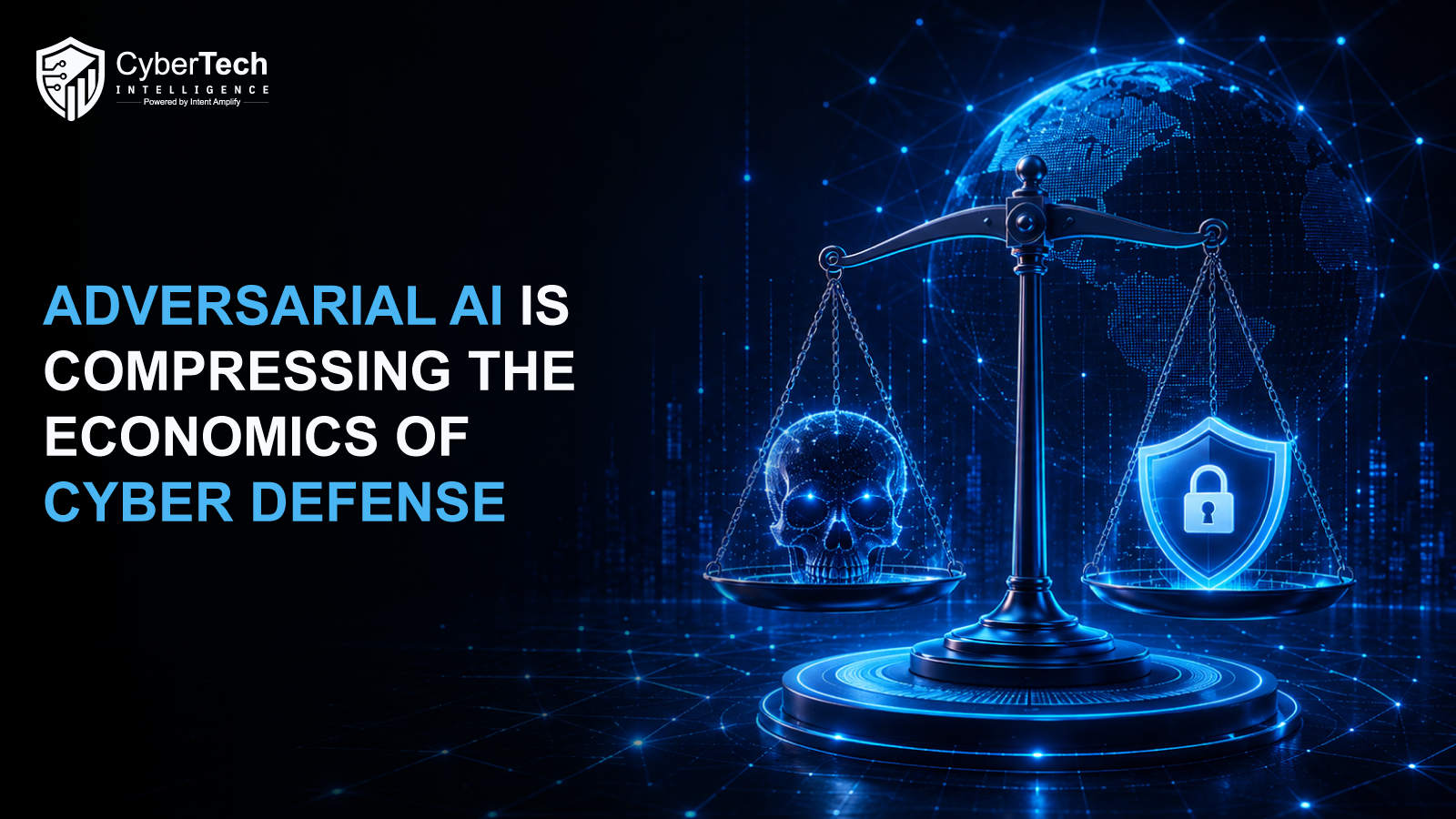
Cyberattacks are entering a different operating model. Activities that once required specialized expertise, sustained effort, and significant time can now be executed faster, iterated more frequently, and adapted at greater scale. Adversarial AI functions as a force multiplier, accelerating reconnaissance, vulnerability research, social engineering, credential targeting, malware refinement, identity abuse, and attacks against enterprise AI systems.
For U.S. enterprise executives, the strategic question is not whether artificial intelligence has created an entirely new category of cyber threat. The more consequential shift is that AI compresses the attack lifecycle while reducing the cost and skill required to execute familiar tradecraft. As attack velocity increases, the time available for detection, investigation, and containment contracts accordingly.
Google Threat Intelligence Group reported in May 2026 that adversaries have progressed from early experimentation to the “industrial-scale application of generative models” across vulnerability discovery, exploit generation, polymorphic malware development, autonomous malware operations, information campaigns, and attacks targeting AI supply chains.¹
This changes the operating assumptions for cyber defense. Security programs are no longer confronting isolated automation; they are responding to adversaries that use AI to accelerate decision-making, personalize attacks, adapt tactics, evade detection, and continuously refine operations throughout the intrusion lifecycle.
CyberTech Intelligence Perspective
Adversarial AI changes the economics of cyberattacks. Credentials, infrastructure, access, social engineering, and exploitable systems remain central to successful intrusions. AI reduces the time, effort, and cost required to identify opportunities, refine attack paths, and adapt operations at scale.
Microsoft reported that AI-automated phishing emails achieved a 54% click-through rate compared with 12% for standard attempts, a 4.5x increase, and estimated that AI automation could raise phishing profitability by up to 50x through scaled targeting at minimal cost.2
AI-powered phishing has progressed beyond a user-awareness challenge into an industrialized persuasion capability. Adversaries can personalize tone, business context, timing, language, and pretext with far less effort, increasing both the scale and credibility of social engineering campaigns. As attack quality improves, human judgment alone becomes a less reliable security control.
IBM’s X-Force Threat Intelligence Index 2026 adds another warning signal: exploitation of public-facing software or system applications increased 44% year over year, 56% of disclosed vulnerabilities did not require authentication to exploit, 300,000 AI chatbot credentials were observed for sale on the dark web, and active ransomware groups increased 49%.3
The board-level conclusion is direct. Adversarial AI does not replace core cyber hygiene. It punishes weak hygiene faster.
The Enterprise Problem: AI Has Changed Attack Economics
Attackers have always searched for leverage. AI gives them leverage in language, code, reconnaissance, infrastructure management, malware variation, and decision support.
Google Threat Intelligence Group reported in 2026 that AI-driven coding has accelerated adversaries' development of infrastructure suites and polymorphic malware, while AI-enabled malware such as PROMPTSPY signals a shift toward autonomous orchestration, in which models interpret system states and generate commands dynamically.1
This should worry executives because many enterprise controls still depend on recognizable patterns. Static indicators, fixed playbooks, periodic reviews, isolated security tools, and manual approval chains struggle when adversaries rapidly vary their behavior.
EY’s March 2026 research shows that security leaders are treating AI-enabled threats as an immediate operating concern, not a future scenario. 96% of senior security leaders described AI-enabled cyber attacks as a significant organizational threat, and 48% said AI played a role in at least one-quarter of the incidents their organizations experienced over the previous year. Confidence has not caught up with exposure: fewer than half said they were strongly confident in their ability to defend against a major AI-enabled breach. 4
That confidence gap is the real executive risk. Concern is widespread. Operating maturity is uneven.
Why Traditional Defense Timelines Are Breaking
The most dangerous enterprise assumption is that defenders have time to investigate, validate, and respond. AI-assisted attacks continue to compress that window.
Palo Alto Networks Unit 42 reported that the fastest quartile of intrusions reached exfiltration in 72 minutes in 2025, down from 285 minutes in 2024, while the share of incidents reaching exfiltration in under 1 hour rose from 19% to 22%.5
Even without treating AI as the sole cause, the implication is severe. Traditional escalation models were designed for human-paced investigation: detect, triage, escalate, meet, approve, contain. AI-assisted operations compress that sequence.
Unit 42 also reported that 87% of intrusions involved two or more attack surfaces, 67% crossed three or more, and 43% crossed four or more.5
This is why tool-by-tool maturity metrics mislead leadership. Endpoint coverage may look strong. Cloud controls may look funded. Identity may have a roadmap. SaaS monitoring may be improving. Yet the attacker moves across all of them.
The Identity Control Plane Is Under Pressure
Identity is now the executive control plane for cyber resilience. It governs who can act, what can connect, which agents can execute, where data can move, and how attackers turn a foothold into business impact.
Unit 42 reported that identity weaknesses played a material role in nearly 90% of investigations, and preventable gaps contributed to more than 90% of incidents.5
Microsoft reported that phishing-resistant multifactor authentication blocks more than 99% of unauthorized access attempts, while attackers are pivoting toward token theft, OAuth consent phishing, workload identities, device-code phishing, and other flows that exploit legitimate authentication mechanisms.2
This changes the board question. The right question is not “Do we have MFA?” The better question is, “Can we continuously govern every human identity, non-human identity, token, service account, OAuth grant, privileged session, and AI agent with measurable containment speed?”
CyberTech Intelligence Adversarial AI Defense Framework™
The CyberTech Intelligence Adversarial AI Defense Framework helps enterprise leaders move from basic awareness to measurable readiness across attack-speed response, identity governance, behavioral detection, AI system protection, and executive evidence.
For the full framework, readers can refer to The AI Security Operations Playbook, published by CyberTech Intelligence. The ebook expands on how enterprises can structure AI threat intelligence, SOC modernization, identity threat detection, prompt injection readiness, automated containment, and governance reporting against AI-powered cyber threats.
Executive Adversarial AI Readiness Scorecard
Readiness against adversarial AI should be evaluated through measurable evidence, not broad confidence statements. For a deeper view of the Executive Transformation Scorecard, readers can refer to AI Threat Intelligence Report 2026, published by CyberTech Intelligence.
The report expands on how CISOs, CIOs, risk leaders, board stakeholders, and security operations teams can assess attack-speed response, identity threat detection, AI-powered phishing resilience, multi-surface visibility, AI governance maturity, supplier AI risk, and board reporting quality.
What Enterprise Leaders Should Prioritize
First, measure response speed against realistic attack compression. If the fastest intrusions can reach exfiltration in 72 minutes, then detection and containment must be tested against that window, not against historical service-level agreements.5
Second, elevate identity security. Machine identities, service accounts, OAuth grants, tokens, SaaS permissions, API keys, and AI agents must be treated with the same seriousness as executive accounts.
Third, move from static indicators to AI threat intelligence and behavioral analytics. Google’s 2026 threat reporting shows adversaries using AI for adaptive malware, vulnerability research, autonomous execution, and large-scale operational support.1
Fourth, mature AI risk management before scaling creates exposure. Cisco found that 90% of organizations say privacy programs expanded because of AI, 43% increased privacy spending, 93% plan more privacy or data governance investment, and only 12% describe AI governance committees as mature and proactive.6
Fifth, align investment with proactive defense. PwC’s 2026 Global Digital Trust Insights survey of 3,887 executives found that 60% rank cyber risk investment among their top three strategic priorities in response to geopolitical uncertainty, yet only 24% spend significantly more on proactive cyber measures than on reactive measures.7
Adversarial AI Is Becoming a Board-Level Trust Test
Adversarial AI will increasingly affect how customers, regulators, insurers, investors, and partners evaluate digital trust. It will shape procurement questionnaires, cyber insurance reviews, AI governance audits, software supply chain assessments, and incident disclosure expectations.
McKinsey’s 2026 research found that cybersecurity remains one of the most frequently cited AI risks, with 72% of respondents identifying cybersecurity as highly relevant as AI adoption expands.8
Deloitte’s 2026 State of AI in the Enterprise report is based on a survey of 3,235 leaders conducted between August and September 2025 across 24 countries, including board, C-suite, president, vice president, and director-level respondents involved in AI initiatives.9
KPMG’s Cybersecurity Considerations 2026 cites its Global Tech Report finding that 92% of technology executives believe managing AI agents will become an essential skill within five years.10
That is not a distant workforce observation. It is an operating-model warning. Security teams will need to supervise autonomous activity, validate AI-enabled decisions, test agent behavior, govern data access, and maintain audit evidence.
Enterprise Adversarial AI Readiness Assessment
Adversarial AI requires more than awareness. It requires evidence that the enterprise can govern identity, detect behavioral anomalies, protect AI systems, contain fast-moving intrusions, monitor suppliers, and report risk clearly to leadership.
CyberTech Intelligence helps enterprise cybersecurity and technology leaders translate AI-accelerated threat shifts into research-led narratives, executive-ready frameworks, buyer-focused insights, and strategic demand programs. Across AI security, identity security, cloud protection, Zero Trust, SIEM, XDR, threat intelligence, AI security operations, GenAI security, prompt injection risk, and cyber governance, CyberTech Intelligence supports organizations working to connect emerging risk with executive decision-making.
For U.S. enterprises, the message is clear. Adversarial AI does not merely increase cyber risk. It changes the tempo of risk. Organizations that build identity discipline, behavioral detection, AI governance, and response-speed evidence now will be better positioned to preserve enterprise trust as attackers become faster, more adaptive, and more persuasive.
Request an Enterprise Adversarial AI Readiness Assessment
Adversarial AI requires more than awareness. It requires evidence that the enterprise can govern identity, detect behavioral anomalies, protect AI systems, contain fast-moving intrusions, monitor suppliers, and report risk clearly to leadership.
CyberTech Intelligence helps CISOs, CIOs, security operations leaders, AI governance teams, risk executives, and board stakeholders evaluate these capabilities through an Enterprise Adversarial AI Readiness Assessment. The assessment examines AI threat exposure, identity security maturity, AI security operations readiness, prompt injection risk, non-human identity governance, supplier AI exposure, and executive reporting maturity.
For organizations strengthening AI security, adversarial AI readiness, AI risk management, AI threat intelligence, and enterprise cyber resilience, this assessment can support board education, campaign strategy, SOC modernization, identity governance, and evidence-based security planning.
Request an Enterprise Adversarial AI Readiness Assessment: Contact Us for more information.
References
- Google Threat Intelligence Group, GTIG AI Threat Tracker: Adversaries Leverage AI for Vulnerability Exploitation, Augmented Operations, and Initial Access, May 2026
https://cloud.google.com/blog/topics/threat-intelligence/ai-vulnerability-exploitation-initial-access - Microsoft, Microsoft Digital Defense Report 2025
https://cdn-dynmedia-1.microsoft.com/is/content/microsoftcorp/microsoft/msc/documents/presentations/CSR/Microsoft-Digital-Defense-Report-2025.pdf - IBM, X-Force Threat Intelligence Index 2026
https://www.ibm.com/reports/threat-intelligence - EY, Cybersecurity Leaders Investing in AI and Agentic Defenses to Combat Escalating AI-enabled Threats, March 2026
https://www.ey.com/en_us/newsroom/2026/03/cybersecurity-leaders-investing-in-ai-and-agentic-defenses-to-combat-escalating-ai-enabled-threats - Palo Alto Networks Unit 42, 2026 Global Incident Response Report
https://www.paloaltonetworks.com/resources/research/unit-42-incident-response-report - Cisco, 2026 Data and Privacy Benchmark Study
https://www.cisco.com/c/dam/en_us/about/doing_business/trust-center/docs/cisco-privacy-benchmark-study-2026.pdf - PwC, 2026 Global Digital Trust Insights
https://www.pwc.com/jg/en/assets/global-digital-trust-insights/dti-report-2026.pdf - McKinsey & Company, State of AI Trust in 2026: Shifting to the Agentic Era
https://www.mckinsey.com/capabilities/tech-and-ai/our-insights/tech-forward/state-of-ai-trust-in-2026-shifting-to-the-agentic-era - Deloitte, The State of AI in the Enterprise 2026
https://www.deloitte.com/us/en/what-we-do/capabilities/applied-artificial-intelligence/content/state-of-ai-in-the-enterprise.html - KPMG, Cybersecurity Considerations 2026
https://assets.kpmg.com/content/dam/kpmgsites/be/pdf/TA-Cybersecurity-considerations-2026-EN-brochure-017-16-9-LR.pdf
Author
CyberTech Intelligence Research Desk
Author