Enterprise cybersecurity is entering a decisive architectural shift. For CISOs, the issue is no longer whether AI will influence security operations. It is whether existing SOC models can evolve fast enough to remain effective against machine-speed threats.
U.S. enterprises are increasing investment in autonomous AI cybersecurity platforms to address three converging pressures: rising attack velocity, identity-driven compromise, and unsustainable SOC workloads. This transition is not a tooling upgrade. It is an operating model change for enterprise cyber defense.
Microsoft’s 2025 Digital Defense Report highlights the growing scale of modern cyber threats. Microsoft now processes more than 100 trillion security signals every day, blocks approximately 4.5 million new malware files daily, analyzes 38 million identity risk detections per day, and screens roughly 5 billion emails daily for phishing and malware. The report also found that identity-based attacks increased by 32% during the first half of 2025, with more than 97% of those attacks involving password-based techniques such as password spraying and brute-force attempts. [1]
For security leaders, these figures point to a fundamental capacity problem. Manual triage, rule-based workflows, and disconnected security tools cannot keep pace with adversaries operating at cloud and AI speed.
Traditional SOC architectures were designed around human-led alert review, manual investigation, and remediation across fragmented platforms. That model is increasingly misaligned with modern threat conditions, where attackers exploit identities, cloud misconfigurations, SaaS exposure, APIs, and automation to move faster than conventional response cycles.
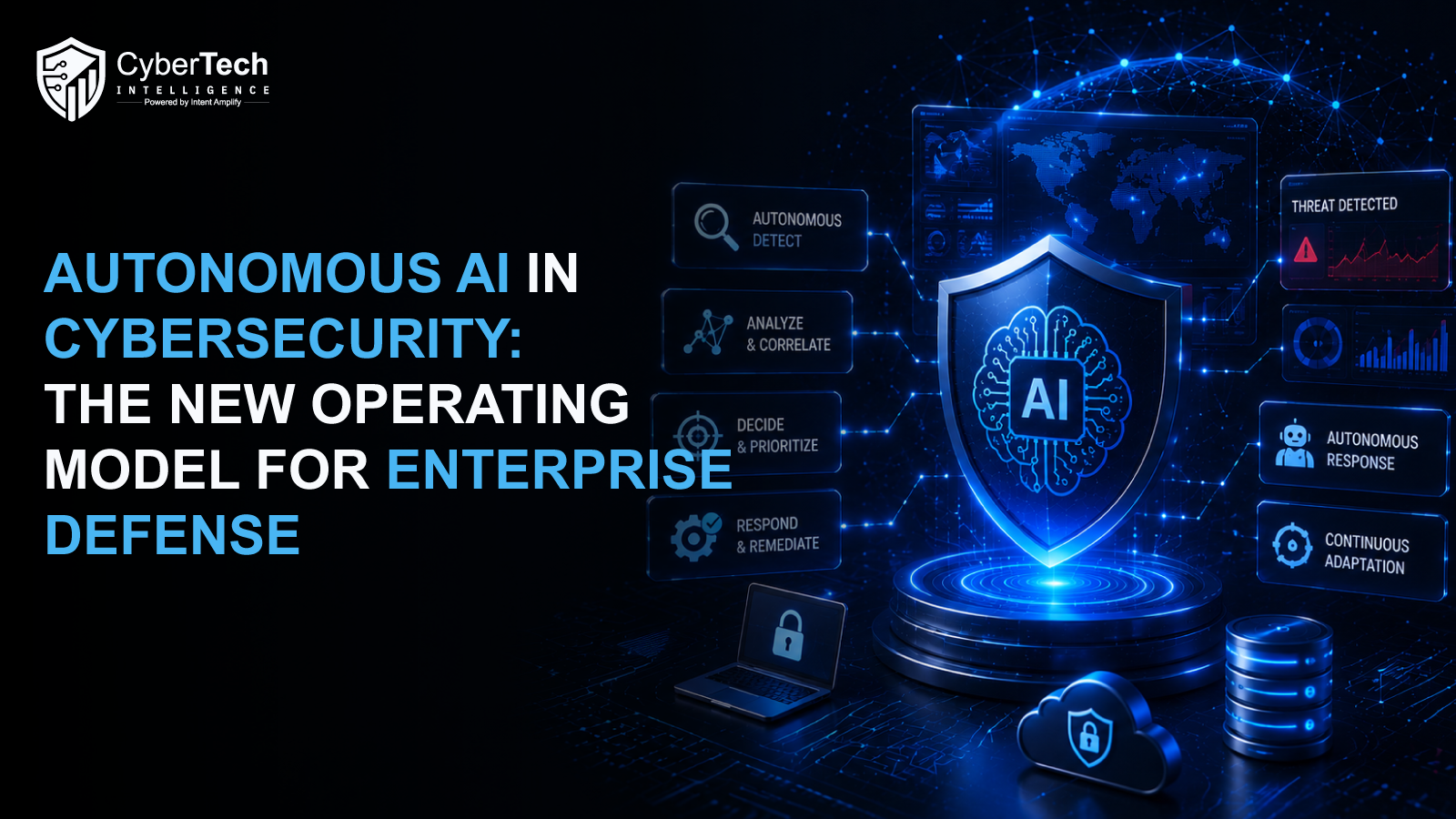
Autonomous AI systems are emerging as a response to this operational gap. Unlike legacy automation, which depends on predefined playbooks, autonomous security systems can interpret telemetry, correlate signals, prioritize threats, recommend action, and execute response steps within approved governance boundaries.
Enterprise SOCs Are Reaching Operational Saturation
Modern enterprise environments now span multi-cloud infrastructure, SaaS applications, hybrid workforces, APIs, microservices, machine identities, operational technology, IoT-connected assets, and AI-enabled business systems. Each layer expands the attack surface and produces continuous telemetry that must be assessed in near real time.
This has created a capacity problem inside the SOC, and the financial impact is becoming increasingly measurable.5
IBM’s 2025 Cost of a Data Breach Report found that the average cost of a data breach in the United States rose to a record $10.22 million, up 9% from the previous year and remaining the highest globally. While the global average breach cost declined to $4.44 million, organizations that extensively deployed security AI and automation reduced breach-related costs by approximately $1.9 million per incident. The average breach lifecycle fell to 241 days, the shortest recorded in nine years, highlighting the growing impact of AI-driven detection and response capabilities. However, the report also found that organizations lacking AI governance faced significantly higher costs, with breaches involving shadow AI adding an average of $670,000 in additional losses. [2]
These numbers frame autonomous cybersecurity as a business risk issue, not only an operational efficiency initiative. The economics of simply adding more tools and analysts are becoming difficult to sustain. CISOs need architectures that increase defensive capacity without creating proportional increases in cost, complexity, or headcount dependency.
Autonomous AI Is Reshaping the Security Operations Model
Cybersecurity automation has existed for years through SOAR platforms, scripts, detection rules, and response playbooks. However, these systems generally execute predefined logic. They improve workflow efficiency but do not independently reason across a complex enterprise context.
Autonomous AI systems represent a more advanced model.
Modern AI-enabled cybersecurity platforms combine large language models, behavioral analytics, reinforcement learning, graph intelligence, threat intelligence correlation, generative AI copilots, and continuous telemetry reasoning. These capabilities allow security systems to evaluate activity dynamically across identity, endpoint, network, cloud, application, and data layers.
This distinction matters because enterprise risk rarely appears as a single isolated alert. A suspicious login, anomalous API call, privilege escalation, or unusual data movement event may only become meaningful when correlated with identity behavior, asset criticality, cloud posture, endpoint activity, and known adversary techniques.
Autonomous AI can connect those signals faster and more consistently than manual workflows. It can reduce false positives, prioritize high-risk incidents, surface attack paths, and support faster containment.
|
SOC Function |
Traditional Model |
Autonomous AI-Enabled Model |
|
Alert triage |
Analyst-led review of alerts |
AI prioritizes incidents by risk, context, and asset criticality |
|
Investigation |
Manual correlation across tools |
AI correlates identity, endpoint, cloud, network, and application telemetry |
|
Response |
Playbook-driven remediation |
AI recommends or executes approved containment actions |
|
Identity defense |
Static access rules and alerts |
Continuous behavioral analysis and privilege-risk detection |
|
Analyst role |
High-volume alert handling |
Supervision, validation, threat hunting, adversarial testing, and governance |
|
Reporting |
Manual dashboards and incident summaries |
AI-assisted risk narratives, executive reporting, and trend analysis |
Accenture’s 2025 State of Cybersecurity Resilience research found that only 10% of organizations are adequately prepared to use AI-powered cybersecurity services. At the same time, 63% remain vulnerable to AI-enabled attacks because of modernization and resilience gaps, while 77% lack sufficient AI governance and data security maturity. [3]
The same research indicates that organizations with mature AI-powered cybersecurity strategies experienced a 69% lower likelihood of cyberattacks compared with less mature organizations. [3]
Identity Security Is Becoming the Primary AI Control Plane
Identity is now one of the most important battlefields in enterprise cybersecurity. As organizations adopt cloud platforms, SaaS ecosystems, remote access models, APIs, and machine identities, attackers increasingly target credentials and privileges rather than infrastructure vulnerabilities.
Microsoft’s 2025 Digital Defense Report found that identity-based attacks rose 32% in the first half of 2025, with more than 97% involving large-scale password attacks. The report also warns that in cloud environments, criminal and nation-state actors are increasingly conducting end-to-end attacks as legitimate users or resources, manipulating any asset the compromised identity is trusted to access. [4]
Autonomous AI is particularly valuable in identity-centric environments because identity risk depends on behavioral context. AI-driven systems can continuously analyze authentication patterns, device trust, impossible travel, privilege escalation, API behavior, lateral movement, access deviations, and session anomalies.
This explains why identity protection, privilege governance, and zero-trust enforcement are becoming priority areas for autonomous cybersecurity investment. As zero-trust programs mature, AI-driven identity security will increasingly determine how quickly enterprises can detect and contain compromise.
The Economic Case for Autonomous Cybersecurity Is Strengthening
The CISO mandate has expanded. Security leaders must now manage rising threat volume, compliance pressure, cyber insurance scrutiny, talent shortages, third-party exposure, cloud complexity, and board-level expectations around resilience.
Traditional SOC scaling models are under pressure because they rely heavily on human capacity. Hiring more analysts can improve coverage, but it does not fully solve alert overload, tool fragmentation, response latency, or 24/7 operational demand.
Autonomous AI offers a more scalable model. By automating telemetry analysis, alert triage, incident correlation, and response recommendations, security teams can improve coverage without increasing headcount at the same rate.
McKinsey has estimated that generative AI could contribute between $2.6 trillion and $4.4 trillion annually to the global economy. [4]
Cybersecurity represents a high-value AI use case because it directly supports financial protection, operational continuity, regulatory compliance, and digital trust.
Google Cloud and Mandiant have also reported increased threat activity across cloud-native environments, including credential abuse, reconnaissance, and attacker tradecraft targeting cloud infrastructure.
The Future SOC Will Operate Through Human-Guided Autonomy
Autonomous cybersecurity does not eliminate the role of human analysts. It changes where human expertise is applied.
The future SOC will operate through a human-guided autonomy model. AI systems will manage high-volume telemetry analysis, triage, signal correlation, and response recommendations. Human teams will supervise autonomous workflows, validate high-impact remediation, investigate complex threats, manage exceptions, and maintain governance oversight.
AI-assisted SOC environments can improve investigation speed, threat prioritization, operational efficiency, analyst productivity, and incident response scalability when deployed with strong telemetry integration, validation controls, and clear escalation paths.
Over time, analyst responsibilities will shift toward adversarial simulation, threat modeling, AI governance, resilience engineering, executive cyber advisory, and strategic risk management.
This workforce transition is important for security leadership. CISOs will need to redesign SOC roles, escalation procedures, validation controls, and governance models to ensure autonomous systems improve resilience without creating unmanaged operational risk.
Autonomous AI Introduces New Governance and Risk Requirements
Autonomous AI strengthens cyber defense, but it also creates new enterprise risk categories.
|
Governance Risk |
Why It Matters |
|
Opaque recommendations |
Security teams may not understand why an AI system prioritized or dismissed an incident. |
|
Over-automation |
Systems may execute containment actions without enough validation. |
|
Model manipulation |
Prompt injection, poisoning, or evasion can alter security reasoning. |
|
False confidence |
AI-generated summaries may appear authoritative even when the context is incomplete. |
|
Audit gaps |
Regulators and boards may require evidence of how autonomous actions were approved. |
|
Human oversight drift |
Teams may gradually defer too much judgment to AI systems. |
Threat actors are experimenting with prompt injection, model poisoning, AI evasion, autonomous malware adaptation, generative phishing, and AI-assisted reconnaissance. As a result, AI is both a defensive capability and an expanding attack surface.
For CISOs, this makes AI governance a core requirement of cybersecurity strategy. Security leaders must ensure that autonomous systems are explainable, auditable, validated, monitored, and subject to human oversight.
Federal guidance, including the NIST AI Risk Management Framework, emphasizes explainability, transparency, validation, accountability, and operational control. These principles are becoming essential for the responsible deployment of AI in security operations. [7]
Regulatory expectations are also increasing. SEC cybersecurity disclosure rules, critical infrastructure protection measures, and government-led AI governance initiatives are raising the standard for resilience, transparency, and executive accountability.
This means autonomous cybersecurity can no longer be treated as a technical deployment alone. It must be governed as part of enterprise risk management.
Autonomous Cybersecurity Is Becoming Core Enterprise Infrastructure
Cybersecurity is now a board-level business priority. It directly affects operational resilience, regulatory exposure, customer trust, investor confidence, and enterprise continuity.
PwC’s 2026 Global Digital Trust Insights survey found that nearly eight in ten organizations, 78%, expect their cyber budget to increase over the next 12 months, with AI ranked as the top cybersecurity investment priority [8]
For CISOs, this creates both an opportunity and a mandate. Autonomous cybersecurity can help modernize defense architecture, but it must be deployed with clear governance, measurable outcomes, and alignment with business risk.
The most important question is no longer whether AI will transform security operations. The strategic question is how quickly organizations can integrate autonomous defense models before legacy SOC infrastructure becomes insufficient for modern attack conditions.
Conclusion
Autonomous AI systems represent one of the most significant architectural changes in enterprise cybersecurity.
CISOs are facing AI-enabled adversaries, expanding cloud environments, identity-centric attacks, SOC saturation, and machine-speed threat activity. Traditional security operations cannot scale indefinitely through manual processes, fragmented tools, and headcount expansion.
Autonomous AI offers a new model based on adaptive intelligence, contextual analysis, continuous learning, real-time reasoning, machine-speed response, and scalable resilience.
However, the future of cyber defense will not be fully autonomous. The strongest model will combine autonomous AI with human expertise, executive oversight, governance, and strategic risk management.
Organizations that establish this balance early will be better positioned to improve cyber resilience, reduce SOC strain, accelerate incident response, strengthen regulatory readiness, and build durable enterprise trust. The future SOC will not be fully autonomous, but it will be too fast, too distributed, and too complex to remain fully manual.
As cyber resilience becomes a boardroom priority, organizations can no longer afford to let alert fatigue, fragmented tools, and understaffed SOC teams slow down threat response. CyberTech Intelligence helps cybersecurity leaders stay informed with expert insights, industry research, and strategic guidance designed to strengthen security operations.
Connect with CyberTech Intelligence to explore SOC modernization, autonomous cybersecurity readiness, and AI governance strategies.
References
- Microsoft (2025) Microsoft Digital Defense Report 2025. Available at: https://cdn-dynmedia-1.microsoft.com/is/content/microsoftcorp/microsoft/msc/documents/presentations/CSR/Microsoft-Digital-Defense-Report-2025.pdf#page=1.
- IBM (2025) Cost of a Data Breach Report 2025. Available at: https://www-api.ibm.com/adobe/assets/urn:aaid:aem:607b9590-38e0-4c91-b433-aa8a17f5b5e8/original/as/cost-of-a-data-breach-2025-full-report.pdf.
- Accenture (2025) State of Cybersecurity Resilience 2025. Available at: https://www.accenture.com/content/dam/accenture/final/accenture-com/document-3/State-of-Cybersecurity-report.pdf#zoom=40.
- McKinsey & Company (2023) The Economic Potential of Generative AI: The Next Productivity Frontier. Available at: https://www.mckinsey.com/capabilities/mckinsey-digital/our-insights/the-economic-potential-of-generative-ai-the-next-productivity-frontier.
- CrowdStrike (2025) 2025 Global Threat Report. Available at: https://www.crowdstrike.com/en-us/resources/reports/global-threat-report-executive-summary-2025/.
- Google Cloud / Mandiant (2025) Cloud Threat Horizons Report H2 2025. Available at: https://cloud.google.com/security/report/resources/cloud-threat-horizons-report-h2-2025.
- National Institute of Standards and Technology (NIST) (2023) Artificial Intelligence Risk Management Framework AI RMF 1.0. Available at: https://www.nist.gov/itl/ai-risk-management-framework.
- PwC (2025) Global Digital Trust Insights 2025. Available at: https://www.pwc.com/us/en/services/consulting/cybersecurity-data-tech-risk/library/global-digital-trust-insights.html.