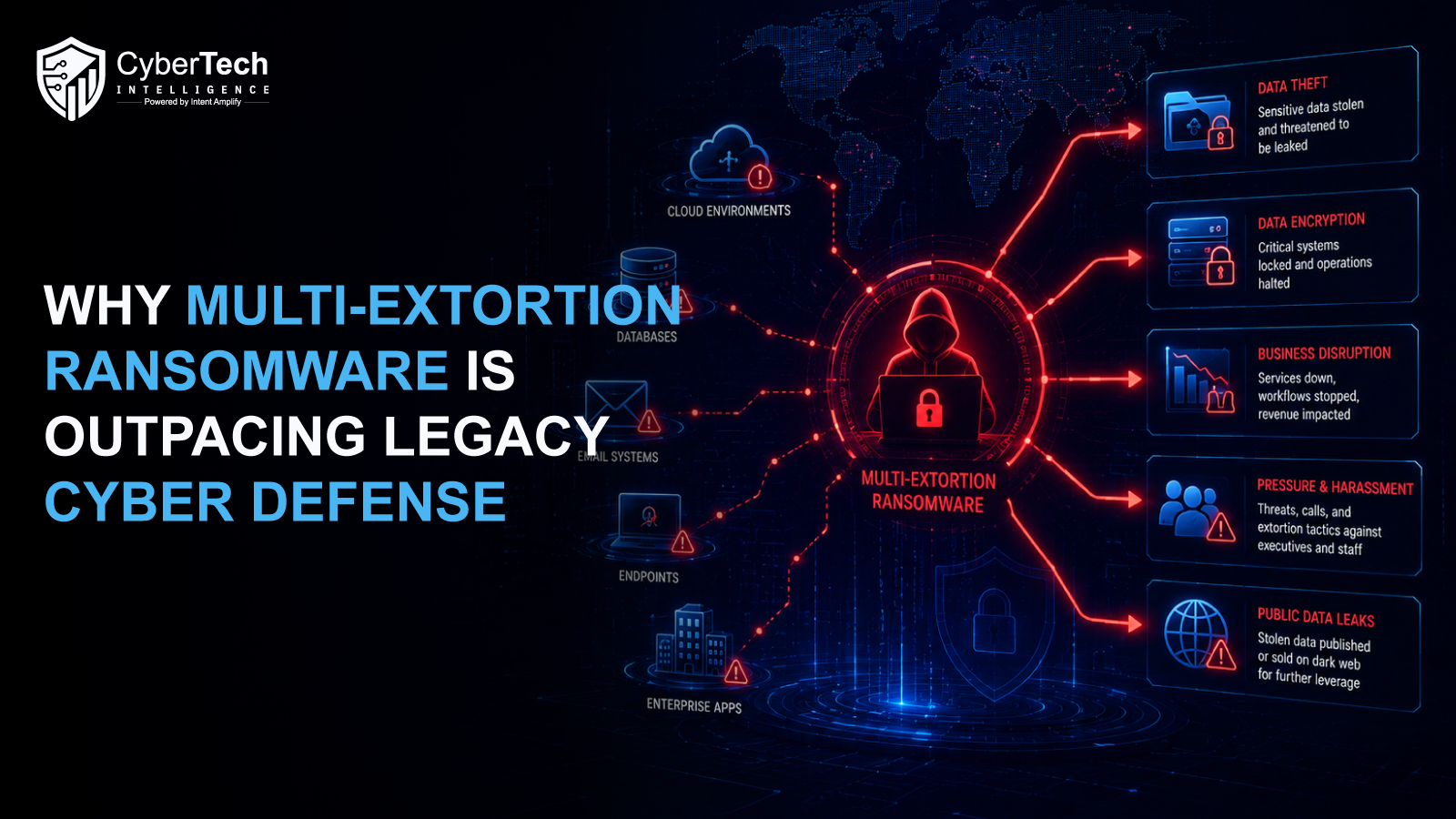
Ransomware has evolved beyond file encryption into a coordinated extortion model that combines data theft, operational disruption, leak-site publication, customer and partner coercion, distributed denial-of-service attacks, and targeted social engineering. Encryption remains one stage of the attack lifecycle, but attackers increasingly derive leverage from business disruption, confidentiality exposure, and reputational pressure.
This evolution reflects the growing industrialization of cybercrime. Modern ransomware operations function through specialized ecosystems comprising initial access brokers, credential marketplaces, malware developers, infrastructure providers, negotiators, and financial laundering networks. The specialization of these roles enables threat groups to scale operations, shorten attack timelines, and sustain extortion pressure throughout investigation, recovery, and disclosure activities.
Enterprise resilience therefore depends on controlling trusted access as rigorously as preventing malicious code execution. Threat actors routinely exploit compromised identities, cloud services, SaaS applications, APIs, unmanaged endpoints, and third-party connections to establish persistence and move laterally across hybrid environments. Security programs should integrate identity governance, continuous visibility, privilege management, segmentation, and data protection into a unified resilience strategy that limits attacker mobility and reduces the business impact of compromise.
Multi-Extortion Has Become a Board-Level Risk
Multi-extortion ransomware is an enterprise resilience issue, not only a security operations issue. Akamai reported that more than $724 million in cryptocurrency was extorted from victims associated with TrickBot-linked activity, and that the malware family has been used by ransomware groups. Akamai also observed TrickBot-related activity connected to suspicious scheduled tasks across customer assets. [1]
The same Akamai reporting found that nearly 50% of analyzed cryptomining attacks targeted nonprofits and educational organizations. That finding does not make cryptomining equivalent to ransomware. It does, however, support a broader risk point: financially motivated actors repeatedly exploit sectors with valuable computing environments, decentralized systems, and constrained security resources. [1]
Board exposure increases because multi-extortion attacks can create damage even when systems are restored. Stolen data can be leaked. Customers can be contacted. Regulators may require notification. Executives may face public disclosure pressure. Supply chain partners may become secondary victims. The core question is no longer, “Can we decrypt or restore?” It is, “Can we sustain operations, protect trust, and make defensible decisions while under coercion?”
|
Board Question |
Why It Matters |
|
Can the organization maintain critical operations during a data-leak extortion event? |
Tests resilience beyond system restoration. |
|
Which identities could allow ransomware to spread across cloud, SaaS, and on-prem environments? |
Identifies privilege concentration. |
|
Are backups immutable, segmented, and regularly restored in tests? |
Measures recoverability under attack conditions. |
|
Do we have decision protocols for leak-site threats, customer contact, and regulatory notification? |
Reduces executive delay during extortion. |
|
Can we detect lateral movement within compressed breakout windows? |
Tests whether response speed matches attacker speed. |
|
Which third parties could become indirect ransomware entry points? |
Surfaces supply chain exposure. |
Why Legacy Defenses Are Losing Control
Many enterprise security architectures were built around a perimeter-centric model. That model assumed suspicious traffic could be stopped at the edge, malware could be identified through signatures, and internal activity could be treated as comparatively trusted. Modern ransomware campaigns exploit the weakness of that assumption.
Credential theft remains one of the most reliable intrusion paths. Infostealers, phishing kits, session hijacking, MFA fatigue, and underground credential markets allow attackers to enter environments through legitimate accounts. Once inside, they can blend into normal traffic unless the organization monitors identity behavior, privilege changes, cloud activity, and anomalous access patterns.
Hybrid work has widened the exposure. Employees now access systems through home networks, personal devices, collaboration platforms, SaaS applications, and remote access tools. Each connection expands the number of places where identity, endpoint, and data controls must operate consistently.
Tool fragmentation makes detection harder. Many organizations have accumulated overlapping security products that generate high alert volume without strong correlation. Analysts may see isolated endpoint alerts, identity events, network anomalies, and cloud findings without a unified view of the intrusion path. In ransomware operations, that delay matters.
Attackers also use legitimate administrative tools to reduce malware dependency. PowerShell, remote management utilities, native operating system functions, and cloud administration consoles can support reconnaissance, privilege escalation, and lateral movement. Detection based only on known malicious files misses this behavior.
Cloud misconfiguration compounds the problem. Over-permissive storage, weak API governance, unmanaged service accounts, excessive SaaS privileges, and poor identity hygiene all create paths that ransomware operators can exploit. Patching remains uneven, especially in large organizations with legacy infrastructure and operational constraints.
Ransomware-as-a-Service Has Industrialized Extortion
Ransomware-as-a-service has matured into a broader cybercrime supply chain rather than a simple malware rental model. Chainalysis reported in its 2026 crypto ransomware analysis that ransomware operations are now supported by initial access brokers and other specialized services that help affiliates obtain compromised network access before deployment. The report also estimated that initial access brokers received at least $14 million in on-chain payments in 2025, underscoring how access sales continue to enable ransomware activity at scale. [4]
Many ransomware-as-a-service groups now resemble commercial software ecosystems, with affiliate portals, payment workflows, negotiation playbooks, leak-site infrastructure, support channels, and revenue-sharing models. Some groups provide affiliates with playbooks for intrusion, credential harvesting, data theft, encryption, and victim pressure. [4]
Unit 42’s 2025 incident response reporting shows that the ransomware economy is still escalating, but the pressure has shifted from ransom size alone to business disruption. Unit 42 reported that the median initial extortion demand increased nearly 80%, from $695,000 in 2023 to $1.25 million in 2024. It also found that 86% of incidents involved significant business disruption, including operational downtime, reputational damage, or both. This indicates that modern ransomware groups are using disruption and exposure as economic leverage, rather than relying only on encryption-based payment pressure. [3]
Initial access brokers strengthen this ecosystem. They compromise organizations and sell access packages that may include VPN credentials, remote desktop access, privileged accounts, or cloud tokens. This specialization allows ransomware affiliates to begin operations without conducting the initial intrusion themselves.
Negotiation has also become more calculated. Threat actors may assess revenue, insurance posture, regulatory exposure, business dependencies, and likely downtime costs before setting demands. The objective is not random disruption. It is economic coercion calibrated to the victim’s operational pressure.
AI Is Compressing the Defender’s Response Window
Artificial intelligence is increasing the speed, scale, and personalization of ransomware operations. CrowdStrike reported that the fastest observed breakout occurred in 27 seconds. [2]
This compression changes incident response economics. If attackers can move from initial access to lateral movement in minutes, delayed triage becomes a material risk. Security teams need detection logic that identifies ransomware precursors before encryption or data publication threats begin.
AI-enabled phishing is especially concerning. Attackers can generate messages that reflect executive writing styles, vendor relationships, internal workflows, and employee context. Deepfake voice and video impersonation further increase the risk of business email compromise, payment fraud, help desk manipulation, and executive impersonation.
Automation also improves reconnaissance. Threat actors can map external infrastructure, analyze exposed credentials, identify vulnerable systems, generate phishing content, and run large-scale targeting operations with less manual effort. Malware development is also becoming more adaptive as attackers vary code structure, adjust behavior, and evade static detection.
The defensive implication is clear: detection must focus less on known malware artifacts and more on behavior, identity misuse, privilege movement, abnormal administrative tooling, and suspicious data access.
Sector Exposure Varies, but the Pressure Pattern Is Consistent
|
Sector |
Multi-Extortion Pressure Point |
|
Healthcare |
Patient-care disruption, medical data exposure, emergency workflow interruption |
|
Financial services |
Customer data theft, payment disruption, fraud exposure, and regulatory scrutiny |
|
Manufacturing |
Production downtime, OT/IT disruption, logistics interruption |
|
Education and nonprofits |
Constrained budgets, decentralized systems, sensitive records |
|
Government |
Citizen service disruption, public confidence risk, sensitive data exposure |
|
Critical infrastructure |
Safety, continuity, national security, cascading operational impact |
|
SaaS and technology |
Downstream customer exposure, source code risk, identity provider compromise |
Sector exposure matters because extortion pressure is rarely uniform. Healthcare organizations face patient safety and privacy consequences. Manufacturers face downtime and supply chain interruption. SaaS providers face downstream customer impact. Education and nonprofits often manage broad user populations with limited security funding. The attacker’s leverage changes by sector, but the pattern remains consistent: steal sensitive data, disrupt operations, increase public pressure, and force rapid executive decisions.
The 2026 Outlook Requires Resilience by Design
SentinelOne forecasts that annual global damage costs for ransomware multi-stage extortion attacks will reach $74 billion in 2026. It also forecasts total cybercrime cost to surpass $10.5 trillion and agentic phishing attacks to exceed 42% of global breaches in 2026. These figures are forecast-based, so they should be treated as directional risk indicators rather than confirmed loss totals. [5]
The strategic conclusion remains firm. Prevention-only security is insufficient against adversaries that can enter through valid credentials, move through trusted services, and create extortion pressure without relying solely on encryption. Organizations must assume some controls will fail and design for containment, detection, recovery, and executive decision speed.
Zero Trust architecture helps reduce implicit trust between users, devices, applications, and networks. Identity-first security strengthens control over privileged users, service accounts, contractors, cloud roles, and third-party access. Extended detection and response improves correlation across endpoints, identities, cloud infrastructure, networks, and SaaS platforms. Threat intelligence gives defenders context on ransomware groups, tactics, exposed credentials, and active exploitation.
First-90-Days CISO Action Plan
|
Action |
Primary Owner |
Purpose |
|
Map privileged identity paths |
IAM / security architecture |
Identify privileged users, service accounts, cloud roles, contractors, and third-party access. |
|
Tune ransomware precursor detections |
SOC/detection engineering |
Monitor credential dumping, privilege escalation, abnormal admin tooling, mass file access, and data exfiltration. |
|
Validate backup recoverability |
Infrastructure/resilience teams |
Test restoration of critical systems from immutable and segmented backups. |
|
Review cloud and SaaS exposure |
Cloud security / SaaS owners |
Assess remote access, APIs, storage permissions, privileged SaaS roles, and backup access. |
|
Run multi-extortion tabletop exercises |
CISO / incident response / legal |
Simulate data leaks, customer contact, regulator pressure, and public disclosure. |
|
Formalize extortion governance |
Executive leadership / legal / communications |
Define decision rights, escalation paths, insurance coordination, and communication protocols. |
Strategic Priorities for Enterprise Security Leaders
CISOs should prioritize five measures.
- First, reduce identity exposure across privileged users, non-human identities, contractors, service accounts, and cloud roles.
- Second, segment critical systems so ransomware operators cannot move freely after an initial compromise.
- Third, validate backup resilience through restoration testing rather than policy review alone.
- Fourth, improve detection engineering for lateral movement, credential misuse, data exfiltration, and administrative tool abuse.
- Fifth, rehearse ransomware decisions with legal, communications, operations, finance, insurance, and executive leadership.
The objective is to reduce attacker leverage. Multi-extortion succeeds when adversaries can combine operational disruption, data exposure, regulatory pressure, and executive uncertainty. A mature program limits that leverage by improving visibility, constraining privilege, protecting critical data, and accelerating coordinated response.
Strengthen Your Ransomware Readiness with CyberTech Intelligence
CyberTech Intelligence helps enterprise security leaders understand fast-moving cyber risks and translate threat intelligence into practical business decisions. As multi-extortion ransomware becomes more identity-driven, cloud-aware, and operationally disruptive, organizations need clear analysis that supports CISO priorities, board reporting, incident readiness, and resilience planning.
Our team provides research-led cybersecurity insights, risk analysis, threat intelligence content, and strategic advisory support designed for enterprise decision-makers. From ransomware trend analysis to security program positioning, CyberTech Intelligence helps organizations communicate risk with clarity and act with confidence.
References
- Akamai (2025) Ransomware Trends 2025. Available at: https://www.akamai.com/site/en/documents/state-of-the-internet/2025/ransomware-trends-2025.pdf
- CrowdStrike (2026) 2026 CrowdStrike Global Threat Report: AI Accelerates Adversaries and Reshapes the Attack Surface. Available at: https://www.crowdstrike.com/en-us/press-releases/2026-crowdstrike-global-threat-report/
- Palo Alto Networks (2025) From Ransom to Revenue Loss. Available at: https://www.paloaltonetworks.com/blog/2025/10/from-ransom-to-revenue-loss/
- Chainalysis (2026) Crypto Ransomware: 2026 Crypto Crime Report. Available at: https://www.chainalysis.com/blog/crypto-ransomware-2026
- SentinelOne (2026) Key Cyber Security Statistics for 2026. Available at: https://www.sentinelone.com/cybersecurity-101/cybersecurity/cyber-security-statistics/