Executive Summary
Ransomware has entered a new operational phase. Modern ransomware operations combine credential theft, cloud compromise, data extortion, recovery interference, and executive decision pressure into a coordinated extortion model. For enterprise leaders, the strategic issue extends beyond file encryption. It includes the organization's ability to sustain critical operations, preserve recovery confidence, and make informed decisions while facing legal, financial, regulatory, and reputational pressure.
Microsoft’s latest security analysis found that attackers sought to steal data in 80% of cyber incidents investigated by its security teams, while more than half of cyberattacks with known motives were driven by extortion or ransomware, representing at least 52% of incidents.1
This shift matters because the mechanics of ransomware now extend beyond endpoint compromise. Attackers increasingly pursue identities, tokens, software-as-a-service environments, cloud storage, backup systems, virtualization layers, and third-party integrations. Google Cloud’s M-Trends 2026 reported that cybercriminal groups in 2025 optimized for immediate impact and deliberate recovery denial, based on more than 500,000 hours of frontline incident investigations.2
Enterprise resilience, therefore, requires a broader operating model. Prevention remains necessary, but it cannot stand alone. Organizations need verified recovery, identity containment, cloud visibility, executive rehearsal, crisis communication, and security operations capable of detecting early-stage intrusion behavior before disruption becomes unavoidable.
CyberTech Intelligence Perspective
Modern ransomware is increasingly designed to undermine organizational confidence rather than rely solely on encryption. Attackers target the systems enterprises depend on to recover, including identities, cloud platforms, SaaS environments, backup infrastructure, virtualization layers, recovery workflows, and executive decision processes.
CyberTech Intelligence research and analysis indicates that ransomware resilience is becoming a test of enterprise operating maturity. The strongest organizations are not defined only by how many attacks they block. They are defined by how quickly they can verify identity integrity, isolate affected services, preserve evidence, recover trusted systems, coordinate executive decisions, and maintain business continuity under pressure.
For CISOs, CIOs, board risk committees, and business continuity leaders, this shifts ransomware planning from incident response toward resilience governance. The central question is whether the enterprise can continue operating and make defensible decisions when technical certainty is incomplete.
Ransomware Has Become a Business Resilience Test
Modern ransomware operators do not merely attack technology. They attack confidence. They study where the business depends on fragile digital processes, which services must remain available, which data sets carry regulatory sensitivity, and which systems would create maximum leverage if unavailable. This makes ransomware a board-level business continuity challenge rather than a narrow security operations issue.
The Verizon 2026 Data Breach Investigations Report executive summary found that ransomware grew to 48% of all breaches, up from 44% in the prior year.3
That figure signals a strategic problem. Even as some victims resist payment, the frequency and business relevance of ransomware remain high. Verizon also reported that 69% of ransomware victims in its dataset did not pay, while the median ransom payment declined to $139,875.3
The decline in payment does not mean the threat is fading. It suggests a different enterprise maturity pattern: more organizations are trying to recover without funding attackers, yet the disruption, legal exposure, and recovery costs remain material. This is where resilience becomes decisive. A company that refuses to pay but cannot restore core services quickly may still face severe operational damage.
Google Cloud’s Cybersecurity Forecast 2026 described ransomware, data theft, and multifaceted extortion as the most financially disruptive category of cybercrime globally, with activity escalating around third-party providers and zero-day exploitation for high-volume data exfiltration.4
The implication for business leaders is clear: ransomware readiness should be evaluated through survivability, not just defense coverage. The organizations best positioned for the next phase will be those that can contain compromise, protect trust, recover verified systems, and communicate credibly while disruption is still unfolding.
CyberTech Intelligence Research Desk Observation: Recovery assurance is emerging as a competitive business capability. Organizations that can restore trusted services quickly, preserve evidence, maintain customer communication, and demonstrate continuity discipline are better positioned to protect revenue, reputation, regulatory confidence, and board trust during ransomware disruption.
The Economics of Modern Extortion
Ransomware has matured into an economic model built around pressure. Attackers seek situations where downtime becomes more expensive than response, uncertainty becomes more damaging than disclosure, and leadership feels forced to choose between imperfect options. The most effective campaigns now exploit the gap between technical compromise and business recovery.
Verizon’s 2026 Breach Impact Study reviewed approximately 70,000 United States cyber insurance claims, of which roughly 38,000 had recorded losses paid to policyholders.5
This claims-based perspective is important because it shows cyber harm after the incident response window. The financial consequences of ransomware rarely end when systems are restored. Business interruption, legal expenses, forensic work, communications, recovery consulting, cyber insurance changes, and customer-impact management can continue long after the initial intrusion.
Verizon found that business interruption accounted for 32% of known loss amounts in 2024, up from 21% in 2023, representing 51% growth.5
This trend reframes ransomware economics. The ransom demand may be visible, but interruption is often the deeper cost driver. When order processing, claims systems, logistics platforms, patient services, manufacturing workflows, or customer portals stop functioning, the organization faces a cascading business problem rather than a single security event.
The same study noted that contingent business interruption, meaning interruption due to third-party losses, reached 13% of known loss amounts in its first year of collection. 5
That finding reinforces a practical reality: resilience can no longer be limited to internal systems. Enterprises depend on external software providers, cloud platforms, managed service partners, data processors, and industry-specific platforms. A ransomware event affecting one provider can create operational consequences across many customers.
Why Conventional Security Models Are Losing Ground
Many organizations still operate cybersecurity models designed for a more predictable enterprise. They assume a defined perimeter, manageable user population, limited privileged access, and relatively stable infrastructure. That model no longer reflects the modern environment.
Today’s enterprise runs across hybrid infrastructure, cloud-native applications, remote endpoints, application programming interfaces, machine identities, collaboration platforms, and software-as-a-service tools. Each layer introduces trust relationships that attackers can abuse. Security teams often monitor these environments through disconnected consoles, uneven telemetry, and control frameworks that do not always map cleanly to business-critical processes.
Microsoft reported that it processes more than 100 trillion security signals every day, blocks approximately 4.5 million net-new malware files daily, analyzes 38 million identity risk detections in an average day, and screens 5 billion emails daily for malware and phishing.6
The scale of these signals illustrates why fragmented manual defense is increasingly unsustainable. Enterprises do not lack alerts; they often lack correlation, prioritization, and decision speed. Ransomware operators benefit when security teams cannot connect identity anomalies, cloud configuration changes, endpoint behavior, backup access, and data movement into a single incident narrative.
Conventional models also tend to prioritize initial compromise over recovery confidence. This creates a dangerous imbalance. Prevention matters, but a resilience strategy must assume that at least some controls will fail. The test is whether the organization can limit blast radius, preserve reliable evidence, recover clean systems, and avoid executive paralysis.
Identity, AI, and the New Attack Surface
Identity is now one of the most important control planes in ransomware defense. Attackers increasingly use stolen credentials, phishing-resistant bypass techniques, session tokens, OAuth abuse, help-desk manipulation, and software-as-a-service secrets to gain access without immediately deploying obvious malware.
Google Cloud’s Cloud Threat Horizons Report H1 2026 found that identity compromise underpinned 83% of compromises observed in its H2 2025 findings.7
The identity problem is not limited to employees. Machine identities, service accounts, application credentials, automation tokens, and workload permissions often carry broad access across cloud and software environments. If these identities are poorly governed, attackers can move laterally with minimal friction and little human interaction.
Artificial intelligence adds another layer of acceleration. Microsoft reported that multifactor authentication can block more than 99% of identity-based attacks, underscoring why phishing-resistant authentication remains a foundational defense even as threat actors adopt automation and synthetic content. 1
The emerging challenge is not that AI replaces every attacker tactic. It improves the efficiency of reconnaissance, phishing, malware variation, data analysis, and social engineering. It also compresses timelines. Security leaders should therefore treat identity defense as a continuous verification discipline rather than a one-time login control.
Cloud, SaaS, and Hybrid Exposure
Cloud adoption has changed ransomware’s operational terrain. Critical data now resides across object storage, collaboration suites, customer platforms, code repositories, cloud databases, identity providers, and managed infrastructure. The same transformation that improves agility also creates interdependence.
Google Cloud observed that the window between vulnerability disclosure and active exploitation collapsed from weeks to days in the second half of 2025. 7
This shrinking window exposes a structural weakness. Traditional patch cycles and manual review processes often move too slowly for cloud-facing systems and internet-exposed software. Attackers can exploit vulnerable services before organizations complete normal operational governance.
Google Cloud also reported that ransomware-as-a-service groups and state-sponsored actors are sabotaging logs and backups to conceal activity and hinder recovery. 7
For enterprise leaders, this means cloud security must include forensic readiness. Logging, retention, administrative separation, immutable evidence, and recovery isolation are no longer technical refinements. They are governance controls that determine whether leadership can understand what happened and restore safely.
Recovery Architecture as a Competitive Advantage
The strongest ransomware programs treat recovery as an architecture, not an afterthought. Backup availability alone is insufficient. Recovery systems must be isolated, tested, prioritized, and protected from the same identity compromise that may affect production.
Mandiant observed in 2025 that ransomware operators targeted backup infrastructure, identity services, and virtualization management planes as part of a systemic shift toward recovery denial.2
This finding is critical because virtualization and backup systems often sit near the heart of enterprise continuity. If attackers compromise hypervisors, administrative consoles, storage layers, or backup objects, they can disrupt many systems at once. In practical terms, recovery denial turns a technology incident into a business survival test.
Verizon’s breach impact analysis found that in manufacturing claims, the median business interruption loss was $232,000, which was 158% more expensive than the overall dataset median, and business interruption accounted for 30% of all losses.5
This reinforces why recovery planning must be tied to process economics. A manufacturer, hospital, retailer, bank, or logistics company should not restore systems in a generic order. Restoration should follow business criticality, revenue dependency, safety impact, regulatory obligation, and customer consequence.
Zero Trust for Operational Continuity
Zero Trust has often been positioned as an access framework, but its larger value is operational resilience. It reduces implicit trust, narrows lateral movement, strengthens identity verification, and gives defenders more opportunities to interrupt ransomware staging before enterprise-wide disruption occurs.
A mature Zero Trust model should cover employees, privileged administrators, service accounts, workloads, software-as-a-service platforms, application programming interfaces, backup environments, and recovery tooling. The objective is not simply to authenticate users. It is to make unauthorized movement costly, visible, and containable.
Microsoft’s latest defense guidance places identity protection among its top recommendations and states that identity is the top attack vector, with emphasis on phishing-resistant multifactor authentication across all accounts, including administrative accounts. 6
Zero Trust also requires segmentation of recovery environments. Backup consoles, identity rebuild processes, privileged access paths, and cloud restoration tooling should not depend entirely on the same trust fabric that attackers may compromise. Resilience increases when an organization can recover from protected pathways even after production identity systems become suspect.
Modern Security Operations in the Age of Extortion
Security operations centers are under pressure to detect subtle precursor activity before ransomware becomes visible. Encryption is often the final stage, not the beginning. Earlier signals may include abnormal credential use, unusual privilege escalation, data staging, backup enumeration, security tool tampering, remote management abuse, and suspicious cloud administrative actions.
Mandiant reported that global median dwell time rose to 14 days from 11 days, while cyber espionage and North Korean information technology worker incidents showed a median dwell time of 122 days.2
The same report found that organizations first detected malicious activity internally 52% of the time, up from 43% in 2024. 2
Higher internal detection rates increase the importance of response execution. Early visibility into malicious activity creates value only when supported by defined escalation paths, containment authority, and coordinated recovery processes. Detection without operational execution rarely changes business outcomes.
Google Cloud’s Cybersecurity Forecast 2026 expects security analysts to shift from drowning in alerts to directing AI agents in an “Agentic SOC,” where AI handles data correlation, incident summaries, and threat intelligence drafting while analysts focus on validation and judgment.2
AI-assisted security operations strengthen detection and response capabilities when supported by disciplined operational governance. Mature programs combine automation with standardized playbooks, reliable evidence, defined decision authority, and human oversight to produce consistent resilience outcomes.
Board Governance and Executive Accountability
Ransomware resilience now belongs in the boardroom. Directors and executives are expected to understand whether the organization can continue operating, restore services, meet disclosure obligations, communicate credibly, and manage third-party consequences during a cyber crisis.
Verizon’s 2026 Data Breach Investigations Report executive summary showed that third-party exposure remains significant across industries, including 68% in retail breaches and 61% in manufacturing breaches.3
This makes cyber governance a supply-chain issue as much as an internal-control issue. Boards should ask whether critical vendors have recovery obligations, whether contracts define incident communication timelines, whether contingency plans exist for provider outages, and whether business units understand dependency concentration.
The board conversation should move beyond tool coverage. Leaders need operational measures: time to contain privileged compromise, percentage of critical systems covered by immutable recovery, restoration success rates, cloud logging completeness, third-party concentration risk, and incident simulation maturity.
CyberTech Intelligence Enterprise Resilience Operating Framework
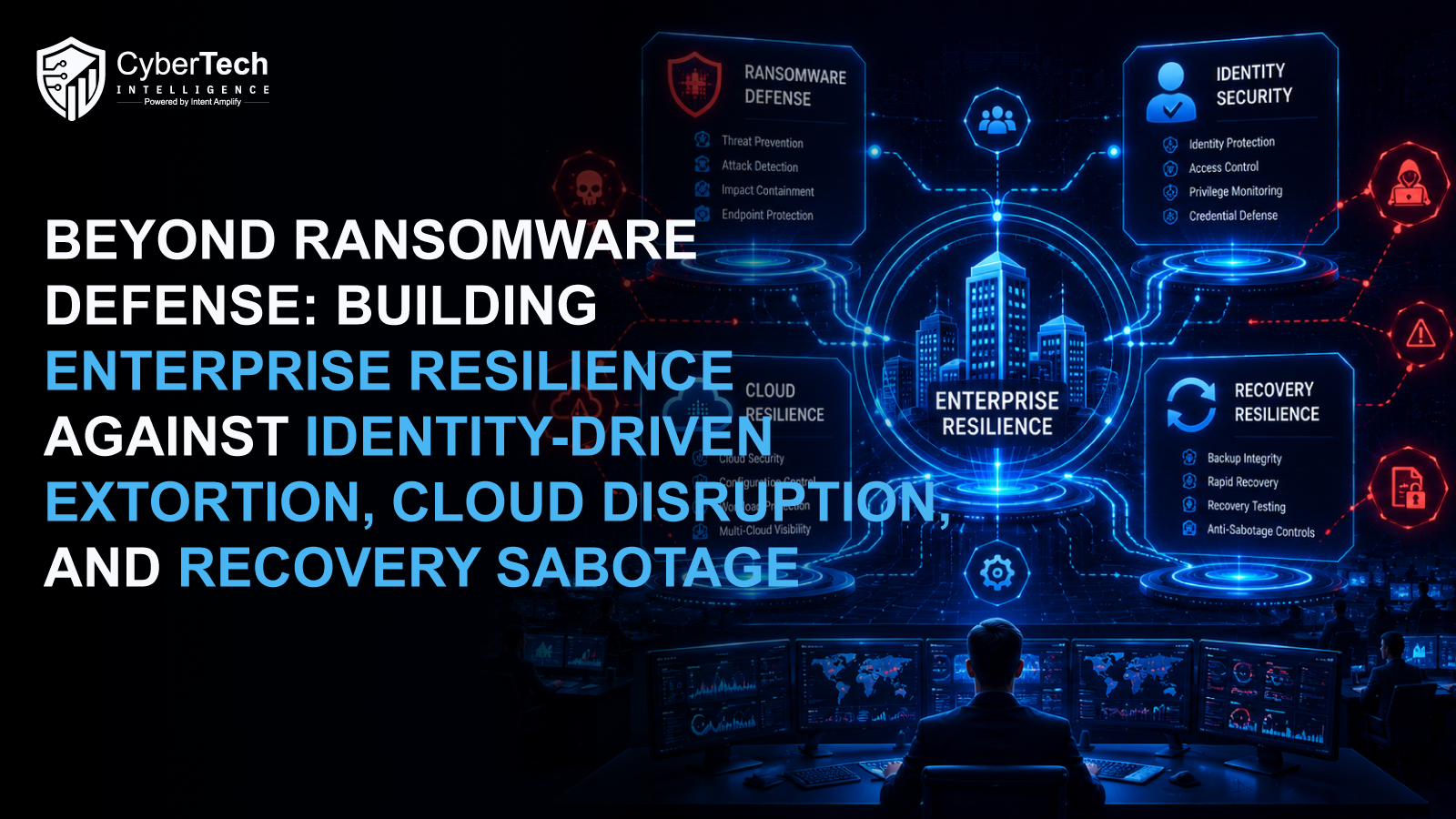
The CyberTech Intelligence Enterprise Resilience Operating Framework gives enterprise leaders a practical model for moving ransomware resilience from technical response to business operating discipline. The framework is built around five pillars: Identity Assurance, Cloud & Recovery Resilience, Zero Trust Operations, AI-Assisted Security Operations, and Executive Governance.
|
Framework Pillar |
Executive Question |
Resilience Purpose |
|
Identity Assurance |
Can the organization continuously verify users, administrators, service accounts, machine identities, and privileged access paths? |
Reduces attacker movement through stolen credentials, excessive permissions, and unmanaged access |
|
Cloud & Recovery Resilience |
Can cloud services, SaaS platforms, backup systems, and recovery environments remain trusted during disruption? |
Protects recovery confidence, restoration sequencing, and continuity of critical business services |
|
Zero Trust Operations |
Are access decisions, segmentation, and movement controls enforced across users, workloads, APIs, SaaS, and recovery systems? |
Limits ransomware blast radius and improves containment before disruption spreads |
|
AI-Assisted Security Operations |
Can teams use AI to accelerate detection, correlation, triage, and investigation without weakening governance? |
Improves speed while preserving auditability, analyst judgment, and response accountability |
|
Executive Governance |
Are crisis roles, disclosure workflows, recovery priorities, legal review, insurer notification, and board communication rehearsed? |
Enables leadership to make defensible decisions when facts are incomplete, and pressure is rising |
This framework turns ransomware resilience into a measurable operating model. Instead of treating identity, cloud, recovery, Zero Trust, security operations, and executive governance as separate initiatives, leaders can evaluate how these capabilities work together during disruption.
Executive Resilience Scorecard
According to CyberTech Intelligence research and analysis, enterprise ransomware resilience should be evaluated through measurable governance evidence, not only security tool coverage. The scorecard below helps CISOs, CIOs, CROs, board risk committees, enterprise architects, and business continuity leaders assess whether resilience capabilities are strong enough to support operational continuity during identity-driven extortion, cloud disruption, and recovery sabotage.
|
Readiness Area |
Executive Question |
Evidence to Review |
|
Identity Governance Maturity |
Are privileged users, machine identities, cloud roles, service accounts, and SaaS administrators continuously governed? |
MFA coverage, PAM logs, access reviews, machine identity inventory, excessive-permission reduction, emergency-access procedures |
|
Recovery Assurance |
Can critical services be restored under realistic ransomware conditions? |
Immutable backup validation, isolated recovery paths, clean-room rebuild exercises, recovery-time performance, restoration sequencing |
|
Cloud Resilience |
Can cloud, SaaS, and hybrid environments be investigated, contained, and restored after compromise? |
Cloud logging, SaaS activity records, identity telemetry, API visibility, recovery playbooks, provider dependency maps |
|
Zero Trust Implementation |
Are users, workloads, APIs, SaaS tools, and recovery systems protected through least privilege and segmentation? |
ZTNA coverage, segmentation status, conditional access policies, privileged-session controls, workload access rules |
|
Executive Crisis Governance |
Can leadership make timely decisions during data theft, recovery denial, supplier disruption, or disclosure pressure? |
Tabletop exercises, escalation thresholds, board briefing templates, insurer notification steps, legal review workflows |
|
Third-Party Resilience |
Are critical suppliers and SaaS providers included in ransomware readiness planning? |
Contractual notification terms, vendor access reviews, supplier recovery evidence, concentration-risk analysis, contingency plans |
|
Business Continuity Maturity |
Can priority operations continue while investigation and restoration remain underway? |
Business impact analysis, continuity plans, manual workarounds, service dependency maps, crisis operating procedures |
This scorecard strengthens executive usability by translating ransomware resilience into evidence that can be reviewed, funded, and governed. It also supports advisory conversations, board workshops, resilience assessments, and account-based engagement with organizations improving ransomware readiness.
Future Outlook
The next generation of ransomware will likely place greater emphasis on recovery denial, identity paralysis, cloud disruption, and data theft without necessarily relying on encryption. Attackers will continue to pursue economic leverage rather than technical spectacle.
Google Cloud reported that the 2025 ransomware landscape reached a record high number of unique data leak sites with at least one post, indicating a crowded and adaptive extortion environment. 8
As profit margins shift and law enforcement pressure continues, threat actors may experiment with more aggressive extortion, secondary monetization, data resale, and targeting of smaller organizations. For defenders, this means resilience must be adaptable. Static controls will not keep pace with an adversary economy that continues to reorganize around opportunity.
Conclusion
Ransomware has become an enterprise resilience challenge because it attacks the systems, relationships, and confidence that allow organizations to operate. The most mature organizations will not rely on perfect prevention. They will build layered resilience: strong identity controls, segmented environments, verified recovery, cloud visibility, modern security operations, and board-level readiness.
The path forward is not simply more spending. There is better alignment between cybersecurity and business continuity. Security leaders must translate technical exposure into operational consequence. Executives must evaluate resilience using measurable recovery and containment outcomes. Boards must hold management accountable for readiness before crisis conditions appear.
Modern ransomware operations are designed to create pressure. Resilient organizations are designed to absorb, contain, and recover from it.
Enterprise Ransomware Resilience Assessment
Ransomware resilience now requires more than endpoint defense, backup availability, or incident response planning. It requires evidence that the enterprise can govern identity exposure, protect cloud and SaaS dependencies, validate recovery architecture, enforce Zero Trust controls, coordinate executive decision-making, maintain business continuity, and manage third-party resilience during disruption.
CyberTech Intelligence helps CISOs, CIOs, CROs, board risk committees, enterprise architects, security operations leaders, and business continuity teams evaluate readiness through an Enterprise Ransomware Resilience Assessment. The assessment examines identity resilience, cloud governance, recovery architecture, Zero Trust maturity, executive readiness, business continuity, and third-party resilience.
For organizations strengthening ransomware resilience in 2026, this assessment can support board reporting, resilience roadmap prioritization, recovery architecture review, crisis simulation planning, third-party governance, and executive readiness discussions.
Contact CyberTech Intelligence
References
- Microsoft, Extortion and Ransomware Drive Over Half of Cyberattacks, October 16, 2025
https://blogs.microsoft.com/on-the-issues/2025/10/16/mddr-2025/ - Google Cloud Mandiant, M-Trends 2026: Data, Insights, and Strategies From the Frontlines, March 24, 2026
https://cloud.google.com/blog/topics/threat-intelligence/m-trends-2026/ - Verizon, 2026 Data Breach Investigations Report Executive Summary, 2026
https://www.verizon.com/business/resources/executivebriefs/2026-dbir-executive-summary.pdf - Google Cloud, Preparing for Threats to Come: Cybersecurity Forecast 2026, November 5, 2025
https://cloud.google.com/blog/topics/threat-intelligence/cybersecurity-forecast-2026/ - Verizon, 2026 Breach Impact Study, 2026
https://www.verizon.com/business/resources/reports/2026-breach-impact-study-dbir.pdf - Microsoft, Microsoft Digital Defense Report 2025: Lighting the Path to a Secure Future, November 21, 2025
https://cdn-dynmedia-1.microsoft.com/is/content/microsoftcorp/microsoft/bade/documents/products-and-services/en-us/security/Microsoft-Digital-Defense-Report-2025-v5-21Nov25.pdf - Google Cloud, Cloud Threat Horizons Report H1 2026, 2026
https://cloud.google.com/security/report/resources/cloud-threat-horizons-report-h1-2026 - Google Cloud Threat Intelligence Group, Ransomware Under Pressure: Tactics, Techniques, and Procedures in a Shifting Threat Landscape, March 17, 2026
https://cloud.google.com/blog/topics/threat-intelligence/ransomware-ttps-shifting-threat-landscape