Executive Summary
AI threat detection has moved from experimental promise to operational necessity. Security Operations Centers (SOCs) are under pressure from faster intrusions, identity-led compromise, expanding SaaS exposure, shadow AI, and adversaries using automation to compress the attack lifecycle. The opportunity is real, but so is the confusion. Many teams are asking the same uncomfortable question: where does AI in cybersecurity genuinely improve outcomes, and where does the marketing language run ahead of operational proof?
The answer is more nuanced than either enthusiasm or skepticism allows. AI-powered cybersecurity works best when it enriches human judgment, correlates events across fragmented telemetry, prioritizes weak signals, accelerates threat hunting, and reduces repetitive investigation work. It performs poorly when organizations expect a model to replace detection engineering, understand business context without grounding, or make unsupervised containment decisions across high-impact systems.
The ebook highlights AI threat detection, use of AI for SOC operations, machine learning cybersecurity, and the real challenge of AI vs. traditional SIEM when it comes to threat detection. The ebook targets CISOs, SOC managers, IT security managers, threat intelligence managers, and AI security engineers. The central thesis of the ebook is straightforward: while AI can accelerate and adapt detection efforts, it does so only with clean telemetry, good identity context, a behavior baseline, explainable results, and human accountability.
Why AI-Powered Threat Detection Is Now a Leadership Issue
Detection was previously seen as a matter of improving SOC operations. But in 2026, detection became a matter of business resilience. The speed at which attackers act, the fact that they are now utilizing more legitimate services, that they are leveraging identity pathways, and the reality that their attacks span cloud, SaaS, endpoints, networks, and artificial intelligence-powered workflows make detection that fails to look at all layers irrelevant.
Palo Alto Networks Unit 42 reports that attacks are 4x faster, with data exfiltration occurring in under one hour in some cases, while 65% of initial access is driven by identity-based techniques and 87% of attacks unfold across multiple attack surfaces. 1. These figures explain why the old model of isolated alert review is losing effectiveness. Speed now defines cyber risk, and correlation has become as important as detection itself.
Mandiant reports that the 2026 edition of M-Trends is grounded in over 500,000 hours of frontline incident investigations conducted in 2025, with global median dwell time rising to 14 days from 11 days and internal detection accounting for 52% of first detections, up from 43% in the prior year. 2 The improvement in internal detection is encouraging, but the increase in dwell time is a warning: adversaries are finding the spaces where telemetry is weak, context is thin, and response playbooks are slow.
This is why AI-powered threat detection must be evaluated as an operating capability rather than a product feature. The CISO needs to know whether the environment can detect the behaviors that matter before an incident becomes a board discussion. The SOC manager needs to know whether AI reduces investigation friction or simply creates another console. The threat intelligence lead needs to know whether model-assisted detection can translate adversary tradecraft into relevant hypotheses. The AI security engineer needs to know whether AI systems themselves are visible, governed, and tested for abuse.
What Actually Works
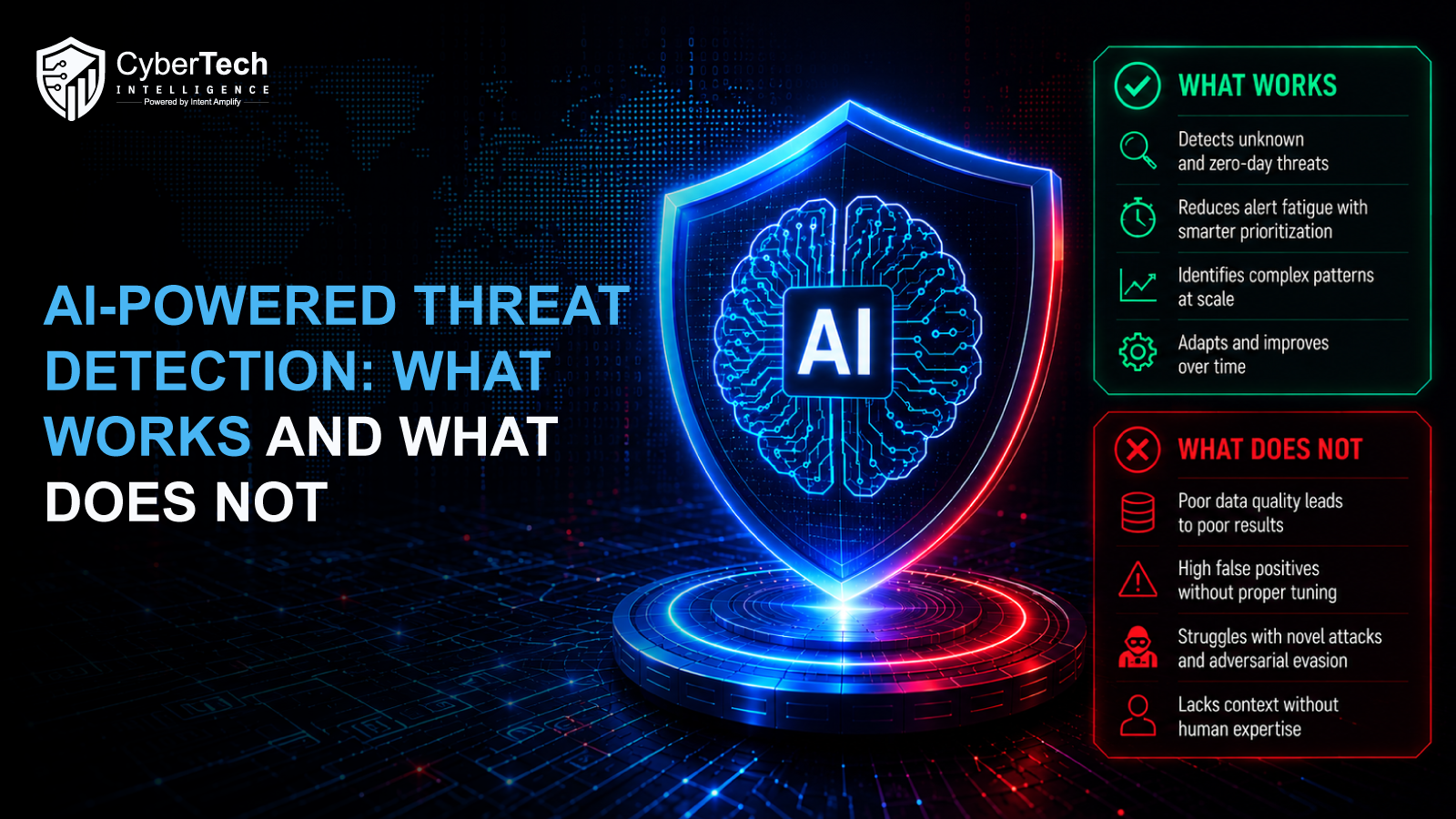
The strongest use case for AI-powered threat detection is not magic pattern recognition. It is context assembly. Analysts rarely fail because they lack alerts; they fail because evidence is scattered across identity logs, endpoint telemetry, SaaS audit trails, cloud control planes, email systems, data movement logs, and network events. AI works when it brings these signals into a coherent investigative narrative, shows why an event matters, and helps the analyst decide what to examine next.
Microsoft refers to security operations as reaching the stage when the SOC will rely not as much on gathering additional data, but more on translating context into actions. The company's May 2026 commentary on the rising AI SOC market states that the bottleneck is not an increased number of alerts anymore, but rather human capability.3. This distinction is helpful in that it draws a line between productive AI and surface-level automation.
AI is also proving valuable for behavior-based threat detection. Traditional indicators of compromise remain important, but they become less effective when adversaries rotate infrastructure, abuse legitimate credentials, rely on living-off-the-land techniques, or move through SaaS integrations. Mandiant argues that detection strategies increasingly need to focus on behavioral anomalies rather than static indicators, including unusual edge-device activity, abnormal API usage patterns, and suspicious SaaS integration behavior. Machine learning is particularly effective in these scenarios because it can identify deviations from expected behavior rather than relying solely on known attacker tools, signatures, or indicators.
Another important use case is analyst augmentation. Generative AI can summarize evidence, map activity to MITRE ATT&CK techniques, propose investigation steps, draft detection logic, explain suspicious correlations, and reduce manual documentation. When deployed appropriately, these capabilities can improve SOC efficiency while preserving analyst accountability. The most effective implementations keep analysts in control, provide transparent reasoning, and maintain an auditable evidence trail.
AI is also valuable in threat hunting, where investigations often begin with hypotheses rather than confirmed alerts. Analysts may explore whether a service account has exhibited unusual OAuth grant activity, whether a user authenticated from an unexpected location before accessing sensitive repositories, or whether multiple low-severity alerts indicate preparation for a larger intrusion. AI can accelerate these investigations by translating natural-language questions into queries, recommending relevant telemetry sources, and surfacing comparable historical patterns.
What Does Not Work
What doesn’t work is relying on AI as an autonomous replacement for security architecture. The solution won’t help where logs are absent, asset management is poor, identity governance is weak, cloud visibility is fragmented, endpoints aren’t protected properly, or there’s no escalation path. When SOC isn’t sure which accounts have privileged access rights, which SaaS connections contain sensitive tokens, or which AI products are approved, AI won’t do much to clarify things.
The clearest failure mode is AI layered on top of noisy data. Alert fatigue is not solved by summarizing bad alerts faster. If rules are poorly tuned, identity context is incomplete, or asset criticality is not maintained, AI can make low-confidence triage appear more polished without making it more reliable. This creates a dangerous form of executive comfort: the dashboard looks modern, but the detection logic remains weak.
A second way in which such tools fail is black-box decision-making. Decision-makers have to be wary of any decision-support system that uses artificial intelligence-based tools but cannot explain its reasoning, the data used for its conclusions, the confidence level, and the action it wants the investigator to take. Explanability is not an academic demand; it is due process. Decision-makers have to justify their decisions at investigations, reviews, and even in public briefings.
Thirdly, there is a false assumption that AI-native detection means that AI-based attacks are understood. Prompt injection, data poisoning, model inversion, membership inference, AI-enabled phishing, deepfake-based social engineering, and agentic AI attacks are unique categories of attacks that need their own specific approaches for telemetry, adversarial testing, access controls on models, and red teaming methodology. There is no such thing as an AI label for SIEM-based workflows.
IBM reports that 63% of breached organizations studied lacked AI governance policies, only 37% had approval processes or oversight mechanisms, 20% experienced breaches linked to shadow AI, and those shadow AI incidents added as much as USD 670K to the average breach cost. 4 This proves why there is a need for linking AI detection to governance, because if the organization cannot identify where AI systems are deployed, who authorized them, and the type of data they handle, then detection will be outpaced by adoption.
The Operating Model: Human-Led, AI-Assisted Detection
The most reliable approach is a human-led, AI-assisted operating model. This approach involves the deployment of AI technology to aid in gathering, prioritizing, correlating, and preparing for responses, leaving humans in control when it comes to making critical decisions. The approach comprises four disciplines.
Telemetry is the foundation. AI needs high-quality inputs from endpoints, identity systems, cloud workloads, SaaS platforms, network devices, email systems, data security tools, and AI application logs. As the number of ways to exploit the available legitimate routes increases, detection will become increasingly dependent on behavioral observation across domains. According to Google Cloud, attackers have been abusing long-term OAuth access tokens and stealing session cookies, compromising SaaS providers, hard-coded secrets, and then pivoting to subsequent environments.2 Without SaaS and identity telemetry, many of these chains will look like normal activity until the damage is done.
Context transforms telemetry into judgment. An anomaly such as a login from a foreign region can be completely acceptable in the case of an executive who is out on travel, alarming in the case of a service account, but extremely critical in the case of a privileged user account accessing backup systems. AI threat detections succeed when they understand criticality, privilege, ownership, sensitivity, and context. They fail otherwise.
The boundaries are set by governance. Team governance has to define what AI recommendations should be automated, approved, logged, and what should be restricted from being done. Actions of containment that involve identity lockout, production workload, data store, backups, and AI models endpoints require well-defined thresholds of escalation. The issue is not whether the AI could take an action. The issue is whether the organization could justify this action and reverse it.
Response closes the loop. AI should help teams update detections after incidents, document lessons learned, identify missing telemetry, and convert adversary behavior into reusable playbooks. Over time, the SOC should become less dependent on isolated heroics and more capable of repeatable learning. This is where autonomous SOC use cases in 2026 have real potential, provided autonomy is introduced gradually and measured against business outcomes, not demonstration value.
A Practical Evaluation Framework
Security leaders evaluating AI-powered threat detection should begin with a simple question: What operational problem will this capability solve? If the answer is merely “we need AI,” the evaluation is not ready. If the answer is reducing mean time to triage, improving correlation across identity and SaaS, detecting anomalous behavior, accelerating threat hunting, or improving detection engineering quality, the conversation becomes measurable.
The first evaluation criterion is visibility coverage. A credible solution must ingest and normalize the telemetry needed for modern intrusions. This includes identity, endpoint, cloud, network, SaaS, email, data, and AI system logs. It should show where coverage is missing rather than pretending that partial visibility is complete.
The second criterion is explainability. It is required that all alerts, summaries, recommendations, or actions taken by the system become explainable. Security specialists have to ask why certain behavior raised an alarm, what baseline was violated, what entities were involved, and what next actions are being suggested. This requirement cannot be avoided where regulations apply.
The third criterion is workflow integration. AI for SOC operations should not force analysts to abandon established processes. It should integrate with SIEM, SOAR, endpoint detection and response, identity security, case management, threat intelligence platforms, and existing escalation procedures. A separate AI console may look impressive in a demo and still fail in production if it interrupts analysts’ working rhythm.
The fourth criterion is control. Human approval, role-based access, audit logging, rollback, policy enforcement, and model behavior monitoring must be built into the operating model. This matters especially where AI is used to recommend containment or remediation.
Criterion five is measurable performance. Precision, decrease in false positives, time saved on each incident, time to detection, response time, analyst effort, increase in coverage of detection, and post-incident learning are all key metrics that should be tracked. The performance of AI-based cybersecurity solutions must be built on data, not buzzwords.
What Leaders Should Do Next
The CISO must avoid two extremes regarding AI-based threat detection: ignoring it as just hype or viewing it as an easy way out of implementing security practices properly. The right approach is to find a highly friction-based workflow process, set up a baseline, test the AI in practice based on measurable results, and scale only once improvements have been shown.
SOC leaders should begin with alert triage, enrichment, investigation summarization, and threat hunting assistance before moving toward automated containment. This staged approach reduces risk while building analyst confidence. IT security managers should focus on operational integration, especially how AI detection connects to existing SIEM, identity, endpoint, and cloud workflows. Threat intelligence teams should use AI to convert adversary behavior into hypotheses, detections, and playbooks. AI security engineers should ensure that AI systems themselves are included in detection coverage, including prompts, API calls, model access, retrieval pipelines, sensitive data flows, and agent activity.
CyberTech Intelligence Perspective
CyberTech Intelligence sees AI-powered threat detection as one of the most important cybersecurity leadership themes of 2026, but the winning message is not “AI replaces analysts.” The better message is that AI helps disciplined teams move faster with stronger context. This aligns with the campaign pillar around AI-Powered Threat Detection and the content demand around AI in cybersecurity, AI security tools, AI threat detection, AI-driven cybersecurity, and AI for SOC operations.
The future of threat detection will not be purely manual, and it will not be fully autonomous in any responsible enterprise environment. It will be adaptive, evidence-driven, human-accountable, and increasingly AI-assisted. The organizations that benefit most will not be the ones that buy the most AI features. They will be the ones who know exactly which detection problems they are solving, which decisions remain human-owned, and which controls must be strengthened before automation scales.
About CyberTech Intelligence
CyberTech Intelligence delivers cybersecurity intelligence, market insights, and research-led content for CISOs, security vendors, and enterprise technology decision-makers. We help organizations understand emerging cyber risks, market shifts, buyer priorities, and technology trends across areas such as AI security, threat intelligence, identity security, cloud security, SOC operations, and Zero Trust.
Through pipeline activation and GTM intelligence, CyberTech Intelligence helps cybersecurity brands reach the right decision-makers with sharper messaging, stronger audience targeting, and research-backed campaign execution. Our programs support visibility, engagement, and demand generation across high-value cybersecurity buyer segments.
CyberTech Intelligence also offers CISO round tables, webinars, expert insights, newsletters, podcasts, blogs, case studies, reports, whitepapers, ebooks, surveys, and strategic consulting.
Explore how we can support your cybersecurity growth and audience engagement goals.
Contact Us
References
- Palo Alto Networks Unit 42, 2026 Unit 42 Global Incident Response Report, 2026
https://start.paloaltonetworks.com/unit-42-incident-response-report-2026.html - Google Cloud Mandiant, M-Trends 2026: Data, Insights, and Strategies From the Frontlines, March 24, 2026
https://cloud.google.com/blog/topics/threat-intelligence/m-trends-2026/ - Microsoft, Microsoft Named an Overall Leader in KuppingerCole Analysts’ 2026 Emerging AI Security Operations Center (SOC) Report, May 6, 2026
https://www.microsoft.com/en-us/security/blog/2026/05/06/microsoft-named-an-overall-leader-in-kuppingercole-analysts-2026-emerging-ai-security-operations-center-soc-report/ - IBM, Cost of a Data Breach, 2025/2026 insights page
https://www.ibm.com/think/insights/data-matters/cost-of-a-data-breach