Executive Summary
Open-source software now sits inside nearly every modern enterprise application, cloud workload, SaaS platform, and AI-enabled workflow. That ubiquity has changed the enterprise risk model. The issue is no longer limited to known vulnerabilities in a library. The larger question is whether the organization can verify the origin, integrity, behavior, and maintenance health of the software components entering development and production environments.
Industry evidence shows why the concern has become urgent. Black Duck’s 2025 Open Source Security and Risk Analysis report found that 97% of reviewed commercial codebases contained open-source components. 86% contained open-source vulnerabilities, and 81% contained high-risk or critical-risk vulnerabilities.[1]
Sonatype’s 2025 malware data shows 845,204 open-source malware packages identified since 2019. [2]
Verizon’s 2025 DBIR adds the enterprise-impact lens: third-party involvement appeared in 30% of breaches, double the 15% reported in the previous year. [3]
For CISOs, these numbers confirm a strategic shift. Software supply-chain security is now a governance, resilience, procurement, compliance, and board-level risk issue requiring dependency visibility, SBOM maturity, CI/CD hardening, runtime monitoring, provenance validation, and formal dependency ownership.
Why Open Source Has Become Strategic Enterprise Risk
Open-source software is one of the strongest accelerators of modern software development. It enables engineering teams to reuse mature libraries, adopt tested frameworks, integrate new capabilities quickly, and reduce product launch timelines. Cloud-native applications, enterprise SaaS platforms, financial technology systems, AI services, and customer-facing platforms all depend on third-party components.
That efficiency creates a deeper security problem. Most enterprise applications are no longer built from internally authored code alone. They are assembled from layered dependency trees that include open-source packages, commercial components, container images, development kits, build tools, and third-party services. The organization may control the application, but it does not directly control every component the application relies on.
The scale is substantial. OpenSSF and the Linux Foundation’s Census III report showed that open-source application libraries remain deeply embedded across modern software ecosystems, with cloud-specific packages and newer language ecosystems gaining visibility in widely used dependency sets. [4]
This gap matters because the software-delivery trust model has changed. Traditional security programs protected endpoints, networks, infrastructure, and production systems from direct compromise. Supply-chain attacks move upstream by exploiting trusted software relationships and entering through normal development activity. The security question is now more precise: can the enterprise validate what enters the environment before, during, and after deployment?
Dependency Sprawl Is Expanding Enterprise Exposure
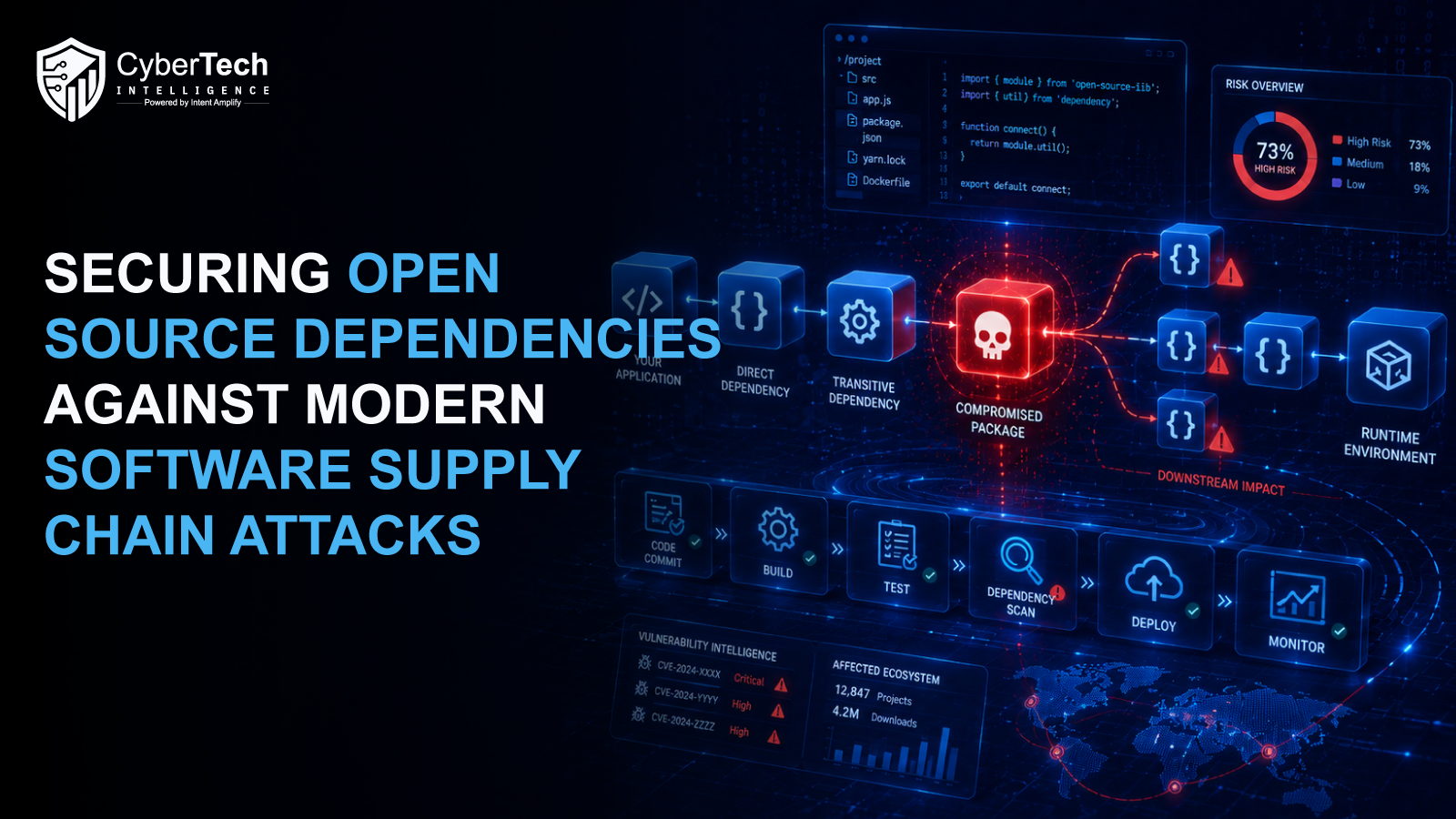
Dependency sprawl is now one of the most persistent risks inside enterprise development environments. A single application may include direct dependencies, transitive dependencies, runtime libraries, container layers, APIs, infrastructure modules, and integrated SaaS services. Each layer can create exposure if it is vulnerable, abandoned, malicious, or poorly governed.
The operational scale is increasing. Black Duck reported that the average number of open-source files in an application rose from 5,386 in 2020 to 16,082 in 2024, creating more places for hidden vulnerabilities, outdated components, license exposure, and compromised dependencies to remain unnoticed. [4]
Large organizations often use different repositories, build systems, programming languages, registries, and release pipelines. Some teams may have mature Software Composition Analysis controls, while others rely on manual review or default package-manager behavior. If a compromised dependency is discovered in a common framework, the organization may need to locate every affected workload, rebuild containers, rotate credentials, validate artifacts, suspend releases, and coordinate remediation across engineering teams.
Open-source dependency security has therefore moved beyond vulnerability management. Known Common Vulnerabilities and Exposures remain important, but teams must also assess provenance, maintainer trust, release behavior, repository health, update patterns, contribution history, license obligations, and runtime activity.
How Attackers Exploit Software Trust
Software supply-chain attacks succeed because they abuse trust. In many cases, adversaries do not need to breach a firewall or exploit a production vulnerability. They place malicious code where developers, build systems, or package managers are likely to retrieve it.
Dependency confusion is one example. Attackers publish malicious packages to public repositories using names that resemble or match private internal packages. If package-resolution rules are misconfigured, or if a build process prefers a higher public version number over an internal source, the malicious package may be downloaded automatically. The attack turns routine dependency installation into an intrusion path.
Typosquatting uses a different weakness: human error. Attackers create packages with names that look similar to legitimate libraries, relying on spelling mistakes, character substitutions, or familiar naming conventions. In fast-moving engineering environments, a single incorrect installation command can introduce a malicious dependency into development or build systems.
Other attacks rely on malicious updates, compromised project ownership, or abuse of trusted repository signals. Attackers may create packages with convincing documentation, realistic commit histories, issue discussions, and dependency metadata. Once developers adopt the package, later updates can introduce credential theft, backdoors, data exfiltration routines, or environment-specific payloads.
The scale of this activity is growing. Sonatype’s Q2 2025 Open Source Malware Index reported 16,279 malicious open-source packages identified in one quarter alone, across major ecosystems such as npm and PyPI. That volume demonstrates why manual package review cannot be the primary defense model for modern enterprises. [2]
Compromised Maintainers Create Distribution Risk
Open-source maintainers have become high-value targets. Many widely used packages are maintained by small teams or individual developers. These maintainers often support critical software ecosystems without the enterprise-grade security resources available to large vendors. Attackers understand this imbalance.
Common compromise paths include phishing, credential theft, session hijacking, multi-factor authentication bypass, stolen access tokens, compromised developer workstations, and social engineering. Once a maintainer account is compromised, the attacker may be able to publish a malicious version of a legitimate package. That creates a dangerous distribution advantage.
The package name remains trusted, the repository may look authentic, and the version history may appear normal. Automated update tools may then accelerate adoption across downstream environments. Organizations need controls that detect unusual release behavior, enforce package signing, restrict uncontrolled updates, and validate whether a new version behaves consistently with expected functionality.
CI/CD Pipelines Are Critical Security Infrastructure
CI/CD pipelines are now among the most sensitive systems in the enterprise technology stack. They often hold privileged access to source code, secrets, signing keys, artifact repositories, cloud environments, deployment automation, and production infrastructure.
That privilege makes CI/CD infrastructure a high-value target. Attackers who compromise a build pipeline can alter software artifacts before deployment, inject malicious scripts into release processes, steal secrets, tamper with infrastructure-as-code templates, or abuse deployment permissions. The downstream impact can be broader than a single application compromise because the pipeline may serve multiple teams and services.
Common attack paths include exposed secrets in repositories, over-permissive identity and access management, insecure GitHub Actions, vulnerable self-hosted runners, weak branch protections, unverified third-party actions, and misconfigured artifact repositories. These weaknesses are especially dangerous because build systems are designed to automate trust.
The 2021 Codecov breach remains a useful precedent for how software-development tooling compromise can affect downstream customers. Attackers reportedly compromised hundreds of restricted customer environments and attempted to reach additional software-development and IT-service providers, including IBM. The lesson is current even if the incident is historical: development tooling must be treated as part of the enterprise control plane.
AI-Assisted Package Campaigns Raise Scale Risk
AI-assisted tooling may make malicious package operations easier to scale. Threat actors can use generative systems to write convincing documentation, create plausible contributor profiles, automate publication, generate code variants, and imitate legitimate developer behavior.
The issue is not that every AI-generated package is malicious. The issue is that attackers can manufacture credibility faster through README files, issue comments, commit messages, examples, and dependency metadata that resemble legitimate community activity. This challenges review habits that rely on visible cues such as documentation depth, project activity, popularity, contributor history, and repository presentation.
The implication for CISOs is practical. Enterprises need stronger validation mechanisms around provenance, cryptographic verification, package allowlisting, repository trust policies, behavioral analysis, and runtime monitoring. In an environment where credible-looking software can be generated at scale, trust must be based on evidence rather than appearance.
CI/CD Misconfiguration as a Supply-Chain Attack Path
Unit 42’s analysis of a SaaS company’s DevOps pipeline demonstrates how CI/CD configuration weaknesses can become software supply-chain attack paths. The analysis focused on the company’s DevOps infrastructure rather than its production environment, reflecting a broader shift in adversary attention toward the systems that create, test, and distribute software.
The simulated insider-threat scenario examined how misconfigurations could allow an attacker to access sensitive development resources or alter software delivery. Production controls may be strong, but if the pipeline is weak, an attacker may compromise what enters production before runtime defenses can respond.
For enterprise security leaders, the case reinforces a critical point: CI/CD systems require the same governance, monitoring, identity control, and incident-response planning as other mission-critical platforms.
Business Impact for U.S. Enterprises
Dependency-based attacks can disrupt several layers of the organization. A compromised package may affect developer workstations, test systems, build servers, containers, cloud workloads, customer-facing applications, and internal services.
The governance implications are increasing. Software supply-chain risk is now shaped by regulatory pressure, customer security expectations, cyber-insurance underwriting, procurement due diligence, and board-level resilience requirements. One trusted supplier or dependency can generate operational, financial, regulatory, and reputational consequences across many organizations.
The EU Cyber Resilience Act is also raising expectations for software manufacturers and vendors in European markets, including secure design, vulnerability handling, product maintenance, and lifecycle accountability. U.S. organizations that sell internationally may need stronger software-governance practices.
Visibility, Detection, and Runtime Control
Visibility remains the foundation of software supply-chain security. Without a reliable inventory of dependencies, security teams cannot determine which applications are exposed, which business services are affected, or which remediation actions should be prioritized.
Software Composition Analysis tools and Software Bills of Materials are becoming foundational controls for mature DevSecOps programs. They help teams identify components, map transitive dependencies, track vulnerable packages, document software composition, and improve incident-response speed.
However, static visibility is not enough. A package that appears safe during code review may later demonstrate suspicious behavior in runtime environments. It may initiate unauthorized outbound communication, attempt credential harvesting, spawn unexpected processes, access sensitive files, or behave differently depending on environment variables.
This is why runtime visibility is becoming more important. Container runtime security, workload protection, behavioral analytics, eBPF telemetry, and anomaly detection can help identify malicious dependency behavior after deployment. These controls add a detection layer when upstream validation fails.
Governance, SBOMs, and Due Diligence
Technology controls cannot resolve software supply-chain risk without governance. Organizations need formal policies that define how dependencies are approved, who owns dependency risk, which packages are allowed, how exceptions are handled, and how critical components are monitored over time.
SBOM programs are part of that governance model. A mature SBOM capability gives the organization structured visibility into software composition across applications, containers, and third-party products. It also supports vendor transparency, audit readiness, vulnerability response, and customer assurance.
Dependency due diligence should move beyond vulnerability scoring. Security and engineering teams should evaluate maintainer activity, contributor diversity, release frequency, unresolved security issues, project sustainability, package-signing practices, and suspicious repository behavior. A package with no current vulnerability may still be risky if it is abandoned or dependent on fragile downstream components.
Practical Roadmap
|
Priority |
Primary Owner |
Purpose |
|
Dependency visibility |
DevSecOps / AppSec |
Inventory dependencies across applications, containers, repositories, CI/CD systems, infrastructure-as-code templates, and cloud workloads. |
|
Software-delivery hardening |
Platform engineering/security architecture |
Enforce MFA, least privilege, branch protections, artifact signing, protected runners, and centralized secret management. |
|
Package trust enforcement |
Engineering / AppSec |
Use approved registries, package allowlists, integrity checks, provenance validation, and controlled public-package access. |
|
Runtime detection |
SOC/cloud security |
Monitor abnormal network activity, credential access, file-system changes, process anomalies, and unexpected privilege use. |
|
Governance maturity |
CISO / engineering leadership/compliance |
Define ownership, approval criteria, risk scoring, exception handling, vendor requirements, and executive reporting metrics. |
The roadmap should operate as a continuous discipline rather than a one-time remediation project. Dependency risk changes whenever developers add packages, maintainers publish new releases, attackers compromise repositories, or vendors change their software composition.
Board-Ready Questions
|
Board Question |
Why It Matters |
|
Do we know which open-source components are embedded in critical applications? |
Establishes dependency visibility. |
|
Can we identify affected systems quickly when a package is compromised? |
Tests SBOM and response maturity. |
|
Are CI/CD pipelines protected from secret theft, workflow tampering, and unauthorized deployment? |
Measures build-chain resilience. |
|
Do we validate package provenance before deployment? |
Reduces reliance on assumed software trust. |
|
Which teams own dependency risk across engineering, security, procurement, and compliance? |
Clarifies accountability. |
|
Can runtime monitoring detect malicious behavior from trusted components? |
Addresses post-deployment compromise. |
These questions help board members assess whether the organization can verify the software it builds, buys, deploys, and operates.
What CISOs Should Prioritize
CISOs should treat open-source dependency security as a resilience discipline. The goal is not to restrict open source, but to make software trust measurable, enforceable, and observable.
This requires a balanced operating model. Developers need access to trusted components. Security teams need visibility and policy enforcement. Platform teams need secure-by-default pipelines. Procurement teams need stronger vendor evidence. Executives need exposure metrics.
Useful metrics include critical applications with SBOM coverage, dependencies sourced from approved registries, mean time to identify affected assets after a disclosure, CI/CD workflows using least-privilege access, exposed secrets detected in repositories, signed artifact coverage, and runtime alerts linked to dependency behavior.
CyberTech Intelligence Enterprise Software Trust Governance Framework™
CyberTech Intelligence recommends that enterprises assess software supply chain resilience through a governance-led model that connects dependency visibility, provenance assurance, CI/CD integrity, runtime monitoring, and executive accountability.
The CyberTech Intelligence Enterprise Software Trust Governance Framework™ is built on five core pillars.
|
Framework Pillar |
Executive Purpose |
Priority Actions |
|
Dependency Visibility |
Establish a reliable view of direct dependencies, transitive dependencies, container components, build tools, open-source packages, and AI-recommended libraries. |
Automate SBOM generation, maintain dependency inventories, classify critical components, identify package ownership, and monitor dependency changes across repositories, builds, containers, and production environments. |
|
Provenance Assurance |
Move from assumed trust to verified software origin, integrity, and release control. |
Adopt artifact signing, cryptographic verification, repository allow lists, package reputation checks, SLSA-aligned provenance controls, and OpenSSF-aligned software assurance practices. |
|
CI/CD Integrity |
Protect the build and release chain from workflow tampering, secret theft, unauthorized deployment, and artifact manipulation. |
Harden CI/CD pipelines, isolate build environments, protect secrets and signing keys, enforce least privilege, review workflow permissions, and secure artifact registries. |
|
Runtime Trust Monitoring |
Detect malicious behavior from trusted components after deployment. |
Monitor unauthorized outbound connections, credential access, privilege escalation, abnormal package behavior, unexpected processes, and suspicious runtime activity linked to third-party components. |
|
Executive Software Trust Governance |
Translate software supply chain risk into measurable executive oversight. |
Track SBOM coverage, provenance adoption, CI/CD maturity, runtime monitoring coverage, critical dependency exposure, AI-assisted development governance, and response readiness. |
This framework helps security and engineering leaders shift from informal software trust to continuous verification. It also gives CISOs a structured model for explaining software supply chain maturity to executive teams and boards.
Conclusion: Trust Must Be Verified Continuously
Open-source software will remain essential to enterprise innovation. It gives organizations speed, flexibility, interoperability, and access to global engineering communities. But legacy assumptions about software trust are no longer sufficient.
Threat actors increasingly recognize that software dependencies provide scalable access into enterprise ecosystems. By compromising packages, maintainers, build pipelines, or developer workflows, attackers can bypass many traditional controls and reach downstream environments through trusted paths.
The organizations best positioned for resilience will combine dependency visibility, CI/CD hardening, software provenance, SBOM maturity, runtime monitoring, and governance accountability. Securing open-source dependencies is now a core requirement for secure software delivery, enterprise resilience, and long-term digital trust. In 2026, software trust cannot be assumed because a component is popular, current, or widely used. It must be verified continuously.
Strengthen Software Supply Chain Resilience with CyberTech Intelligence
CyberTech Intelligence helps organizations understand, assess, and reduce modern cybersecurity risk across software supply chains, cloud environments, third-party ecosystems, and enterprise technology operations. As open-source dependencies become embedded across critical applications, enterprises need stronger visibility, governance, and runtime assurance to prevent trusted components from becoming attack paths.
CyberTech Intelligence can support security leaders with research-led insights, risk assessment, threat intelligence, and strategic guidance for improving SBOM maturity, securing CI/CD pipelines, validating package provenance, and strengthening dependency governance.
Connect with us
References
- Black Duck (2025) New Black Duck Report: 86% of Commercial Codebases Contain Vulnerable Open Source, Exposing Organizations to Security Risks. Available at: https://www.blackduck.com/blog/ossra-addresses-common-open-source-questions.html
- Sonatype (2025) Malware Reaches 845K Packages: Sonatype OSS Malware Index. Available at: https://www.sonatype.com/press-releases/q2-2025-open-source-malware-index
- Verizon Business (2025) 2025 Data Breach Investigations Report. Available at: https://www.verizon.com/business/resources/reports/2025-dbir-executive-summary.pdf
- Black Duck (2025) New Black Duck Report: 86% of Commercial Codebases Contain Vulnerable Open Source, Exposing Organizations to Security Risks. Available at: https://news.blackduck.com/2025-02-25-New-Black-Duck-Report-86-of-Commercial-Codebases-Contain-Vulnerable-Open-Source,-Exposing-Organizations-to-Security-Risks
- Reuters (2021) Codecov Hackers Breached Hundreds of Restricted Customer Sites: Sources. Available at: https://www.reuters.com/technology/codecov-hackers-breached-hundreds-restricted-customer-sites-sources-2021-04-19/
- Palo Alto Networks (n.d.) Anatomy of a Cloud Supply Pipeline Attack. Available at: https://www.paloaltonetworks.com/cyberpedia/anatomy-cloud-supply-pipeline-attack