Executive Summary
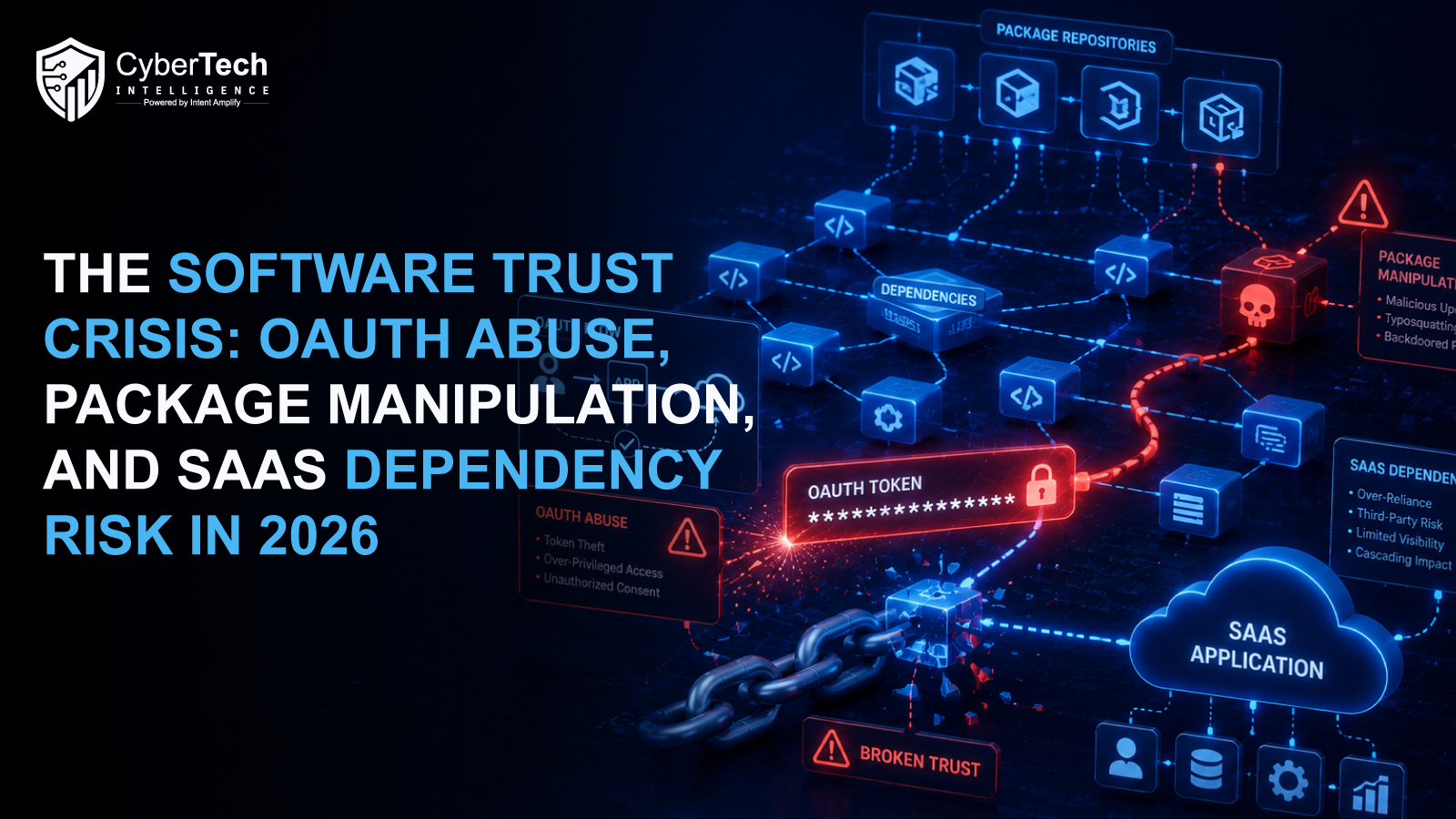
Enterprise cybersecurity is entering a phase where trusted software relationships create greater exposure than direct infrastructure compromise. Business applications now depend on software-as-a-service platforms, OAuth consent flows, open-source packages, cloud roles, application programming interfaces, build pipelines, developer credentials, and automated deployment systems. These connections accelerate software delivery while expanding the enterprise trust surface available to attackers.
Enterprise software risk extends beyond vulnerable code. Attackers are increasingly abusing delegated access, publishing malicious packages, targeting developer environments, exploiting SaaS integrations, and moving from build systems into cloud infrastructure. Enterprise software assurance now encompasses the identities, dependencies, integrations, artifacts, and provider relationships that support every application. Continuous verification of these trust relationships is fundamental to software resilience.
Microsoft reported that OAuth redirection is being abused as a phishing and malware-delivery path, allowing trusted authentication flows to redirect victims from legitimate sign-in experiences to attacker-controlled infrastructure.1
Microsoft reported a May 28, 2026, dependency-confusion campaign in which threat actors published malicious npm packages under names that resembled internal corporate software components. The packages used trusted-looking organizational naming patterns to increase the likelihood of being pulled into developer and build environments during routine installation activity.2
This report reframes the 2026 software trust problem for U.S. enterprises. It examines OAuth abuse, dependency confusion, SaaS permission sprawl, CI/CD exposure, financial impact, and governance requirements. Its core finding is straightforward: software trust must now be managed as a board-relevant resilience discipline, not only as an engineering control.
CyberTech Intelligence Perspective
Software trust has become an enterprise governance discipline. The integrity of business applications now depends not only on secure code, but also on the identities, dependencies, integrations, software provenance, SaaS permissions, and delivery pipelines that allow software to operate across the enterprise.
CyberTech Intelligence research and analysis indicates that enterprise software resilience increasingly depends on continuous verification of trusted software relationships. OAuth grants, open-source packages, SaaS connectors, developer credentials, build systems, and deployment artifacts should be treated as governance assets because they influence operational continuity, data exposure, regulatory readiness, and board-level cyber risk.
For CISOs, CIOs, CTOs, DevSecOps leaders, platform engineering teams, and board risk committees, the question is no longer only whether an application is secure. It is whether the organization can prove that the software relationships supporting critical business services are visible, governed, verified, and resilient.
Research Lens: Why Software Trust Is Now an Enterprise Risk Category
For many years, application security programs focused on code review, vulnerability scanning, penetration testing, and production hardening. Those practices remain necessary, yet they do not fully address the modern exposure model. Enterprise applications are now assembled from external packages, deployed through automated build systems, connected to SaaS platforms, and authorized through identity protocols that grant access across data-rich environments.
Compromise frequently begins outside traditional enterprise boundaries and still creates internal operational consequences. A malicious package may enter a development workflow. A deceptive OAuth application may gain file or email access. A developer token may expose a repository. A SaaS connector may synchronize sensitive records to a platform that the security team does not fully monitor.
Verizon reported that breaches with third-party involvement increased by 60% from the previous year’s dataset and reached 48% of total breaches.3
The findings reinforce a broader shift from perimeter defense to dependency governance. Enterprises now need visibility into the external code, vendors, permissions, APIs, and automation flows that support their most important business services.
CyberTech Intelligence Research Desk analysis indicates that the organizations most exposed in 2026 are those with rapid software delivery, decentralized SaaS adoption, weak consent governance, incomplete dependency inventories, and limited oversight of developer access. Organizations frequently assess these exposures independently, while attackers combine them into a single intrusion path.
CyberTech Intelligence Research Desk Observation: Organizations increasingly inherit cyber risk through trusted software relationships rather than direct infrastructure compromise. The most exposed enterprises are often those that cannot continuously verify which applications have delegated access, which packages enter build environments, which SaaS connectors touch sensitive data, which developer identities can influence releases, and which software providers affect operational continuity.
The New Architecture of Digital Dependency
The 2026 enterprise operates through a layered model of dependency. At the access layer, OAuth grants, service accounts, cloud roles, and API keys authorize software to act on behalf of users or systems. At the component layer, open-source packages and commercial libraries form the foundation of applications. At the integration layer, SaaS tools exchange data across departments. At the delivery layer, CI/CD platforms build, sign, test, and deploy code. At the governance layer, policies and ownership models determine whether risks are visible before they become incidents.
Palo Alto Networks Unit 42 reported that 87% of breaches involved at least two attack surfaces, with endpoints appearing in 61% of incidents, networks in 50%, and SaaS applications in 23%.4
Multi-surface attacks are defining enterprise software risk. A single event can begin with OAuth consent, move through SaaS data access, expose developer credentials, and affect cloud workloads. Other attack paths begin with package manipulation and end in production compromise. Traditional security categories often obscure these combined pathways.
Google Cloud reported that the window between vulnerability disclosure and active exploitation collapsed from weeks to days during the second half of 2025.5
Shorter exploitation windows reduce the value of slow review cycles. Annual assessments, static inventories, and delayed remediation boards cannot keep pace with attacker exploitation windows. Software assurance requires continuous validation aligned with business-critical services.
OAuth Abuse and the Delegated Access Gap
OAuth enables legitimate delegated access across cloud and SaaS environments. It is widely used because businesses need applications to connect, share data, and automate workflows. The same convenience creates exposure when consent grants become excessive, invisible, or persistent.
Microsoft’s March 2026 research described OAuth redirection abuse as an operational technique that uses trusted authentication behavior to send victims from legitimate sign-in pages to malicious destinations.1
OAuth abuse frequently resembles legitimate application activity. It may not look like password theft. It may appear as approved application activity, authorized API access, or normal SaaS behavior. Password resets alone may not remove risk if refresh tokens, permissions, or application grants remain active.
Google Cloud reported that identity compromise underpinned 83% of compromises observed in its H2 2025 findings.5
Delegated access should be managed as a measurable enterprise exposure category. Security teams need a central inventory of connected applications, high-risk scopes, inactive grants, risky publishers, excessive API permissions, and unusual token use. Business owners also need accountability for approving tools that touch regulated data, customer records, collaboration platforms, and administrative functions.
A mature OAuth governance program should answer practical questions. Which applications can read email? Which can write files? Which connectors access customer data? Which grants have not been used recently? Which permissions survive a credential reset? Which integrations are owned by departments rather than central IT? These answers determine whether delegated trust is being managed or merely assumed.
Package Manipulation and Open-Source Integrity Risk
Open-source components are essential to software innovation, but they also create a dependency chain that many enterprises cannot fully see. Applications may contain direct libraries, transitive packages, container images, scripts, plugins, and build-time utilities pulled from public repositories. Each element can become a delivery vehicle for malicious code or vulnerable functionality.
Dependency confusion exploits trusted automation within software delivery pipelines. Build tools may retrieve packages from public registries if internal naming and repository controls are misconfigured. Developers may trust familiar namespaces. Continuous integration jobs may run scripts before a human notices anything unusual. In this model, speed becomes both a business advantage and a security weakness.
The governance implication is clear. Software bills of materials should not remain static compliance documents. They should function as living dependency intelligence connected to vulnerability context, package reputation, provenance checks, exploitability, and business-service importance.
SaaS Connectors and Cross-Platform Exposure
SaaS platforms have become core infrastructure for modern operations. Sales teams rely on customer relationship management systems. Finance teams use cloud accounting platforms. Human resources teams manage employee records through external tools. Engineering teams connect repositories, issue trackers, documentation systems, and deployment platforms. Collaboration tools hold files, conversations, credentials, and project context.
These platforms are powerful because they connect. That connection is also the risk. A SaaS-to-SaaS integration can move data between systems, grant delegated access, or provide persistence after a user leaves the organization. In many enterprises, the number of connectors grows faster than governance.
Palo Alto Networks Unit 42 reported that weak identity controls played a meaningful role in 90% of breaches examined in its 2026 incident response analysis.4
This finding is relevant because SaaS integration risk is often identity risk expressed through applications. Permissions accumulate over time, ownership degrades, and application activity continues to appear legitimate.
A disciplined SaaS assurance model should include application discovery, connector ownership, delegated scope review, sensitive-data mapping, anomaly detection, and rapid revocation workflows. Procurement and legal teams should also require providers to support incident evidence, access transparency, breach notification, and continuity obligations.
CI/CD Assurance and Developer Identity Risk
Build systems are no longer back-office engineering tools. They are production-adjacent control planes that determine what code becomes deployable business software. CI/CD platforms manage secrets, pull dependencies, run scripts, create artifacts, trigger infrastructure changes, and push releases into customer-facing environments.
Google Cloud’s Cloud Threat Horizons Report H1 2026 includes a case of compromise from CI/CD to cloud through OpenID Connect abuse.5
This example matters because modern pipelines often use federated identity to access cloud resources. When these trust paths are poorly scoped, attackers may turn a developer or pipeline compromise into cloud control-plane exposure.
GitHub’s Octoverse 2025 observed that AI and agents are reshaping software development practices and changing developer workflows at scale.6
AI-assisted development accelerates software delivery and increases the need for continuous software assurance. Enterprise software assurance should verify AI-recommended packages before adoption, validate the provenance of generated dependencies, prevent secrets from entering repositories and prompts, restrict AI coding agents to least-privilege access, and enforce short-lived, auditable build credentials.
Enterprise engineering programs should govern CI/CD environments as privileged infrastructure. Effective governance includes signed artifacts, protected branches, short-lived credentials, secrets scanning, dependency allowlists, hardened runners, environment segmentation, and mandatory review gates for high-risk releases.
Financial and Governance Implications
Software trust failures can create business consequences that extend far beyond remediation. A malicious package may require emergency code review and product updates. OAuth abuse can expose sensitive email, files, or customer records. A SaaS connector compromise may trigger legal review and customer notification. CI/CD manipulation can force a company to validate whether released software can still be trusted.
Verizon’s breach impact research analyzed approximately 70,000 U.S. cyber insurance claims, including roughly 38,000 with recorded losses paid to policyholders.7
Verizon also found that business interruption accounted for 32% of known loss amounts in 2024, up from 21% in 2023, representing 51% growth.7
These figures reinforce why boards need software assurance metrics tied to operational consequence. Executives should not only ask whether vulnerabilities are being patched. They should ask which applications are most dependent on external packages, which OAuth grants have a broad scope, which SaaS tools hold regulated data, which build systems can deploy to production, and which providers can affect continuity.
Insurance readiness is also shifting toward evidence. Organizations may need to prove access controls, logging quality, dependency visibility, incident response testing, and recovery capability. Software trust is becoming part of insurability and governance maturity.
Research Findings for Enterprise Leaders
This report identifies five findings for U.S. enterprise leaders.
First, delegated access is becoming a hidden control gap. OAuth grants, refresh tokens, and application permissions often receive less scrutiny than user accounts, even though they can provide durable access to sensitive systems.
Second, dependency integrity is now inseparable from business continuity. Open-source packages and third-party libraries are not only development assets; they are operational dependencies embedded in customer-facing services.
Third, SaaS integration risk is undermeasured. Many enterprises know which platforms they buy, but fewer know which connectors have broad permissions, which data they touch, or who owns them after deployment.
Fourth, CI/CD platforms require board-level recognition as high-value infrastructure. Pipeline compromise can affect code, cloud access, secrets, artifacts, and releases.
Fifth, periodic governance is too slow. Attackers are exploiting software trust relationships faster than conventional assessment cycles can respond.
Executive Software Trust Scorecard
According to CyberTech Intelligence research and analysis, enterprise software trust should be evaluated through measurable governance evidence rather than tool deployment alone. The scorecard below helps CISOs, CIOs, CTOs, DevSecOps leaders, platform engineering leaders, and board risk committees assess whether software assurance is keeping pace with OAuth risk, dependency exposure, SaaS integration growth, CI/CD privilege, and developer identity expansion.
|
Readiness Area |
Executive Question |
Evidence to Review |
|
OAuth Governance Maturity |
Are delegated access grants, high-risk scopes, refresh tokens, and user-consented applications continuously reviewed? |
OAuth app inventory, risky scope reports, consent grant reviews, inactive app removal, token revocation workflows |
|
Dependency Visibility |
Can the organization identify direct and transitive dependencies across critical applications? |
Dependency inventories, SCA findings, package reputation checks, vulnerable component mapping, critical service linkage |
|
SBOM Coverage |
Are software bills of materials complete, current, and connected to business-service risk? |
SBOM coverage by application, update cadence, exploitability mapping, release governance integration |
|
SaaS Connector Governance |
Are SaaS integrations, third-party applications, and cross-platform data flows governed? |
Connector inventory, owner mapping, data access scope, third-party permission reviews, provider evidence obligations |
|
CI/CD Security |
Are build systems, artifacts, runners, secrets, and deployment paths protected as privileged infrastructure? |
Signed artifacts, branch protections, secrets scanning, hardened runners, short-lived credentials, environment separation |
|
Developer Identity Governance |
Are developer accounts, service identities, API tokens, and repository permissions governed through least privilege? |
Privileged developer access reviews, repository permission audits, service-account ownership, token rotation evidence |
|
Executive Software Trust Maturity |
Can leadership measure software trust exposure across critical business services? |
Board dashboards, high-risk dependency reports, software assurance KPIs, incident readiness metrics, remediation ownership |
This scorecard strengthens executive usability by translating software trust into measurable governance evidence. It helps leaders move beyond vulnerability counts and evaluate whether trusted software relationships are visible, accountable, continuously verified, and resilient enough to support business operations.
CyberTech Intelligence Enterprise Software Trust Operating Framework
The CyberTech Intelligence Enterprise Software Trust Operating Framework gives enterprise leaders a structured model for governing the trusted relationships that now define software resilience. The framework is built around five pillars: Identity Trust, Dependency Integrity, SaaS Governance, CI/CD Assurance, and Executive Oversight.
|
Framework Pillar |
Executive Question |
Governance Purpose |
|
Identity Trust |
Can the organization govern OAuth grants, developer identities, service accounts, API tokens, and application permissions? |
Reduces exposure from delegated access abuse, excessive permissions, persistent tokens, and unowned software identities |
|
Dependency Integrity |
Can the organization verify the packages, libraries, containers, scripts, and third-party components entering software environments? |
Strengthens software provenance, package reputation management, SBOM value, and supply chain assurance |
|
SaaS Governance |
Can the enterprise identify which SaaS connectors, integrations, and user-consented applications touch sensitive data or critical workflows? |
Reduces cross-platform exposure from unmanaged connectors, excessive scopes, and unclear application ownership |
|
CI/CD Assurance |
Can build pipelines, artifacts, secrets, runners, and deployment pathways be trusted before release? |
Protects software delivery from dependency confusion, credential exposure, unauthorized builds, and cloud-control-plane abuse |
|
Executive Oversight |
Can leaders measure software trust through business-service impact, operational continuity, and risk evidence? |
Gives boards and executive teams visibility into software dependency risk, resilience exposure, and assurance maturity |
This framework converts software trust from a set of technical controls into an enterprise operating model. Leaders should use it to connect application security, dependency management, SaaS governance, developer identity, CI/CD assurance, and board reporting into one continuous software-resilience discipline.
Future Outlook
Software trust risk will intensify as AI-assisted development, autonomous agents, SaaS automation, cloud-native deployment, and open-source reuse continue expanding. Attackers will keep targeting the mechanisms that make digital operations efficient: permission delegation, package ecosystems, automated builds, and trusted integrations.
Microsoft’s May 2026 dependency-confusion research shows that malicious packages are actively being used to profile developer and build environments.2
Google Cloud’s cloud threat research shows that attackers can move from CI/CD compromise into cloud environments through identity and OpenID Connect abuse.5
The next stage of enterprise defense will require continuous validation of identities, packages, connectors, artifacts, providers, and deployment pathways. Trust will need to be measured, not assumed.
Conclusion
OAuth abuse, dependency confusion, SaaS connector exposure, and CI/CD compromise are reshaping enterprise cybersecurity in 2026. The highest-risk attack paths now originate within trusted software relationships that support everyday business operations.
For U.S. enterprise leaders, software trust is an enterprise resilience challenge with implications for security, operational continuity, and governance. Organizations require continuous visibility into the software relationships supporting critical services, delegated permissions that create persistent access, packages entering production, developer identities with release privileges, and external providers that influence operational continuity.
Leading organizations will establish software trust as a core governance capability. They will integrate delegated-access governance, dependency intelligence, secure software delivery, SaaS oversight, and executive governance within a unified operating model. In the next phase of enterprise cybersecurity, competitive resilience will increasingly depend on the ability to continuously verify software trust across identities, dependencies, integrations, and delivery pipelines.
Enterprise Software Trust Assessment
Software trust now requires more than secure coding, vulnerability scanning, or periodic application review. It requires evidence that the enterprise can govern delegated access, verify dependency integrity, preserve software provenance, control SaaS connectors, secure CI/CD environments, manage developer identities, and report software trust maturity to executive stakeholders.
CyberTech Intelligence helps CISOs, CIOs, CTOs, DevSecOps leaders, platform engineering teams, enterprise architects, and board risk committees evaluate these capabilities through an Enterprise Software Trust Assessment. The assessment examines delegated access governance, dependency integrity, software provenance, SaaS connector governance, CI/CD resilience, developer identity security, and executive software trust maturity.
For organizations strengthening software assurance in 2026, this assessment can support board reporting, software supply chain modernization, DevSecOps governance, SaaS risk reduction, CI/CD security improvement, and executive cyber resilience planning.
Contact CyberTech Intelligence
References
- Microsoft, OAuth Redirection Abuse Enables Phishing and Malware Delivery, March 2, 2026
https://www.microsoft.com/en-us/security/blog/2026/03/02/oauth-redirection-abuse-enables-phishing-malware-delivery/ - Microsoft, Malicious npm Packages Abuse Dependency Confusion to Profile Developer Environments, May 29, 2026
https://www.microsoft.com/en-us/security/blog/2026/05/29/33-malicious-npm-packages-abuse-dependency-confusion-profile-developer-environments/ - Verizon, 2026 Data Breach Investigations Report, 2026
https://www.verizon.com/business/resources/T158/reports/2026-dbir-data-breach-investigations-report.pdf - Palo Alto Networks Unit 42, 2026 Global Incident Response Report, 2026
https://www.paloaltonetworks.com/resources/research/unit-42-incident-response-report - Google Cloud, Cloud Threat Horizons Report H1 2026, 2026
https://cloud.google.com/security/report/resources/cloud-threat-horizons-report-h1-2026 - GitHub, Octoverse 2025: The State of Open Source, 2025
https://octoverse.github.com/ - Verizon, 2026 Breach Impact Study, 2026
https://www.verizon.com/business/resources/reports/2026-breach-impact-study-dbir.pdf