Executive Summary
Software supply chain security has entered a new phase as artificial intelligence becomes embedded across development, testing, deployment, remediation, and runtime operations. The enterprise risk is no longer limited to vulnerable open-source packages, insecure build pipelines, or missing Software Bills of Materials (SBOMs). In 2026, organizations must also govern AI-generated code, model dependencies, agentic development workflows, machine identities, application programming interfaces (APIs), container artifacts, and runtime tool access.
The scale of investment shows how strategic this issue has become. IBM and Red Hat announced a $5 billion commitment to Project Lightwell in May 2026, backed by more than 20,000 engineers, to strengthen enterprise open-source security from upstream development through production environments. ¹
That level of investment signals a broader market reality: open-source and AI-era software supply chains are no longer engineering hygiene topics; they are enterprise resilience priorities.
AI is also accelerating the speed of secure and insecure software activity. Microsoft’s Build 2026: Securing Code, Agents, and Models Across the Development Lifecycle introduced MDASH, an agentic security system that orchestrates more than 100 specialized AI agents to discover, validate, and prove exploitability across codebases.²
Microsoft also reported that its agentic security system helped researchers identify 16 new vulnerabilities across Windows networking and authentication components, including 4 critical remote code execution flaws. ³
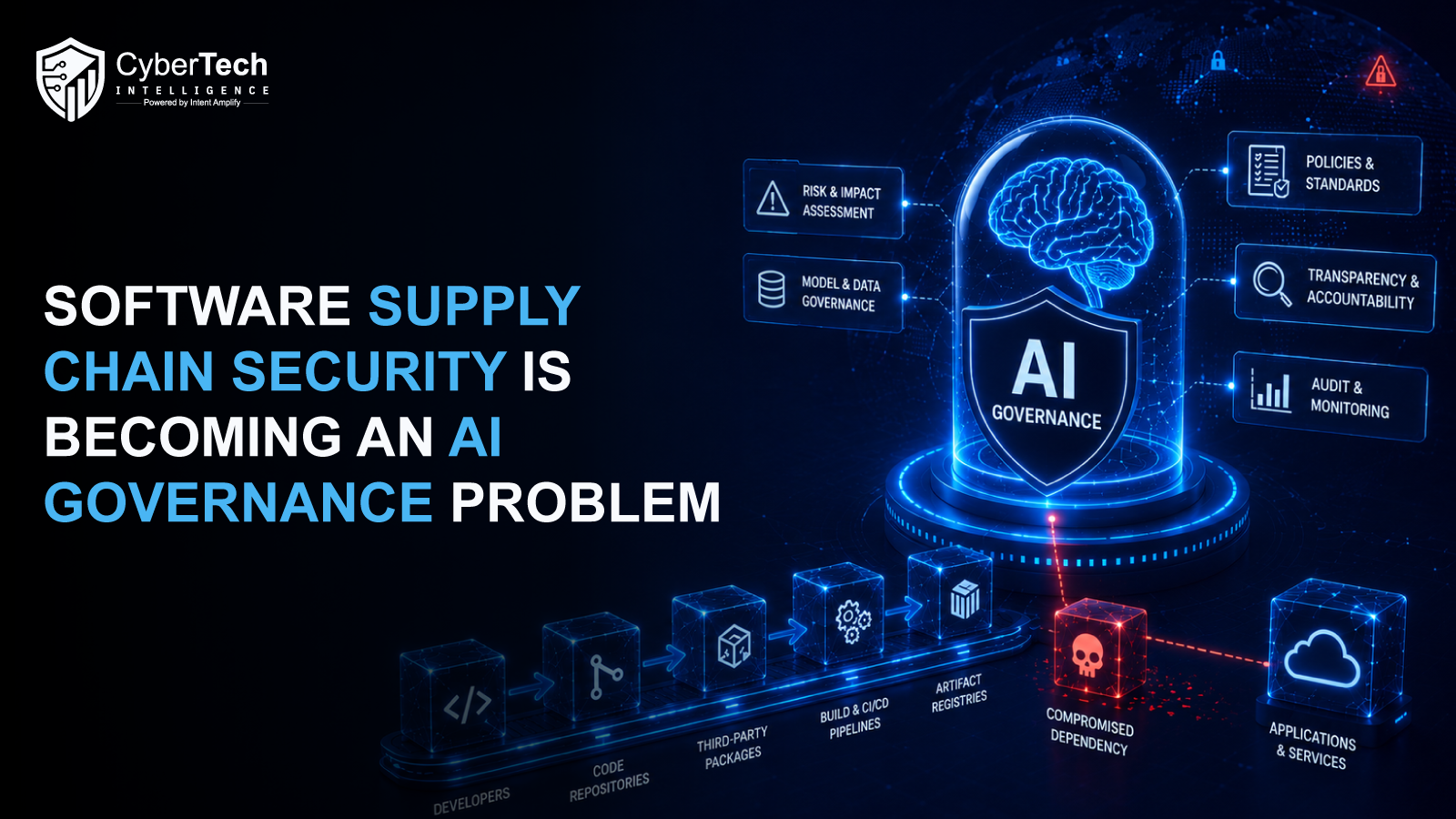
For CISOs, CIOs, and engineering leaders, the implication is clear. Software supply chain security must evolve from dependency visibility into AI-era governance built around Trusted AI Agents, Software Provenance, AI Supply Chain Assurance, Runtime Governance, and Executive AI Oversight.
CyberTech Intelligence Perspective
CyberTech Intelligence views software supply chain security as an AI governance discipline, not only a DevSecOps or dependency-management function. As AI becomes embedded across software creation, testing, validation, remediation, deployment, and runtime operations, enterprise software trust increasingly depends on the governance of both software artifacts and the AI systems that influence them.
This shift changes the assurance model. Organizations can no longer ask only which packages, containers, libraries, or open-source components are present in an application. They must also understand which AI agents generated code, which models influenced development, which tools were invoked, which artifacts were signed, which datasets shaped behavior, and how runtime workflows are governed after deployment.
For CISOs, CIOs, CTOs, DevSecOps leaders, platform engineering teams, and AI governance leaders, software supply chain security must evolve into a unified operating model that connects software provenance, AI agent governance, model assurance, runtime controls, and executive oversight.
From Dependency Risk to AI-Era Supply Chain Risk
The software supply chain has grown into a complex enterprise ecosystem spanning open-source libraries, internal components, third-party packages, containers, APIs, infrastructure-as-code templates, and automated build systems. Each dependency expands the enterprise attack surface through vulnerabilities, compromised maintainers, malicious updates, abandoned projects, or unverifiable software provenance.
AI further expands this ecosystem by embedding automated decision-making throughout the software development lifecycle. AI assistants generate code, agents remediate vulnerabilities, automated systems test applications, and deployment pipelines interact directly with cloud platforms and package registries. Software assurance now extends beyond software artifacts to the AI-enabled systems that influence how software is developed, validated, and released.
IBM's Cybersecurity Trends 2026 reports a sharp increase in supply chain and third-party compromises over the past five years, reinforcing the growing enterprise impact of software trust failures. ⁴
This trend should concern enterprise leaders because supply chain compromise can scale across customers, subsidiaries, partners, cloud services, and downstream applications from one trusted entry point.
The strategic challenge is no longer limited to identifying vulnerable packages. It is proving that software was produced through a trusted process, using trusted inputs, approved models, verified artifacts, governed agents, and controlled automation.
Why AI Agents Are Becoming Software Supply Chain, Participants
AI agents are becoming active participants in the software delivery lifecycle. They can generate code, open pull requests, test fixes, inspect dependencies, invoke APIs, query documentation, create tickets, and recommend remediation. In some environments, agents may also deploy infrastructure or modify workflows through developer platforms.
This creates a new governance category. An AI agent should not be treated like a passive developer tool because it can take actions, use credentials, interact with repositories, and influence production code. Microsoft’s Cyber Pulse: An AI Security Report states that more than 80% of the Fortune 500 are deploying active AI agents, while only 47% of organizations report implementing specific generative AI security controls. ⁵
Microsoft also reported that 29% of employees have used unsanctioned AI agents for work tasks, which indicates that agent activity can spread before governance models mature. ⁵
Google Cloud’s Next ’26 security updates introduced AI-BOM capabilities to help secure AI-generated code and mitigate shadow AI risk while also adding Agent Identities and Agent Gateway protections for the agentic web. ⁶
These developments show that enterprise AI governance is moving closer to software supply chain governance.
For enterprise leaders, this changes the audit question. The question is no longer only “Which dependencies are in this application?” It is also “Which agent created, modified, reviewed, tested, signed, or deployed this artifact?”
CyberTech Intelligence Research Desk Observation
Enterprises are increasingly inheriting software risk from autonomous decision-making systems, not only from traditional dependencies. When AI agents generate code, recommend fixes, open pull requests, validate vulnerabilities, modify workflows, or interact with repositories, they become active participants in the software supply chain.
The organizations most exposed will not always be those with the largest dependency footprint. They will often be the organizations that cannot explain which AI agents touched software artifacts, what permissions those agents held, which models influenced development decisions, whether generated code was reviewed, and how runtime behavior is monitored after deployment.
SBOMs Are Necessary but No Longer Sufficient
SBOMs remain important because they provide structured visibility into software components, versions, and dependencies. They help enterprises understand exposure when vulnerabilities emerge and support procurement, compliance, and incident response. However, static SBOMs are no longer sufficient for AI-era software delivery because modern environments change continuously.
An SBOM generated once during a release may not capture late-stage dependency changes, AI-generated code, model files, datasets, prompt templates, agent tools, container layers, or runtime plug-ins. In AI-enabled environments, the supply chain extends beyond source code into model provenance, data lineage, inference dependencies, autonomous actions, and runtime integrations.
Google Cloud’s AI-BOM direction reflects this next step by extending transparency into AI-generated code and AI development workflows. ⁶
This type of inventory is important because enterprises increasingly need to understand how AI systems influence software artifacts, not only which software components are present.
The next maturity stage is an operationalized software inventory. This means SBOMs, AI-BOMs, model inventories, artifact signing, build provenance, dependency risk scoring, and runtime telemetry should be connected to engineering workflows rather than treated as separate compliance documentation.
Open Source Security Is Becoming a Board-Level Issue
Open source remains a foundation of enterprise software, but its scale has created systemic risk. Most enterprises rely on open-source packages deeply embedded across cloud applications, developer tooling, infrastructure platforms, data systems, and AI frameworks. The challenge is that open-source ecosystems move faster than traditional vendor-risk processes.
IBM and Red Hat’s Project Lightwell announcement is important because it reflects a major enterprise push to secure open-source use through AI-assisted vulnerability identification, testing, remediation, and production-ready patching. ¹
The $5 billion commitment and more than 20,000 participating engineers indicate that open-source security is now being treated as strategic infrastructure, not just developer hygiene. ¹
For boards, the issue is business continuity. A compromised open-source package can affect customer-facing applications, internal platforms, regulated systems, and software products distributed to customers. Unlike a single vendor incident, an open-source compromise can propagate invisibly through dependency trees, container images, build systems, and downstream integrations.
Organizations should therefore treat open-source intake as a controlled supply chain process. Mature programs should define approved registries, package-signing requirements, dependency review criteria, maintainer-risk assessment, license governance, emergency patching procedures, and production deployment gates.
Model Supply Chains Introduce New Attack Paths
AI models introduce supply chain risks that differ from traditional software libraries. Models may be downloaded from public repositories, fine-tuned on internal data, embedded into applications, connected to retrieval systems, or deployed through cloud services. Each step introduces trust decisions around model origin, training data, serialization format, permissions, and runtime behavior.
Cisco’s State of AI Security 2026 identifies AI supply chain vulnerability, agentic AI risk, and the weaponization of AI by attackers as critical AI security challenges. ⁷ Cisco’s broader agentic AI research also found that 85% of organizations are experimenting with, piloting, or deploying agentic AI, while only 5% have reached broad production, and nearly 60% of security leaders cite security concerns as the primary barrier to wider adoption. ⁸
These figures matter because model and agent adoption are advancing faster than enterprise assurance. AI models can be manipulated in ways that do not resemble conventional software vulnerabilities. Poisoned datasets, malicious model weights, unsafe plug-ins, insecure tool calls, and prompt-based manipulation may all affect enterprise outcomes.
For CISOs, this means machine learning security operations, or MLSecOps, must become part of enterprise software governance. MLSecOps connects DevSecOps practices to model development, training data, deployment pipelines, inference monitoring, and adversarial testing.
Runtime Supply Chains Require Continuous Control
In traditional software security, much of the focus was on build-time controls. In agentic and AI-enabled systems, runtime behavior becomes equally important. Agents can retrieve context, call tools, invoke APIs, exchange data, and make decisions after deployment. This creates runtime supply chains where risk emerges through dynamic interaction rather than static dependency alone.
Cloudflare’s guidance on securing Model Context Protocol workflows highlights risks, including authorization sprawl, prompt injection, and supply chain exposure, while describing controls for governing AI usage without slowing the workforce. ⁹
This is a useful signal because enterprises are starting to manage AI workflows as connected security architectures rather than isolated model deployments.
Runtime governance should include agent identity, tool authorization, audit logging, data-loss controls, prompt inspection, package access monitoring, and API-level policy enforcement. The goal is not to stop automation. The goal is to ensure autonomous systems operate inside verified boundaries.
CyberTech Intelligence Enterprise AI Software Governance Framework™
CyberTech Intelligence recommends that enterprise leaders govern AI-era software supply chain risk through a unified AI software governance framework. The goal is not only to identify vulnerable dependencies or generate SBOMs. The goal is to govern the full software trust lifecycle across AI agents, source code, packages, containers, models, build systems, runtime workflows, and executive accountability.
|
Framework Pillar |
Executive Question |
What Leaders Should Measure |
|
Trusted AI Agents |
Are AI agents that influence software development governed as privileged software supply chain participants? |
Agent identities, code-generation activity, pull request activity, repository permissions, tool access, approval workflows, audit logs, and least-privilege enforcement. |
|
Software Provenance |
Can the enterprise prove where the software came from and how it was built? |
Signed packages, verified builds, trusted registries, CI/CD integrity, artifact signing, container provenance, source-to-production traceability, and tamper-resistant pipelines. |
|
AI Supply Chain Assurance |
Are AI models, datasets, prompts, AI-BOMs, and agent tools governed alongside traditional software components? |
AI-BOM maturity, model provenance, dataset lineage, prompt templates, model dependencies, AI-generated code coverage, and approved AI development tools. |
|
Runtime Governance |
Can the organization monitor how AI-enabled software, agents, APIs, and tools behave after deployment? |
Agent tool use, API calls, runtime telemetry, data-loss signals, package access, prompt activity, model behavior, and policy enforcement. |
|
Executive AI Oversight |
Is AI software supply chain risk visible to leadership as a resilience and governance issue? |
Dependency exposure, unsigned artifacts, AI-generated code risk, agent access reviews, model inventory completeness, remediation cycle time, and executive risk reporting. |
The priority is to create an AI Supply Chain Assurance. This inventory should include application dependencies, containers, SBOMs, AI-BOMs, models, datasets, prompts, agent tools, build systems, and deployment pipelines.
The second priority is Software Provenance. Enterprises should require signed packages, verified builds, trusted registries, tamper-resistant pipelines, and traceability from source code to production artifacts. Provenance should apply to models and agent tools as well as traditional software.
The third priority is Trusted AI Agents. AI agents that contribute to software development should have unique identities, least-privilege access, approved tool permissions, monitored activity, and clear accountability. No autonomous agent should modify code, open deployment workflows, or invoke sensitive APIs without traceable controls.
The fourth priority is AI Supply Chain Assurance & Runtime Governance. Security teams should integrate model scanning, dataset governance, adversarial testing, inference monitoring, and model access controls into the software development lifecycle.
The fifth priority is Executive AI Oversight. CISOs and CIOs should report dependency exposure, unsigned artifacts, high-risk packages, AI-generated code coverage, model inventory completeness, agent access reviews, and remediation cycle time.
CyberTech Intelligence views AI software governance as a business resilience requirement. The strongest enterprise programs will not be measured only by the number of vulnerabilities remediated or SBOMs generated. They will be measured by whether leaders can prove software origin, govern AI agents, verify model provenance, control runtime behavior, operationalize AI-BOMs, and connect software trust to business continuity and executive risk reporting.
Executive Decision Points
|
Decision Area |
Executive Metric |
|
Governance Ownership |
Percentage of software supply chain risks assigned across security, engineering, procurement, legal, and AI governance teams. |
|
SBOM Operationalization |
Percentage of SBOMs connected to vulnerability prioritization, artifact signing, build validation, and incident response. |
|
AI Agent Controls |
Percentage of AI agents with unique identities, approved tool access, repository permissions, audit logs, and owner mapping. |
|
AI-BOM Readiness |
Percentage of AI-generated code, model dependencies, datasets, prompts, and agent tools captured in AI-BOM workflows. |
|
Open-Source Intake Control |
Percentage of packages sourced from trusted registries, signed packages verified, and maintainer-risk reviews completed. |
|
Model Provenance |
Percentage of models with documented origin, dataset lineage, fine-tuning records, deployment approvals, and runtime boundaries. |
|
Runtime Assurance |
Percentage of high-risk applications and AI workflows covered by runtime monitoring, API policy enforcement, and behavioral telemetry. |
Enterprise leaders should first decide whether software supply chain governance is clearly owned across security, engineering, procurement, legal, and AI governance teams. Fragmented ownership creates blind spots because dependency risk, model risk, and agent risk often sit across different departments.
The second decision point is whether SBOMs are operational or merely documentary. If SBOMs are generated for compliance but not connected to vulnerability prioritization, artifact signing, build validation, and incident response, they provide limited security value.
The third decision point is whether AI-generated code and AI agents are included in software security reviews. Microsoft’s finding that active AI agents are already being deployed across many of the world’s largest enterprises, while many organizations still lack specific generative AI security controls, shows why this question is now urgent.
The fourth decision point is whether open-source intake is controlled. Enterprises should know which repositories are trusted, which packages are allowed, how maintainers are assessed, and how emergency fixes are distributed.
The final decision point is whether model provenance and runtime behavior are monitored. AI systems should not be deployed unless the enterprise can explain their origin, permissions, dependencies, and operational boundaries.
Executive AI Software Governance Scorecard
|
Readiness Area |
Early Stage |
Developing |
Mature |
|
AI Agent Governance |
AI agents are used in development or remediation workflows without consistent ownership, identity, or permission controls. |
Approved agents are documented for selected teams, but unsanctioned agents and embedded platform agents remain partially visible. |
AI agents have unique identities, owners, least-privilege access, approved tool permissions, audit logs, and review workflows. |
|
AI-BOM Maturity |
SBOMs exist for selected applications, but AI-generated code, models, datasets, prompts, and agent tools are not captured. |
AI-BOM efforts are emerging for high-priority applications or AI systems. |
AI-BOMs connect AI-generated code, model dependencies, datasets, prompt templates, tools, and artifacts to release and risk workflows. |
|
Model Provenance |
Model origin, training data lineage, fine-tuning history, and deployment context are not consistently documented. |
Critical models are reviewed, but provenance and risk records vary by team or platform. |
Model origin, dataset lineage, fine-tuning, permissions, deployment path, and runtime boundaries are documented and governed. |
|
Runtime Governance |
Software assurance focuses mainly on build-time controls and static scans. |
Runtime monitoring exists for selected applications, APIs, or AI workflows. |
Agent activity, model behavior, API calls, tool invocation, data access, package access, and policy violations are monitored continuously. |
|
Software Provenance |
Build provenance, signing, and trusted registry controls are inconsistent. |
Critical applications use signed artifacts and verified builds, but coverage is incomplete. |
Source code, packages, containers, infrastructure templates, models, and production artifacts are signed, verified, and traceable. |
|
MLSecOps Maturity |
AI security is handled separately from software development and DevSecOps. |
Model scanning, dataset review, or AI testing is used for selected projects. |
MLSecOps is integrated into DevSecOps through model scanning, dataset governance, adversarial testing, inference monitoring, and access control. |
|
Executive AI Governance Readiness |
Leadership reporting focuses on vulnerabilities, compliance, or AI adoption. |
Some software supply chain and AI risk metrics are reported, but they are not connected. |
Executives receive clear reporting on AI agent controls, AI-BOM maturity, software provenance, model governance, runtime assurance, and software resilience. |
This scorecard helps CISOs, CIOs, CTOs, DevSecOps leaders, platform engineering teams, AI governance leaders, and board risk committees evaluate whether software supply chain security is still being managed as dependency visibility or as a broader AI governance discipline. Mature organizations will show measurable progress across AI agent governance, AI-BOM maturity, model provenance, runtime governance, software provenance, MLSecOps, and executive oversight.
Conclusion
Software supply chain security in the AI era is no longer only about vulnerable dependencies or static SBOMs. It is about governing a dynamic ecosystem of code, models, agents, APIs, artifacts, registries, containers, datasets, and runtime workflows. AI has accelerated development, but it has also expanded the number of systems that can influence production software.
The enterprises most prepared for 2026 will be those that move from visibility to governance. They will operationalize SBOMs and AI-BOMs, verify artifact provenance, govern AI agents as software supply chain participants, secure model pipelines, and monitor runtime behavior continuously.
As AI becomes embedded throughout the software lifecycle, software trust increasingly depends on the ability to continuously govern autonomous systems, software provenance, and runtime behavior, not simply verify source code. Organizations that can prove where their software came from, how it was built, which AI systems influenced it, and how it behaves after deployment will be better positioned to scale innovation without accepting unmanaged supply chain risk.
The next phase of software supply chain security will be defined by proof. Enterprises will need to prove which components were used, which agents influenced development, which models shaped outcomes, which artifacts were signed, which runtime behaviors were monitored, and which governance controls remained active from code creation through production operations.
Assess Your Enterprise AI Software Governance Readiness
CyberTech Intelligence helps CISOs, CIOs, CTOs, DevSecOps leaders, platform engineering teams, and AI governance leaders move from dependency visibility to AI-era software assurance. Through the Enterprise AI Software Governance Assessment, organizations can evaluate AI software governance maturity, AI agent controls, software provenance, model governance, runtime assurance, AI-BOM readiness, MLSecOps maturity, and enterprise software resilience.
CyberTech Intelligence also supports enterprise teams through:
- AI Software Supply Chain Governance Review
- AI Agent and Developer Workflow Assessment
- Software Provenance and Artifact Integrity Review
- AI-BOM and Model Governance Workshop
- Executive Software Trust Briefing
Use this Expert Insight as the starting point for a structured governance conversation that connects software supply chain security, AI governance, DevSecOps, MLSecOps, runtime assurance, and business resilience.
References
- IBM and Red Hat Commit $5 Billion to Redefine the Future of Open Source in the AI Era, May 2026
https://newsroom.ibm.com/2026-05-28-ibm-and-red-hat-commit-5-billion-to-redefine-the-future-of-open-source-in-the-ai-era - Microsoft, Microsoft Build 2026: Securing Code, Agents, and Models Across the Development Lifecycle, June 2026
https://www.microsoft.com/en-us/security/blog/2026/06/02/microsoft-build-2026-securing-code-agents-and-models-across-the-development-lifecycle/ - Microsoft, Defense at AI Speed: Microsoft’s New Multi-Model Agentic Security System Tops Leading Industry Benchmark, May 2026
https://www.microsoft.com/en-us/security/blog/2026/05/12/defense-at-ai-speed-microsofts-new-multi-model-agentic-security-system-tops-leading-industry-benchmark/ - IBM, Cybersecurity Trends 2026, March 2026
https://www.ibm.com/think/insights/more-2026-cyberthreat-trends - Microsoft, Cyber Pulse: An AI Security Report, February 2026
https://www.microsoft.com/en-us/security/security-insider/emerging-trends/cyber-pulse-ai-security-report - Google Cloud, Next ’26: Redefining Security for the AI Era with Google Cloud and Wiz, April 2026
https://cloud.google.com/blog/products/identity-security/next26-redefining-security-for-the-ai-era-with-google-cloud-and-wiz - Cisco, The State of AI Security 2026, February 2026
https://blogs.cisco.com/ai/cisco-state-of-ai-security-2026-report - Cisco, The Agent Trust Gap: What Our Research Reveals About Agentic AI Security, March 2026
https://blogs.cisco.com/security/the-agent-trust-gap-what-our-research-reveals-about-agentic-ai-security - Cloudflare, Scaling MCP Adoption: Our Reference Architecture for Secure and Governed Enterprise AI, April 2026
https://blog.cloudflare.com/enterprise-mcp/