
Executive Overview
Post-quantum security has moved from a specialist research topic into a board-level cyber-resilience priority. For chief information security officers, chief information officers, and executive committees, the issue is no longer theoretical. It is becoming a practical test of whether a company can identify fragile trust dependencies, modernize legacy protections, and coordinate a controlled transition before customer, regulatory, or supplier pressure accelerates.
NIST’s current post-quantum cryptography guidance confirms that it has released three standards that can be implemented now to protect electronic information, including confidential messages and e-commerce transactions. These standards include ML-KEM for key establishment and ML-DSA and SLH-DSA for digital signatures.
That milestone matters because it shifts planning from a technical task to a leadership responsibility. Many enterprises rely on public-key methods across identity platforms, cloud workloads, application programming interfaces, virtual private networks, software-signing workflows, certificates, operational technology, and third-party services. Yet few have a complete view of where those methods sit, who owns them, or how easily they can be changed.
The concern is especially urgent for information that must remain confidential for many years. Healthcare records, financial histories, government data, defense information, intellectual property, and critical infrastructure documentation may retain value long after current safeguards weaken. IBM noted in 2026 that “harvest now, decrypt later” attacks put data considered secure today at risk because encrypted information can be collected now and exposed once quantum capabilities mature.1
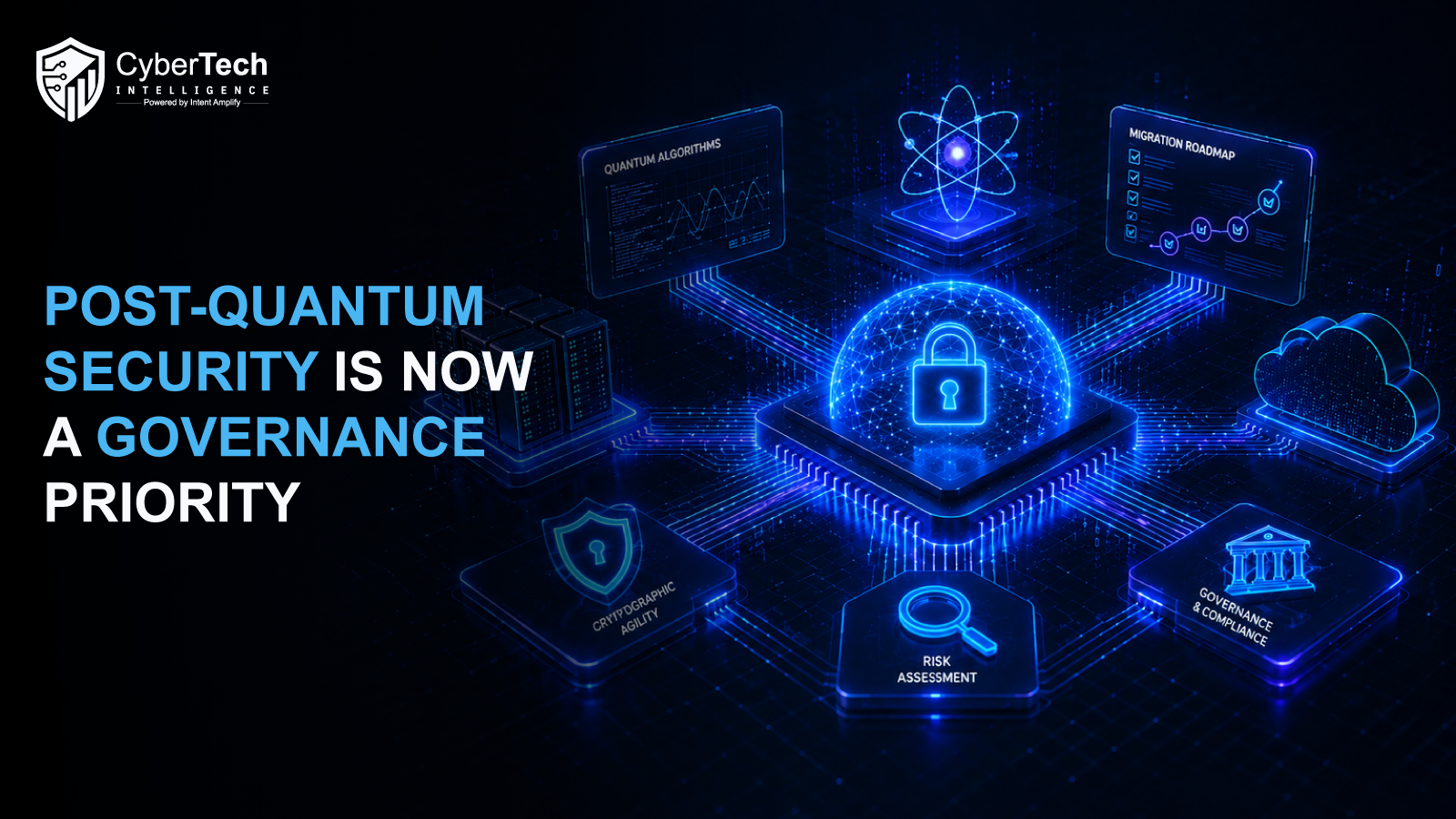
For senior leaders, post-quantum preparation should therefore be viewed as a governance, architecture, and trust-modernization program. It is not simply an algorithm upgrade. The more durable objective is to build visibility, supplier accountability, transition discipline, and crypto agility before urgency narrows strategic options.
Five Pillars of Enterprise PQC Governance
The Five Pillars of Enterprise PQC Governance provide a practical executive model for moving post-quantum security from technical awareness to accountable enterprise action. The framework focuses on the governance disciplines that boards, CISOs, CIOs, enterprise architects, procurement leaders, and compliance teams need before post-quantum migration becomes urgent.
CyberTech Intelligence Research Desk Observation: The organizations making the fastest progress toward quantum readiness are not necessarily those deploying new algorithms first. They are the ones establishing cryptographic visibility, integrating post-quantum cryptography into broader modernization initiatives, and aligning procurement, infrastructure, and governance around a common transition strategy.
Enterprise PQC Governance Model:
Discovery → Prioritization → Crypto-Agility → Supplier Governance → Executive Oversight
|
Pillar |
Executive Question |
Business Purpose |
|
Discovery |
Where is cryptography embedded across the enterprise? |
Build visibility across algorithms, certificates, keys, libraries, protocols, identity systems, cloud workloads, applications, and supplier-controlled services |
|
Prioritization |
Which trust dependencies create the greatest business risk? |
Focus early action on long-life sensitive data, regulated workloads, customer-facing platforms, payment systems, critical operations, and externally exposed services |
|
Crypto-Agility |
Can cryptographic algorithms be replaced without disrupting operations? |
Support algorithm substitution, automated certificate management, centralized key governance, flexible protocol configuration, and controlled exception handling |
|
Supplier Governance |
Are vendors prepared to support post-quantum migration? |
Require providers to clarify supported standards, implementation timelines, upgrade paths, interoperability evidence, and customer migration support |
|
Executive Oversight |
How is migration progress measured and governed? |
Track ownership, funding, inventory coverage, high-risk dependencies, supplier gaps, pilot progress, unresolved exceptions, and board-level reporting |
This framework gives leaders a common language for PQC governance. Instead of treating post-quantum preparation as an isolated cryptographic upgrade, executives can evaluate whether the organization has the visibility, prioritization discipline, architecture flexibility, supplier accountability, and oversight structure needed to protect digital trust over time.
Why Waiting Creates Business Risk
The Five Pillars of Enterprise PQC Governance begin with a practical reality: waiting increases business risk because large-scale cryptographic change takes longer than most organizations expect. Enterprises often underestimate the time required to change cryptographic foundations across complex digital estates. Migration can take years, particularly where legacy systems, fragmented ownership, vendor-controlled platforms, and undocumented dependencies exist.
Google introduced a 2029 timeline for post-quantum cryptography migration in March 2026, citing progress in quantum hardware development, quantum error correction, and factoring-resource estimates.2
This updated market signal does not mean every enterprise must rush into deployment. It does mean security leaders should stop treating the transition as a distant architectural concern. The migration clock is shaped by more than quantum hardware maturity. It is also shaped by data-retention periods, infrastructure complexity, vendor timelines, budget cycles, and regulatory expectations.
NIST’s NCCoE migration guidance states that migrating to post-quantum cryptography requires understanding how quantum-vulnerable public-key algorithms are used across hardware, software, and services, and then developing roadmaps to prioritize the adoption of NIST post-quantum algorithms.3
This guidance reflects operational reality. Security teams cannot protect what they cannot locate. Architecture groups cannot redesign trust mechanisms without understanding application dependencies. Procurement cannot hold suppliers accountable without clear requirements. Boards cannot oversee exposure without practical metrics.
Early action is therefore a matter of business prudence rather than alarm. The goal is preparation: knowing where vulnerable methods exist, which assets matter most, which providers influence timing, and which modernization programs can absorb the work with minimal disruption.
The Commercial Impact Extends Beyond Encryption
Encryption is often described as a technical control, but in practice, it underpins digital commerce. Customer authentication, payment flows, secure software updates, cloud connectivity, API traffic, employee access, device identity, and partner integrations all depend on trust mechanisms functioning reliably.
If those mechanisms become outdated, the impact can reach procurement, legal review, customer assurance, insurance evaluation, regulatory supervision, and operational continuity. This is particularly important in banking, healthcare, aerospace, energy, public services, defense, telecommunications, and critical infrastructure, where data sensitivity and compliance obligations are high.
IBM’s Institute for Business Value warned in its recent quantum-safe readiness report that quantum computers capable of breaking today’s encryption may emerge before many companies complete their transition, while threat actors are already using “harvest now, decrypt later” tactics.4
For business leaders, this signals future cost and execution pressure. Modernization will require discovery tools, engineering effort, vendor coordination, certificate lifecycle improvements, architecture review, testing capacity, and workforce development. Delayed planning may convert a manageable investment into an emergency remediation.
A planned approach creates more flexibility. Post-quantum requirements can be incorporated into cloud redesign, identity transformation, Zero Trust programs, public key infrastructure renewal, software supply-chain controls, and application modernization. When aligned with existing initiatives, the transition becomes less disruptive and easier to justify financially.
The board-level question should therefore change. Instead of asking when quantum computers will break today’s encryption, leaders should ask how prepared the business is to update its trust architecture safely.
Current Readiness Remains Immature
Most enterprises remain at an early stage of post-quantum preparation. The challenge is not only technical capability; it is also visibility. Many teams still lack a reliable inventory of algorithms, certificates, keys, libraries, protocols, and supplier dependencies.
NIST’s crypto-agility project states that advances in computing, cryptographic research, and cryptanalytic techniques periodically create the need to replace algorithms that no longer provide adequate security for their use cases. It also links future cryptographically relevant quantum computers to the need for post-quantum standards and migration planning.5
This gap creates practical uncertainty. A CISO may understand the strategic importance of post-quantum planning but still lack the evidence needed to prioritize investment. A CIO may support modernization but discover that legacy platforms cannot be upgraded without broader replacement. Procurement may ask vendors about future support and receive responses that are directionally positive but operationally vague.
Readiness should be measured through concrete questions. Which systems depend on RSA or elliptic curve cryptography? Which workloads protect long-life sensitive information? Which certificates support critical business functions? Which suppliers control upgrade timing? Which applications would fail if cryptographic parameters changed? Which environments can support hybrid deployment? Which teams own remediation?
A company that cannot yet answer these questions should not treat that as a failure. It should treat it as the starting point. The first maturity milestone is not full migration. It is achieving credible visibility.
That visibility is the first pillar of enterprise PQC governance. Without discovery, every later decision becomes less reliable: prioritization is incomplete, crypto-agility planning is speculative, supplier discussions remain vague, and executive reporting lacks evidence. For boards and CISOs, cryptographic visibility should become the baseline metric for quantum-readiness planning.
A Practical Roadmap for Post-Quantum Adoption
A strong roadmap begins with discovery. Security leaders should build an inventory of public-key usage across applications, cloud platforms, identity systems, API gateways, VPNs, databases, code-signing workflows, operational technology, Internet of Things environments, and third-party services. This inventory should become a living management asset, not a one-time audit exercise.
The second step is risk ranking. Not every system requires the same urgency. Priority should go to long-retention sensitive data, customer-facing platforms, payment systems, identity infrastructure, regulated workloads, intellectual property repositories, critical operations, and externally exposed services. This allows investment to follow business impact rather than technical noise.
The third step is crypto agility. Firms should avoid replacing one rigid design with another. Future-ready architecture should support algorithm substitution, automated certificate management, centralized key governance, approved cryptographic libraries, flexible protocol configuration, and clear exception handling.
The fourth step is controlled testing. During transition, many environments may need hybrid models that combine classical and post-quantum methods. These models can reduce migration risk, but only when tested for interoperability, latency, storage impact, monitoring, rollback procedures, and operational support.
The fifth step is supplier governance. Vendor readiness should appear in procurement reviews, renewal discussions, cloud governance, security questionnaires, and third-party risk scoring. Providers should clarify supported standards, upgrade paths, implementation timelines, test evidence, and customer migration support.
The final step is executive oversight. Post-quantum planning needs named ownership, funding visibility, board reporting, legal input, and compliance tracking. Without central governance, technical work will remain fragmented.
Executive PQC Governance Checklist
According to CyberTech Intelligence research and analysis, executive PQC readiness should be assessed through measurable governance evidence rather than broad technology intent. The checklist below gives boards, CISOs, CIOs, procurement leaders, and enterprise architects a practical way to evaluate whether post-quantum preparation is moving from awareness to accountable execution.
|
Governance Area |
Readiness Evidence |
Status |
|
Cryptographic Inventory |
Public-key algorithms, certificates, keys, libraries, protocols, and dependent systems have been identified |
Not Started / In Progress / Complete |
|
Long-Life Data Exposure |
Sensitive data with long confidentiality requirements has been mapped and prioritized |
Not Started / In Progress / Complete |
|
Critical Trust Dependencies |
Identity systems, PKI, APIs, VPNs, code-signing workflows, cloud services, and customer-facing platforms have been reviewed |
Not Started / In Progress / Complete |
|
Crypto-Agility Planning |
Algorithm substitution, certificate automation, key governance, and exception handling are included in modernization plans |
Not Started / In Progress / Complete |
|
Hybrid Testing |
Classical and post-quantum approaches have been tested for interoperability, latency, rollback, monitoring, and operational support |
Not Started / In Progress / Complete |
|
Supplier Readiness |
Vendors have provided evidence of supported standards, migration timelines, upgrade paths, and implementation support |
Not Started / In Progress / Complete |
|
Executive Reporting |
Board and executive reporting tracks inventory coverage, high-risk assets, supplier gaps, funding needs, and remediation timelines |
Not Started / In Progress / Complete |
This checklist improves executive accountability by turning PQC readiness into evidence that can be reviewed, funded, and governed. It also helps security teams move the conversation away from abstract quantum timelines and toward practical modernization decisions.
Cloud and Vendor Readiness Will Influence Pace
Supplier governance is one of the most important pillars of enterprise PQC readiness because no organization will complete this transition alone. Cloud platforms, managed service providers, endpoint vendors, certificate authorities, hardware security modules, SaaS products, developer tools, and open-source libraries will all influence migration timing.
Google has outlined a 2029 timeline for securing its own environment for the post-quantum era, citing progress in quantum hardware, error correction, and factoring-resource estimates.2
Cloudflare’s post-quantum cryptography documentation, recently updated in 2026, describes how it is deploying post-quantum cryptography to help protect against “harvest now, decrypt later” threats.6
NIST also released working drafts in June 2026 proposing updates to Personal Identity Verification standards to support post-quantum cryptography, including changes related to ML-DSA and ML-KEM. This signals that post-quantum support is moving into practical identity and authentication standards, not only abstract cryptographic research.7
These developments are encouraging, but the ecosystem will not mature evenly. Some providers will move quickly. Others will lag because of legacy dependencies, product complexity, performance trade-offs, or unclear customer demand. That unevenness makes supplier accountability essential.
CISOs and procurement leaders should begin asking better questions now. Which NIST standards are supported? Is hybrid mode available? Does adoption require a major version upgrade? What evidence confirms interoperability? How will support affect pricing, contracts, service-level commitments, and implementation timelines?
Waiting until customers, auditors, or regulators require evidence will reduce negotiating leverage. Early engagement gives buyers more control.
Strategic Priorities for CISOs and Boards
CISOs should frame post-quantum preparation as a cyber-resilience and governance program. The first deliverable should be visibility across cryptographic assets and dependencies. That evidence will guide prioritization, budget planning, supplier engagement, crypto-agility planning, and executive reporting.
CIOs should connect the transition to modernization work already underway. Identity consolidation, cloud transformation, infrastructure refresh, certificate automation, DevSecOps maturity, and software engineering standards all provide entry points for a stronger trust architecture.
Boards should request practical metrics rather than deep algorithmic detail. Useful indicators include inventory coverage, high-risk asset identification, supplier-readiness status, long-life data exposure, pilot progress, and funding requirements.
Procurement and legal teams should update vendor expectations. Suppliers should provide roadmap clarity, supported standards, upgrade paths, security evidence, and contractual commitments where appropriate.
The strongest posture is disciplined urgency. Leaders should avoid both complacency and rushed deployment. Early discovery, careful testing, coordinated governance, and supplier engagement will reduce disruption while preserving strategic choice.
Conclusion
Post-quantum security is becoming one of the defining cybersecurity transitions of the next decade. Recent guidance from NIST, Google, IBM, and Cloudflare shows that preparation is moving from theory into infrastructure, identity, certificate, and supplier-planning discussions.
The central challenge is not simply adopting new algorithms. It is building the enterprise capability to identify vulnerable trust dependencies, protect long-life sensitive data, coordinate suppliers, test hybrid models, modernize architecture, and sustain crypto agility over time.
Businesses that begin early will be better positioned to manage cost, reduce disruption, satisfy customer and regulatory expectations, and preserve confidence in digital operations. Those who delay may still complete the transition, but under tighter timelines and with less room for thoughtful sequencing.
Post-quantum preparation is therefore more than a cybersecurity initiative. It is a measure of governance maturity, operational resilience, and digital trust leadership.
Enterprise PQC Governance Assessment
Post-quantum preparation requires more than awareness of new cryptographic standards. It requires evidence of cryptographic visibility, long-life data exposure, supplier readiness, PKI modernization, cloud dependency mapping, and executive oversight. CyberTech Intelligence helps security and technology leaders translate post-quantum uncertainty into a practical governance and modernization agenda.
An Enterprise PQC Governance Assessment can help CISOs, CIOs, board risk committees, enterprise architects, procurement teams, and security leaders evaluate where post-quantum exposure sits across cryptographic assets, critical trust dependencies, supplier-controlled platforms, and long-retention data environments. The assessment is designed to support roadmap prioritization, executive reporting, vendor evaluation, and cyber-resilience planning.
To discuss quantum-readiness planning, cryptographic discovery, supplier governance, or board-level PQC strategy, connect with the CyberTech Intelligence team.
About CyberTech Intelligence
CyberTech Intelligence helps CISOs, enterprise security teams, and cybersecurity vendors navigate complex security transitions with research-led intelligence, buyer insights, threat analysis, and go-to-market intelligence. From post-quantum security and crypto agility to AI security, cloud protection, identity security, SIEM, XDR, threat intelligence, and Zero Trust, the platform connects emerging cyber risk with practical business and technology guidance.
References
- IBM, Quantum Computers Are Speeding Towards Cryptographic Relevancy, April 2026
https://www.ibm.com/think/perspectives/quantum-computers-are-speeding-towards-cryptographic-relevancy - Google, Google’s Timeline for PQC Migration, March 2026
https://blog.google/innovation-and-ai/technology/safety-security/cryptography-migration-timeline/ - National Institute of Standards and Technology, Migration to Post-Quantum Cryptography, accessed June 2026
https://www.nccoe.nist.gov/applied-cryptography/migration-to-pqc - IBM Institute for Business Value, Secure the Post-Quantum Future, 2025, accessed June 2026
https://www.ibm.com/thought-leadership/institute-business-value/en-us/report/2025-quantum-safe-readiness - National Institute of Standards and Technology, Crypto Agility, updated April 2025, accessed June 2026
https://csrc.nist.gov/projects/crypto-agility - Cloudflare, Post-Quantum Cryptography, updated May 2026, accessed June 2026
https://developers.cloudflare.com/ssl/post-quantum-cryptography/ - National Institute of Standards and Technology, Working Drafts: Post-Quantum Cryptography Updates to the PIV Standards, June 2026
https://www.nist.gov/news-events/news/2026/06/working-drafts-post-quantum-cryptography-updates-piv-standards