CyberTech Intelligence Perspective
Artificial intelligence is becoming a new enterprise execution layer rather than another software capability. Unlike traditional applications, AI systems increasingly retrieve enterprise knowledge, invoke tools, influence decisions, and execute business workflows with varying degrees of autonomy. As a result, AI security is evolving from an application security discipline into an enterprise governance capability that spans identity, data, runtime behavior, operational oversight, and executive accountability. Organizations that treat AI as software alone may secure code effectively while leaving autonomous decision pathways insufficiently governed.
Enterprise security programs were built to protect applications, infrastructure, identities, networks, endpoints, and data stores. That foundation still matters. It simply does not cover the full risk profile of artificial intelligence once AI models move from pilots into production workflows.
In practical terms, AI systems are no longer passive assistants. They increasingly influence access, decisions, workflows, data movement, software creation, customer interaction, and operational execution. That is why the “secure it like software” mindset is becoming too narrow for CISOs, CTOs, and senior technology leaders.
The gap is already visible. IBM reported in 2025 that 13% of organizations experienced breaches of AI models or AI applications, while another 8% did not know whether such a compromise had occurred. That uncertainty is not a small reporting issue. It suggests that many enterprises lack a reliable inventory of AI systems, owners, data flows, and runtime behaviors. [1]
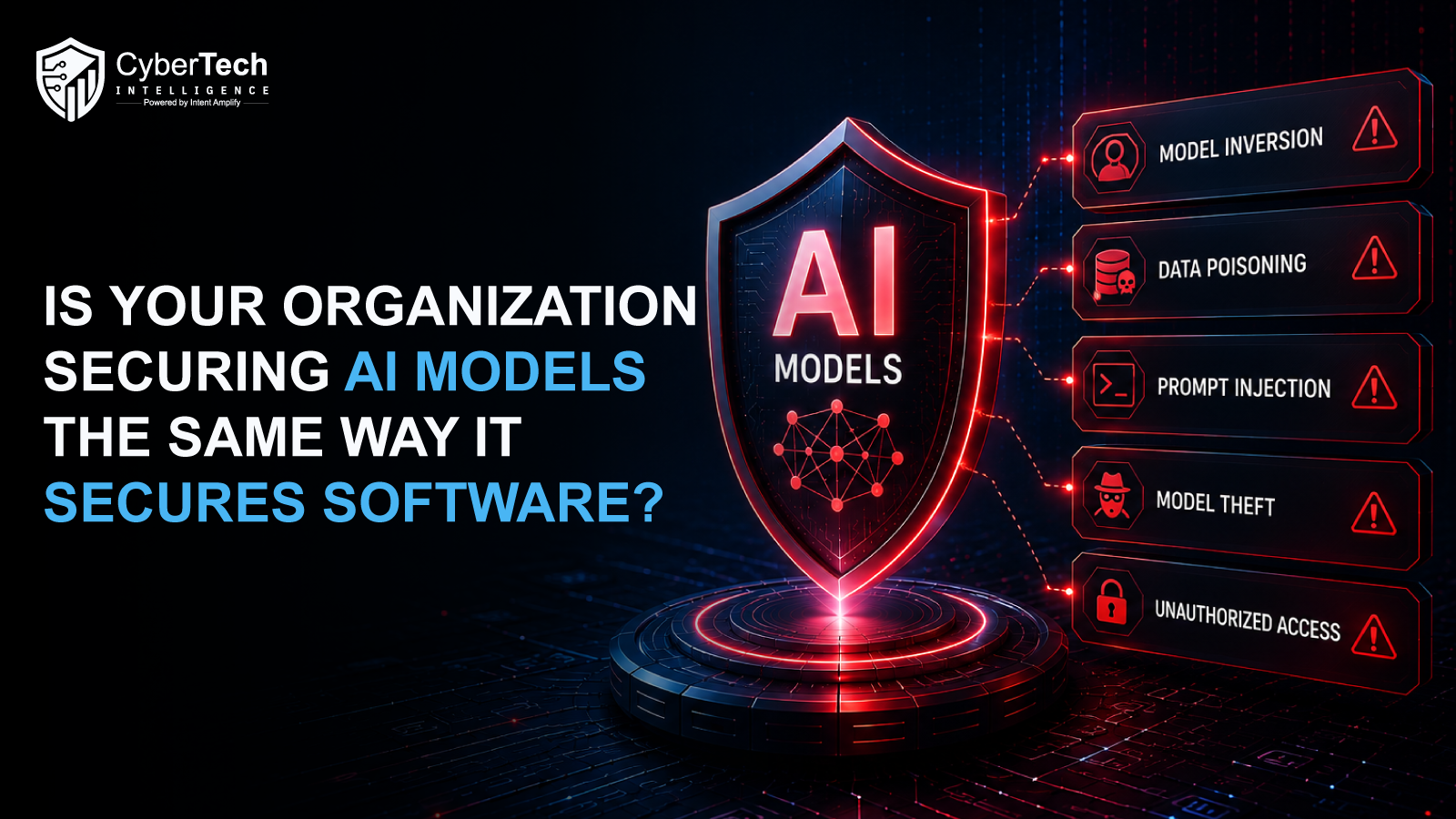
Software security usually assumes that risk can be traced to code, configuration, infrastructure, or access logic. AI risk is less contained. It can emerge through prompts, training data, retrieval systems, embeddings, model behavior, orchestration layers, plug-ins, and autonomous agents. A conventional application may fail because a dependency is vulnerable. An AI system may fail because a malicious instruction is hidden in a retrieved document, an agent invokes a tool outside its intended scope, or sensitive data is exposed through model output.
The strategic question is not whether AI should be governed. It is whether the security organization has enough visibility, authority, and evidence to govern AI before unmanaged deployment becomes a normal business practice.
Emerging Trend: AI Risk Is Moving from Model Accuracy to Runtime Exposure
Early AI governance discussions focused on accuracy, bias, explainability, and acceptable use. Those concerns remain important, especially for regulated industries. The security problem, however, has shifted toward runtime exposure.
AI systems now sit inside software development, fraud operations, customer service, knowledge management, compliance review, and executive analytics. They summarize regulated data, generate code, query internal systems, call application programming interfaces, and interact with third-party services. Once AI systems can retrieve, decide, and act, the risk profile moves beyond model quality.
Research has also found that 97% of organizations that reported AI-related breaches lacked proper AI access controls. The same research stated that 60% of AI-related security incidents led to compromised data, while 31% caused operational disruption. Those figures show why AI cannot remain a governance side project owned only by legal, data science, or innovation teams. [1]
The OWASP Top 10 for Large Language Model Applications 2025 reinforces this shift by identifying risks such as prompt injection, sensitive information disclosure, insecure output handling, excessive agency, and vector database weaknesses. These risks sit across model behavior, user input, retrieval architecture, tool invocation, and authorization design. They do not fit neatly inside traditional software vulnerability categories. [2]
This is where AI security tools have value, but only inside a broader control architecture. Prompt inspection, model scanning, AI runtime monitoring, red teaming, and data leakage detection can reduce exposure. They cannot compensate for unclear ownership, weak identity governance, missing policy, or unapproved AI use across business functions.
Market Implications: Regulation and AI Adoption Are Moving Faster Than Control Maturity
Business pressure to scale AI is accelerating. Cisco’s 2025 AI Readiness Index, based on a global study of 8,000 senior IT and business leaders, found that AI “Pacesetters” represent only 13% of organizations worldwide. Cisco also found that these leading organizations are almost four times as likely to move AI use cases into production. [4]
The implication for security leaders is direct: AI value increasingly depends on governance maturity. Organizations that cannot govern AI securely will either slow adoption, accept unmanaged exposure, or create a fragmented control environment that becomes difficult to defend during audit, incident response, or regulatory review.
Deloitte’s State of Generative AI in the Enterprise research, based on 2,773 director- to C-suite-level respondents across 14 countries, also shows that AI adoption is now a senior leadership issue rather than a contained technical experiment. Once AI deployment becomes global and cross-functional, inconsistent security controls become an enterprise operating risk. [5]
Regulation adds further pressure. In the European Union, the AI Act introduces a risk-based compliance model with requirements that affect transparency, governance, human oversight, and high-risk AI systems. General provisions and AI literacy requirements started applying on February 2, 2025; rules for general-purpose AI started applying on August 2, 2025, and the majority of AI Act rules are scheduled to apply from August 2, 2026. [6]
Outside the EU, organizations still face a more fragmented environment shaped by privacy rules, cyber disclosure expectations, federal or national AI guidance, and sector-specific oversight. For multinational enterprises, the practical response is to establish a common internal AI security baseline and then map local obligations to that baseline.
Enterprise AI Security Priorities by Industry
|
Industry |
Immediate AI Security Priority |
|
Financial Services |
AI governance, fraud prevention, model access control |
|
Healthcare |
Patient data protection, AI auditability, clinical oversight |
|
Government |
AI assurance, compliance, secure autonomous operations |
|
Manufacturing |
Operational technology integration, AI runtime monitoring |
|
Telecommunications |
AI agent identity, customer data governance |
|
Critical Infrastructure |
Autonomous system resilience, operational continuity |
Board-Ready Questions CISOs Should Be Able to Answer
|
Executive Question |
Why It Matters |
|
Which AI models, agents, and AI-enabled applications are currently in production? |
Tests whether AI asset visibility exists. |
|
What sensitive data can each AI system access? |
Identifies exposure across customer, employee, financial, source code, and regulated data. |
|
Which AI systems can trigger actions through tools, APIs, or workflow automation? |
Reveals excessive agency and privilege risk. |
|
Are AI access controls integrated with IAM, DLP, SIEM, and incident response? |
Tests whether AI security is operationalized. |
|
How are prompt injection, data leakage, and unsafe output risks monitored? |
Measures runtime security maturity. |
|
Who owns risk acceptance for high-impact AI use cases? |
Clarifies governance accountability. |
These questions are not only useful for board reporting. They also expose whether the organization has moved from AI experimentation to AI control maturity.
Expert Perspective: Securing AI Requires a Different Operating Model
The mistake is assuming that artificial intelligence can be absorbed into existing software security programs without structural change. Some controls can be reused. Many need to be extended.
A secure software development lifecycle covers requirements, code review, dependency management, testing, deployment, and monitoring. AI systems need those practices plus controls for model provenance, training and fine-tuning data, prompt behavior, retrieval-augmented generation, model output, human oversight, third-party model dependencies, and non-human identities.
CyberTech Intelligence AI Security Control Framework
Knowing how to secure AI in production requires organizations to govern five interconnected control layers that together determine operational resilience, auditability, and enterprise trust.
|
AI Security Control Layer |
What CISOs Should Validate |
|
AI asset inventory |
Models, agents, applications, prompts, retrieval stores, data sources, plug-ins, APIs, and business owners are documented. |
|
AI threat modeling |
Prompt injection, data poisoning, model inversion, unsafe retrieval, excessive agency, and model supply chain risks are assessed. |
|
Identity and access |
Models and agents use least-privilege service accounts, governed API keys, scoped permissions, and monitored activity. |
|
Runtime monitoring |
Prompt abuse, abnormal tool calls, sensitive data exposure, retrieval anomalies, and agent behavior are logged and investigated. |
|
Governance and policy |
Approved use cases, restricted data, human oversight, third-party review, escalation rules, and audit evidence are defined. |
The identity layer deserves particular attention. AI systems often act through service accounts, delegated permissions, API keys, or user credentials. If those identities are over-permissioned, an AI agent can become a privilege expansion mechanism that retrieves sensitive data, invokes unauthorized tools, or triggers workflow actions beyond its intended scope.
This is why IAM for AI agents should become part of enterprise identity governance. AI agents need unique identities, scoped permissions, activity logging, owner assignment, revocation processes, and exception review. Treating agents as ordinary application features may be administratively convenient, but it weakens accountability when an automated workflow takes an action that no human directly approved.
An effective AI governance and security policy should define approved use cases, restricted data categories, model approval steps, third-party review requirements, human oversight thresholds, logging obligations, incident escalation rules, and audit evidence expectations.
NIST’s Artificial Intelligence Risk Management Framework and Generative AI Profile provide a useful reference point because they translate AI risk into govern, map, measure, and manage activities. For 2026 planning, AI risk management should not sit outside the cybersecurity strategy. [3]
Executive AI Security Readiness Scorecard
|
Executive Capability |
Readiness Question |
|
AI Asset Visibility |
Can every production AI model, agent, and application be identified? |
|
Identity Governance |
Do AI agents operate with unique identities and least-privilege access? |
|
Runtime Monitoring |
Can abnormal prompts, retrieval activity, and tool execution be detected in real time? |
|
Data Governance |
Is sensitive enterprise data protected throughout AI interactions? |
|
Executive Accountability |
Are ownership, approval, and risk acceptance clearly assigned? |
Recommendations: What Security Leaders Should Prioritize Now
The following priorities should be viewed as an integrated enterprise control model rather than isolated technical improvements. Organizations typically mature AI security by establishing governance first, improving operational visibility second, and then extending runtime controls as AI adoption expands.
1. Assign accountable ownership for every production AI system
Every production AI system should have a business owner, technical owner, security owner, and data owner. The expected evidence should include system purpose, approved data access, model source, control owner, review date, and risk acceptance record. The outcome is clear accountability when AI affects regulated data, customer interaction, operational workflows, or enterprise decision-making.
2. Build the AI inventory around real data flows
Security teams should map which AI systems access customer data, employee data, intellectual property, source code, financial records, regulated content, and operational systems. This inventory should include third-party AI tools and embedded AI features inside enterprise platforms. The control outcome is better exposure management, not merely cleaner documentation.
3. Integrate AI agent security into IAM governance
AI agents should have unique identities, scoped permissions, defined owners, monitored activity, and revocation workflows. Privileged agent actions should be reviewed the same way privileged human and service account actions are reviewed. This reduces the risk of silent privilege expansion and improves traceability when an agent retrieves data or triggers a workflow.
4. Extend security operations to AI-specific incidents
AI monitoring should not create another isolated dashboard. Alerts related to prompt abuse, sensitive data exposure, abnormal agent behavior, unauthorized tool calls, and retrieval anomalies should connect to security information and event management, data loss prevention, identity governance, and incident response workflows.
Incident response playbooks should also include AI-specific scenarios such as prompt injection, unauthorized data retrieval, abnormal agent behavior, model output manipulation, sensitive data leakage, and compromise of third-party AI services.
5. Evaluate AI security tools against control gaps
AI security tools should be selected against defined control gaps, not category hype. A CISO should be able to explain whether a tool improves model inventory, prompt inspection, red teaming, output monitoring, access governance, data leakage detection, agent control, runtime alerting, or audit evidence collection.
Looking Ahead
Enterprise AI security programs are likely to evolve beyond protecting individual models toward governing autonomous operating environments. Future investment will increasingly focus on AI identity, runtime assurance, delegated authority, policy enforcement, and continuous operational visibility. Organizations that establish these capabilities early will be better positioned to scale AI adoption while maintaining trust, regulatory confidence, and operational resilience.
Conclusion: AI Security Must Become Governable, Observable, and Accountable
Securing AI-like software is a defensible starting point. It is not a defensible end state. AI models and AI-enabled applications inherit software risk, data risk, identity risk, third-party risk, and governance risk at the same time. That convergence changes what CISOs need to measure and what boards need to understand.
The organizations that mature fastest will not be the ones that slow AI adoption by default. They will be the ones that make AI adoption governable, observable, and accountable. That requires clear ownership, least-privilege access, runtime monitoring, AI-aware incident response, and a control model that can stand up to executive scrutiny.
CyberTech Intelligence brings expert cybersecurity research, market intelligence, and executive-level analysis together to help technology organizations decode emerging cyber risks, buyer priorities, and enterprise security trends.
Our work supports sponsored research, CISO engagement, vendor intelligence, demand intelligence, and pipeline activation programs that help cybersecurity brands build authority, influence market conversations, and engage high-intent decision-makers.
Enterprise AI Security Readiness Assessment
Organizations beginning to operationalize AI governance should first evaluate whether their existing security architecture can adequately govern autonomous systems, AI agents, and model-driven workflows.
A CyberTech Intelligence Enterprise AI Security Readiness Assessment helps security leaders evaluate:
- AI asset inventory and ownership
- AI identity and privilege management
- Runtime monitoring maturity
- Prompt and retrieval risk exposure
- AI governance and policy alignment
- AI incident response readiness
- Regulatory preparedness
- Executive reporting capabilities
Available executive engagements include:
- Enterprise AI Security Readiness Assessment
- AI Governance Strategy Workshop
- AI Runtime Security Review
- AI Identity & Access Assessment
- Executive AI Risk Briefing
Organizations seeking to strengthen enterprise AI governance should begin with a structured Enterprise AI Security Readiness Assessment to establish visibility, accountability, and operational control before AI adoption expands further.
References
- IBM (2025) IBM Report: 13% of Organizations Reported Breaches of AI Models or Applications, 97% of Which Reported Lacking Proper AI Access Controls. Available at: https://newsroom.ibm.com/2025-07-30-ibm-report-13-of-organizations-reported-breaches-of-ai-models-or-applications,-97-of-which-reported-lacking-proper-ai-access-controls.
- OWASP (2025) OWASP Top 10 for Large Language Model Applications 2025. Available at: https://owasp.org/www-project-top-10-for-large-language-model-applications/assets/PDF/OWASP-Top-10-for-LLMs-v2025.pdf.
- National Institute of Standards and Technology (NIST) (2024) Artificial Intelligence Risk Management Framework: Generative Artificial Intelligence Profile. Available at: https://www.nist.gov/itl/ai-risk-management-framework.
- Cisco (2025) Cisco AI Research: The Most AI-Ready Companies Outpace Peers in the Race to Value. Available at: https://newsroom.cisco.com/c/r/newsroom/en/us/a/y2025/m10/cisco-ai-research-the-most-ai-ready-companies-outpace-peers-in-the-race-to-value.html.
- Deloitte (2025) State of Generative AI in the Enterprise. Available at: https://www.deloitte.com/us/en/about/press-room/state-of-generative-ai.html.
- European Commission (2025) Timeline for the Implementation of the EU AI Act. Available at: https://ai-act-service-desk.ec.europa.eu/en/ai-act/timeline/timeline-implementation-eu-ai-act.