

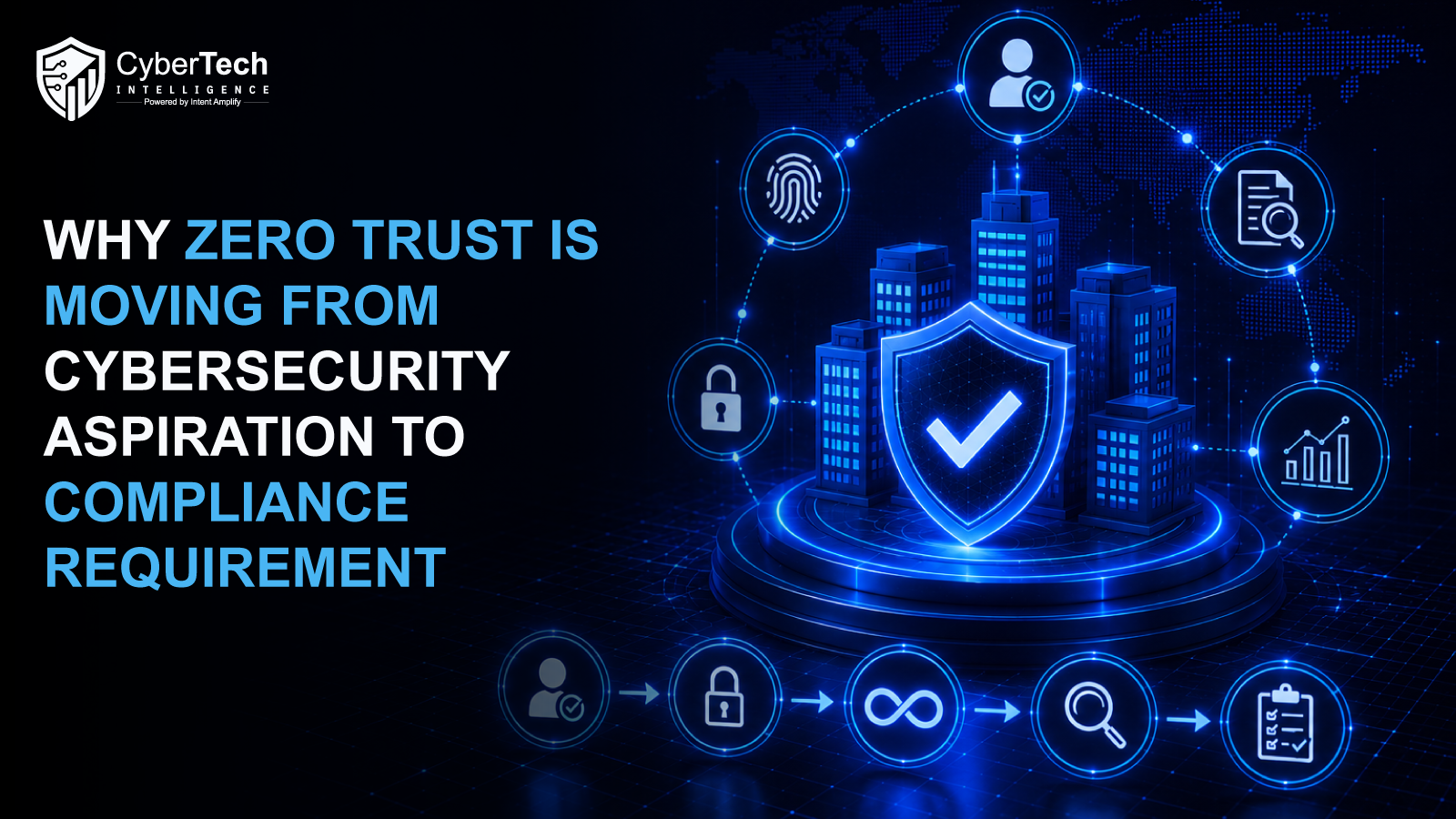
Zero Trust has entered an evidence economy. For years, it was discussed as a strategic cybersecurity ambition: verify every request, reduce implicit confidence, and limit the damage that follows credential theft, unmanaged devices, or compromised sessions. That principle still matters, but enterprise expectations have changed. Boards, insurers, procurement teams, public-sector buyers, and auditors now want evidence that safeguards are enforced, monitored, documented, and improved.
That is why Zero Trust security is moving from aspiration to requirement.
The market is no longer treating this as a niche architecture discussion. Enterprise investment continues to shift toward identity-centric security, continuous verification, Zero Trust Network Access, and governance-driven security programs as organizations seek stronger visibility, accountability, and assurance outcomes.
Those figures point to a larger shift. Zero Trust is not growing only because security leaders like the concept. It is expanding because digital business has become harder to govern. Hybrid work, SaaS adoption, cloud workloads, contractors, third-party integrations, machine identities, and AI agents have made static access models difficult to defend. A user may be legitimate at login and risky five minutes later. A device may appear compliant in one session and exposed in the next. A privileged workflow may begin with an employee and continue through an automated system.
In that environment, trust cannot be granted once and forgotten.
The New Question Is Proof, Not Policy
The strongest signal of maturity is no longer a Zero Trust framework document. It is operating proof. Auditors want to see how access is granted, limited, reviewed, revoked, and monitored. Insurers want to understand whether controls reduce the probability and blast radius of compromise. Procurement teams want confidence that suppliers can protect shared data. Boards want risk language that connects architecture to resilience, continuity, and financial exposure.
This is where many organizations discover the gap between strategy and evidence. They may already have multi-factor authentication, identity and access management, endpoint security, secure remote access, cloud controls, and monitoring tools. Yet they still struggle to answer practical questions. Who owns this privileged account? Why does this group retain broad permissions? Which service identities are still active? Which exceptions remain open? Which critical applications are still reachable through legacy access paths?
Zero Trust compliance forces these questions into the open. A policy that says “least privilege access” is not enough if standing permissions remain broad. A dashboard showing authentication volume does not prove that risk-based decisions are working. A Zero Trust audit checklist must be tied to real control evidence: entitlement reviews, device posture records, conditional access decisions, privileged-session logs, exception approvals, and remediation timelines.
The market is moving in that direction because attackers are moving faster than traditional governance can tolerate.
CyberTech Intelligence Observation
Most organizations do not struggle with Zero Trust because they lack security technologies. The larger challenge is operational accountability. Identity ownership, privilege governance, access reviews, exception management, and evidence collection often span multiple teams and systems. As a result, enterprises frequently deploy controls faster than they can demonstrate control effectiveness.
AI-Speed Attacks Are Exposing Legacy Access Weaknesses
Zscaler’s ThreatLabz 2026 VPN Risk Report surveyed 822 IT and cybersecurity professionals and found that 79% fear AI exploitation speed, 61% encountered AI-enabled attacks in the previous 12 months, and 70% have limited or no visibility into AI-enabled threats moving over VPN infrastructure.1
The same Zscaler analysis reported that one in five organizations cannot distinguish an AI-assisted intrusion from a conventional attack, while only 24% have deployed AI-powered monitoring.1
This is why VPN-to-ZTNA migration has become a practical entry point. Traditional VPNs were built to extend network connectivity. Once connected, users may receive more reach than their work requires. Zero Trust Network Access changes the model by granting application-specific permissions based on identity, device posture, context, and policy. That distinction matters for assurance. A VPN may show that someone is authenticated. ZTNA can help show which person reached which application, under what condition, through which session, and whether enforcement changed when risk increased.
The technical difference becomes a compliance advantage. It helps convert access management into auditable evidence.
Identity Has Become the First Layer of Audit Readiness
Zero Trust architecture starts to become measurable when identity becomes the control plane. Identity security answers the questions every reviewer understands: who can access what, why do they need it, how was it approved, and when should it expire?
Palo Alto Networks Unit 42 reported in its 2026 Global Incident Response Report that its analysis covered more than 750 major incidents across more than 50 countries. The report found that identity weaknesses were exploited in 89% of investigations, 87% of attacks involved multiple attack surfaces, 65% of initial access was driven by identity-based techniques, and 48% of attacks involved the browser.2
Unit 42 also reported that the fastest attacks moved from initial access to data exfiltration in just 72 minutes, representing a 4x acceleration over the prior year, while attacks involving third-party SaaS applications increased 3.8x since 2022 and accounted for 23% of all attacks.2
These findings explain why IAM, MFA, privileged access management, conditional access, continuous verification, and browser-aware protection now sit at the center of enterprise security architecture. Attackers are not moving through one clean path. They are blending identity misuse, SaaS exposure, endpoint activity, browser sessions, and cloud access. That makes fragmented control ownership risky.
For audit readiness, identity evidence should be treated as a board-level asset. Security teams need to show MFA coverage, privileged-account reviews, dormant-user removal, service-account ownership, high-risk session monitoring, device compliance, and policy exception closure. Without these records, a Zero Trust audit becomes a paperwork exercise. With them, it becomes a defensible governance process.
Federal Procurement Is Reinforcing the Shift
The compliance pressure is also visible in the public sector. The U.S. General Services Administration’s 2026 Zero Trust Architecture guidance states that Zero Trust goes beyond “trust but verify” and treats all networks and traffic as potential threats. It also emphasizes that no single technology, product, or service can achieve Zero Trust Architecture goals on its own.3
That point is important for private-sector enterprises as well. Federal expectations often influence contractors, suppliers, technology vendors, and partners. Once a government buyer strengthens security requirements, downstream vendors must prepare stronger evidence. Procurement language then spreads into commercial questionnaires, cyber insurance reviews, customer assurance requests, and third-party risk programs.
In practical terms, Zero Trust is becoming a market-access issue. Organizations that cannot demonstrate access governance may face slower sales cycles, tougher security reviews, greater underwriting scrutiny, and weaker customer confidence.
AI Agents Are Expanding the Zero Trust Boundary
The next phase of Zero Trust implementation will not stop with employees and devices. AI agents, automated workflows, and nonhuman identities are becoming part of enterprise operations. McKinsey reported in 2026 that agentic AI is reshaping the enterprise control plane, with agentic AI spend potentially rising to 15% of enterprise cybersecurity budgets within the next three years, concentrated in identity, governance, and data.4
Microsoft’s 2026 Zero Trust for AI guidance adds another important signal. Its updated Zero Trust Workshop includes an AI pillar covering 700 security controls across 116 logical groups and 33 functional swim lanes.5
Microsoft’s Cyber Pulse: An AI Security Report also found that only 47% of organizations report implementing specific generative AI security controls, while 29% of employees have already used unsanctioned AI agents for work tasks.6
This is where Zero Trust compliance becomes more complex. Enterprises must now govern human identities, machine identities, service accounts, APIs, AI agents, data access, prompts, plugins, and autonomous actions. The audit trail must expand accordingly. A mature program needs registries, ownership, least privilege, behavioral monitoring, and clear escalation paths when nonhuman activity becomes risky.
Zero Trust Is Becoming a Resilience Discipline
Google Cloud’s Mandiant M-Trends 2026 is based on more than 500,000 hours of frontline incident investigations conducted globally in 2025. The report emphasizes that adversaries are using AI-driven techniques, but many successful intrusions still rely on human and systemic failures that defenders can address through fundamentals.7
IBM’s 2026 X-Force Threat Intelligence Index found a 44% increase in attacks that began with the exploitation of public-facing applications, largely driven by missing authentication controls and AI-enabled vulnerability discovery. IBM also reported that vulnerability exploitation accounted for 40% of incidents observed by X-Force in 2025, while large supply chain and third-party compromises nearly quadrupled since 2020.8
These findings support a clear conclusion: Zero Trust is no longer only about remote access. It is about reducing the conditions that allow attackers to move quickly, quietly, and widely. That includes excessive permissions, poor visibility, unmanaged identities, weak authentication, fragmented monitoring, and unclear ownership across cloud, SaaS, endpoint, browser, and third-party environments.
Deloitte’s 2026 Cyber Forecasts also reinforces this direction, identifying identity security, platformization, cyber AI, and defense resilience as critical mandates for the year ahead. Deloitte specifically notes that IAM frameworks must expand to govern the autonomous decision-making capabilities of AI agents. 9
A Practical 90-Day Roadmap Without Rip-and-Replace
Most enterprises do not need to start with a wholesale replacement program. A better Zero Trust implementation roadmap begins with targeted modernization.
During the first 30 days, security and IT teams should identify crown-jewel applications, privileged roles, remote access paths, unmanaged devices, sensitive data stores, SaaS integrations, and high-risk third-party connections. This creates a practical Zero Trust maturity assessment and reveals where implicit trust creates measurable business exposure.
During the next 30 days, teams should reduce avoidable risk. They can close MFA gaps, remove dormant accounts, narrow VPN reach, reduce standing privileges, assign ownership for service identities, strengthen endpoint security, and define exception workflows. The goal is not perfection. It is a measurable reduction of unnecessary trust.
During the final 30 days, leaders should build an evidence pack for auditors, insurers, customers, and executives. That pack should include access-review records, ZTNA migration status, conditional access policies, device posture reporting, privileged-session visibility, microsegmentation progress, unresolved exceptions, and a prioritized remediation plan.
This approach avoids the rip-and-replace trap. It preserves useful investments, reduces the heaviest exposure first, and gives leaders a governance story they can defend.
The New Standard: Verify, Enforce, Document, Defend
Zero Trust has crossed the chasm because the market now expects proof. Buyers want assurance before signing contracts. Public-sector agencies want stronger procurement alignment. Insurers want maturity signals. Boards want measurable risk reduction. Security teams need a model that can govern hybrid infrastructure, cloud applications, AI agents, unmanaged devices, and third-party ecosystems.
The organizations that move fastest will not be the ones that repeat the phrase most often. They will be the ones who translate Zero Trust principles into enforceable safeguards, measurable outcomes, and executive-ready reporting.
For CyberTech Intelligence readers, the implication is direct. This is no longer a “should we adopt it?” conversation. The better question is whether the organization can prove that trust decisions are governed, tested, monitored, and continuously improved.
In 2026, trust is not something enterprises can declare. It is something they must verify, enforce, document, and defend.
About CyberTech Intelligence
CyberTech Intelligence helps enterprise technology, cybersecurity, and GTM leaders translate complex market shifts into research-led narratives, buyer-focused content, and strategic demand programs. Through solution-focused insights, campaign assets, and executive-ready analysis, CyberTech Intelligence supports organizations working across security modernization, compliance-driven messaging, and enterprise technology growth.
For teams building campaigns around Zero Trust, identity security, cybersecurity compliance, ZTNA, or audit-ready security programs, CyberTech Intelligence can help shape the narrative into content that educates buyers and supports pipeline activation.
Connect with the team
References
-
Zscaler ThreatLabz, ThreatLabz 2026 VPN Risk Report: VPN Risks in the AI Era, March 2026
https://www.zscaler.com/blogs/company-news/ai-machine-speed-breaking-vpn-security -
Palo Alto Networks Unit 42, Unit 42 Report: AI and Attack Surface Complexity Fuel Majority of Breaches, February 17, 2026
https://www.paloaltonetworks.com/company/press/2026/unit-42-report--ai-and-attack-surface-complexity-fuel-majority-of-breaches -
U.S. General Services Administration, Zero Trust Architecture, 2026
https://www.gsa.gov/technology/it-contract-vehicles-and-purchasing-programs/it-security/zero-trust-architecture -
McKinsey & Company, Securing the Agentic Enterprise: Opportunities for Cybersecurity Providers, March 24, 2026
https://www.mckinsey.com/capabilities/risk-and-resilience/our-insights/securing-the-agentic-enterprise-opportunities-for-cybersecurity-providers -
Microsoft Security, New Tools and Guidance: Announcing Zero Trust for AI, March 19, 2026
https://www.microsoft.com/en-us/security/blog/2026/03/19/new-tools-and-guidance-announcing-zero-trust-for-ai/ -
Microsoft Security Insider, Cyber Pulse: An AI Security Report, 2026
https://www.microsoft.com/en-us/security/security-insider/emerging-trends/cyber-pulse-ai-security-report -
Google Cloud Mandiant, M-Trends 2026 Report: Executive Edition, 2026
https://cloud.google.com/security/resources/m-trends-executive-edition -
IBM, IBM 2026 X-Force Threat Index: AI-Driven Attacks Are Escalating as Basic Security Gaps Leave Enterprises Exposed, February 25, 2026
https://newsroom.ibm.com/2026-02-25-ibm-2026-x-force-threat-index-ai-driven-attacks-are-escalating-as-basic-security-gaps-leave-enterprises-exposed -
Deloitte, 2026 Cyber Forecasts, 2026
https://www.deloitte.com/us/en/services/consulting/articles/cybersecurity-forecast-for-2026.html

Author
CyberTech Intelligence Research Desk
Author