The Strategic Constraint Has Shifted From Generation to Verified Change
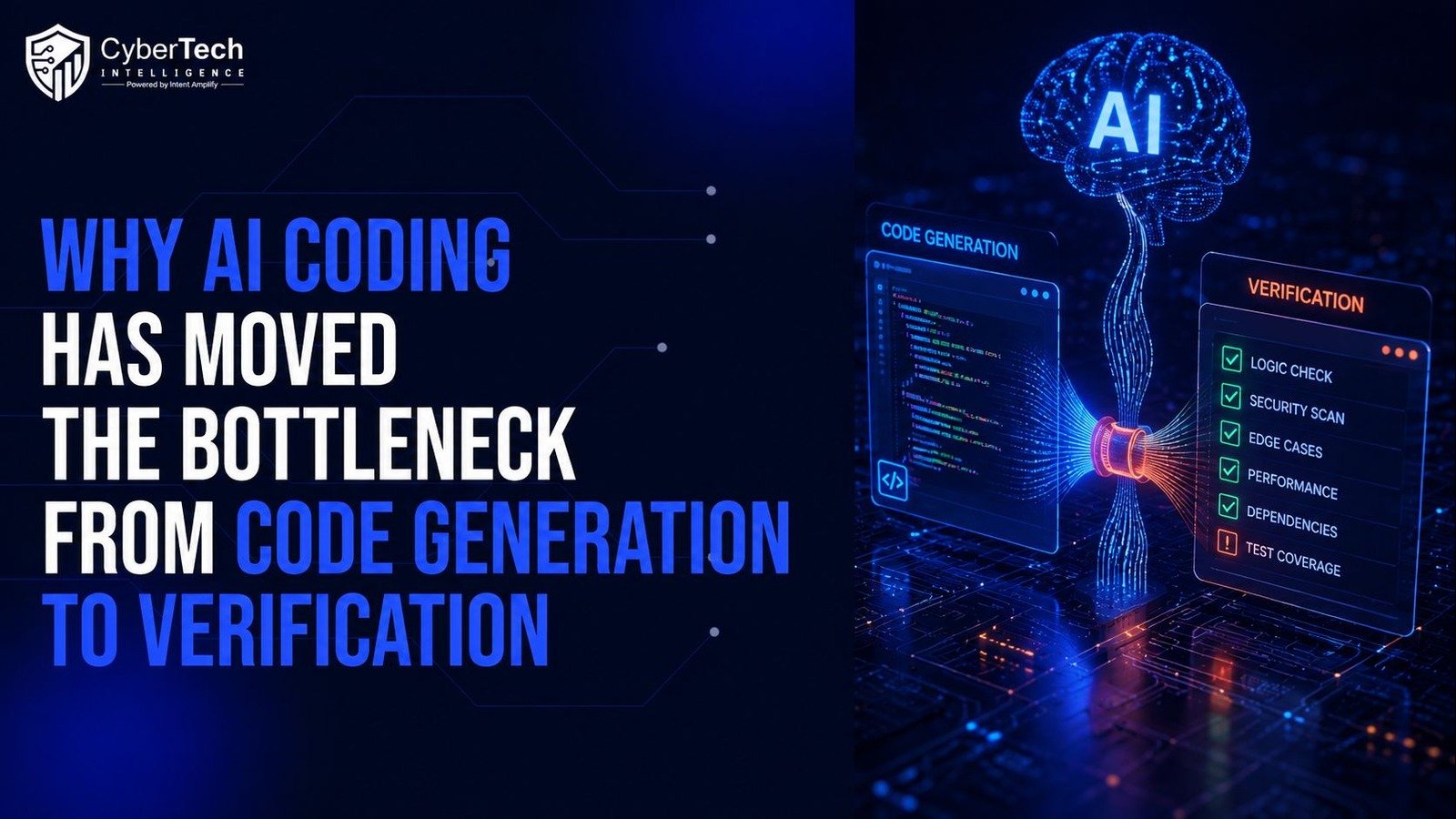
Generative AI has reduced the cost of producing a plausible code change. It has not removed the production obligation to understand what failed, why it failed, what else the change can affect, and whether the new behavior is safe enough to merge. That is why the strategic bottleneck is moving from code creation to verified change.
Stack Overflow’s 2025 survey shows the trust gap beneath rapid adoption: 84% use or plan to use AI tools, yet 46% distrust accuracy; 66% report “almost right” output as a frustration and 45% cite more time debugging AI-generated code. [4] DORA’s 2026 analysis similarly notes that time saved in creation can be redirected into auditing and verification. [6]
The competitive capability is therefore not an agent that writes more code. It is an engineering system that can take known defects through context, reproduction, root cause, bounded change, validation, CI, and human approval with less developer effort.
Expert Analysis
The strategic unit of AI engineering value is not the patch. It is the verified change that arrives with enough context, tests, integration evidence, and bounded uncertainty for a developer to make a confident merge decision.
AI Error Is a System Condition, Not a Model Personality
“Hallucination” can sound like a property that will disappear when the next model improves. In production software, however, incorrect change is also created by missing context, weak tests, ambiguous tickets, stale dependencies, incomplete environments, and the absence of an explicit stop condition.
DORA’s 2025 research calls AI an amplifier: the surrounding system determines whether faster generation becomes useful throughput or magnified dysfunction. [5] NIST’s SSDF makes the same systems point from a security perspective by integrating secure practices across the development lifecycle. [9]
A robust autonomous workflow therefore treats uncertainty as data. If the issue cannot be reproduced, the relevant context is missing, the tests do not establish the expected behavior, or integration remains ambiguous, the correct output may be escalation rather than another patch.
The Highest-Risk Moment Is the Handoff to Human Review
Human review is scarce, high-value engineering attention. When an agent hands off a change without a clear evidence package, the reviewer becomes the agent’s debugger: reconstruct the ticket, find the root cause, inspect drift, run tests, investigate failures, and decide whether the diff is trustworthy.
METR’s early-2025 RCT is useful because its success criterion included whether experienced maintainers believed code would pass review, not merely an automated benchmark. In that scoped setting, developers took 19% longer with AI tools. [7] The result does not generalize to every team, but it highlights why human review quality matters as a productivity endpoint.
Solvin’s public workflow aims to move work left of that handoff: reproduce, test, fix, revalidate, run CI, and open a pull request only when the change is supported; otherwise escalate. [1] [2]
Engineering Context Must Include Issues, Repositories, Tests, and CI
Autonomous bug remediation is a context-integration problem. The system needs the issue narrative and priority, repository topology, service boundaries, commit history, dependencies, environment, test suites, CI behavior, security checks, and the organization’s own definition of done.
Context is also temporal. The correct code path can change between ticket creation and execution, dependencies can move, and a previously green test can become irrelevant. A production workflow must reacquire context at execution time and make the evidence visible in the pull request.
Solvin describes connections to issue systems, repositories, and CI, with codebase-specific mapping and sandboxed execution. [1] [3] That architecture is commercially important because it determines whether the system can own the full remediation loop rather than only the code-generation step.
Patch Volume Is Useful, but Evidence Sequence Is More Powerful
The raw number of patches says little about engineering value. A stronger sequence is: selected issue → reproduced failure → root-cause evidence → bounded change → tests → security/regression checks → CI → review-ready PR → human approval → merge.
Each transition can be measured. The resulting funnel exposes where autonomy fails: tickets that cannot be reproduced, code changes that fail integration, low-confidence fixes that should be escalated, PRs rejected for scope, or merged changes that reopen later.
Outcome-based commercial models become more defensible when the evidence sequence is visible. If the customer pays only when its team approves and merges a verified fix, both buyer and vendor are incentivized to improve the quality of the funnel rather than maximize agent activity. [1]
Control Design Must Protect Developer Trust as Well as Velocity
Engineering teams will bypass or abandon automation that creates noisy diffs, unpredictable access, repeated false confidence, or hidden cleanup work. Trust comes from predictable boundaries: what the system can access, what it can change, what evidence it must produce, and when it stops.
Solvin’s public materials emphasize sandboxed execution, auditability, zero data retention, BYOK and on-premises options, plus escalation when evidence is insufficient. [1] [2] These controls should be evaluated against each customer’s repository, secret, CI, data-residency, and software-supply-chain requirements.
Governance should include engineering, platform, application security, and product ownership. The design-partner period is an opportunity to turn those constraints into product requirements while measuring whether the workflow actually returns developer time.
Solvin AI Perspective
Solvin AI is designed around the thesis that the post-generation workflow is the real unit of engineering work. A virtual engineer should operate in the background, absorb issue and code context, reproduce the failure, make and validate the change, and deliver a pull request that a developer can confidently approve. [1] [2]
The strongest differentiation is therefore not “more autonomous” in the abstract. It is evidence-bounded autonomy: the system owns more of the remediation sequence while explicitly retaining human merge control and tying economics to accepted outcomes.
Measures That Reveal the Operating Model
The following measures connect autonomous activity to engineering value. Review them by bug class, service, and confidence band rather than relying only on an enterprise average.
Table 1. Autonomous Bug Remediation Operating Measures
|
Decision Layer |
Measure |
What It Reveals |
|---|---|---|
|
Backlog Priority |
Selected issues by business impact, recurrence, ownership, fixability, and backlog age |
Whether autonomy is focused on engineering work worth removing rather than merely easy tickets. |
|
Context & Reproduction |
Coverage of repository/service context, environment grounding, and repeatable pre-fix reproduction |
Whether the system understands the real failure before it changes code. |
|
Validation |
Coverage of pre/post tests, security and regression checks, CI results, and integration evidence |
Whether a proposed change is supported by evidence before it reaches a developer. |
|
Human Review |
Median review minutes, rejection reasons, approval rate, and merge rate |
Whether the evidence package reduces reviewer effort while preserving human merge authority. |
|
Safe Escalation |
Share of attempts escalated for no reproduction, low confidence, failed validation, or access constraints |
Whether the system stops safely instead of guessing or pushing uncertain changes into review. |
|
Outcome Economics |
Merged fixes, cycle time, reopen/regression rate, cost per accepted fix, and engineering hours reclaimed |
Whether autonomous remediation produces durable engineering and commercial value. |
Strategic Recommendations
- Define autonomy around verified outcomes, not generated patches or agent-session volume.
- Require a reproduced failure or explicit escalation state before claiming a remediation attempt is valid.
- Make issue context, repository context, tests, security checks, and CI evidence part of the pull-request package.
- Preserve human merge authority and capture rejection reasons as structured product-learning data.
- Bound autonomous access through secure sandboxing, scoped credentials, audit logs, and customer-specific governance.
- Measure developer review minutes, accepted fixes, regression/reopen rates, and cost per merged outcome together.
- Use the Early Access Design Partner Program to pressure-test production backlogs while giving engineering leaders direct influence on the roadmap.
Solvin AI Autonomous Bug Remediation Operating Model™
Eight operating layers connecting engineering backlog intake to verified, review-ready outcomes and evidence-led learning
|
01 |
Backlog Intake & Business Priority |
|
02 |
Codebase Context & Environment Grounding |
|
03 |
Reproduction & Root-Cause Validation |
|
04 |
Test-Driven Fix Generation |
|
05 |
Security, Regression & Quality Validation |
|
06 |
CI/CD & Integration Verification |
|
07 |
Confidence, Escalation & Human Merge Control |
|
08 |
Outcome Economics & Continuous Learning |
Figure 1. Solvin AI Autonomous Bug Remediation Operating Model™ - Eight-Layer Architecture
Solvin AI Autonomous Bug Remediation Scorecard™
Table. Solvin AI Autonomous Bug Remediation Scorecard™
|
Domain |
Executive Assessment Question |
Ready-State Evidence |
|---|---|---|
|
Backlog Coverage & Prioritization |
Is the automation working on the right bugs, vulnerabilities, and maintenance items rather than simply the easiest tickets? |
Prioritized backlog, severity/business-impact fields, ownership, suppression rules, and selection rationale. |
|
Repository & Context Grounding |
Can the system identify the repositories, services, dependencies, history, and environment needed to understand the issue? |
Repository map, linked issue context, dependency evidence, configuration scope, and environment trace. |
|
Reproduction Reliability |
Is the original failure reproduced before the system claims to have fixed it? |
Reproduction steps, failing test or observable condition, environment details, and repeatable evidence. |
|
Root-Cause Quality |
Does the proposed remediation address the causal defect rather than masking the symptom? |
Root-cause note, affected path, assumptions, changed components, and rationale for the selected fix. |
|
TDD & Test Evidence |
Are tests created or updated to demonstrate the failure and validate the corrected behavior? |
Relevant test additions/changes, pre-fix failure evidence, post-fix pass evidence, and coverage notes. |
|
Security & Regression Validation |
Are security checks and likely regressions evaluated before the change reaches human review? |
Security test results, regression suite results, edge-case checks, and unresolved-risk notes. |
|
CI & Integration Readiness |
Has the change passed the delivery gates that matter in the customer’s actual engineering environment? |
CI status, build/integration results, dependency checks, automated reviewer feedback, and retry history. |
|
PR Confidence & Human Merge Control |
Does the pull request arrive with enough evidence for a developer to review efficiently and retain final accountability? |
PR summary, confidence/evidence package, changed files, test results, escalation state, and human approval/merge record. |
|
Sandbox, Data & Access Governance |
Is autonomous execution isolated and governed so code, credentials, and data are handled within approved boundaries? |
Sandbox policy, access scope, secret controls, audit logs, retention settings, BYOK/on-prem options where required. |
|
Outcome Economics & Learning |
Can leaders connect automation cost to accepted engineering outcomes and improve the workflow from observed results? |
Merged-fix count, acceptance rate, cycle time, rework/regression rate, cost per merged fix, and trend reviews. |
Restricted to 10 engineering leaders. Work closely with Solvin’s co-founders and receive three months of automated bug and security remediation at no cost. After the trial period, receive 50% off fully outcome-based pricing for the first year. You pay only when your engineering team approves and merges the fixes.
Continue the Autonomous Bug Remediation Journey
Move from engineering-leader education to a bounded design-partner evaluation through one consistent path from workload diagnosis to verified, outcome-based remediation.
Table. Solvin AI Autonomous Bug Remediation Content and Action Journey
|
Stage |
Asset or Offer |
Purpose |
|---|---|---|
|
Top of Funnel |
Identify where bug backlog, technical debt, security remediation, manual reproduction, and verification are consuming engineering capacity. |
|
|
Middle of Funnel |
Apply the eight-layer operating model, validation gates, leadership questions, and readiness scorecard to a real engineering workflow. |
|
|
Decision Stage |
Review current evidence on AI adoption, developer trust, technical-debt burden, verification, secure development, and autonomous remediation. |
|
|
Commercial Stage |
Select a bounded backlog sample, map repositories and CI, define acceptance criteria, estimate recoverable engineering time, and identify governance constraints. |
|
|
Activation Stage |
Limited to 10 engineering leaders: collaborate with Solvin’s co-founders, receive 3 months at no cost, then 50% off fully outcome-based pricing for the first year after the trial; pay only for fixes your team approves and merges. |
About Solvin AI
Solvin AI is building an autonomous virtual engineering workforce focused on bug and security remediation. It runs in the background, connects to the engineering systems that provide issue and code context, reproduces defects, applies a test-driven workflow, validates changes through available security and CI gates, and delivers review-ready pull requests. Final approval and merge remain with the customer’s engineering team. [1] [2] [3]
Research and Citation Governance
Public Solvin AI materials and founder LinkedIn communications are used for product positioning and workflow descriptions. Independent developer surveys, software-delivery research, standards guidance, and scoped industry studies are used for market and operating context. Quantitative findings retain their stated sample, date, and limitations; product claims are attributed to Solvin AI rather than presented as independent research. Early Access commercial terms in this campaign follow the supplied client brief: 10 design-partner spots, 3 months at no cost, then 50% off fully outcome-based pricing for the first year after the trial, with payment tied to approved and merged fixes.
References
[1] Solvin AI. “Coding Agents Introduce Bugs. Solvin Fixes Them.” 2026. https://solvin.ai/. Accessed August 20, 2026. Product source used for autonomous background execution, bug workflow, secure sandbox, validation, pull-request delivery, and outcome-based pricing claims.
[2] Yaniv Shemesh. “AI has made code cheaper to generate. It has not made code cheaper to trust.” LinkedIn, 2026. https://www.linkedin.com/posts/yshemesh_devtools-ai-softwareengineering-activity-7464866539251417088-fC0V. Accessed August 20, 2026. Founder communication used for the validation-bottleneck, TDD-loop, escalation, and design-partner positioning.
[3] Amnon Perlmutter. “Anthropic’s Mythos is going to surface a lot more vulnerabilities.” LinkedIn, 2026. https://www.linkedin.com/posts/amnon-perlmutter-1696791_anthropics-mythos-is-going-to-surface-a-activity-7465723724022042624-8dtq. Accessed August 20, 2026. Founder communication used for always-on background remediation, Jira intake, codebase context, and security-backlog positioning.
[4] Stack Overflow. 2025 Developer Survey — AI. 2025. https://survey.stackoverflow.co/2025/ai. Accessed August 20, 2026. Survey source used for AI adoption, trust, “almost right” output, debugging burden, and security/privacy concerns.
[5] DORA / Google Cloud. State of AI-assisted Software Development 2025. 2025. https://dora.dev/research/2025/dora-report/. Accessed August 20, 2026. Research source used for the finding that AI acts as an amplifier of the surrounding engineering system.
[6] DORA. “Balancing AI tensions: Moving from AI adoption to effective SDLC use.” March 10, 2026. https://dora.dev/insights/balancing-ai-tensions/. Accessed August 20, 2026. Research commentary used for the shift of time from code creation toward auditing and verification.
[7] METR. “Measuring the Impact of Early-2025 AI on Experienced Open-Source Developer Productivity.” July 10, 2025. https://metr.org/blog/2025-07-10-early-2025-ai-experienced-os-dev-study/. Accessed August 20, 2026. Randomized study used with explicit scope limits for productivity and review-ready coding work.
[8] KPMG. Technology Sector M&A Survey. 2025. https://kpmg.com/kpmg-us/content/dam/kpmg/pdf/2025/technology-sector-ma-survey.pdf. Accessed August 20, 2026. Survey used to contextualize technical-debt burden; 74% of PE/VC respondents in the cited sample reported 20–40% of engineering time on technical debt.
[9] National Institute of Standards and Technology. Secure Software Development Framework (SSDF) Version 1.1, SP 800-218. February 2022. https://csrc.nist.gov/pubs/sp/800/218/final. Accessed August 20, 2026. Secure-development framework used for root-cause prevention, secure environments, and integrated SDLC practices.
[10] CISA and FBI. “Product Security Bad Practices.” Updated January 17, 2025. https://www.cisa.gov/news-events/alerts/2025/01/17/cisa-and-fbi-release-updated-guidance-product-security-bad-practices. Accessed August 20, 2026. Secure-by-design guidance used for product security and avoidable-risk context.