
Executive Summary

Zero Trust has moved past the architecture slide. For CISOs, CTOs, and board-facing technology leaders, the harder test is whether the organization can prove that access controls operate consistently across identities, devices, applications, data repositories, and third-party access paths.

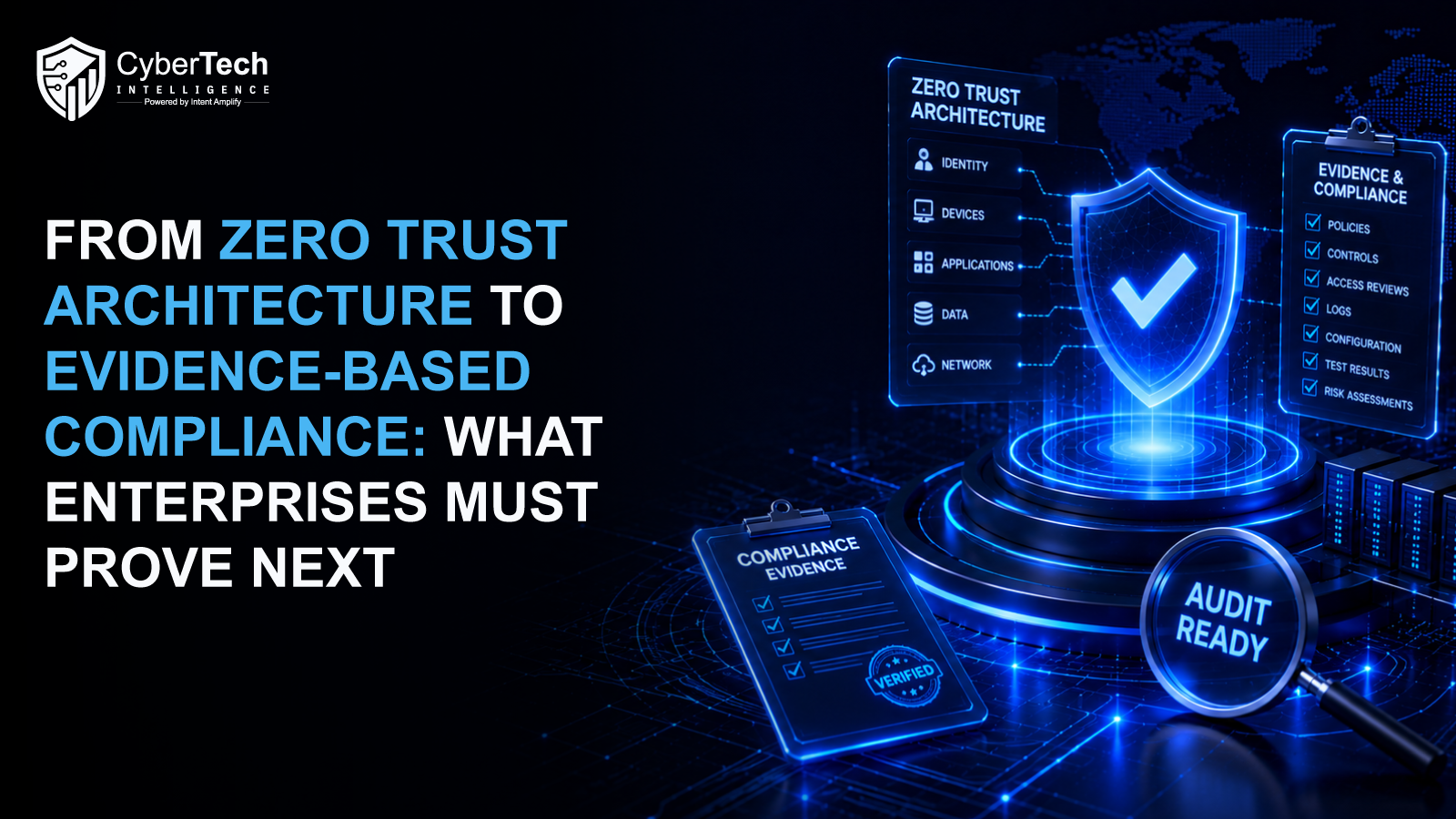
That distinction matters because Zero Trust Compliance is now an evidence problem. Boards, regulators, cyber insurers, customers, and internal audit teams expect more than a policy statement or tool inventory. They want proof that trust is evaluated continuously, privileged access is governed, exceptions are time-bound, and control performance can be traced when scrutiny arrives.

The HPE and Cybersecurity Insiders 2026 Zero Trust Security Report found that identity and access is the leading priority for 71% of respondents, followed by device and network enforcement at 64%, cloud and SaaS security at 61%, and data protection at 57%. [1]

Zero Trust Implementation can no longer be judged by deployment activity alone. Zero Trust Maturity will depend on the quality of evidence an enterprise can produce, how clearly that evidence maps to risk, and whether executives can defend the program as a security assurance model rather than another technology rollout.

Why Zero Trust Is Becoming a Governance Question

The original Zero Trust principle was simple: do not assume that a user, device, application, or workload deserves access because it sits inside a network boundary. That principle became unavoidable as enterprises expanded into hybrid work, SaaS platforms, public cloud, contractor ecosystems, managed service relationships, and distributed data environments.

The operating reality is less simple. Many organizations still manage Zero Trust Architecture in separate workstreams. Identity teams handle IAM and MFA. Network teams manage Zero Trust Network Access. Cloud teams address posture and workload controls. Compliance teams collect evidence after the fact. Security operations teams investigate incidents from another toolset. Each domain may be improving, but the control narrative remains fragmented.

That fragmentation is increasingly difficult to defend. In the United States, cybersecurity disclosure expectations have increased pressure on public companies to explain how cyber risk is assessed, governed, and escalated. In Europe, NIS2 and DORA place more emphasis on management accountability, operational resilience, ICT third-party risk, and incident reporting. While these frameworks differ in scope and jurisdiction, they share a common expectation: organizations must be able to demonstrate governance, accountability, risk management, and operational resilience through documented evidence rather than policy intent alone.

For enterprises operating across the US, the Middle East, the UK, APAC, and Europe, the answer is not to create separate control models for every region. A stronger approach is to use a common Governance Framework that can support multiple compliance narratives through one view of identity, access, segmentation, telemetry, exceptions, and remediation.

NIST Zero Trust remains useful because it gives security leaders a defensible reference model for resource-specific access, continuous evaluation, policy enforcement, and visibility. In practice, it helps connect Zero Trust Security with NIST CSF, Security Assessment practices, Cybersecurity Compliance, and board-level reporting. [4]

CyberTech Intelligence Observation

Most enterprises do not struggle with Zero Trust because of technology limitations. The larger challenge is operational accountability. Identity governance, access ownership, exception management, segmentation decisions, audit evidence, and remediation workflows often span multiple teams and platforms. As a result, organizations frequently deploy controls faster than they can demonstrate control effectiveness. The next phase of Zero Trust maturity will be defined by governance consistency rather than technology adoption.

From Control Deployment to Control Evidence

A Zero Trust program can look mature while still being hard to prove. It may have modern tooling, a formal roadmap, executive sponsorship, and strong policy language, yet struggle when auditors ask for evidence across real operating conditions.

The questions are specific. Who accessed a sensitive system? What device was used? Was that device compliant at the time? Was MFA applied because the session was high risk, or only because the user logged in? Which applications are protected through ZTNA? Which systems still rely on legacy reachability? Which exceptions are active, who approved them, and when do they expire?

These questions matter because Cyber Risk Management depends on traceability. A policy may state that least privilege is enforced, but the enterprise must show that access is appropriate, reviewed, limited, and remediated when risk changes.

Identity risk makes the evidence gap more urgent. Microsoft reported that identity-based attacks increased by 32% in the first half of 2025, and that 97% of identity attacks were password attacks. For CISOs, this indicates that attackers continue to exploit the access layer because it provides a direct route into enterprise systems, cloud services, administrative interfaces, and business-critical data. [2]

The CyberTech Intelligence Zero Trust Evidence Framework™

Evidence Area

What the Enterprise Must Prove

Identity control

Users, privileged accounts, service accounts, machine identities, and third parties are governed according to risk.

ZTNA enforcement

Access is application-specific, policy-based, logged, and tied to user, device, and session context.

Segmentation

Critical systems are isolated based on business risk, data sensitivity, and containment priority.

Data access

Sensitive data access is classified, monitored, justified, and governed at the point of use.

Exception governance

Exceptions have owners, expiry dates, risk acceptance, compensating controls, and review cycles.

Continuous evidence

IAM, MFA, ZTNA, endpoint, cloud, segmentation, and data-access signals support audit and investigation needs.


Executive Zero Trust Assurance Metrics

Boards and executive stakeholders should receive reporting across the following indicators:

Metric

Governance Outcome

MFA Coverage

Identity assurance

Privileged Accounts Reviewed

Reduced access risk

ZTNA Coverage

Reduced attack surface

Excess Permissions Removed

Least-privilege maturity

Exception Closure Time

Governance effectiveness

Identity Ownership Coverage

Accountability

Audit Evidence Completeness

Assurance readiness

Why Zero Trust ROI Needs a More Disciplined Argument

Zero Trust ROI is often weakened by exaggerated claims. No serious security leader should argue that Zero Trust eliminates breach risk. The stronger argument is narrower and more credible: a governed access model reduces unnecessary trust, limits attack paths, constrains lateral movement, improves visibility, and strengthens evidence during incidents, audits, and customer assurance reviews.

Security leaders should avoid measuring ROI through deployment milestones, product adoption rates, or implementation activity. More meaningful indicators include reduced trust exposure, lower privilege accumulation, fewer unmanaged identities, shorter audit preparation cycles, faster investigations, and improved governance visibility.

IBM’s 2025 Cost of a Data Breach Report placed the global average cost of a data breach at USD 4.44 million. That figure should not be used as a simplistic savings claim; it should be treated as a financial risk benchmark for evaluating reduced exposure, faster containment, stronger access governance, and improved evidence quality. [3]

This distinction matters for executives. A board does not need a lecture on microsegmentation. It needs to know whether the organization has reduced the chance that one compromised identity can reach critical systems. A CFO does not need every ZTNA policy detail. They need to understand whether Security Investment is reducing unmanaged access, audit burden, operational disruption, and breach-related exposure.

What Enterprises Must Prove Next

Identity Security Must Become Evidence-Based

Identity Security is the center of Zero Trust Compliance because access decisions begin with identity. The enterprise must govern employees, contractors, administrators, service accounts, machine identities, cloud roles, and third parties.

The evidence requirement is not simply whether IAM exists. It is whether access is appropriate, risk-aware, time-bound where needed, and reviewed with enough discipline to remove unnecessary privilege. A mature identity evidence model should show entitlement ownership, approval history, privileged access usage, MFA enforcement, dormant account remediation, service-account governance, and exception status.

ZTNA Must Reduce Real Reachability

Zero Trust Network Access is often introduced as a Secure Remote Access replacement for VPN, but its larger purpose is to reduce implicit reachability. A Zero Trust Audit should show which applications sit behind ZTNA, which users and devices can reach them, what contextual signals influence policy decisions, and where legacy access paths remain.

If a user can authenticate once and then reach broad internal network segments, the organization still carries perimeter-era risk under a Zero Trust label. Expansion should start with privileged administrative paths, regulated systems, contractor access, and high-value private applications.

Segmentation Must Reflect Business Risk

Segmentation is often treated as network engineering, but its real value depends on business-risk alignment. A flat network increases blast-radius risk. Overly rigid segmentation can disrupt operations and push teams toward unmanaged workarounds.

The mature position is more measured: segment based on business criticality, data sensitivity, application dependency, and containment priority. Evidence should show which paths are allowed, which are blocked, why exceptions exist, and how rules are maintained as systems change.

Data Access Must Be Part of the Control Narrative

Some programs focus heavily on users, devices, and networks while leaving data governance to separate privacy or compliance teams. That separation is risky. Sensitive data now moves through SaaS platforms, analytics environments, collaboration systems, cloud storage, APIs, development pipelines, and third-party workflows.

Evidence-based Zero Trust requires data access to be governed at the point of use. The organization should know where sensitive data resides, who can access it, whether access aligns with business purpose, how activity is monitored, and what happens when behavior becomes abnormal.

Audit Evidence Must Become Continuous

Manual evidence collection is one of the clearest signs of weak Zero Trust Compliance. Screenshots, spreadsheets, exports, and last-minute control narratives may satisfy a narrow request, but they do not prove continuous control performance.

A stronger model uses live evidence from IAM logs, MFA decisions, ZTNA policy outcomes, endpoint posture, privileged session records, data access activity, segmentation events, vulnerability signals, and exception workflows. Executives can move from asking whether the organization can pass the next audit to asking whether control performance is improving over time, where exceptions are increasing, and which trust assumptions still create material risk.

Board and Audit Committee Questions

Executive Question

Why It Matters

What evidence shows that unnecessary trust has been reduced around critical systems?

Tests whether the program is reducing material exposure.

Which identities and access paths remain outside enforcement?

Reveals residual risk and roadmap gaps.

Are policy exceptions documented, time-bound, and reviewed?

Shows whether operational exceptions are governed.

Can audit teams verify access controls without manual reconstruction?

Measures evidence maturity.

Which legacy access paths still create broad reachability?

Identifies perimeter-era risk under a modern label.

How is ROI measured beyond tool deployment?

Connects investment to risk reduction and assurance.

What High-Maturity Organizations Do Differently

Organizations with mature Zero Trust programs consistently demonstrate five characteristics:

  • Identity ownership is clearly assigned.
  • Access decisions are evidence-based.
  • Exceptions are actively governed.
  • Security telemetry supports assurance reporting.
  • Governance metrics are reviewed by executive stakeholders.

The defining factor is not technology deployment. It is the organization's ability to enforce governance consistently, demonstrate accountability, and produce evidence that withstands scrutiny.

Strategic Implications for CISOs and CTOs

For CISOs, the priority is to define Zero Trust as an assurance model. That means identifying the highest-risk trust assumptions, building evidence requirements around them, and reporting progress in terms of control effectiveness rather than deployment volume.

For CTOs, the challenge is integration. Security Architecture should not become a collection of disconnected enforcement points that slow down cloud, application, and infrastructure teams. It should be embedded into architecture standards, identity integration patterns, access workflows, and platform engineering practices.

For risk and compliance leaders, the opportunity is to strengthen Cybersecurity Compliance without multiplying control frameworks. A common evidence model can support internal audit, regulatory reporting, customer assurance, third-party reviews, and cyber insurance processes.

Recommendations for an Evidence-Based Program

Start with a targeted Zero Trust Readiness assessment that maps identities, privileged roles, applications, data repositories, third-party access, legacy network paths, and current audit evidence. The goal is not a decorative maturity score. The goal is to identify where trust is excessive, where evidence is weak, and where remediation will reduce material risk.

Define an evidence model for priority controls. Each critical control should have a policy owner, enforcement point, telemetry source, evidence record, review cadence, exception process, and executive metric. This structure converts Zero Trust from a security architecture initiative into a measurable governance system.

Prioritize identity remediation early. Reduce standing privilege, enforce stronger MFA for high-risk users, govern machine identities, close dormant accounts, and connect IAM events with security operations workflows. Identity is where many attacks begin and where auditors increasingly expect precise evidence.

Expand ZTNA through risk sequencing. High-value private applications, privileged administrative paths, contractor access, and regulated systems should take priority before broad enterprise rollout. This approach creates measurable improvement without turning implementation into an infrastructure bottleneck.

Measure Zero Trust ROI through operational outcomes. Track reduced VPN dependency, fewer unmanaged access paths, lower excessive privilege, shorter audit cycles, faster exception closure, and improved investigation speed. These measures are easier for finance, risk, and board stakeholders to evaluate.

Conclusion

Zero Trust is no longer only an architecture conversation. It is becoming an evidence conversation.

For enterprises operating across the US, the Middle East, the UK, APAC, and Europe, this shift matters because regulatory scrutiny, customer assurance expectations, board oversight, cyber insurance requirements, and operational risk are converging. Security leaders must now show how controls function in practice, where they reduce trust, how exceptions are governed, and how evidence supports compliance.

The organizations that progress fastest will not be those with the largest number of tools or the broadest claims. They will be the ones who can prove control performance where risk matters most. In the next phase of Zero Trust maturity, organizations will be judged less by the controls they deploy and more by their ability to demonstrate governance effectiveness, evidence quality, and measurable assurance outcomes.

CyberTech Intelligence helps cybersecurity vendors, enterprise security leaders, and technology decision-makers translate complex security priorities into credible market education, analyst-led content, sponsored research, vendor intelligence, and executive engagement. 

Contact us

Sources and References

  1. HPE and Cybersecurity Insiders (2026) Zero Trust Security Report 2026. Available at: https://www.cybersecurity-insiders.com/wp-content/uploads/2026-HPE-Zero-Trust-Security-Report-by-CSI.pdf.
  2. Microsoft (2025) Microsoft Digital Defense Report 2025: Safeguarding Trust in the AI Era. Available at: https://www.microsoft.com/en-us/corporate-responsibility/cybersecurity/microsoft-digital-defense-report-2025/.
  3. IBM (2025) Cost of a Data Breach Report 2025. Available at: https://www.ibm.com/reports/data-breach.
  4. National Institute of Standards and Technology (2025) Implementing a Zero Trust Architecture: High-Level Document. Available at: https://www.nist.gov/publications/implementing-zero-trust-architecture-high-level-document.
  5. U.S. Securities and Exchange Commission (2023) Cybersecurity Risk Management, Strategy, Governance, and Incident Disclosure. Available at: https://www.sec.gov/files/rules/final/2023/33-11216.pdf.
  6. European Commission (2026) NIS2 Directive: Securing Network and Information Systems. Available at: https://digital-strategy.ec.europa.eu/en/policies/nis2-directive.
  7. European Insurance and Occupational Pensions Authority (2026) Digital Operational Resilience Act. Available at: https://www.eiopa.europa.eu/digital-operational-resilience-act-dora_en.