Autonomy Does Not Answer "Who Decides?"
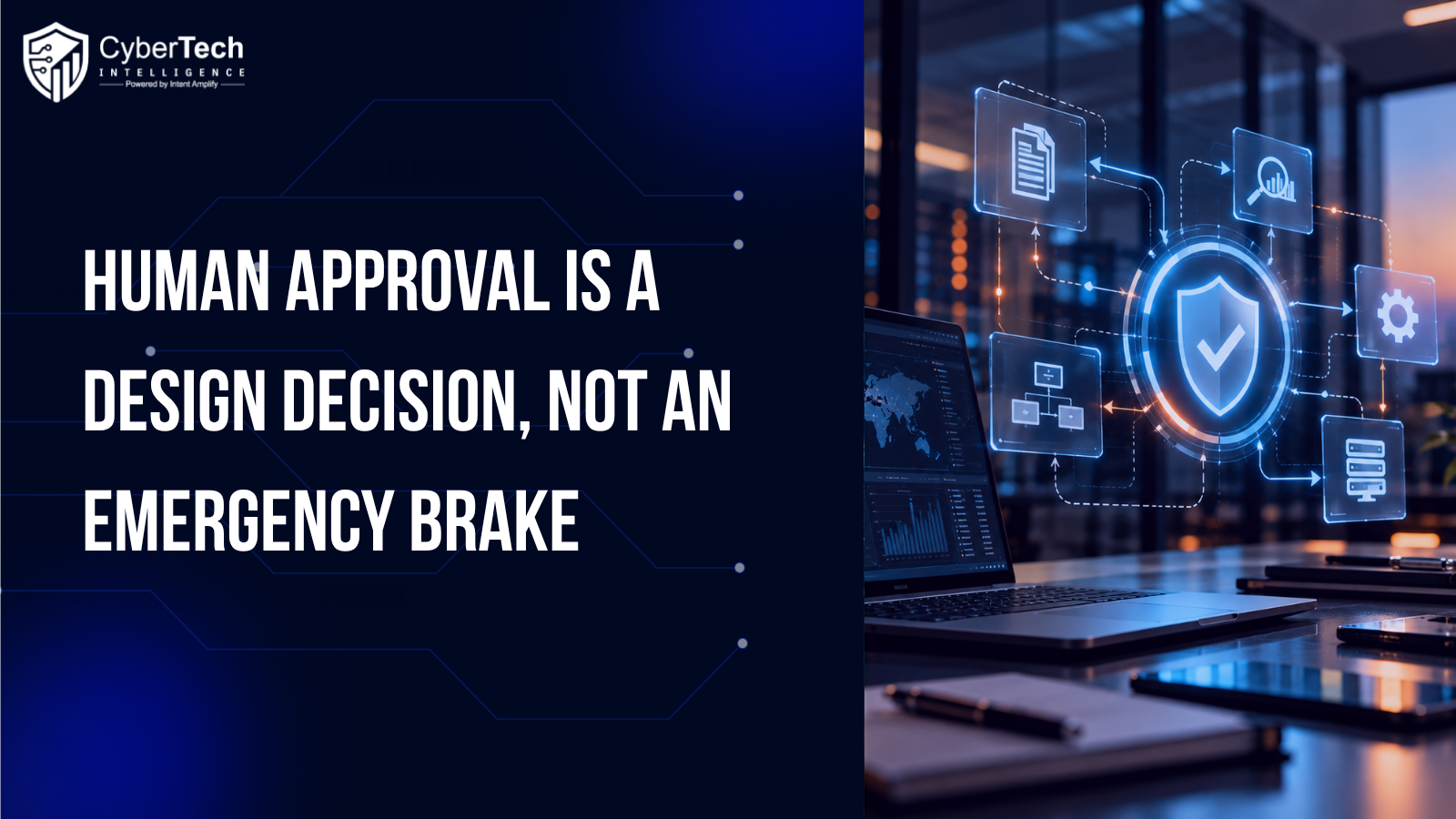
An agent can gather evidence, rank options, propose a response, and in some environments take action. None of those capabilities answers the governance question: who is accountable for deciding how much authority the agent receives? Human oversight becomes useful only when it is attached to named decisions rather than added as a generic promise that a person is 'in the loop.'
NIST's March 2026 work on post-deployment AI monitoring says real-world monitoring is crucial for validating expected behavior, observing unforeseen outputs, and understanding unexpected consequences. It also notes that monitoring methods remain fragmented. [1] Monitoring therefore needs an owner who can interpret what changed and decide whether autonomy should continue, narrow, pause, or stop.
Approval Should Follow the Action Lifecycle
A practical approval model separates workflow ownership from technical control. The workflow owner defines the intended security outcome, acceptable delay, and business consequence. Security engineering defines permissions, tool access, evidence requirements, failure handling, and rollback. Risk or legal teams may join when the action crosses their decision boundary, but the primary approver should remain obvious.
MITRE's AI Assurance Landscape describes assurance as a broad, multi-category problem and notes the absence of one standardized assurance approach across AI-enabled systems. [2] That is a useful reminder for SOC leaders: 'human oversight' is not a single control. It is a set of explicit choices about ownership, review, evidence, and intervention.
High-Impact Actions Need a Continuous Owner
Approval at deployment does not justify every future action. Models change, prompts and tools change, data sources change, permissions expand, and new response actions are added. The owner needs a review cadence that can detect when a workflow has crossed the boundary that was originally approved.
NIST's July 2026 public-facing AI documentation draft is specifically concerned with documentation that helps external stakeholders understand AI systems and their use. [3] For a SOC, the same discipline is valuable internally: the person approving a consequential action should be able to see what the workflow was designed to do, what limitations are known, and what evidence supports the proposed action.
Human Oversight Needs Stop Authority
NIST's 2026 concept work on trustworthy AI in critical infrastructure highlights operational needs such as explainability, graceful degradation, and fail-safe operation. [4] Those concepts are especially relevant when security automation can change access, isolate systems, block traffic, or disrupt business processes. A human owner who can review a workflow but cannot pause or contain it does not have meaningful operational control.
The Human-Approval Ownership Test
The following CyberTech Intelligence decision model is designed to expose ambiguous approval boundaries quickly. It is not a certification or an external standard.
Figure 1. CyberTech Intelligence Human-Approval Ownership Model
|
Decision |
Workflow Owner Must Answer |
Security / Engineering Must Answer |
Evidence to Retain |
|---|---|---|---|
|
Task |
What outcome is the agent expected to deliver? |
Are inputs, tools, outputs, and limits defined? |
Task definition, owner, approved scope. |
|
Authority |
What business consequence can the action create? |
What can the agent read, write, change, or trigger? |
Identity, permissions, tools, expiry. |
|
Approval |
Which actions require a person before execution? |
Can the system route the proposal to the right approver? |
Proposed action, evidence, approver decision. |
|
Change |
What change would require renewed approval? |
Can scope, model, tool, and permission changes be detected? |
Change record, re-review, next review date. |
|
Incident |
Who owns the consequence if the workflow behaves unexpectedly? |
Can activity be contained, investigated, and reconstructed? |
Incident evidence, response, corrective action. |
|
Stop |
Who is authorized to pause or reduce autonomy? |
Can access be revoked and the workflow fail safely? |
Stop decision, rollback, access revocation. |
CyberTech Intelligence Perspective
The missing layer in many agentic SOC discussions is not another model or another automation tool. It is decision ownership. The strongest operating question is simple: if this agent proposes or takes a consequential action tomorrow, who is expected to approve it, who can stop it, and what evidence will that person see? If those answers are unclear, the workflow is not fully governed even if it performs well in a pilot.
Build Approval Ownership into the SOC
-
Require a named workflow owner before an agentic use case enters production.
-
Classify actions by consequence, not by how impressive the automation appears.
-
Give each consequential action a named approver, evidence requirement, and fallback path.
-
Re-review authority when models, tools, permissions, or response actions materially change.
-
Keep monitoring tied to someone who can actually narrow or stop the workflow.
-
Treat stop authority and rollback as part of design, not as an incident-only procedure.
Run the Human Oversight Ownership Test
Choose five agentic or AI-assisted SOC workflows. For each one, name the workflow owner, the approver for its highest-impact action, the person who can stop it, and the evidence each reviewer receives. Any blank field becomes a governance action before autonomy expands.
About CyberTech Intelligence
CyberTech Intelligence provides research-led cybersecurity intelligence, executive content, and market engagement programs. This publication is vendor-neutral and intended for education, decision support, and claim-safe GTM planning.
Evidence and Citation Note
External sources are used only within their stated scope. Government and standards work is treated as governance and assurance guidance, not as a finding about any named product or organization. CyberTech Intelligence does not infer a control weakness, incident, budget, or buying project without direct evidence.
References
- National Institute of Standards and Technology, “Challenges to the monitoring of deployed AI systems: Center for AI Standards and Innovation,” March 6, 2026. https://www.nist.gov/publications/challenges-monitoring-deployed-ai-systems-center-ai-standards-and-innovation (Accessed September 23, 2026. Relevance: current NIST research on post-deployment AI monitoring, unexpected behavior, and monitoring challenges.)
- MITRE, “The AI Assurance Landscape (v1.0),” May 8, 2025. https://www.mitre.org/news-insights/publication/ai-assurance-landscape-v10 (Accessed September 23, 2026. Relevance: independent synthesis of AI assurance needs across more than 50 frameworks.)
- National Institute of Standards and Technology, “Guidance and Templates for Public-Facing AI Documentation: An AI Standards Zero Draft (Initial Public Draft),” July 30, 2026. https://www.nist.gov/publications/guidance-and-templates-public-facing-ai-documentation-ai-standards-zero-draft-initial (Accessed September 23, 2026. Relevance: current NIST work on understandable AI documentation and transparency.)
- National Institute of Standards and Technology, “Concept Note: AI RMF Profile on Trustworthy AI in Critical Infrastructure,” created April 6, 2026; updated July 17, 2026. https://www.nist.gov/programs-projects/concept-note-ai-rmf-profile-trustworthy-ai-critical-infrastructure (Accessed September 23, 2026. Relevance: current NIST profile work highlighting trustworthiness needs for high-stakes AI, including explainability, fail-safe operation, and lifecycle risk management.)
- ETSI, “ETSI releases world-leading standard for securing AI,” January 14, 2026. https://www.etsi.org/newsroom/press-releases/2627-etsi-releases-world-leading-standard-for-securing-ai/ (Accessed September 23, 2026. Relevance: lifecycle-based baseline cybersecurity requirements for AI systems and models.)