
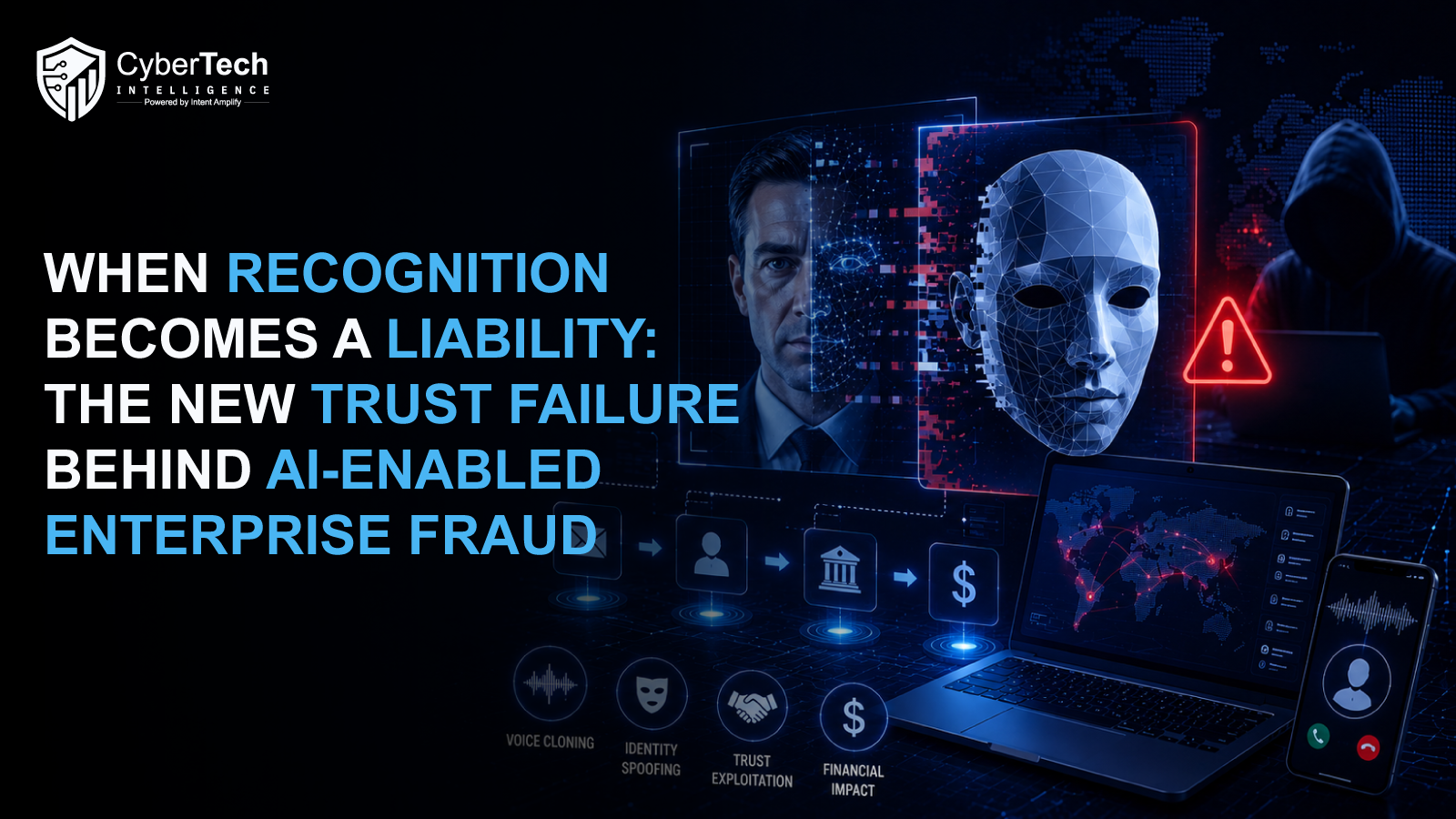
Enterprise fraud has expanded beyond spoofed domains, malicious links, forged invoices, and urgent payment requests. Generative AI is reshaping the enterprise trust fabric by eroding the identity signals traditionally used to authorize business decisions, including a familiar voice, an established writing style, a convincing video presence, a trusted supplier relationship, and communications attributed to senior executives. As organizations accelerate AI adoption, identity assurance increasingly becomes the decisive control for financial integrity.
Synthetic impersonation represents a structural challenge to enterprise fraud resilience. Conventional recognition-based controls rely on familiarity, organizational hierarchy, visual cues, and communication patterns that adversarial AI can now reproduce with remarkable fidelity. Financial exposure increasingly stems from compromised decision-making, where legitimate business workflows become vehicles for unauthorized transactions without exploiting a technical vulnerability.
The FBI's 2025 Internet Crime Report received more than one million complaints and recorded losses exceeding $20 billion, with Business Email Compromise remaining one of the highest-loss cybercrime categories after investment fraud.¹ These findings reflect a broader transformation in enterprise risk. Attackers increasingly target verification architecture, identity assurance, and transaction governance because influencing a trusted business process often delivers greater operational value than compromising enterprise infrastructure. 1
For U.S. companies, the exposure is amplified by hybrid work, executive visibility, cloud collaboration, distributed finance operations, and complex supplier ecosystems. These conditions have made digital interaction normal, fast, and highly trusted. They have also created an environment where manipulated communication can move through business workflows with fewer natural points of resistance.
Gartner reported that 62% of organizations experienced at least one deepfake attack in the previous 12 months.2
The central leadership question is no longer whether adversaries can create convincing synthetic content. They can. The more urgent question is whether the enterprise still allows sensitive action to proceed because something feels familiar.
CyberTech Intelligence Perspective
AI-enabled enterprise fraud is fundamentally a trust architecture challenge. The risk is not only that adversaries can imitate executives, suppliers, employees, or customers. The deeper risk is that many organizations still allow high-impact business decisions to move forward based on recognition, hierarchy, urgency, or communication familiarity.
CyberTech Intelligence research and analysis indicates that enterprises must redesign authorization around independently verifiable evidence. Sensitive actions involving payments, supplier changes, privileged access, confidential documents, onboarding decisions, or executive exceptions should not depend on whether a voice sounds familiar, a message feels authentic, or a video appears convincing.
For CISOs, CFOs, CIOs, enterprise risk leaders, treasury teams, procurement leaders, and board risk committees, recognition-based trust is becoming a liability. Sustainable fraud resilience requires identity assurance, workflow governance, independent verification, transaction integrity, and executive accountability.
The Real Exposure Is Not the Fake Voice, but the Decision It Triggers
A cloned voice or manipulated video creates business impact only when it influences an operational decision. Financial loss occurs when employees authorize payments, modify supplier records, reset privileged credentials, disclose sensitive information, approve onboarding requests, or override established controls based on a communication perceived as authentic.
Synthetic media presents a governance challenge rather than a media-detection problem. Detection remains valuable, but financial exposure typically materializes before manipulated content is identified. Enterprise risk originates in authorization workflows that continue to depend on human recognition under time pressure instead of independent identity verification and documented approval controls.
KPMG reported that 81% of surveyed Canadian business leaders who experienced fraud in the previous 12 months said the attack was AI-enabled, while 72% said AI-powered schemes cost between 1% and 5% of business profits.3
Although the study is Canada-focused, the operating lesson is directly relevant to U.S. enterprises. Large organizations in both markets share the same risk ingredients: remote decision-making, public leadership data, supplier complexity, digital finance platforms, and high-value transactions that often depend on speed.
The most resilient organizations will not ask employees to become deepfake experts. They will redesign sensitive workflows so that a familiar voice, polished message, or convincing video cannot independently trigger high-impact action.
BEC 2.0 Is Turning Familiarity Into an Operational Weakness
Business Email Compromise has always depended on urgency, authority, and deception. Generative AI increases the credibility, scale, and precision of social engineering by producing communications that mirror internal writing styles, incorporate authentic business context, replicate executive language, and transition seamlessly across email, collaboration platforms, voice, and video.
KPMG reported that organizations affected by AI-enabled fraud most frequently encountered AI-generated phishing emails or chat messages (60%), deepfake documents (39%), and executive voice-cloning attacks (24%). 3
This pattern shows why BEC 2.0 is increasingly multimodal. A fraudulent email may be reinforced by a phone call. A voice interaction may be supported by a manipulated document. A video meeting may create the perception of executive consensus. Each channel strengthens the others, making the request feel less like an external attack and more like a routine business activity.
IBM’s 2026 X-Force Threat Index states that cybercriminals are using artificial intelligence to scale operations while exploiting basic security gaps.4
The practical implication is clear: familiarity has become an attackable asset. If an employee is trained to trust a leader’s tone, a supplier’s language, or a known workflow pattern without independent evidence, the organization is effectively exposing a soft control layer.
CyberTech Intelligence Research Desk Observation: The enterprise challenge is no longer determining whether AI can convincingly imitate trusted individuals. That threshold has already been crossed. The competitive advantage now belongs to organizations that redesign authorization workflows so that recognition no longer determines financial or operational outcomes. Governance, rather than perception, becomes the foundation of enterprise trust.
Public Executive Visibility Is Becoming a Fraud Enablement Layer
Corporate leaders are more visible than ever. Earnings calls, investor briefings, keynote sessions, podcasts, webinars, media interviews, annual meetings, and social platforms all create useful signals for legitimate stakeholders. They also provide material that can help adversaries imitate authority.
An attacker does not need perfect information. Public content can reveal tone, cadence, vocabulary, emotional style, business priorities, and preferred phrasing. When combined with open-source research from LinkedIn, company websites, press releases, job postings, leaked credentials, supplier references, and conference agendas, this material can support highly targeted impersonation.
Gartner reported that 32% of organizations faced an attack on artificial intelligence applications, alongside rising deepfake activity.5
This creates a difficult leadership paradox. Executives need visibility to build trust with investors, customers, employees, analysts, and partners. Yet the same visibility can increase adversarial mimicry risk. The solution is not withdrawal from public communication. The better answer is disciplined internal practice.
Companies should define which actions can never be authorized through voice, video, chat, or informal escalation alone. They should also educate employees that visible executives are easier to imitate, not automatically easier to verify.
Human Judgment Alone Cannot Carry Financial Verification Anymore.
Most legacy awareness programs were designed for a simpler threat environment. Employees were trained to notice poor grammar, unfamiliar links, suspicious attachments, odd domains, and urgent language. Generative tools reduce many of those warning signs. Messages can now be polished, context-aware, emotionally calibrated, and aligned with corporate style.
KPMG observed that in the age of AI, fraud increasingly looks like business as usual and must become a continuous governance priority rather than a periodic awareness topic.6
This is where many organizations underestimate the burden placed on employees. A finance analyst may feel uncomfortable delaying a request that appears to come from a chief financial officer. A procurement manager may hesitate to challenge a long-standing supplier. A legal operations team may avoid slowing a confidential matter. In these moments, the employee is not only evaluating risk; they are navigating hierarchy, time pressure, and perceived business urgency.
An expert-led fraud program should remove that burden. Verification should be built into the workflow, not left to individual courage. Employees should have clear authority to pause unusual requests, and executives should publicly reinforce that control and discipline are expected.
This is the human-centered core of synthetic impersonation defense. Strong process design protects employees from being forced into impossible judgment calls.
High-Trust Sectors Are Becoming High-Impact Targets
The highest exposure is not limited to organizations with poor technology controls. It often appears in sectors where trust is central to daily operations.
Financial services face immediate monetization risk because account recovery, wire activity, onboarding, customer service, and fraud operations depend heavily on identity confidence. A convincing synthetic customer, employee, or executive can influence high-value workflows.
Healthcare organizations face risk through patient verification, billing, claims processing, telehealth, workforce onboarding, and third-party administration. A manipulated identity or generated document can trigger privacy exposure, reimbursement loss, regulatory scrutiny, or patient-trust erosion.
Manufacturing companies are vulnerable through supplier coordination, procurement escalation, logistics timing, invoice handling, and plant-level urgency. A false request may appear credible if it references a real shipment, production deadline, or vendor relationship.
Legal and professional services firms face heightened consequences because they manage confidential transactions, escrow activity, settlement coordination, merger discussions, and client instructions. In these environments, trust is not only operational; it is the business model.
Insurance providers face growing pressure around claims integrity, policy changes, customer verification, and synthetic identity. As generated documents improve, manual review becomes less reliable.
PwC’s 2026 fraud analysis notes that financial institutions face increasingly sophisticated threats involving synthetic identities, deepfakes, account takeovers, and AI-enabled scam activity.7
The common theme across these sectors is that trust becomes action quickly. That is precisely what adversaries are learning to exploit.
Detection Tools Will Miss What Weak Workflows Allow
Deepfake detection has value, but it should not be treated as the primary defense. Enterprise communication is fragmented across email, chat, mobile messaging, video platforms, call recordings, collaboration suites, vendor portals, and customer systems. Synthetic content may also appear in compressed video streams, low-quality audio, multilingual calls, partial recordings, or real-time conversations where forensic analysis is difficult.
EY’s guidance emphasizes crisis readiness, rapid-response planning, employee training, detection tooling, and a culture of verification as manipulated-media threats evolve.8
The larger issue is procedural. Even if detection improves, attackers can still exploit workflows that allow high-risk action based on informal communication. A moderately convincing call can succeed if the target feels pressured, the request is plausible, and the process lacks independent confirmation.
This is why leading organizations are shifting the question from “Can we identify every fake?” to “Can any unverified interaction create material business impact?” The second question is more useful because it focuses on resilience rather than perfect detection.
CyberTech Intelligence Enterprise Trust Assurance Framework
The most immediate improvement is cultural. Employees need explicit permission to verify sensitive requests, even when they appear to come from senior leadership. This message must come from executives, not only from security teams. If employees believe control discipline may be interpreted as resistance, they will hesitate.
Gartner identified deepfakes among four critical threat areas requiring urgent improvement from cybersecurity leaders in 2026.9
The CyberTech Intelligence Enterprise Trust Assurance Framework gives enterprise leaders a structured model for reducing AI-enabled fraud, synthetic impersonation, and recognition-based trust failure. The framework is built around seven pillars: Identity Assurance, Independent Verification, Workflow Governance, Executive Accountability, Transaction Integrity, Behavioral Oversight, and Board Governance.
|
Framework Pillar |
Executive Question |
Governance Purpose |
|
Identity Assurance |
Can the organization verify the identity behind high-risk requests without relying on voice, video, writing style, or perceived familiarity? |
Reduces exposure from synthetic impersonation, executive mimicry, and supplier identity manipulation |
|
Independent Verification |
Are sensitive actions confirmed through known, trusted channels rather than contact details or context supplied in the new request? |
Prevents manipulated communication from becoming sufficient proof of legitimacy |
|
Workflow Governance |
Are high-impact decisions routed through approved systems with defined approval paths and exception rules? |
Limits informal bypasses that attackers exploit during urgent or confidential scenarios |
|
Executive Accountability |
Do senior leaders visibly support verification, delay, and escalation when sensitive requests appear unusual? |
Protects employees from pressure and makes verification a leadership-backed norm |
|
Transaction Integrity |
Are payments, supplier changes, privileged access requests, and confidential document transfers evaluated through risk-aware controls? |
Connects fraud prevention with financial, operational, and identity assurance |
|
Behavioral Oversight |
Can the organization detect abnormal activity across communication behavior, transaction patterns, and workflow deviations? |
Helps identify suspicious combinations of message, identity, and business-process signals |
|
Board Governance |
Can leadership report recognition-based trust exposure, control maturity, fraud readiness, and verification culture to the board? |
Elevates synthetic impersonation from awareness training to enterprise resilience oversight |
This framework shifts enterprise fraud defense from employee judgment to governed verification. It allows security, finance, risk, procurement, legal, human resources, and board stakeholders to align around one operating model for protecting high-impact decisions in the era of synthetic business communication.
Executive Trust Maturity Scorecard
According to CyberTech Intelligence research and analysis, AI-enabled fraud resilience should be measured through governance evidence rather than employee awareness alone. The scorecard below helps CISOs, CFOs, CIOs, enterprise risk leaders, treasury leaders, procurement leaders, and board risk committees assess whether recognition-based trust is being replaced with independently governed verification.
|
Readiness Area |
Executive Question |
Evidence to Review |
|
Identity Assurance Maturity |
Can the organization validate executives, suppliers, employees, and customers through trusted controls rather than familiarity? |
Identity verification procedures, privileged request controls, executive escalation logs, supplier contact records |
|
Executive Verification Controls |
Are executive requests for payments, access changes, confidential documents, or urgent exceptions independently verified? |
Callback rules, known-channel confirmation records, executive exception logs, verification policy evidence |
|
Payment Governance |
Are payment changes, emergency disbursements, wire requests, and supplier banking updates governed through documented workflows? |
Payment approvals, dual-control evidence, vendor master change records, transaction review logs |
|
Workflow Integrity |
Can high-impact actions be completed only through approved systems and auditable process paths? |
Workflow records, exception approvals, system-of-record evidence, segregation-of-duty controls |
|
Employee Verification Culture |
Are employees explicitly authorized to pause, question, and escalate suspicious requests without career or performance concern? |
Training records, executive communications, escalation outcomes, policy statements, tabletop findings |
|
Fraud Response Readiness |
Can the organization preserve evidence, notify banks or suppliers, involve legal, and investigate synthetic impersonation quickly? |
Incident playbooks, evidence retention rules, bank contact lists, response exercises, investigation records |
|
Board Governance Maturity |
Can leadership report AI-enabled fraud exposure, verification maturity, payment risk, and workflow resilience to the board? |
Board dashboards, KPI reports, risk acceptance records, audit findings, governance maturity updates |
This scorecard strengthens executive usability by translating synthetic impersonation risk into measurable trust assurance evidence. It supports board reporting, financial control modernization, payment governance, executive verification, fraud-response planning, and enterprise resilience improvement.
Expert Outlook: Enterprise Trust Must Become Evidence-Led
Synthetic impersonation will become harder to separate from normal business communication as legitimate AI adoption expands. Employees will increasingly encounter automated summaries, generated drafts, virtual assistants, voice interfaces, avatars, and machine-supported workflows during ordinary work. As these tools become familiar, malicious communication may feel less unusual.
McKinsey’s 2025 global AI survey found that nearly 9 out of 10 respondents said their organizations regularly use AI.10
The next phase of enterprise protection will require a sharper separation between communication and authorization. A message can inform, but it should not independently approve. A voice can provide context, but it should not replace evidence. A video can support collaboration, but it should not override the documented process.
For U.S. business leaders, the priority is to remove ambiguity from high-impact decisions. Organizations that define when verification is mandatory, who owns it, and how it is recorded will be better positioned than those relying on recognition, intuition, or informal escalation.
Conclusion: In the AI Era, Familiarity Is Not Proof
AI-generated voice, synthetic video, and machine-produced communications are reshaping enterprise fraud by undermining the identity cues historically used to authorize business decisions. Familiarity, organizational hierarchy, writing style, and visual recognition no longer provide sufficient assurance for high-value financial transactions, privileged requests, or sensitive business operations.
Sustainable fraud resilience requires governance capable of preserving decision integrity even when every communication appears credible. Independent verification, transaction governance, phishing-resistant authentication, segregation of duties, behavioral analytics, and documented authorization workflows create a stronger control environment for finance, legal, procurement, human resources, and executive functions.
Organizations that replace recognition-based trust with independently governed verification processes will not simply reduce exposure to AI-enabled fraud. They will strengthen enterprise resilience, preserve financial integrity, and establish a sustainable trust architecture for the era of synthetic business communication.
Enterprise Financial Trust Assessment
AI-enabled fraud resilience now requires more than deepfake awareness, email security, or employee training. It requires evidence that the enterprise can govern identity assurance, validate executive requests, protect payment workflows, detect behavioral anomalies, preserve investigation evidence, and report trust maturity to executive stakeholders.
CyberTech Intelligence helps CISOs, CFOs, CIOs, enterprise risk leaders, treasury leaders, procurement leaders, and board risk committees evaluate these capabilities through an Enterprise Financial Trust Assessment. The assessment examines identity assurance maturity, executive verification controls, AI-enabled fraud resilience, workflow integrity, payment governance, behavioral governance, and board oversight.
For organizations strengthening financial trust and fraud resilience in 2026, this assessment can support board reporting, payment-control modernization, executive verification strategy, workflow assurance, fraud simulation planning, cyber insurance readiness, and enterprise resilience planning.
Contact CyberTech Intelligence
References
- FBI, 2025 Internet Crime Report, 2026
https://www.ic3.gov/AnnualReport/Reports/2025_IC3Report.pdf - Gartner, Why CIOs Can’t Ignore the Rising Tide of Deepfake Attacks, September 2, 2025
https://www.gartner.com/en/newsroom/press-releases/2025-09-02-why-cios-cannot-ignore-the-rising-tide-of-deepfake-attacks - KPMG, AI Fraud Hits Canadian Companies’ Bottom Lines, March 2026
https://kpmg.com/ca/en/media/2026/03/ai-fraud-hits-canadian-companies-bottom-lines.html - IBM, IBM 2026 X-Force Threat Index: AI-Driven Attacks Are Escalating as Basic Security Gaps Leave Enterprises Exposed, February 25, 2026
https://newsroom.ibm.com/2026-02-25-ibm-2026-x-force-threat-index-ai-driven-attacks-are-escalating-as-basic-security-gaps-leave-enterprises-exposed - Gartner, Gartner Survey Reveals GenAI Attacks Are on the Rise, September 22, 2025
https://www.gartner.com/en/newsroom/press-releases/2025-09-22-gartner-survey-reveals-generative-artificial-intelligence-attacks-are-on-the-rise - KPMG, Fraud in the Age of AI, March 2026
https://kpmg.com/ca/en/insights/2026/03/fraud-in-the-age-of-ai.html - PwC, The Fraud Trend to Watch in 2026 and Beyond: The Era of Deepfakes, February 2026
https://www.pwc.com/cz/cs/blog/rizeni-rizik/the-fraud-trend-to-watch-in-2026-and-beyond.html - EY, When Deepfake Dangers Cause Real Crises, January 2026
https://www.ey.com/en_us/insights/forensic-integrity-services/when-deepfake-dangers-cause-real-crises - Gartner, Gartner Identifies Four Critical Threats Requiring Urgent Improvements From Cybersecurity Leaders, June 2, 2026
https://www.gartner.com/en/newsroom/press-releases/2026-06-02-gartner-identifies-four-critical-threats-requiring-urgent-improvements-from-cybersecurity-leaders - McKinsey & Company, The State of AI: Global Survey 2025, November 2025
https://www.mckinsey.com/capabilities/quantumblack/our-insights/the-state-of-ai


