Executive Summary
Deepfake fraud and AI-enabled business email compromise are no longer future-state risks. They are active financial crime methods that exploit the way enterprises verify identity, approve payments, onboard employees, and trust executive communication.
The shift is material because adversaries are no longer limited to crude phishing templates or poorly written impersonation emails. Generative AI can help attackers create polished messages, synthetic voices, realistic video cues, and multi-channel pressure that appears to come from executives, suppliers, auditors, candidates, or business partners.
Business email compromise remains one of the most financially damaging cybercrime categories. The FBI Internet Crime Complaint Center reported 24,768 BEC complaints and $3.04 billion in adjusted BEC losses in 2025, up from 21,442 complaints and $2.77 billion in losses in 2024. BEC was the second-highest cybercrime category by reported loss in 2025, behind investment fraud. The FBI also reported that AI-related complaints accounted for 22,364 complaints and $893.3 million in losses in 2025, reinforcing why AI-enabled impersonation and synthetic fraud now require stronger verification controls. [1]
For CISOs, CFOs, and enterprise risk leaders, the issue is no longer whether synthetic fraud will become relevant. It already is. The immediate question is whether payment approval, vendor-change, hiring, and escalation processes are designed for a threat model in which familiar voices, faces, and writing styles can be manufactured.
AI-BEC Has Moved Beyond Email Alone
Traditional BEC relied on deception, urgency, and process weakness. Attackers impersonated executives, compromised inboxes, spoofed suppliers, or redirected payment instructions. Those methods still exist, but generative AI has changed their credibility and scale.
Attackers can now produce grammatically fluent emails that reflect corporate tone, reference real projects, and align with known reporting structures. When prior correspondence is obtained through credential compromise, large language models can help imitate writing style and business context more convincingly. Research on AI-enabled social engineering shows that generative systems can amplify realistic content creation, personalization, and attack automation.
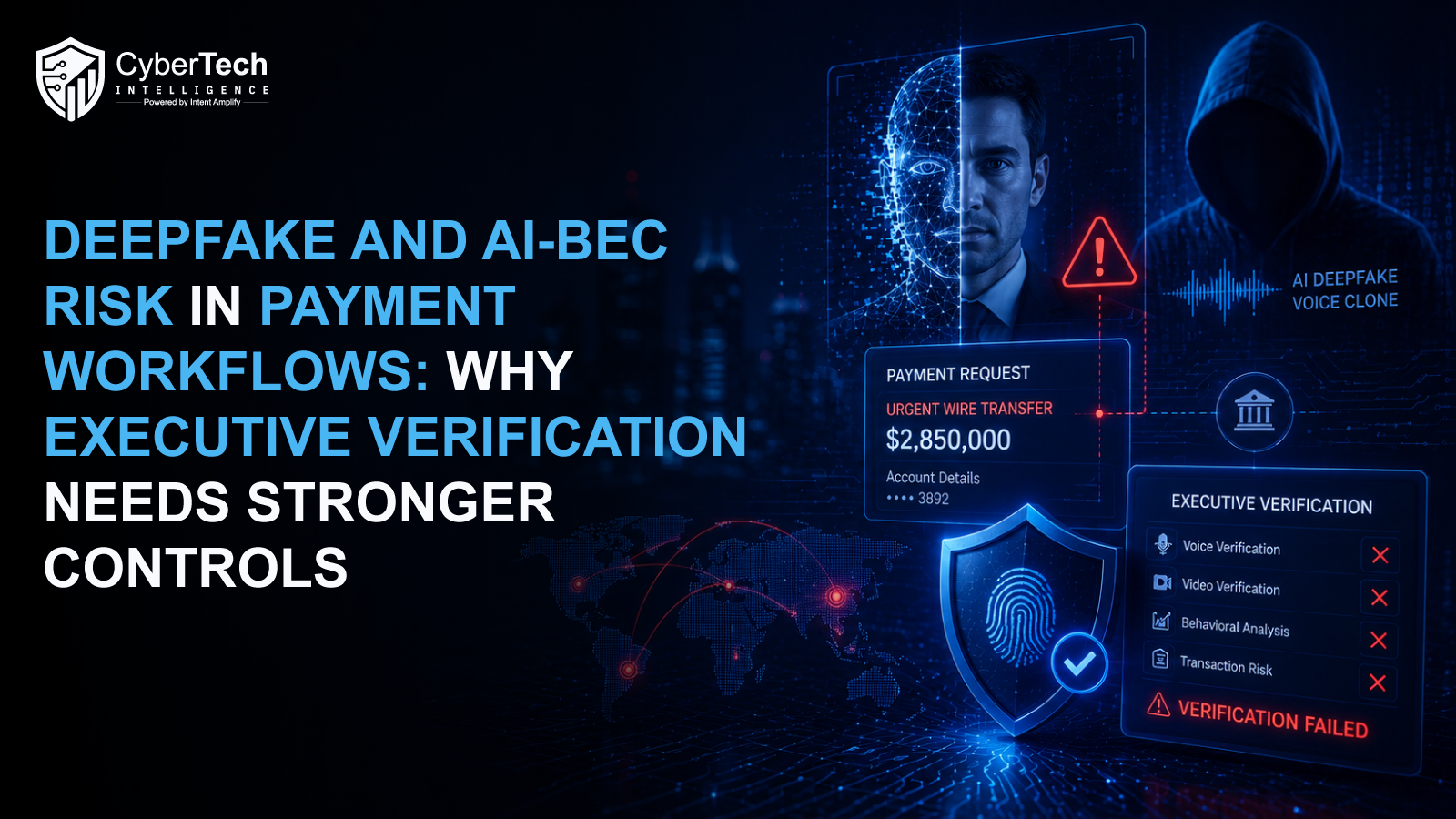
The more serious development is multi-channel synthetic pressure. A finance employee may receive an executive-style email, followed by a cloned voice call. A procurement specialist may receive supplier banking updates, then get a voicemail that appears to confirm the change. An HR team may conduct remote interviews with a synthetic or misrepresented candidate before identity checks reveal inconsistencies.
These scenarios do not depend on malware. They exploit trust, speed, hierarchy, and operational routine. That is why AI-BEC belongs in the same discussion as payment governance, fraud operations, insider-risk management, and executive communications security.
Why Voice and Video Can No Longer Be Treated as Assurance
Most enterprise controls were designed around technical compromise: malicious attachments, stolen credentials, spoofed domains, endpoint compromise, and unauthorized access. Those controls remain necessary, but they do not fully address synthetic impersonation.
Multi-factor authentication can protect access to systems, but it cannot prove that the person speaking in a video call is actually the executive being impersonated. Email security tools can reduce phishing volume, but they may struggle when a message is sent from a legitimate compromised account and contains no obvious malicious payload. Endpoint detection cannot stop an employee from approving a fraudulent wire after a convincing call.
The strongest lesson is procedural. The organizations responding most effectively are treating synthetic fraud as a governance and process challenge, not only as a detection technology issue. The decisive control is not whether an employee can spot every fake; it is whether the business process prevents a fake from authorizing a real transaction.
No high-risk financial or access decision should depend on a single communication channel, even when that channel appears to include a familiar voice or face.
Sector Exposure Is Concentrated Around High-Trust Workflows
Synthetic fraud exposure is highest where high-value decisions depend on remote communication and rapid approval. Financial services and corporate treasury remain primary targets because wire transfers, supplier banking changes, and executive approvals create direct monetization paths.
Legal and professional services firms also face elevated risk. Mergers, acquisitions, settlements, escrow transfers, and client fund movements often involve urgent communication and large-value transactions. In that setting, urgency can appear normal.
Healthcare organizations face exposure through administrative workflows, patient identity processes, billing systems, and access management. Technology and SaaS companies are exposed through remote hiring, contractor onboarding, vendor access, and distributed operating models.
Manufacturing and critical infrastructure organizations carry risk through supplier communications and procurement approvals. Smaller operational teams often rely on trusted relationships and informal escalation. Those relationships support speed, but they can also create verification gaps. FS-ISAC’s Navigating Cyber 2025 also highlighted threat actors’ use of GenAI for fraud and supply chain attacks in the financial sector. [4]
Regulatory Attention Is Increasing
Regulators are beginning to examine synthetic media fraud more closely, especially where it affects financial controls, data protection, securities oversight, identity verification, and critical infrastructure resilience.
FinCEN warned in 2024 that financial institutions had reported increased suspicious activity involving suspected deepfake media in fraud schemes targeting institutions and customers. The alert also connected deepfake fraud to generative AI tools and financial crime reporting obligations.
This matters for compliance teams. Post-incident reviews are likely to assess whether the organization had reasonable payment controls, documented verification procedures, employee escalation authority, and incident response steps for synthetic fraud. Public companies may also face governance concerns if executive impersonation affects market-sensitive communication, disclosure, or transaction authorization.
Regulatory frameworks specific to deepfake-enabled financial crime remain uneven. However, the direction is clear: enterprises will increasingly be expected to show that synthetic impersonation risk has been assessed, assigned to accountable owners, and translated into operational controls.
The Training Gap Is Becoming Operational
Security awareness programs have historically focused on phishing links, attachments, credential harvesting, and suspicious domains. AI-assisted social engineering requires a broader training model.
Employees now need to recognize synthetic authority cues, not only suspicious content. A polished message, familiar tone, or realistic voice should not override verification procedure. Research on deepfake speech has also shown that detection can be challenged by background noise, playback, transcoding, and adversarial manipulation, which means human judgment and technical detection should not be treated as sufficient safeguards on their own.
The practical defense is to move verification from perception to process. Employees should not be asked to decide whether every voice, video, or message is real. They should be required to follow a trusted process before releasing money, changing vendor data, granting access, or accepting urgent executive instructions.
These metrics turn synthetic fraud response from general advice into a measurable control program. They also give CISOs and CFOs a common language for reporting progress to the board.
Board-Ready Questions
|
Executive Question |
Why It Matters |
|
Can a high-value payment be approved based only on email, voice, video, or chat? |
Tests whether synthetic media can bypass payment governance. |
|
Which executives have enough public audio or video exposure to be impersonated? |
Identifies high-risk source material for deepfakes. |
|
Are supplier banking changes verified through a trusted system of record? |
Reduces vendor-payment fraud exposure. |
|
Can finance detect abnormal payment behavior quickly enough to support recovery? |
Improves the chance of stopping or reversing fraudulent transfers. |
|
Do help desk, finance, HR, and procurement teams have escalation rules for suspected synthetic impersonation? |
Prevents pressure-based exceptions. |
|
Have high-risk employees experienced realistic deepfake simulations? |
Measures readiness beyond annual awareness training. |
Strategic Outlook: Trust Must Be Verified by Process
Deepfakes and AI-BEC threats will expand as enterprises continue to rely on remote work, video meetings, digital payment workflows, and AI-assisted communication. Adversaries are benefiting from the same generative capabilities that legitimate organizations are adopting for productivity.
For enterprise leaders, the near-term objective is not to find a definitive technical fix. Synthetic media will continue to improve. The more realistic priority is to strengthen the controls that govern decisions: payment release, vendor data changes, privileged access, executive approvals, and incident escalation.
Cryptographic trust, verified communication channels, independent callback procedures, cross-functional fraud intelligence, and behavioral controls that reduce pressure-based compliance are now foundational. Enterprises that modernize those controls early will be better positioned as synthetic impersonation becomes more convincing, more scalable, and harder to distinguish from legitimate business communication. In the synthetic fraud era, trust has to be verified by process, not inferred from a familiar voice, face, or writing style.
Strengthen Verification Before Synthetic Fraud Reaches the Business
CyberTech Intelligence helps enterprises understand and respond to emerging cyber risks with research-led intelligence, strategic advisory, and executive-ready security insights. As deepfake fraud and AI-enabled BEC reshape payment, vendor, HR, and executive communication risks, organizations need stronger verification controls, practical response playbooks, and clearer visibility across security, finance, and risk teams.
CyberTech Intelligence can support enterprises with threat intelligence, control assessment, AI fraud readiness reviews, and actionable guidance for reducing synthetic impersonation exposure.
References
- Federal Bureau of Investigation (2025) Internet Crime Report 2025. Available at: https://www.ic3.gov/AnnualReport/Reports/2025_IC3Report.pdf.
- Financial Crimes Enforcement Network (2024) FinCEN Alert on Fraud Schemes Involving Deepfake Media Targeting Financial Institutions. Available at: https://www.fincen.gov/sites/default/files/shared/FinCEN-Alert-DeepFakes-Alert508FINAL.pdf.