
Executive Snapshot
Malware-free attacks are succeeding because enterprise trust has become executable. A valid credential, a stolen session cookie, an excessive OAuth grant, or an unmanaged SaaS integration can give an attacker operational reach without deploying a detectable payload.
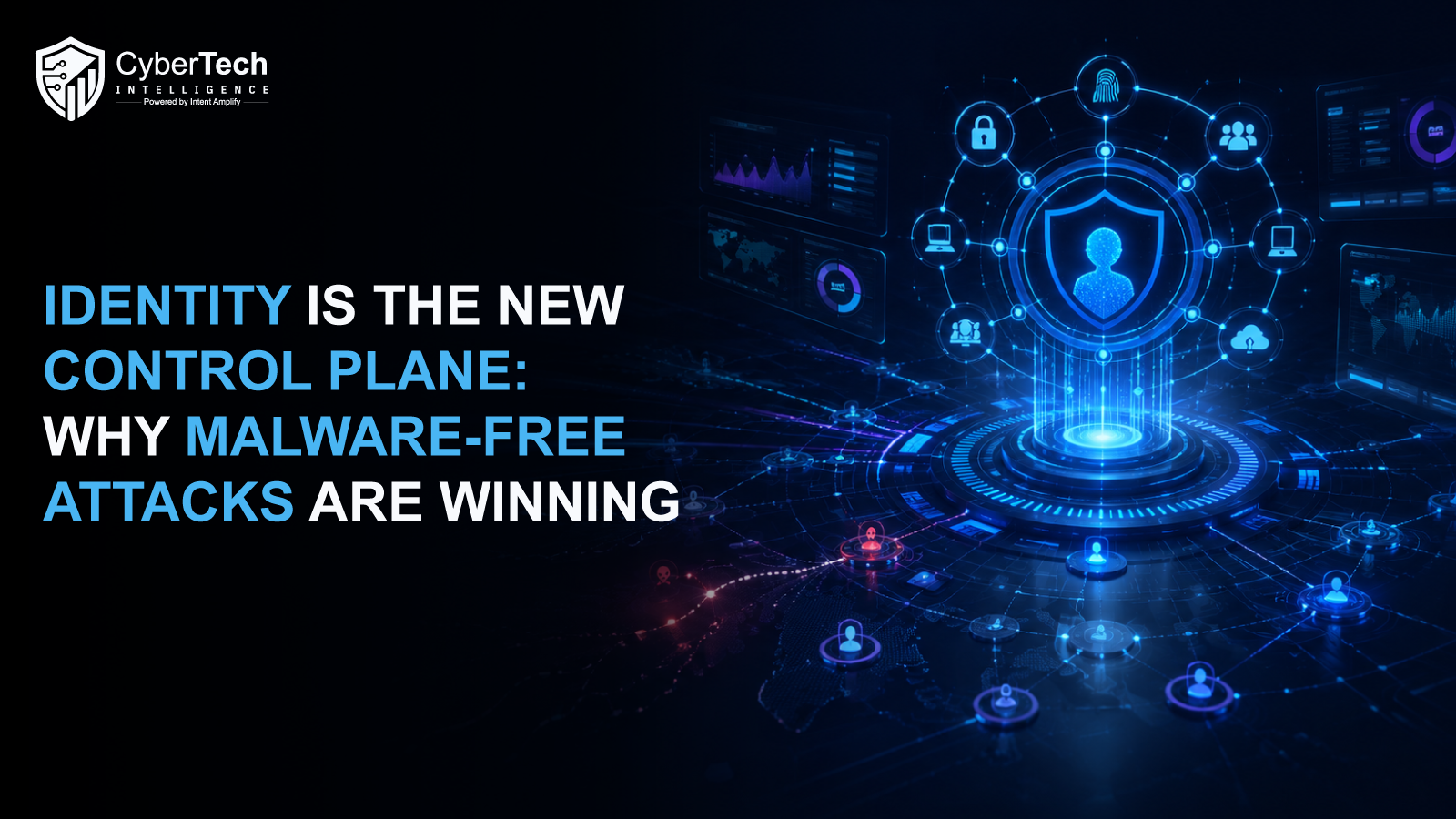
For CISOs, Heads of IAM, Zero Trust leaders, and SaaS security owners, identity is now the practical control plane for enterprise defense. It determines who can reach data, which applications can act on behalf of users, how privileged workflows are approved, and whether suspicious activity can be interrupted before it becomes a material incident.
Microsoft reported 38 million identity risk detections on an average day, alongside more than 100 trillion daily security signals. That scale shows how deeply identity telemetry now sits inside cyber defense. Identity risk now operates as a detection-and-response discipline rather than an administrative IAM function. [1]
CrowdStrike reported that 82% of detections in 2025 were malware-free, with intrusions moving through valid credentials, trusted identity flows, SaaS applications, and cloud infrastructure. The business risk is not limited to unauthorized access. Malware-free attacks can accelerate data exposure, fraud, service disruption, regulatory reporting pressure, and recovery complexity because the attacker is operating through systems the enterprise already trusts. [2]
Key Industry Updates
Attackers Are Compressing the Response Window
Google Cloud Mandiant’s M-Trends 2026 found that global median dwell time increased to 14 days, up from 11 days, while organizations detected malicious activity internally 52% of the time, compared with 43% in 2024. Internal detection improved, but the longer dwell time is the warning. Attackers are becoming better at hiding inside administrative behavior, SaaS workflows, and native identity activity. [3]
Security teams cannot depend only on login failures, known indicators, or endpoint alerts. They need behavioral correlation across identity provider logs, SaaS audit trails, privileged access workflows, endpoint telemetry, and cloud control plane events.
SaaS and OAuth Are Now Identity Risk Domains
OAuth security has moved from an application development concern to an enterprise risk priority. Modern collaboration environments depend on app-to-app authorization. That convenience creates a durable attack surface.
An OAuth grant can allow mailbox access, file reads, directory permissions, API calls, and administrative actions without repeated user authentication. A compromised application can preserve access even after a password reset. Protecting OAuth tokens from cyber attacks, therefore, requires consent governance, token visibility, app inventory, permission review, and rapid revocation capability.
CISA established the Secure Cloud Business Applications project to address cybersecurity and visibility gaps exposed by SaaS intrusions and cloud compromises. Although the project is designed for federal cloud security, CISA notes that all organizations can use it to strengthen SaaS security. For U.S. enterprises, that matters because cloud productivity suites now hold regulated data, legal material, customer records, and operational workflows. [4]
Trend Analysis: Identity Has Become the Enterprise Control Plane
Zero Trust identity architecture is often reduced to multifactor authentication, single sign-on, and conditional access. Those controls are necessary, but they are not sufficient.
NIST defines zero trust as a shift away from static network perimeters toward users, assets, and resources, with no implicit trust granted based solely on network location or asset ownership. In operational terms, identity becomes the policy decision point for access, privilege, session risk, and enforcement. [5]
The strategic challenge is that identity infrastructure has expanded faster than identity governance. Many enterprises now operate a hybrid identity across Entra ID, Active Directory, privileged access platforms, SaaS applications, service accounts, machine identities, and third-party integrations. Each layer creates drift. Dormant accounts remain active. Groups accumulate privileges. OAuth applications retain permissions. Service accounts become invisible dependencies.
Attackers do not need every control to fail. They need one identity path that is trusted, over-permissioned, or poorly monitored. This is why an identity-first security strategy should focus on control quality, not control inventory.
Apply the CyberTech Intelligence Identity Control Plane Framework™
The CyberTech Intelligence Identity Control Plane Framework™ provides a structured model for understanding how malware-free attacks move through trusted access paths. It connects credential risk, OAuth exposure, SaaS permissions, cloud identity activity, privileged access, and response readiness into one identity-first security model.
The framework helps security leaders identify where identity risk becomes enterprise exposure and where governance must improve before trusted access turns into an attacker-controlled pathway.
Access the Identity Control Plane Framework
CyberTech Intelligence Perspective
Identity security functions as an enterprise risk control model rather than solely an IAM discipline. Traditional IAM emphasizes provisioning, role management, identity lifecycle administration, and compliance evidence. Malware-free intrusions require a broader operating model that integrates identity governance with threat detection, SaaS security, cloud identity protection, incident response, and business risk management.
A mature identity security program is built on five control layers: comprehensive inventory and ownership across human, machine, privileged, third-party, and OAuth identities; phishing-resistant authentication for high-risk roles; governance of OAuth applications and access tokens; behavioral detection for anomalous sessions, privilege changes, and SaaS activity; and coordinated response capabilities covering session revocation, token invalidation, OAuth application removal, privileged access reset, and downstream exposure analysis.
Endpoint Visibility Cannot Explain the Full Intrusion
Endpoint detection and response remains a core control. Its limitation is visibility. Malware-free intrusion techniques often use legitimate tools, valid sessions, browser activity, native administrative functions, and API calls. The endpoint may show activity, but not intent.
Mandiant reported that exploits remained the most common initial infection vector for the sixth consecutive year, accounting for 32% of intrusions, while highly interactive voice phishing rose to 11% and became the second-most observed vector. Attackers are combining technical exploitation and social engineering to reach identity systems, help desks, SaaS administrators, and privileged workflows. [3]
CrowdStrike also reported a 266% increase in cloud-conscious intrusions by state-nexus threat actors. For U.S. enterprises with distributed workforces and deep SaaS adoption, cloud identity security, SaaS security, and identity federation are now central to cyber resilience. [2]
The organizations most exposed are often those with fragmented controls. IAM owns access. The SOC owns alerts. Cloud teams own configuration. SaaS administrators own application settings. Risk teams own evidence. Attackers move across those seams.
Actionable Insights for CISOs and IAM Leaders
Prioritize identities that can create material exposure, including privileged administrators, cloud operators, finance approvers, SaaS administrators, developers with production access, service accounts, and third-party users. Treat OAuth consent as a privileged workflow, with application inventory, permission classification, consent approval, dormant app removal, and alerting for suspicious grants.
Build detection around identity behavior. A risky sign-in becomes more meaningful when paired with new device registration, unusual SaaS download volume, token reuse, privilege change, or abnormal API sequencing. Shorten containment time through defined workflows for session revocation, token invalidation, OAuth grant removal, MFA reset review, account disablement, and privilege rollback.
Move From Identity Threat Visibility to Executive Readiness
The controls outlined above show where identity security must become more operational: credential theft detection, OAuth governance, SaaS visibility, cloud identity monitoring, lateral movement detection, and faster identity response. For CISOs, IAM leaders, Zero Trust owners, and SaaS security teams, the next step is not only understanding these risk areas but also organizing them into a structured readiness model that supports clearer prioritization, stronger governance, and more defensible executive reporting.
CyberTech Intelligence’s Executive Readiness Scorecard expands on this approach by helping security leaders assess how prepared their organization is to detect, govern, and interrupt identity-based intrusion paths before they create business exposure. The scorecard connects identity risk signals to control maturity, response readiness, SaaS governance, OAuth exposure, and board-level cyber resilience.
Access the Executive Identity Security Readiness Scorecard
Use the scorecard to assess identity security maturity across credential theft detection, OAuth governance, SaaS visibility, cloud identity monitoring, lateral movement detection, and response readiness.
CyberTech Intelligence Desk Observation
The next phase of enterprise security will be shaped by how effectively organizations govern trusted access. Malware-free attacks expose a weakness many boards still underestimate: the enterprise can be compromised through normal-looking activity.
IBM’s 2025 Cost of a Data Breach Report found that the global average breach cost reached $4.44 million, while U.S. breach costs reached $10.22 million. For identity-first security leaders, that cost profile reinforces a board-level point: when identity compromise reaches critical systems, the incident becomes a business interruption, compliance, and resilience problem. [6]
For CISOs, the priority is to make identity observable, governable, and interruptible.
"Observable" means identity behavior is visible across environments.
"Governable" means access, tokens, applications, and privileges have accountable ownership.
"Interruptible" means risky sessions and grants can be contained without slow manual coordination.
Strengthen Identity-First Security Readiness
As malware-free attacks move through credentials, OAuth grants, SaaS access, and cloud identity infrastructure, security leaders need a clearer way to evaluate where trusted access can become enterprise risk.
CyberTech Intelligence helps cybersecurity teams and GTM leaders build research-led identity security programs through:
- Executive identity security reports
- Identity-first threat analysis
- Readiness scorecards and proprietary frameworks
- CISO and IAM-focused campaign assets
- Market education for malware-free intrusion readiness
Build stronger identity-first security with CyberTech Intelligence.
Conclusion
Malware-free attacks are winning because they exploit the trust fabric of the enterprise. They use valid credentials, authorized applications, approved sessions, and cloud services that security teams often treat as normal until the damage is visible.
The strategic response is not to replace endpoint security. It is to elevate identity security into the control plane for enterprise defense. That requires stronger identity governance, OAuth security, continuous identity monitoring, cloud identity security, lateral movement detection, and faster response workflows across IAM, SOC, SaaS, and cloud teams.
For U.S. enterprise security leaders, the operating test is straightforward: can the organization detect when trusted access becomes hostile? If the answer is unclear, identity risk is already a board-level issue.
References
- Microsoft (2025) Microsoft Digital Defense Report 2025. Available at: https://www.microsoft.com/en-us/corporate-responsibility/topics/cybersecurity/reports/microsoft-digital-defense-report-2025/.
- CrowdStrike (2026) CrowdStrike 2026 Global Threat Report. Available at: https://www.crowdstrike.com/en-us/global-threat-report/.
- Google Cloud Mandiant (2026) M-Trends 2026: Data, Insights, and Strategies from the Frontlines. Available at: https://cloud.google.com/blog/topics/threat-intelligence/m-trends-2026/.
- Cybersecurity and Infrastructure Security Agency (2026) Secure Cloud Business Applications Project. Available at: https://www.cisa.gov/resources-tools/services/secure-cloud-business-applications-scuba-project.
- National Institute of Standards and Technology (2020) SP 800-207: Zero Trust Architecture. Available at: https://csrc.nist.gov/pubs/sp/800/207/final.
- IBM (2025) Cost of a Data Breach Report 2025. Available at: https://www-api.ibm.com/adobe/assets/urn:aaid:aem:607b9590-38e0-4c91-b433-aa8a17f5b5e8/original/as/cost-of-a-data-breach-2025-full-report.pdf.


