
Executive View
The Oracle PeopleSoft zero-day should change how enterprises discuss ERP security. For years, enterprise resource planning platforms have been treated as administrative infrastructure, protected through application ownership, maintenance windows, access reviews, and audit cycles. That model is now under pressure because attackers increasingly view ERP systems as high-value breach pathways into payroll, HR, finance, student records, procurement, grants, identity workflows, and regulated business data.
The financial implications are difficult to ignore. IBM’s Cost of a Data Breach Report 2025 found that third-party vendor and supply chain compromise carried an average breach cost of $4.91 million.¹
That finding is particularly relevant to Oracle PeopleSoft because ERP platforms rarely operate in isolation. They connect with implementation partners, managed service providers, payroll processors, identity systems, data warehouses, reporting tools, cloud services, and external support teams. When an ERP system is exposed, the risk is rarely limited to one application.
The PeopleSoft incident sharpened this concern. Google Cloud’s Mandiant and Google Threat Intelligence Group (GTIG) reported that activity linked to UNC6240, associated with ShinyHunters, targeted Oracle PeopleSoft application infrastructure between May 27 and June 9, 2026. The activity aligned with the exploitation of CVE-2026-35273, a critical remote code execution vulnerability with a CVSS score of 9.8.²
Rapid7 reported that affected PeopleTools versions include 8.61 and 8.62, while Oracle confirmed that the vulnerability is remotely exploitable without authentication and can result in remote code execution.³ ⁴
The message for CISOs is clear: ERP security can no longer remain hidden in the back office, because ERP compromise now belongs in the same conversation as breach resilience, third-party risk management, privileged access governance, and board-level operational continuity.
CyberTech Intelligence Perspective
CyberTech Intelligence views ERP security as an enterprise governance issue, not only an application security task. Oracle PeopleSoft environments often sit at the center of payroll, HR, finance, procurement, identity workflows, reporting, and regulated business data. When ERP visibility is fragmented, a technical vulnerability can quickly become a business continuity, compliance, and board-level risk.
According to CyberTech Intelligence research and analysis, the organizations best prepared for ERP security events will not be those that only track patch completion. They will be those that can show evidence of exposure visibility, privileged access control, third-party governance, monitoring coverage, incident readiness, and residual risk ownership.
Why the Back-Office Label Is Now Dangerous
The phrase “back office” can create a false sense of distance. It suggests that ERP systems are important but contained, operational but not strategically exposed, business-critical but not necessarily attacker-facing. That assumption no longer holds.
A PeopleSoft environment may support payroll processing, benefits administration, finance workflows, student services, grant administration, procurement approvals, supplier records, tax reporting, and executive reporting. It may also rely on privileged administrators, service accounts, external consultants, database teams, integration middleware, file transfer paths, identity providers, and remote access channels. This makes ERP security a connection-layer problem, not only an application patching issue.
Microsoft’s Digital Defense Report 2025 states that Microsoft observes more than 600 million cybercriminal and nation-state attacks every day across its telemetry.⁵
That scale matters because attackers do not separate business applications from security infrastructure in the way internal teams often do. If an ERP platform contains sensitive data, privileged workflows, or trusted integrations, it becomes part of the enterprise attack surface.
For PeopleSoft users, the immediate concern is not only whether the Oracle patch has been applied. The deeper concern is whether the organization can quickly explain which PeopleSoft instances are exposed, which PeopleTools versions are present, which business processes depend on those systems, which vendors can access them, and which logs can prove whether suspicious activity occurred.
CyberTech Intelligence Research Desk Observation
The ERP blind spot is not created by one vulnerable component. It is created by fragmented visibility around business-critical systems.
CyberTech Intelligence assesses that many organizations can identify the ERP product they run but cannot produce a complete security operating picture around that ERP environment. The application team may know the version. The infrastructure team may know where it runs. The security operations center may collect some alerts. The identity team may control administrator access. Procurement may manage vendor support. Compliance may review evidence. Yet none of those views, by itself, explains enterprise exposure.
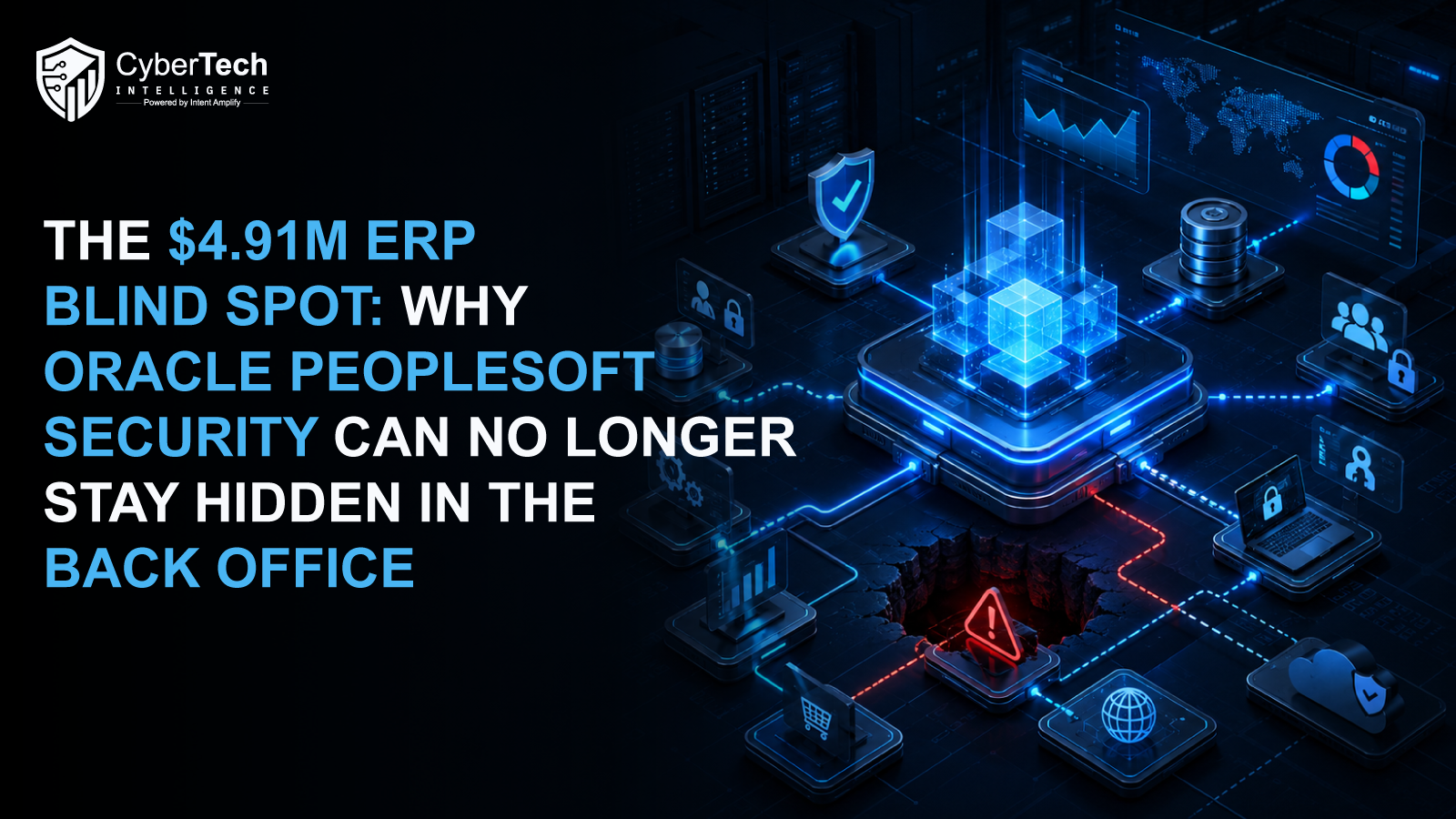
That is the blind spot behind the $4.91 million risk signal. When third-party and supply chain compromise becomes one of the more expensive breach pathways, ERP leaders need more than patch status. They need evidence of exposure, access control, vendor governance, monitoring coverage, incident response readiness, and business impact.¹
The next stage of ERP vulnerability management should move from “Was the patch completed?” to “Can leadership see which ERP risks remain active, who owns them, and what control evidence reduces the impact?”
The PeopleSoft Security Gap Leaders Should Close First
The first gap is asset and exposure visibility.
Security teams should know every PeopleSoft instance, every PeopleTools version, every internet-facing endpoint, every administrator console, and every support path. Non-production environments should not be ignored because test and development systems can still contain sensitive data, integration credentials, or poorly governed access paths.
The second gap is privileged access.
PeopleSoft environments often include administrators, database administrators, batch jobs, service accounts, emergency accounts, and vendor support accounts. A critical vulnerability becomes more damaging when attackers can use overprivileged accounts or weakly monitored support channels to deepen access.
The third gap is third-party access governance.
ERP ecosystems are rarely self-contained, and external providers often play a direct role in implementation, maintenance, hosting, integration, and support. Security leaders should know which vendors can connect, what they can reach, whether sessions are logged, whether access is time-bound, and whether emergency access is reviewed after use.
The fourth gap is ERP monitoring.
PeopleSoft investigation requires usable evidence across web logs, application logs, identity logs, database activity, privileged access systems, network telemetry, and endpoint controls. Because Google Cloud’s Mandiant observed activity across 14 days, historical log availability becomes essential for confirming or ruling out exposure.²
CyberTech Intelligence ERP Exposure Framework™
The CyberTech Intelligence ERP Exposure Framework™ gives CISOs, CIOs, ERP owners, and risk leaders a practical way to evaluate hidden exposure across PeopleSoft and other ERP environments. It connects technical vulnerability management with privileged access, vendor governance, monitoring evidence, patch exceptions, and executive risk reporting.
|
ERP Exposure Area |
What Often Goes Unseen |
Executive Impact |
|
PeopleTools Versioning |
Affected versions may exist across production, test, development, or support environments. |
Exposure may remain active even after public remediation guidance is issued. |
|
Privileged Access |
Service accounts, administrator accounts, emergency accounts, and vendor accounts may have excessive permissions. |
Attackers can expand the blast radius after initial access. |
|
Third-Party Support |
External teams may retain broad, persistent, or poorly monitored access. |
Vendor risk becomes a direct ERP breach pathway. |
|
Monitoring Coverage |
Logs may be incomplete, unavailable, poorly retained, or difficult to search. |
Incident response decisions become slower and less defensible. |
|
Patch Exceptions |
Delays may remain inside technical queues without business-owner visibility. |
Leadership may unknowingly accept material ERP risk. |
|
Business Process Dependency |
Payroll, finance, HR, procurement, reporting, and regulated workflows may depend on exposed systems. |
ERP incidents can disrupt business continuity and board-level operations. |
This framework should be used as a working model for executive reporting. Boards do not need deep technical detail on PeopleTools internals, but they do need evidence that ERP exposure is known, prioritized, controlled, reviewed, and connected to business impact.
ERP Security Response Flow
Critical PeopleSoft Advisory Identified
↓
Confirm PeopleTools Versions and ERP Exposure
↓
Map Business Processes and Data Sensitivity
↓
Review Privileged, Service, and Third-Party Access
↓
Apply Patch or Compensating Control
↓
Search Logs Across the Exposure Window
↓
Document Exceptions, Control Evidence, and Business Owners
↓
Report Residual Risk to Leadership
This flow converts ERP vulnerability management from a technical patch task into a business-risk workflow. It also helps reduce confusion during a live incident, when security, ERP operations, identity teams, legal, compliance, vendors, and business owners may all need to act quickly with evidence.
What CISOs Should Ask This Week
CISOs should ask ERP owners to confirm where PeopleSoft is running, which PeopleTools versions are present, which systems are externally reachable, and which business processes depend on each instance. They should ask identity teams to validate privileged users, service accounts, emergency access paths, and vendor accounts. They should ask security operations teams whether PeopleSoft logs are collected, searchable, retained, and mapped to likely exploitation behavior.
Risk leaders should also ask whether every patch delay has a named owner, compensating control, expiry date, and executive approval. Not every ERP patch can be applied instantly, especially when payroll, finance close, academic administration, or regulatory reporting windows are active. However, an untracked delay is not a risk decision. It is an unmanaged exposure.
Closing Perspective
The $4.91 million ERP blind spot is not only a cost figure. It is a reminder that third-party and supply chain compromise can become materially expensive when critical business systems are involved. Oracle PeopleSoft security now requires the same executive discipline that organizations apply to identity security, cloud exposure, ransomware readiness, and incident response. ¹
The PeopleSoft zero-day showed that ERP platforms can no longer be treated as quiet systems behind the business. They are part of the enterprise risk surface because they hold operational value, regulated data, financial workflows, and trusted access paths.
Based on CyberTech Intelligence research and analysis, ERP security should be measured by exposure reduction, not by patch activity alone. The organizations that are best prepared will be able to answer four questions with evidence: where are we exposed, what business processes are at risk, who can access the environment, and how quickly can we detect, contain, and report suspicious activity?
Request an ERP Exposure Assessment
Oracle PeopleSoft security is no longer only a patch management issue. It is an enterprise exposure question involving privileged access, third-party support, business process dependency, monitoring coverage, incident readiness, and residual risk evidence.
CyberTech Intelligence helps CISOs, CIOs, ERP owners, risk leaders, and compliance teams evaluate ERP exposure before hidden dependencies become breach pathways. An ERP Exposure Assessment can help leadership identify exposed PeopleSoft instances, validate PeopleTools versions, review privileged and third-party access, assess monitoring coverage, document patch exceptions, and prepare board-ready ERP risk reporting.
Request an ERP Exposure Assessment to understand where ERP risk remains active, who owns it, and what evidence supports executive decision-making.
References
- Oracle, Security Alert Advisory: CVE-2026-35273, June 2026
https://www.oracle.com/security-alerts/alert-cve-2026-35273.html - Rapid7, Active Exploitation of Oracle PeopleSoft Zero-Day CVE-2026-35273, June 2026
https://www.rapid7.com/blog/post/etr-active-exploitation-of-oracle-peoplesoft-zero-day-cve-2026-35273/ - Google Cloud / Mandiant, M-Trends 2026 Report, 2026
https://cloud.google.com/security/resources/m-trends-executive-edition - IBM, Cost of a Data Breach Report 2025, 2025
https://www-api.ibm.com/adobe/assets/urn%3Aaaid%3Aaem%3A607b9590-38e0-4c91-b433-aa8a17f5b5e8/original/as/cost-of-a-data-breach-2025-full-report.pdf? - Microsoft, Microsoft Digital Defense Report 2025, 2025
https://cdn-dynmedia-1.microsoft.com/is/content/microsoftcorp/microsoft/final/en-us/microsoft-brand/documents/Microsoft%20Digital%20Defense%20Report%202024%20%281%29.pdf?


