Executive Summary
Business email compromise (BEC) has moved into a more deceptive phase. The goal remains familiar: persuade an employee to approve a payment, disclose sensitive information, alter vendor banking details, or accept an executive instruction without proper validation. What has changed is the credibility of the impersonation. Generative AI now allows attackers to combine polished writing, cloned voices, synthetic video, and publicly available executive context into fraud sequences that can look and sound operationally normal.
The strategic risk is that synthetic trust fraud can exploit legitimate business processes without triggering conventional cyber alarms. A well-crafted AI-BEC attempt may not contain malware, suspicious links, or obvious spoofing indicators. Instead, it can move through familiar approval paths by imitating authority, urgency, and business context. This makes control design more important than message inspection alone. Enterprises should therefore treat AI-enabled BEC as a financial governance issue as much as a security issue. The priority is to ensure that no payment, vendor change, access request, or executive instruction can advance without independent, documented verification.
The financial exposure is already material. The FBI Internet Crime Complaint Center recorded $3.046 billion in reported BEC-related losses in 2025, making BEC one of the most damaging forms of cyber-enabled fraud affecting U.S. victims. Reported losses should be treated as a floor because many victims do not file complaints. [1]
For CISOs, CFOs, and risk committees, the implication is clear. AI-enabled BEC cannot be managed only through email filtering, annual awareness training, or informal callback habits. The attack increasingly targets payment governance, executive communication norms, vendor-change controls, and the human tendency to trust familiar authority signals under pressure.
Why Synthetic Impersonation Is Changing the BEC Model
BEC has always depended on trust. Traditional campaigns exploited hierarchy, urgency, and routine finance processes. A fraudulent email from a spoofed executive account could work if it arrived during a close cycle, referenced a plausible transaction, or pressured an employee to act before asking questions. Security awareness programs responded by teaching employees to identify generic greetings, grammatical errors, suspicious sender domains, and unusual urgency.
That model is losing reliability. AI-generated content removes many of the weak signals employees were trained to detect. Modern impersonation messages can match an executive’s tone, use clean business language, reference public priorities, and adapt quickly to the recipient’s role. In many cases, the message no longer looks like a scam. It looks like a normal request moving through a familiar approval path.
Industry reporting has estimated that AI-generated content is now present in a significant share of phishing and BEC activity. Hoxhunt’s 2026 Phishing Trends Report shows how quickly AI-generated email threats are scaling. After remaining at roughly 1% to 4% of reported phishing threats for most of 2025, AI-generated phishing surged to 56% of reported attacks in December 2025 before settling at 40% in January 2026. While this dataset covers phishing broadly rather than BEC alone, it is a more recent indicator that attackers are increasingly using AI to produce convincing, filter-resistant email lures. [2]
KnowBe4 reported that 82.6% of analyzed phishing emails showed some use of AI in early 2025. These figures should be interpreted as vendor-observed indicators, not universal market measurements, but they point in the same direction of travel: attackers are using AI to remove linguistic friction and scale personalization. [3]
The enterprise exposure is not limited to compromised inboxes. Executive interviews, earnings calls, conference presentations, podcasts, webinars, and social posts can all provide material for impersonation. For organizations with visible leadership teams, public presence now has a fraud-risk dimension. The risk is that organizations fail to account for how that public material can be operationalized against finance, procurement, legal, help desk, and executive-support teams.
How Deepfakes Alter the Attack Sequence
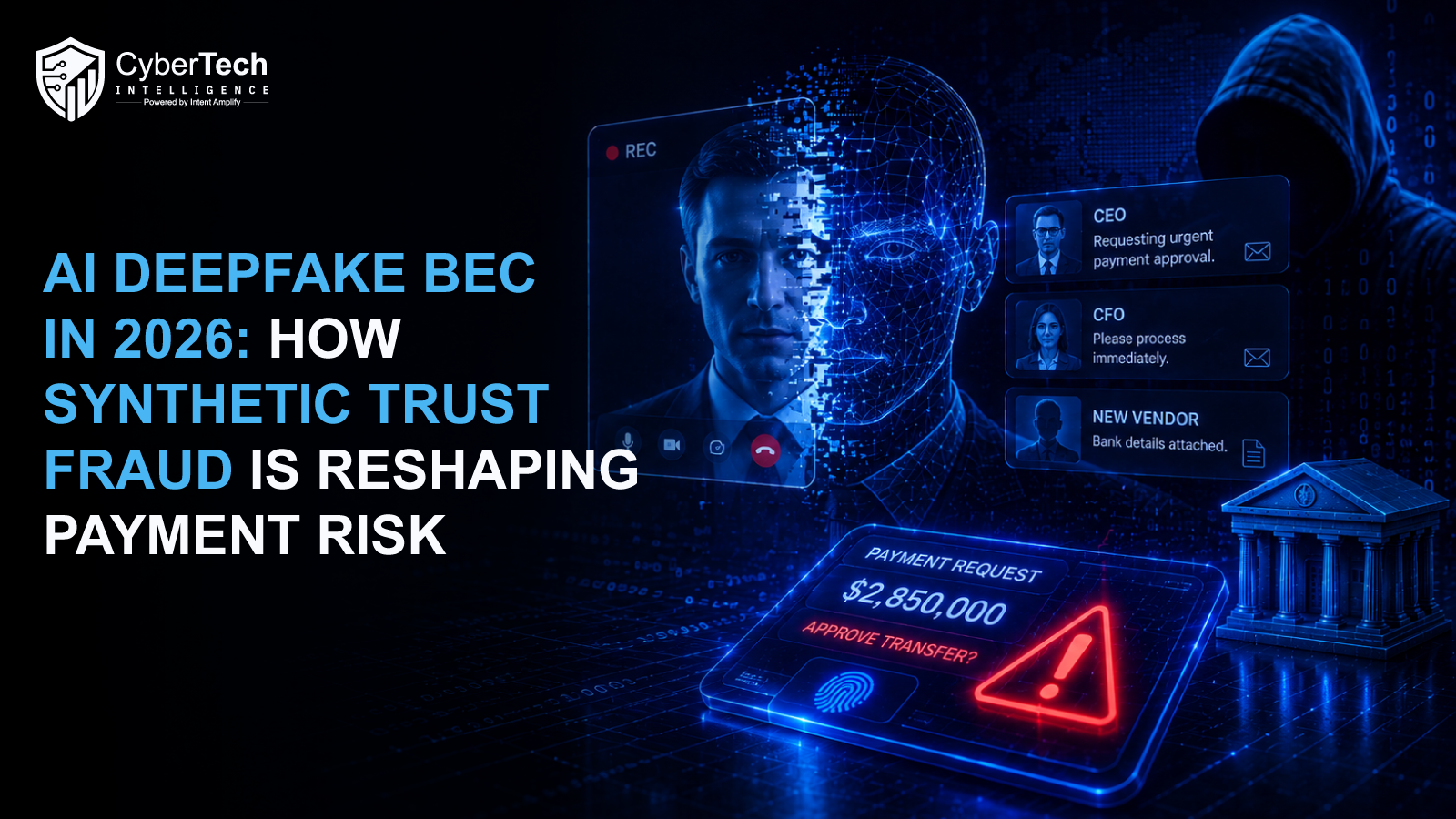
The classic BEC sequence was linear: send an email, create urgency, request payment, and move funds quickly. AI-enabled BEC is more layered. Attackers can now use multimodal sequences in which email, voice, chat, and video reinforce one another. A finance employee may first receive a precise email that appears to come from a senior executive. A cloned voice call may then confirm the request. In higher-value cases, the victim may be pulled into a video meeting where synthetic participants appear to validate the instruction.
Deepfakes also change the timing of doubt. In a traditional BEC attempt, suspicion often begins when the recipient notices an unusual sender, rushed wording, or an unexpected payment request. In a synthetic sequence, those doubts may be delayed because each interaction appears to validate the one before it. The email explains the business reason, the voice call adds authority, and the meeting environment creates social pressure. By the time the employee reaches the approval step, the fraud may feel internally consistent. This is why control design must focus on interrupting the sequence before decision pressure becomes operational compliance.
A believable email becomes more credible after a convincing call. A cloned voice becomes harder to challenge when the request references a real project. A synthetic video meeting can suppress skepticism by simulating multiple authority figures. The attack is not simply technical; it is behavioral engineering supported by synthetic media.
The Arup incident remains the clearest public warning. In 2024, a finance employee reportedly authorized transfers totaling about $25 million after joining what appeared to be a legitimate video call with company leadership. The participants were synthetic, and the fraud was discovered only after the employee contacted corporate headquarters through a separate channel. [4]
That case illustrates the control failure. The employee did not lack access to technology. What failed was the verification model: the process allowed synthetic authority to substitute for independent confirmation. If a payment workflow accepts email, voice, or video appearance as sufficient proof of authority, the workflow is vulnerable.
The Economics of Synthetic Fraud
Capability no longer maps cleanly to attacker sophistication. A campaign that once required strong language skills, manual reconnaissance, and social-engineering discipline can now be assembled from low-cost services. Criminal marketplaces increasingly package identity material, synthetic media tools, and unrestricted language models as low-friction services.
Recent analysis shows that threat actors are commercializing AI-enabled fraud tooling. Group-IB identified at least three active Dark LLM vendors offering subscriptions ranging from $30 to $200 per month, indicating that unrestricted language-model access is becoming part of the underground cybercrime service economy. Pricing should be treated as an indicative marketplace signal rather than a fixed benchmark because underground offerings change quickly by seller, capability, and access model. [5]
DeepStrike reported that deepfake files grew from approximately 500,000 in 2023 to about 8 million in 2025. That estimate suggests a sharp expansion in available synthetic content, although organizations should treat cross-market deepfake-volume estimates as directional rather than exact because definitions and collection methods vary. [7]
Voice cloning is especially relevant for BEC because many payment approvals still rely on verbal confirmation. DeepStrike and other industry sources have reported that a usable voice clone with an 85% acoustic match can be generated from as little as three seconds of source audio. Executives with public audio exposure should assume their voices can be modeled. [7]
Financial Exposure and Recovery Risk
BEC is financially damaging because it converts trust into a legitimate-looking payment movement. Funds may be approved by a real employee, processed through legitimate banking rails, and routed through accounts designed to defeat recovery.
The time dimension is severe. One industry compilation cites a 308-hour median time to detect a BEC attack, equal to nearly 13 days, and reports that only 23% of BEC wire transfers are recovered, down from 29% in 2023. These figures should be presented as reported indicators because the cited article attributes them to Agari and FBI IC3. Even with that caveat, the operational lesson is sound: recovery windows are shorter than many detection timelines. [6]
Why Existing Detection Controls Fall Short
Many enterprise controls were designed around the email channel. Secure email gateways, DMARC enforcement, link analysis, attachment sandboxing, and reporting buttons remain necessary. They reduce exposure to traditional phishing and account impersonation. They do not fully address AI-enabled BEC because the decisive moment in BEC is not always when the message arrives.
The attack has shifted from message delivery to decision manipulation. That shift matters because the decisive moment in BEC is when an employee changes a vendor record, approves a transfer, resets access, shares sensitive information, or accepts an executive instruction without independent validation. The security problem, therefore, extends beyond the inbox into financial workflow design.
Caller ID does not solve the problem because it can be spoofed. Email confirmation does not solve it if the account is compromised, the domain is a lookalike, or the employee is replying inside an attacker-controlled thread. Voice recognition by familiarity is no longer reliable when cloning tools can reproduce tone, cadence, and accent with increasing accuracy.
CyberTech Intelligence Enterprise Financial Trust Framework™
The strongest BEC control is enforceable verification. Training can prepare employees to recognize risk, but employees under pressure often follow established process patterns. If the process allows exceptions, attackers will exploit those exceptions. If the process requires independent confirmation before payment release, the attacker must defeat a much harder control.
Executive payment protocols should be explicit. High-value wire transfers, payment destination changes, urgent vendor requests, and confidential transaction-related payments should never be approved through email, voice, video, chat, or meeting presence alone. A trusted secondary channel should be mandatory. The verification contact should come from an internal system of record, not from the requesting message, email signature, meeting invite, or caller ID.
Code phrases can add protection for executive financial requests if they are governed carefully, rotated when exposure is suspected, and not treated as a substitute for dual approval. They help employees challenge unusual voice or video interactions without creating confrontation. The point is to normalize verification as a business control rather than frame it as employee suspicion.
Training also needs to change. Employees should not only read about deepfakes; they should experience realistic simulations. Finance, treasury, procurement, executive assistants, legal operations, help desk staff, and senior administrators require scenario-based exercises involving cloned voices, synthetic meeting invitations, urgent payment pressure, and vendor bank-change requests. The objective is not fear. It is pattern recognition under pressure.
Executives have a role as well. Public-facing leaders should understand that their digital presence creates impersonation material. Organizations should map high-exposure executives and define approved channels for financial instruction. Any deviation from those channels should trigger escalation.
90-Day Roadmap for AI-Aware BEC Defense
The fastest path to reducing AI-BEC exposure is to strengthen the transaction workflow before depending on advanced detection. Every successful payment-fraud event needs a completion point. For BEC, that point is usually approval, vendor-record change, or release of funds.
Board-Ready Questions for CISOs and CFOs
|
Executive Question |
Why It Matters |
|
Can a high-value payment be approved based only on email, voice, video, or chat? |
Tests whether synthetic media can bypass payment governance. |
|
Which executives have enough public audio or video exposure to be impersonated? |
Identifies high-risk material for deepfakes. |
|
Are vendor banking changes verified through a trusted system of record? |
Reduces supplier-payment fraud exposure. |
|
Can finance detect abnormal payment behavior within a couple of days? |
Improves recovery probability before funds are laundered. |
|
Do help desk and finance teams have escalation rules for suspected synthetic impersonation? |
Prevents pressure-based exceptions. |
|
Have high-risk employees experienced realistic deepfake simulations? |
Measures readiness beyond awareness training. |
Strategic Takeaway
AI deepfakes do not change the business objective of BEC. They change the credibility, speed, and scale of the deception. The attacker’s advantage now comes from making fraudulent instructions feel procedurally normal. A request can arrive in familiar language, reference a real business context, and be reinforced by a synthetic voice or video interaction that reduces the employee’s willingness to pause.
This means the BEC defense has to move closer to the transaction. Email filtering, domain controls, and awareness training remain important, but they are no longer sufficient when the decisive risk occurs inside finance, procurement, legal, HR, or executive-support workflows. The control question is not only whether the organization can detect a suspicious message. It is whether a fraudulent instruction can travel through the business process far enough to alter vendor data, release funds, or approve privileged access.
The most resilient organizations will treat verification as an operating discipline. They will define trusted callback channels, restrict emergency exceptions, monitor behavioral anomalies, and test high-risk teams against realistic synthetic scenarios. They will also make verification culturally acceptable, so employees understand that pausing an urgent executive request is not resistance; it is risk control.
In the synthetic fraud era, trust cannot depend on recognition alone. Familiar voices, polished writing, and convincing video presence must be treated as signals, not proof. The organizations best prepared for the era of synthetic trust fraud will redesign payment authorization around independently verifiable evidence, governed workflows, and measurable financial controls. In doing so, they will strengthen enterprise resilience, preserve stakeholder trust, and reduce operational exposure to AI-enabled deception.
Strengthen Your Defense Against AI-Driven BEC
CyberTech Intelligence helps enterprises assess and respond to emerging cyber risks through research-led insight, executive-level analysis, and practical security guidance.
As AI deepfakes, cloned voices, and synthetic impersonation reshape business email compromise, organizations need stronger controls across payment verification, executive-risk mapping, fraud detection, and governance.
CyberTech Intelligence can support security leaders with actionable threat analysis, AI-aware fraud defense strategies, control recommendations, and board-ready briefings aligned with enterprise risk priorities.
Reduce exposure before synthetic deception becomes financial loss.
Connect with us
References
- Federal Bureau of Investigation (2025) Internet Crime Report 2025. Available at: https://www.ic3.gov/AnnualReport/Reports/2025_IC3Report.pdf.
- Hoxhunt (2026) Phishing Trends Report 2026. Available at: https://hoxhunt.com/lp/phishing-trends-report-2026.
- KnowBe4 (2025) New KnowBe4 Report Reveals a Spike in Ransomware Payloads and AI-Powered Polymorphic Phishing Campaigns. Available at: https://www.knowbe4.com/press/new-knowbe4-report-reveals-a-spike-in-ransomware-payloads-and-ai-powered-polymorphic-phishing-campaigns.
- Elliott, D. (2025) ‘This Happens More Frequently Than People Realize’: Arup Chief on the Lessons Learned from a $25m Deepfake Crime. World Economic Forum. Available at: https://www.weforum.org/stories/2025/02/deepfake-ai-cybercrime-arup/.
- Group-IB (2026) Weaponised AI Is Powering the Fifth Wave of Cybercrime, Group-IB Warns. Available at: https://www.group-ib.com/media-center/press-releases/weaponised-ai-cybercrime/.
- Medhacloud (2026) 52 Email Security Statistics for 2026 — BEC, Spam & Phishing. Available at: https://medhacloud.com/blog/email-security-statistics-2026.
- DeepStrike (2025) Deepfake Statistics 2025. Available at: https://deepstrike.io/blog/deepfake-statistics-2025.