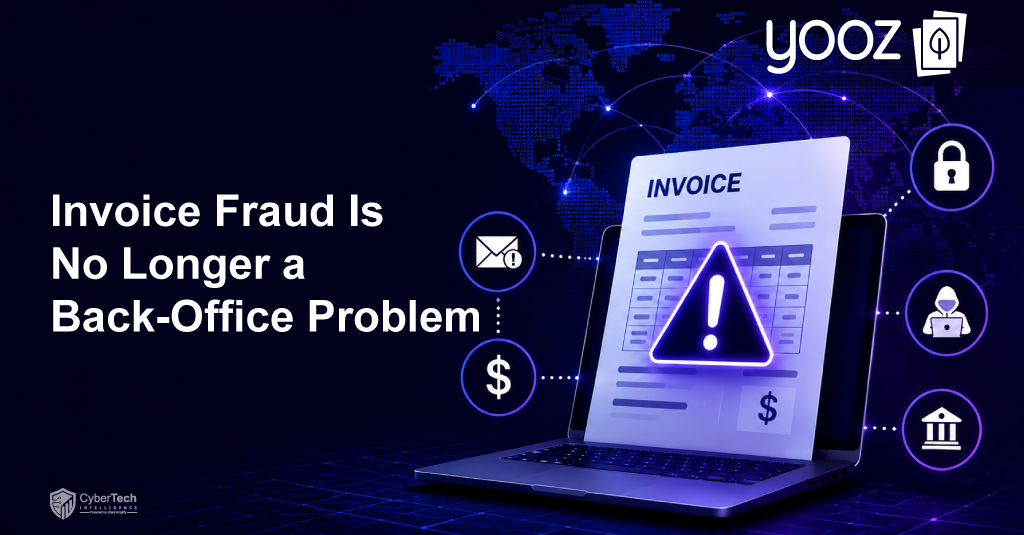
Most finance teams have a process for catching fraud, but few have a process that catches it early enough. By the time they discover a manipulated invoice through an audit, a lender’s due diligence, or a vendor dispute, the damage is usually done.
A recent case revealed just how severe the problem can be. Investigators examining a roughly $400 million private-credit loan allegedly backed by fake invoices discovered lookalike email domains used during invoice confirmations. A small, easy-to-miss detail exposed how easily fraud can make its way through financial workflows, and how far upstream the consequences can reach.
That’s the new reality finance leaders are dealing with. Invoice fraud reaches well beyond basic accounts payable errors or vendor disputes and can affect lending decisions, receivables-backed financing, and risk management throughout the financial system. As private credit and asset-based lending continue to grow, the reliability of invoices and receivables data becomes a foundation for capital allocation.
That puts more pressure on companies to tighten controls and verify invoices earlier, before payments go out or receivables are used to support financing.
How Invoice Fraud Happens Today
As digital finance systems have evolved, so have invoice fraud schemes. The tactics are often subtle, though the same patterns keep showing up in investigations and internal audits:
- Lookalike email domains used during invoice confirmations or payment instructions
- Vendor impersonation, where attackers pose as legitimate suppliers requesting payment updates
- Bank detail changes submitted through routine vendor update requests
- Duplicate or inflated invoices inserted into high-volume payment queues
- False confirmation loops, where invoice verification occurs through compromised communication channels
The weakness behind each tactic is the same. Finance teams still rely heavily on email, spreadsheets, and manual checks to confirm financial documents. Those methods were easier to manage when transaction volume was lower and vendor networks were simpler. At current scale, their limits are much harder to ignore.
Why Manual Diligence Breaks Down
Most companies still depend on human review as the main defense against fraud. The finance team examines invoices, confirms vendor details, and reconciles payment records. While these checks are important, they don’t hold up well against the sheer volume of transactions most teams handle.
First, human review is episodic. It often occurs at approval checkpoints or during month-end reconciliation. Fraud attempts that fall between those checkpoints can proceed unnoticed.
Second, high-volume workflows don’t allow for close review. Accounts payable teams may process hundreds of invoices per day. Small changes, such as altered fonts or edited metadata, are easy to miss under that kind of pressure.
Third, communication channels can be compromised. Email confirmations that appear independent may actually originate from spoofed domains or redirected addresses.
These challenges explain why many organizations now treat invoice fraud as a systemic risk rather than an isolated accounting issue.
Controls That Reduce Fraud Risk
The solution for many finance teams and lenders is to rely on layered controls that combine operational discipline with automated monitoring. The goal is to catch irregularities early without slowing payments to a crawl. In many cases, accounts payable automation platforms support that work by standardizing workflows and flagging anomalies sooner.
Common safeguards include:
Vendor onboarding gates
New vendors undergo structured verification before entering payment systems. Teams confirm details like legal identity and tax information through independent sources rather than vendor-provided documents alone.
Validation checkpoints
Invoice details are checked against purchase orders, contract terms, and historical payment patterns. Any mismatch in amounts or banking information triggers a closer review before approval.
Segregation of duties
Instead of having a single person oversee the entire process, different individuals on the team manage vendor setup and payment authorization. Separating responsibilities reduces the risk of internal collusion or a single point of failure.
Automated audit trails
Digital records track document uploads, edits, approvals, and payment activity. That gives investigators a clear record of what changed and when.
Payment-status reconciliation
Finance teams reconcile payment records against vendor confirmations and bank statements. This process identifies duplicate payments or unusual account changes.
These practices share the same objective to detect fraud earlier well before the organization distributes funds..
Continuous Monitoring After Financing
Invoice fraud becomes particularly dangerous when invoices support financing arrangements. Receivables-backed lending depends on the assumption that invoices represent legitimate obligations. If those invoices are fabricated or manipulated, lenders can take on significant exposure.
In response, financial institutions are starting to monitor receivables data continuously rather than relying solely on diligence performed at the time of loan origination. That can include:
- Tracking invoice issuance patterns across vendors and time periods
- Reviewing payment confirmation channels for domain inconsistencies
- Comparing receivables data against operational metrics such as shipment records or contract volumes
- Monitoring changes to customer or vendor banking information
These checks make it easier to catch irregularities that appear after a financing agreement is already in place.
Practical Steps Without Major System Changes
Strengthening invoice verification doesn’t always require replacing existing systems. In many cases, the fastest gains come from better process design and tighter governance.
Formalize vendor verification procedures.
Require independent confirmation for vendor onboarding and banking updates. Calling a known contact is still one of the most reliable safeguards.
Standardize invoice intake channels.
Centralized submission portals reduce reliance on scattered email threads and improve document traceability.
Introduce automated anomaly alerts.
Simple monitoring rules can flag unusual invoice amounts, duplicate submissions, or sudden vendor account changes.
These steps improve visibility without forcing a full accounting-system overhaul.
A Shared Responsibility Across Finance
Large-scale invoice fraud shows how closely operational controls and financial risk are connected. Accounts payable teams are the first line of defense, and treasury, compliance, and lending teams rely on the accuracy of the data those workflows generate.
Modern fraud schemes exploit gaps between those functions. Strengthening invoice verification requires coordination between payment operations and financial reporting.
As invoice integrity becomes essential to the broader financial ecosystem, accounts payable takes on a more strategic role. Safeguarding those workflows now demands the same level of attention given to any other core financial control.