
Executive Summary
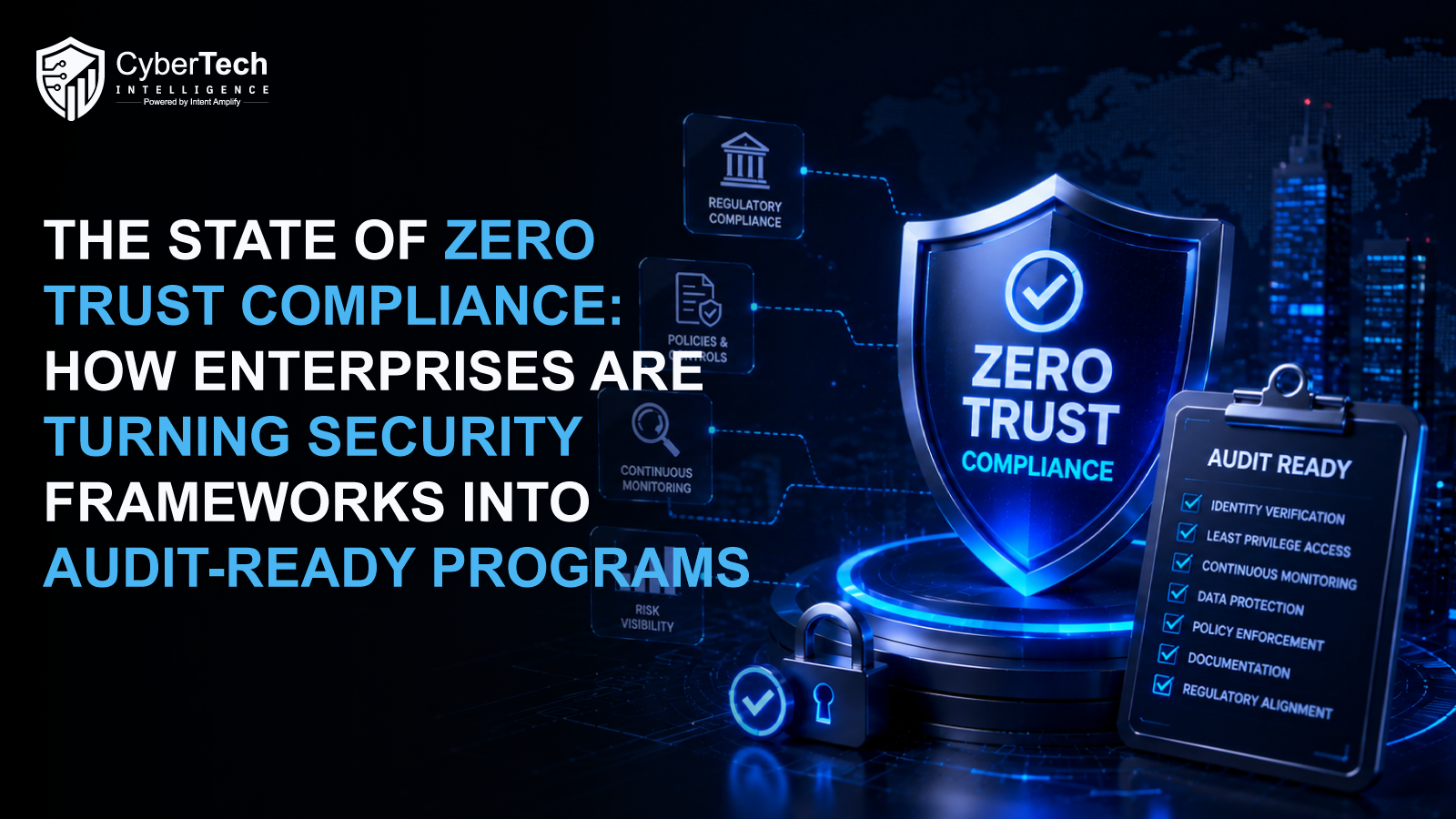
Zero Trust has moved from architecture language into the operating discipline of governance, audit readiness, and cyber risk management. For CISOs, CTOs, and technology leaders, the practical question is whether Zero Trust can be translated into measurable controls, defensible evidence, policy enforcement, and board-ready assurance across hybrid infrastructure, cloud workloads, third-party access, remote users, SaaS environments, and identity estates.
The state of Zero Trust Compliance reflects a necessary shift from security design to control proof. Enterprises are no longer treating Zero Trust Implementation as a one-time transformation program. They are turning it into a governance framework that connects Identity Security, Zero Trust Network Access, least-privilege enforcement, cybersecurity compliance, continuous monitoring, and audit evidence into a repeatable operating model. Audit readiness is not achieved through policy alone. It requires control ownership, telemetry integrity, access governance, risk-based enforcement, exception management, and evidence that allows internal audit, regulators, insurers, customers, and executive committees to understand what is protected and where residual exposure remains.
The execution gap is already visible. Cybersecurity Insiders/HPE found that 82% of security and technology leaders view Universal Zero Trust Network Access as essential, yet only 17% have fully implemented it, exposing a gap between strategic intent and enforceable operating maturity. [1]
Zero Trust Compliance is becoming the bridge between security architecture and defensible governance. The organizations advancing fastest are not treating Zero Trust as a product category. They are treating it as a control discipline that must be mapped, measured, tested, documented, and improved over time. Organizations rarely struggle with Zero Trust because of missing technologies. Most execution failures stem from fragmented ownership, inconsistent access governance, poor entitlement visibility, and the inability to generate evidence across identity, infrastructure, cloud, and compliance functions. As a result, Zero Trust maturity is increasingly determined by governance discipline rather than technology deployment.
Research Objective and Source Approach
This report examines how enterprises are converting Zero Trust frameworks into audit-ready programs, with attention to Zero Trust Maturity, control evidence, NIST Zero Trust alignment, Identity Security, ZTNA, Secure Remote Access, and Zero Trust ROI. Foundational frameworks such as NIST Zero Trust Architecture, NIST CSF, and CISA’s maturity model remain important because they translate technical architecture into governance and risk language. Current market and threat data clarify where execution remains fragmented and why CISOs should frame Zero Trust Readiness as an evidence-led governance priority.
Why Zero Trust Compliance Is Becoming a Board-Level Discipline
Zero Trust was initially discussed as a security model for removing implicit trust from networks, applications, users, and devices. That remains technically accurate, but it is no longer sufficient for enterprise leadership. The board-level concern is not whether the organization has adopted Zero Trust Security principles in theory. The concern is whether the enterprise can demonstrate that access decisions are continuously validated, privileged accounts are governed, remote access is controlled, policy exceptions are documented, and evidence exists to support a Security Audit or Compliance Audit.
Zero Trust compliance has become more strategic because security leaders are now expected to prove that implementation supports measurable outcomes such as reduced breach impact, improved access governance, stronger incident containment, better audit evidence, and more disciplined security investment.
For multinational enterprises, the compliance environment is not contained inside one jurisdiction. Across the United States, Europe, the United Kingdom, the Middle East, and APAC, the core assurance question is consistent: can the organization prove that access to sensitive data and critical systems is governed, monitored, restricted, reviewed, and supported by evidence?
The Execution Gap: Accepted Faster Than Operationalized
The hardest issue in the current market is operational translation. A Zero Trust Framework touches identity, endpoint, network, cloud, application, data, monitoring, and governance domains at once. No single team owns the full control chain, which is why audit readiness becomes difficult.
In many enterprises, Zero Trust Implementation begins with a technically sound initiative, such as replacing broad virtual private network access with application-specific ZTNA or expanding MFA coverage for critical applications. These are sensible starting points, but they become compliance assets only when they produce durable evidence. A policy stating that access is risk-based does not prove that risk-based access is operating. Audit readiness requires logs, access decisions, device posture records, exception workflows, control owners, review cycles, and proof that failed controls were corrected.
The execution gap is also a maturity gap. Leaders may know that Zero Trust matters, but they may not have a clear view of control coverage, enforcement consistency, exception volume, entitlement risk, or user groups that remain outside the architecture. This is why the next stage of Zero Trust Maturity will depend less on broad commitments and more on evidence-grade measurement.
Identity Security Is the First Audit Boundary
Identity has become the first practical boundary for Zero Trust because attackers increasingly do not need to break through the perimeter when they can enter through legitimate credentials, session tokens, compromised accounts, service identities, or over-permissioned cloud roles. For audit and compliance teams, this changes the evidence burden. It is not enough to show that an IAM platform exists. The enterprise must demonstrate that identities are known, classified, protected, monitored, and governed according to risk.
Recent incident evidence supports this priority. Sophos reported that 67% of incidents investigated by its incident response and managed detection and response teams were rooted in identity-related attacks. [2]
Microsoft also reported that identity-based attacks rose 32% in the first half of 2025, reinforcing that identity compromise is not a peripheral risk but a central enterprise attack path. [3]
A mature Identity Security program should account for workforce users, privileged administrators, contractors, developers, third-party users, service accounts, workloads, machine identities, and automated processes that interact with enterprise systems. The larger the identity estate becomes, the harder it is to defend static access models. Zero Trust Maturity depends on whether identity context can be used continuously across access decisions, not simply at login.
The strongest programs establish identity control and ownership across security, IT, HR, procurement, application owners, and business managers. Without that ownership, identity becomes everyone’s responsibility and no one’s accountable control domain.
Excess Privilege Is Where Audits Often Break
Zero Trust Architecture is built around least privilege, but least privilege is one of the hardest principles to maintain in large enterprises. Access accumulates over time. Employees change roles. Contractors remain active after projects end. Service accounts are created for urgent operational reasons and then forgotten. Cloud permissions expand faster than they are reviewed. Exceptions become permanent because no one owns their expiration.
Cybersecurity Insiders/HPE found that 52% of organizations report excessive access privileges as widespread across their environment. That finding goes directly to Zero Trust Compliance because excessive privilege is both a technical exposure and an audit weakness. It undermines least privilege, increases lateral movement risk, complicates incident containment, and weakens the evidence trail when auditors ask whether access is appropriate and periodically reviewed. [1]
The audit-ready response is not simply to run an annual access certification and declare the problem managed. Enterprises need risk-based entitlement review across privileged accounts, business-critical applications, cloud roles, third-party accounts, service accounts, and administrative groups.
ZTNA and Secure Remote Access Are Becoming Compliance Controls
Zero Trust Network Access is often introduced as a Secure Remote Access modernization initiative, particularly when enterprises replace broad VPN access with application-specific access controls. That starting point is reasonable, but it understates the compliance value of ZTNA. When implemented correctly, ZTNA creates a more auditable access model because users are authorized for specific applications rather than placed onto broad network segments.
The operational challenge is that traditional remote access models often create evidence problems. VPN access may confirm that a user connected, but it may not provide clear proof of application-level authorization, device posture, session risk, or granular policy enforcement. In contrast, a well-governed ZTNA model can provide stronger audit trails around who accessed which application, from what device, under which policy, at what time, and with what contextual risk signals.
The move to ZTNA also supports cyber risk management in distributed enterprises because hybrid work, third-party operations, offshore support, cloud-hosted applications, and regional business units all require access models that are specific, observable, and revocable.
Reducing Breach Impact Is Now the Executive Argument
The executive case for Zero Trust is strongest when it is tied to breach containment rather than abstract modernization. Cybersecurity Insiders/HPE found that 63% of organizations pursue Zero Trust primarily to reduce breach impact, which shows that enterprise leaders increasingly view the model as a resilience discipline rather than a narrow access-control project. [1]
That framing connects Zero Trust ROI to board-level risk. When access is segmented, privilege is minimized, identity signals are continuously evaluated, and abnormal activity is monitored, the organization improves its ability to reduce blast radius. The objective is not to claim that Zero Trust prevents every incident. It is to make compromise harder to expand and easier to investigate.
MFA Is a Control, but Exceptions Decide Audit Strength
MFA is one of the most visible controls in Zero Trust Compliance because it connects identity assurance, access governance, and breach prevention in a way that executives and auditors can understand. Yet MFA coverage alone does not create maturity. Audit strength depends on where MFA is enforced, which methods are accepted, how exceptions are governed, and whether privileged access receives stronger protection.
Microsoft reported that MFA blocks more than 99% of unauthorized access attempts even when attackers have valid usernames and passwords. That makes MFA one of the clearest examples of a security control with direct compliance and risk relevance, but the real audit question is rarely whether MFA exists. The question is whether coverage is complete for high-risk access, whether exceptions are justified, whether legacy protocols are controlled, whether administrators use stronger methods, and whether failed authentication attempts are monitored. [3]
For CISOs, MFA creates a useful control-evidence opportunity because it can be mapped to Zero Trust Readiness, NIST CSF outcomes, IAM control objectives, privileged access governance, cyber insurance requirements, and customer assurance questionnaires.
The CyberTech Intelligence Audit Evidence Framework
An audit-ready Zero Trust program requires a model that security, risk, compliance, and technology teams can all understand. The model should translate Zero Trust principles into evidence-producing control areas.
|
Audit Evidence Area |
What teams should be able to prove |
|
Identity governance |
Users, privileged accounts, third parties, service accounts, and machine identities are known, reviewed, and governed. |
|
MFA and authentication |
High-risk users and sensitive applications are protected by strong authentication, with documented exceptions. |
|
ZTNA and remote access |
Access is application-specific, policy-based, logged, and tied to user, device, and session context. |
|
Privilege management |
Standing privilege is reduced, excessive access is remediated, and privileged activity is monitored. |
|
Exception governance |
Exceptions have business justification, compensating controls, owners, expiry dates, and review cycles. |
|
Telemetry and monitoring |
Access decisions, failed controls, abnormal activity, and remediation outcomes are retained as evidence. |
|
Third-party access |
Vendor and contractor access is time-bound, least-privilege, monitored, and removed when no longer needed. |
Designed by CyberTech Intelligence research and analysis for practical execution, the checklist helps security and compliance teams avoid a common failure pattern: presenting Zero Trust as a strategic ambition while leaving audit teams to reconstruct evidence from disconnected systems.
The Business Case: Zero Trust ROI Is a Risk and Governance Argument
Zero Trust ROI is often framed too narrowly as tool consolidation or breach cost avoidance. Those arguments are useful, but incomplete. The stronger business case connects Zero Trust to risk reduction, compliance efficiency, operational resilience, user experience, cloud transformation, third-party governance, and faster executive reporting.
The financial argument is becoming harder to ignore. IBM reported that the average cost of a data breach in the United States reached USD 10.22 million in 2025. For US executive teams, that figure changes the conversation. Zero Trust ROI is not only about saving money through technical consolidation. It is about reducing the likelihood that one compromised account, unmanaged exception, or over-permissioned user becomes a material business event. [4]
For the CISO, the ROI narrative should begin with risk. Credential abuse, excessive privilege, unmanaged remote access, third-party lateral movement, inconsistent cloud access, weak device posture, and poor visibility into sensitive application use directly affect breach likelihood, incident response cost, regulatory exposure, customer trust, cyber insurance posture, and board confidence. For the CTO, the ROI narrative also includes architecture simplification because legacy remote access, fragmented network controls, inconsistent identity integrations, and duplicated policy engines create friction for engineering and operations teams.
Executive Zero Trust Scorecard
|
Metric |
Target |
|
MFA Coverage |
>95% |
|
Privileged Accounts Reviewed |
100% Quarterly |
|
Service Account Ownership |
100% |
|
Third-Party Access Review |
Quarterly |
|
ZTNA Coverage |
80%+ Critical Apps |
|
Policy Exceptions |
Declining Trend |
|
Audit Evidence Completeness |
95%+ |
As per CyberTech Intelligence research and analysis
This Executive Zero Trust Scorecard is a board-level governance reference aligned with common Zero Trust principles from NIST, CISA, and Forrester. Targets should be adapted to each organization’s risk profile, maturity, and compliance requirements.
What Audit-Ready Organizations Do Differently
Organizations with mature Zero Trust programs consistently demonstrate five characteristics:
- Identity ownership is clearly assigned.
- Access decisions are evidence-based.
- Privilege reviews occur continuously.
- Exceptions are actively governed.
- Security telemetry is mapped directly to audit requirements.
The difference is not in technology volume. It is governance consistency.
CISO Action Framework for Audit-Ready Zero Trust
As per CyberTech Intelligence research and analysis
A structured approach helps leaders convert ambition into assurance. A Zero Trust program that cannot define ownership, evidence, and review cadence will struggle under audit pressure, regardless of how strong the architecture appears on paper. A structured approach to be audit-ready by CyberTech Intelligence research and analysis
Limitations and Practical Risks
Zero Trust is not a guarantee of breach prevention. It is a disciplined model for reducing implicit trust, improving access decisions, limiting lateral movement, and strengthening control evidence. Programs fail when enterprises overpromise outcomes, underestimate integration complexity, or treat Zero Trust as a purchasing exercise. They also fail when compliance teams are brought in only after technical implementation is complete.
The other major limitation is data quality. Zero Trust depends on reliable identity attributes, device posture signals, asset inventories, application ownership records, data classification, and policy logic. If those foundations are weak, adaptive access decisions may be incomplete or inconsistent. Audit readiness will also suffer because poor data quality produces poor evidence.
CyberTech Intelligence Observation
The next phase of Zero Trust will not be measured by architecture adoption alone. It will be measured by how effectively enterprises can prove that governance is operating through measurable controls, documented evidence, and repeatable assurance processes. Most organizations now accept the principles of Zero Trust. The harder work is converting those principles into operational discipline that can withstand audit scrutiny, support executive decision-making, and reduce enterprise risk before control failures become material events.
For CISOs and CTOs, this creates a strategic opportunity to move Zero Trust from a security architecture initiative into a defensible enterprise governance model. A mature program can unify Identity Security, Zero Trust Network Access, Security Architecture, Cybersecurity Compliance, and executive reporting around one assurance objective: proving that trust is continuously evaluated, access is governed by risk, exceptions are visible, controls are improving, and audit evidence is ready before the audit begins.
CyberTech Intelligence observes that the strongest Zero Trust programs are not defined by the number of tools deployed. They are defined by control ownership, evidence quality, exception governance, identity assurance, and the ability to translate technical maturity into board-ready risk intelligence. As Zero Trust becomes a board-level measure of resilience and accountability, security leaders will need clearer benchmarks, stronger market insight, and practical guidance to prioritize what matters most.
CyberTech Intelligence helps cybersecurity leaders move beyond surface-level security conversations and make sharper decisions across risk, governance, compliance, and enterprise security transformation. For organizations converting Zero Trust frameworks into audit-ready programs, CyberTech Intelligence provides research-led insight, executive analysis, market intelligence, and practical guidance that support stronger identity governance, access assurance, security architecture, and compliance readiness.
CyberTech Intelligence offers Zero Trust Maturity Assessment, Identity Security Gap Analysis, Audit Readiness Review, and Executive Zero Trust Workshop services to help organizations benchmark current maturity, identify control gaps, and prioritize the highest-impact remediation opportunities. Request a consultation to strengthen your Zero Trust program and turn security strategy into audit-ready maturity.
Turn Zero Trust Strategy into Audit-Ready Security Maturity
CyberTech Intelligence helps cybersecurity leaders move beyond surface-level security conversations and make sharper decisions across risk, governance, compliance, and enterprise security transformation. For organizations working to convert Zero Trust frameworks into audit-ready programs, CyberTech Intelligence provides research-led insight, executive analysis, market intelligence, and practical guidance that support stronger identity governance, access assurance, security architecture, and compliance readiness.
As Zero Trust becomes a board-level measure of resilience and accountability, the right intelligence can help security teams prioritize what matters, prove control maturity, and build a more defensible security program.
CyberTech Intelligence offers:
- Zero Trust Maturity Assessment
- Identity Security Gap Analysis
- Audit Readiness Review
- Executive Zero Trust Workshop
Request a consultation to benchmark your current maturity and identify the highest-impact remediation opportunities.
References
- Cybersecurity Insiders and HPE (2026) Zero Trust Report: Bridging the Execution Gap — Unifying Security from Edge to Cloud. Available at: https://www.cybersecurity-insiders.com/wp-content/uploads/2026-HPE-Zero-Trust-Security-Report-by-CSI.pdf.
- Sophos (2026) Active Adversary Report 2026: Identity Attacks Dominate as Threat Groups Proliferate. Available at: https://www.sophos.com/en-us/press/press-releases/sophos-active-adversary-report-2026-identity-attacks-dominate-as-threat-groups-proliferate.
- Microsoft (2025) Microsoft Digital Defense Report 2025: Safeguarding Trust in the AI Era. Available at: https://cdn-dynmedia-1.microsoft.com/is/content/microsoftcorp/microsoft/msc/documents/presentations/CSR/Microsoft-Digital-Defense-Report-2025.pdf#page=1.
- IBM (2025) IBM Report: 13% of Organizations Reported Breaches of AI Models or Applications, 97% of Which Reported Lacking Proper AI Access Controls. Available at: https://newsroom.ibm.com/2025-07-30-ibm-report-13-of-organizations-reported-breaches-of-ai-models-or-applications,-97-of-which-reported-lacking-proper-ai-access-controls.
- NIST (2020) Special Publication 800-207: Zero Trust Architecture. Available at: https://csrc.nist.gov/pubs/sp/800/207/final.
- NIST (2024) The NIST Cybersecurity Framework 2.0. Available at: https://www.nist.gov/cyberframework.
- CISA (2023) Zero Trust Maturity Model Version 2.0. Available at: https://www.cisa.gov/resources-tools/resources/zero-trust-maturity-model.