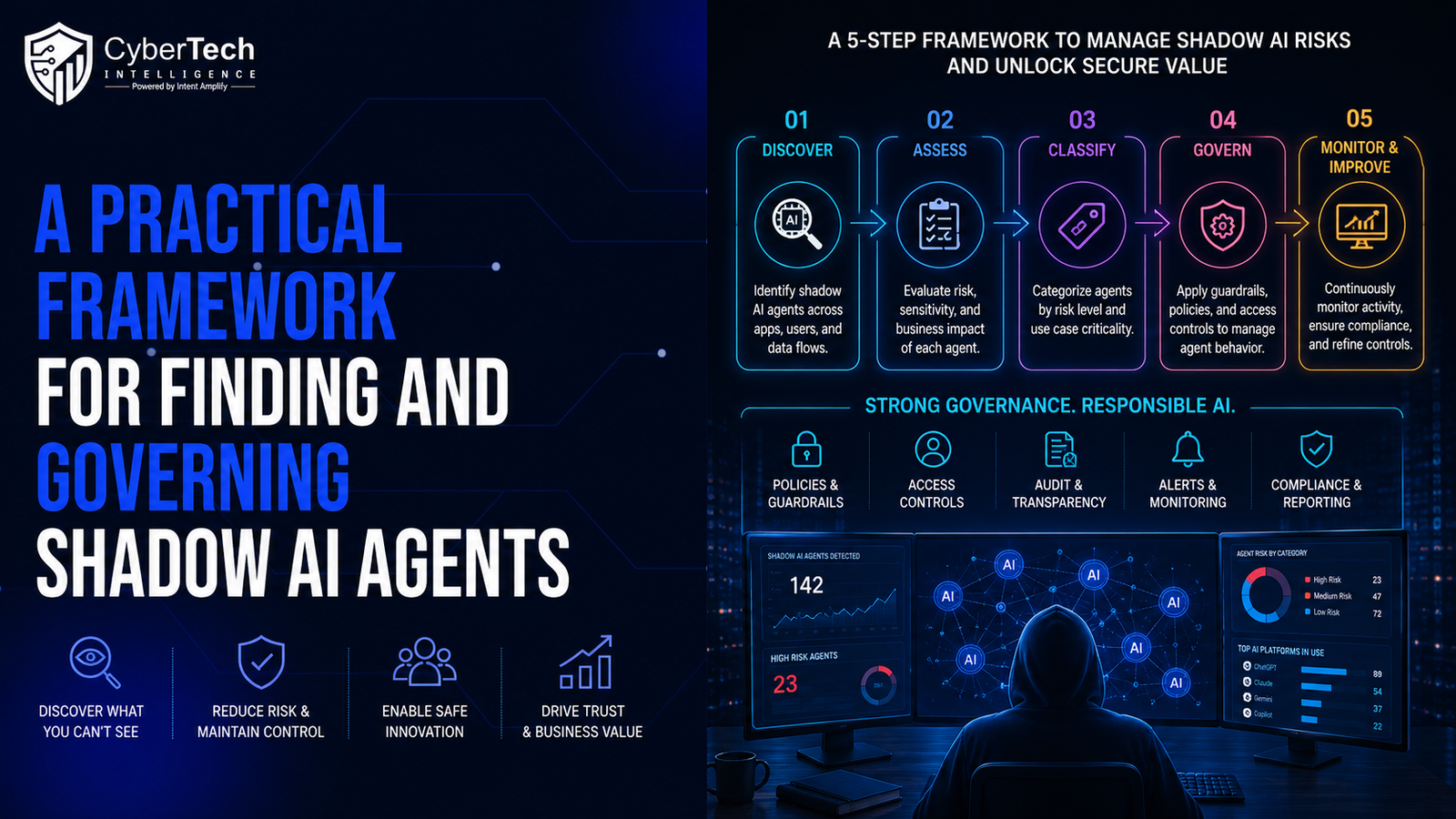
Executive Summary
AI agents are becoming enterprise actors: they can call tools, access data, and execute workflows. The identity challenge appears when those actors are created faster than the organization can discover, own, authorize, observe, and retire them. Microsoft's current governance guidance treats agent identities as lifecycle objects with human sponsorship and access controls. [1] Google Cloud's 2026 agent-security guidance similarly emphasizes first-class agent identity and least-privilege boundaries. [2] CyberTech Intelligence therefore frames shadow AI agent risk as an operating-model problem: discovery must connect directly to identity, authority, approval, monitoring, and offboarding.
CyberTech Intelligence Perspective
CyberTech Intelligence defines a governed shadow-AI-agent model as one in which a material agent can be found, tied to an accountable human sponsor, represented by an explainable identity or credential path, limited to the authority required for its task, observed while operating, and removed when the business purpose ends. The word "shadow" describes a management gap, not malicious intent.
Evidence Base for the Framework
This whitepaper combines current Microsoft and Google agent-identity guidance, NIST lifecycle risk-management work, U.S. Treasury AI risk-management direction, and current vendor frameworks from CyberArk, Palo Alto Networks, and Netskope. [1] [2] [3] [4] [5] [6] [7] Government and standards sources are used for risk-management context. Vendor sources are used only for their own stated approaches. No source proves that a named target organization has an unmanaged agent or identity weakness.
Why Traditional Asset Inventory Breaks at the Workforce Edge
Traditional inventory is often organized around devices, applications, cloud resources, and user accounts. Workforce agents can cut across all four. A business user may create an automation inside a SaaS platform. A developer may run a local coding agent. A team may connect a low-code agent to multiple business systems. A cloud agent may use a workload identity and call external tools. The same business workflow can therefore appear as separate evidence in identity, endpoint, SaaS, network, cloud, and application systems.
The control model should not demand that every team use one discovery technology. It should demand that discovered evidence converge into one agent record with a business owner, identity path, resource map, and control decision.
From Agent Discovery to an Identity-Control System
NIST's 2026 critical-infrastructure AI profile work emphasizes a repeatable lifecycle approach for managing AI risk and communicating trustworthiness requirements. [3] That lifecycle logic is useful outside critical infrastructure as well: discover the system, understand context, select controls, monitor outcomes, and revise the design when the risk changes. For shadow AI agents, the equivalent operating system is discovery, ownership, identity, authority mapping, right-sizing, approval, observation, and retirement.
Eight Operating Layers and Seven Control Questions
Seven questions make the model executable: Can we find the agent? Who owns it? Which identity or credential does it use? What can it reach and change? Is the authority limited to the task? Which actions need approval or deterministic policy? Can we observe and retire the access? The eight-layer framework below converts those questions into a repeatable operating model.
1. Discover the Agent and Its Workflow
Use identity, endpoint, SaaS, browser, cloud, application, and network evidence to locate material agents. Record the discovery source and observed workflow before assigning risk. Discovery should distinguish approved, experimental, personal, embedded, and unknown use so remediation is proportionate.
2. Assign Human Ownership
Microsoft's agent-identity governance documentation makes sponsorship central to lifecycle accountability. [1] In any platform, the equivalent control is a named human who can explain why the agent exists, approve material access, and decide when the workflow should change or stop.
3. Identify the Agent and Credential Path
Document whether the agent acts through its own identity, a user context, service account, OAuth grant, API key, token, cloud role, certificate, or another mechanism. Separate the identity of the human requester from the software actor wherever the platform supports that distinction.
4. Map Authority, Tools, and Data
List the resources and actions available to the agent. Include connected SaaS applications, APIs, repositories, databases, MCP servers, cloud services, external destinations, and any ability to write, delete, deploy, approve, publish, or transact. Palo Alto Networks' 2026 policy roadmap places AI agents, data, applications, models, and infrastructure inside one broader AI-security ecosystem. [5]
5. Right-Size Permission and Persistence
Google Cloud's 2026 VPC Service Controls update describes agent identity as part of least-privilege enforcement for agentic workloads. [2] Translate that into the business workflow: grant only the resources and actions needed for the task, avoid shared high-privilege credentials, and make persistence proportional to the expected duration.
6. Add Approval and Guardrails
Palo Alto Networks' August 2026 identity-security analysis emphasizes continuous discovery of identities and privileges as a basis for controlling access. [4] High-impact actions should use deterministic policy, human approval, or both. Autonomy should expand only where the organization can explain the boundary and monitor the result.
7. Observe Activity and Authority Drift
Netskope's 2026 Zero Trust perspective emphasizes that visibility and monitoring are distinct from initial access control. [6] An authorized agent can still behave unexpectedly or accumulate new reach as the workflow changes. Log material actions, alert on anomalies, and review permission and connection drift.
8. Retire, Revoke, and Learn
The end of the workflow is part of the identity lifecycle. When the business purpose, owner, or platform changes, revoke credentials, disable the agent, remove integrations, and preserve the audit record required for review. Treasury's 2026 AI risk-management work reinforces accountability, transparency, resilience, and lifecycle decision-making as practical operating requirements. [7]
Operational Failure Scenarios
Table 1. Failure Scenarios and Corrective Decisions
|
Scenario |
What Failed |
Corrective Decision |
|
Agent exists but has no owner. |
Discovery is disconnected from accountability. |
Assign sponsor; restrict expansion until ownership is accepted. |
|
Agent uses a user's broad OAuth grant. |
Credential scope exceeds task context. |
Issue narrower delegated access or reduce scope and duration. |
|
New connector adds write access to production. |
Authority drift is not reviewed after workflow change. |
Re-run permission review and add approval for high-impact actions. |
|
Agent activity is logged only inside one tool. |
Evidence is fragmented across systems. |
Correlate agent, identity, resource, and action records for investigation. |
|
Owner leaves and the agent keeps running. |
Lifecycle is not tied to workforce change. |
Transfer sponsorship or retire the agent and revoke access. |
|
Agent can delete or send without confirmation. |
Autonomy exceeds business risk tolerance. |
Add deterministic policy, human approval, or remove the function. |
Sample Qualification Flow for a Newly Discovered Agent
|
Step |
Question |
Outcome |
|
1. Verify |
Is the discovered item actually an active agent or agentic workflow? |
Create record or close false positive. |
|
2. Own |
Can a human sponsor explain the purpose and expected duration? |
Assign an owner or restrict access until ownership is assigned. |
|
3. Identify |
Which credential or identity enables the workflow? |
Document and classify access path. |
|
4. Scope |
Which resources and high-impact actions are available? |
Approve, reduce, or redesign authority. |
|
5. Control |
Which actions need approval, monitoring, or deterministic enforcement? |
Implement operating controls. |
|
6. Decide |
Does the value justify the remaining risk and operational burden? |
Approve, constrain, migrate, or retire. |
Governance and Decision Rights
Figure 1. Shadow AI Agent Governance Framework
|
Decision Stage |
Accountable Owner |
Required Evidence |
Exit Criteria |
|
Discovery Scope |
Security / IT |
Discovery source, agent record, workflow, platform, first-seen evidence. |
Agent is confirmed and classified. |
|
Business Ownership |
Business / Technology Sponsor |
Purpose, sponsor, technical owner, duration, expected outcome. |
Accountability is explicit. |
|
Identity and Access |
Identity / Security |
Credential path, resources, scopes, entitlements, tools, data, actions. |
Authority matches the task. |
|
Runtime Control |
Platform / Application Owner |
Approval gates, guardrails, logs, alerts, and exception route. |
Material actions are observable and governable. |
|
Lifecycle Review |
Identity Governance / Risk |
Use evidence, drift, owner status, exceptions, expiry, incidents. |
Continue, constrain, redesign, or retire decision is evidenced. |
CyberTech Intelligence Shadow AI Agent Control Framework™
Figure 2. Eight-Layer Architecture
|
Layer |
Name |
Operating Requirement |
|
01 |
Discover |
Find material agents and preserve the evidence that proves they exist. |
|
02 |
Assign Ownership |
Name a human sponsor and technical owner. |
|
03 |
Identify |
Document agent identity, human delegation, credential type, and authentication path. |
|
04 |
Map Authority |
Map resources, data, tools, APIs, and high-impact actions. |
|
05 |
Right-Size |
Limit functionality, permissions, and persistence to the approved task. |
|
06 |
Approve |
Add human or deterministic control for actions that can materially change the business. |
|
07 |
Observe |
Monitor activity, investigate exceptions, and review permission or connection drift. |
|
08 |
Retire |
Revoke or redesign access when purpose, ownership, or risk changes. |
Shadow AI Agent Readiness Score™
Table 2. CyberTech Intelligence Shadow AI Agent Readiness Score™
|
Domain |
Executive Assessment Question |
Ready-State Evidence |
|
Discovery |
Can priority agents be found across approved and unapproved paths? |
Repeatable discovery sources and agent inventory. |
|
Ownership |
Does each material agent have a human sponsor and technical owner? |
Named sponsor, owner, purpose, and review date. |
|
Identity |
Is the agent's authentication and delegation path explicit? |
Identity, account, grant, token, key, role, and issuer. |
|
Permission Scope |
Does access match the task? |
Resource list, scopes, entitlements, and justification. |
|
Tool and Data Reach |
Are tools, APIs, MCP servers, applications, and data stores mapped? |
Connection map and data classification. |
|
Approval Controls |
Are high-impact actions independently controlled? |
Human approval, deterministic policy, or explicit prohibition. |
|
Credential Lifecycle |
Can credentials expire, rotate, and be revoked? |
Expiry, rotation, tested revoke, and exception path. |
|
Monitoring |
Can teams observe and investigate important actions? |
Logs, alerts, audit records, and incident workflow. |
|
Drift Review |
Are access and connection changes reviewed? |
Change evidence, scheduled review, and exception aging. |
|
Offboarding |
Can the agent and integrations be retired cleanly? |
Disable/decommission procedure and tested removal. |
|
Measurement |
Are control outcomes measured before autonomy expands? |
Coverage, remediation, review, exception, and retirement metrics. |
How to Calculate the Score
Rate each domain from 0 to 4: 0 = absent; 1 = informal; 2 = documented; 3 = implemented and tested; 4 = measured and continuously improved. The maximum is 44 points. Divide the total by 44 and multiply by 100. Suggested bands are Critical (0-24%), Developing (25-49%), Defined (50-69%), Managed (70-84%), and Adaptive (85-100%). The score is an internal readiness aid, not a certification, a breach prediction, a financial forecast, or a statement of product performance.
Control Principles for Policy and Architecture
- No material agent should operate indefinitely without a named sponsor, purpose, and review date.
- Agent credentials should be distinguishable from human credentials when that improves attribution and control.
- Authorization should be based on the task and resource, not on the maximum access held by the human requester.
- High-impact actions should require a stronger control than low-risk read-only retrieval.
- Every material workflow should have a practical revoke or disable path that is tested before scale.
- Discovery evidence should feed the governance record automatically where possible, but a human decision should remain accountable for approval and exceptions.
Shadow AI Agent Governance Maturity Model
Figure 3. CyberTech Intelligence Shadow AI Agent Governance Maturity Model
|
Maturity |
Operating Pattern |
Leadership Priority |
|
Reactive |
Agents are discovered through incidents, user reports, or isolated tool views; ownership and access records are inconsistent. |
Establish repeatable discovery and a minimum agent record. |
|
Defined |
Priority agents have owners, identity paths, permission maps, and review dates. |
Standardize classification, approval, and retirement rules. |
|
Connected |
Identity, endpoint, SaaS, cloud, application, and business evidence converge into one governance workflow. |
Automate handoffs and event-driven review triggers. |
|
Measured |
Owner coverage, permission scope, exceptions, approval controls, drift, and offboarding are tracked. |
Use evidence to reduce recurring control gaps. |
|
Adaptive |
Controls change as workflow authority, data sensitivity, and business impact change. |
Expand autonomy only where evidence supports it. |
Executive Recommendations and Conclusion
- Make discovery a continuous input to identity governance rather than a one-time AI inventory exercise.
- Require a human sponsor before a material agent receives durable or high-impact access.
- Prefer explicit agent or workload identity where it improves attribution and policy control.
- Design permissions around the task and review them when tools, data sources, or workflow steps change.
- Use approval and deterministic enforcement for actions whose impact cannot be easily reversed.
- Measure ownership coverage, access review, exception aging, control gaps, and retirement outcomes before scaling autonomy.
Benchmark the Shadow Agent Identity-Control Model
Use the CyberTech Intelligence readiness score in a working session to compare discovery, ownership, identity, permission scope, approval, monitoring, and lifecycle evidence across one priority business function.
About CyberTech Intelligence
CyberTech Intelligence provides research-led cybersecurity intelligence, executive content, and market engagement programs. This publication is vendor-neutral and intended for education, decision support, and claim-safe GTM planning.
Research and Citation Governance
This asset uses public sources current through August 26, 2026. Government and NIST sources are used for risk-management and lifecycle context. Vendor sources are used only for the publisher's own stated guidance, product approach, or security perspective. CyberTech Intelligence does not infer that a named organization has a shadow AI agent, compromised identity, security incident, buying intent, or need for a particular product. The framework and readiness score are CyberTech Intelligence decision aids, not certification or incident prediction.
References
[1] Microsoft Learn, “Governing Agent Identities,” Updated June 16, 2026. https://learn.microsoft.com/en-us/entra/id-governance/agent-id-governance-overview Accessed August 26, 2026. Relevance: Current Microsoft documentation on agent identities, human sponsors, time-bound access, lifecycle governance, and access controls.
[2] Google Cloud, “Securing agentic AI with perimeter guardrails: What's new in VPC Service Controls,” June 26, 2026. https://cloud.google.com/blog/products/identity-security/securing-agentic-ai-whats-new-in-vpc-service-controls Accessed August 26, 2026. Relevance: Google Cloud security guidance on first-class agent identity, least privilege, and network-level boundaries for agentic workloads.
[3] National Institute of Standards and Technology, “Concept Note: AI RMF Profile on Trustworthy AI in Critical Infrastructure,” Updated July 17, 2026. https://www.nist.gov/programs-projects/concept-note-ai-rmf-profile-trustworthy-ai-critical-infrastructure Accessed August 26, 2026. Relevance: NIST profile-development work used for lifecycle risk-management and trustworthiness context for AI-enabled capabilities, including agents and tools.
[4] Palo Alto Networks, “Idira Identity Security Platform: Discover Every Privilege (Part 2),” August 4, 2026. https://www.paloaltonetworks.com/blog/identity-security/continuous-identity-privilege-discovery/ Accessed August 27, 2026. Relevance: Vendor identity-security analysis used only for its continuous discovery and privilege-mapping approach across human, machine, and agentic identities.
[5] Palo Alto Networks, “Where AI Adoption Meets Security - Policy Roadmap,” June 2026. https://www.paloaltonetworks.com/blog/wp-content/uploads/2026/06/SAIBD-Policy-Roadmap-One-Pager.pdf Accessed August 26, 2026. Relevance: Vendor policy overview used for its discover-assess-protect framing and recognition of AI applications, agents, models, data, and infrastructure as security subjects.
[6] Netskope, “Agents Deserve A Place In Every Zero Trust Strategy,” June 16, 2026. https://www.netskope.com/blog/agents-deserve-a-place-in-every-zero-trust-strategy Accessed August 26, 2026. Relevance: Vendor perspective used for visibility, monitoring, and extension of Zero Trust principles to agent-resource interactions.
[7] U.S. Department of the Treasury, “Treasury Releases Two New Resources to Guide AI Use in the Financial Sector,” February 19, 2026. https://home.treasury.gov/news/press-releases/sb0401 Accessed August 26, 2026. Relevance: Government release establishing a current AI risk-management framework for a regulated sector and reinforcing scalable accountability, transparency, and resilience.