
The Payment Request May Not Be the First Attack
Deepfake BEC is usually pictured as a finance employee receiving an urgent request from a synthetic CEO. That scenario is important, but it starts too late in the attack chain.
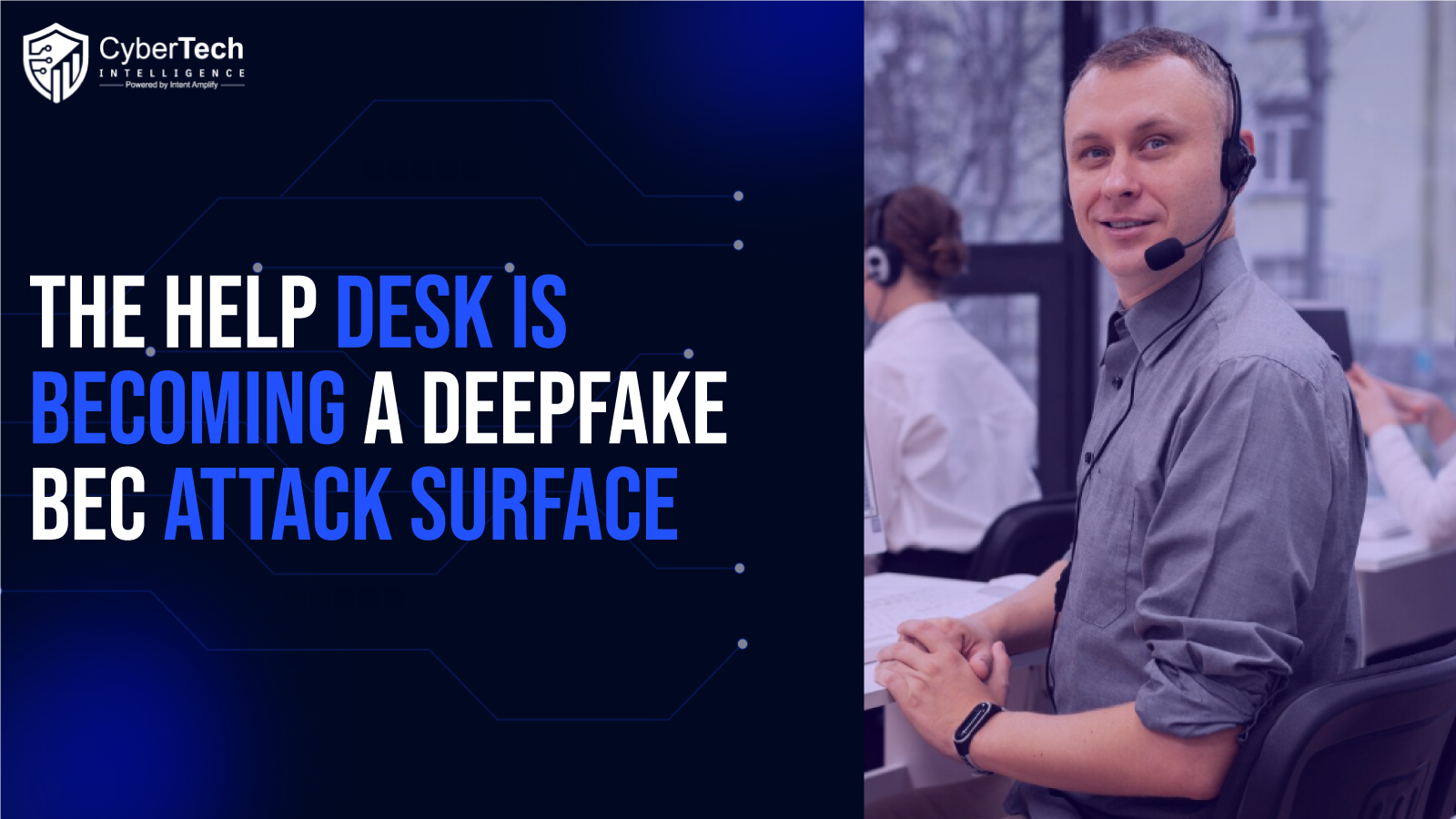
A more patient attacker may first target the help desk.
If support can be persuaded to reset MFA, change a recovery telephone number, enroll a new device, unlock an executive account, or restore access to a finance mailbox, the attacker gains something more valuable than a convincing imitation: legitimate internal access.
From that position, the attacker can study payment cycles, supplier relationships, approval language, executive calendars, internal titles, transaction thresholds, and exception patterns. A later BEC request can then originate from a real account and contain real business context.
The help desk is therefore not only a support function. It is part of the enterprise authorization boundary.
The central question is not whether help desk agents are careful. Most are operating under strict service expectations and real user pressure. The question is whether the recovery workflow asks them to make judgments that synthetic media makes increasingly unreliable.
A caller may sound like a known executive. A video may appear live. The person may know employee details, manager names, recent travel, and internal projects. A board meeting may begin in ten minutes. Those conditions create pressure precisely because they are plausible.
A mature recovery process should remain safe even when the interaction is convincing.
Why Account Recovery Belongs in the BEC Control Model
The FBI’s 2025 Internet Crime Report recorded approximately USD 3.05 billion in adjusted losses associated with business email compromise complaints. AI-related descriptors were also present across more than 22,000 complaints. FinCEN has warned about suspected deepfake media and fraudulent identity documents used to circumvent verification and authentication.
These signals connect BEC, identity proofing, and account recovery.
A reset may enable:
• access to a legitimate executive or supplier conversation;
• creation of mailbox forwarding or deletion rules;
• interception of invoices and payment approvals;
• study of internal language and authority patterns;
• manipulation of recovery factors for persistence;
• access to customer, payroll, legal, or transaction data;
• later requests that appear to come from a trusted internal account.
This is why recovery cannot be treated only as a convenience workflow. It is the process through which the organization reissues trust.
CyberTech Intelligence Observation
Authentication strength is constrained by recovery strength. An organization can deploy strong MFA and still remain exposed if a high-pressure support interaction can replace or reset that control using voice, video, familiarity, or personal knowledge.
The Help Desk’s Impossible Judgment Problem
Traditional support verification often combines personal questions, employee records, caller knowledge, manager confirmation, voice familiarity, or video presence. Each signal may add context. None should independently authorize a high-risk recovery.
Public information and breached data can expose dates, roles, locations, relationships, project names, and personal details. AI can help an attacker organize that information into a coherent interaction. Synthetic voice and video can reinforce the story. A compromised manager account can provide apparent approval.
The problem is not that every verification signal has become worthless. The problem is that weak signals are frequently combined informally and then treated as strong assurance.
A safer workflow distinguishes between context and evidence.
Context may include:
• the caller’s knowledge;
• familiar speech or appearance;
• a plausible explanation;
• urgency;
• a message from a manager;
• a known travel schedule.
Evidence should include:
• a trusted employee record;
• a pre-established recovery method;
• a known managed device;
• phishing-resistant authentication;
• a controlled manager-confirmation route;
• identity-governance approval;
• security review for high-risk users;
• a complete recovery record.
Context can inform the decision. Evidence must govern it.
The CyberTech Intelligence Risk-Tiered Recovery Model
Not every reset needs the same level of friction. Recovery should be calibrated to identity risk, requested action, device context, and business consequence.
Tier 1: Standard Recovery
Applies to low-risk users and routine actions where the account has limited privilege and the recovery factors remain intact.
Possible controls:
• approved self-service recovery;
• existing trusted device;
• standard identity checks;
• automated logging and notification.
Tier 2: Elevated Recovery
Applies when behavior, location, device, timing, or requested change increases risk.
Possible controls:
• manager confirmation through a trusted directory;
• additional identity evidence;
• delayed recovery-factor changes;
• temporary access limitations;
• enhanced logging.
Tier 3: High-Risk Recovery
Applies to executives, finance, treasury, payroll, procurement, administrators, security staff, legal leaders, or users with access to material data and workflows.
Required controls may include:
• restricted recovery authority;
• security-team notification or approval;
• known-device validation;
• phishing-resistant authentication or pre-enrolled recovery method;
• trusted manager or executive-support confirmation;
• temporary privilege reduction;
• post-recovery monitoring;
• recorded reason, verifier, approver, and effective time.
Tier 4: Exceptional Recovery
Applies when normal evidence is unavailable or the request is inconsistent with known context.
The objective is not to complete the reset faster. It is to manage a formal exception. The workflow should define who can approve, which compensating controls are required, what temporary restrictions apply, and when the event receives post-review.
Recovery Flow
Request received
↓
User and action risk classified
↓
Trusted employee and device records checked
↓
Required recovery evidence gathered
↓
Manager, identity, or security approval applied
↓
Temporary restrictions added where needed
↓
Recovery completed or rejected
↓
Evidence retained and monitoring initiated
High-Risk Actions the Help Desk Should Separate
A password unlock is not the same as an MFA reset. An MFA reset is not the same as changing a recovery number. A recovery-factor change is not the same as enrolling a new device for an administrator.
The workflow should distinguish:
• account unlock;
• password reset;
• MFA reset;
• recovery-factor replacement;
• new-device enrollment;
• privileged-account recovery;
• mailbox access restoration;
• role or group membership change;
• emergency access grant.
The more the action changes the basis of future trust, the stronger the evidence requirement should become.
A support ticket should never allow one agent to receive, verify, approve, and complete a high-risk recovery without the required independent control.
Phishing-Resistant MFA and Recovery Governance
Phishing-resistant MFA can reduce exposure for high-risk roles, but deployment alone is not enough. The recovery workflow must be designed to avoid downgrading the user to a weaker method under pressure.
Security leaders should ask:
• Can a phishing-resistant factor be replaced through telephone support?
• Can a new device be enrolled immediately after a reset?
• Can the user access financial or administrative systems before review?
• Does security receive an alert?
• Are recovery-factor changes delayed or separately approved?
• Is the old factor revoked and investigated?
• Are active sessions reviewed after recovery?
Recovery should be treated as a security event for high-risk identities, not merely a closed support ticket.
The Culture Problem: Executive Urgency
A technically strong workflow can fail if leadership culture teaches employees to prioritize seniority over verification.
Executives should communicate three expectations:
1. Verification is required even when the request is genuine.
2. No employee will be penalized for following the recovery process.
3. Leaders will not ask support to bypass controls through voice, video, chat, or personal escalation.
Executives should also participate in tabletop exercises. A policy is more credible when senior leaders experience the process and support it publicly.
The attacker’s advantage is not only synthetic media. It is the assumption that an employee will feel unable to challenge authority.
Help Desk Metrics That Demonstrate Readiness
Metric Governance Value
High-risk identity classification coverage Shows whether enhanced recovery is defined before incidents
Enhanced recovery usage Measures application of stronger proof
Recovery-factor change approvals Demonstrates control over reissued trust
Security notification rate Connects support activity to threat monitoring
Known-device validation rate Measures independent context
Temporary restriction usage Limits post-recovery impact
Evidence completeness Supports investigation and audit
Exception age and closure Shows whether urgent bypasses are governed
Repeat recovery attempts Identifies targeted identities and patterns
Post-recovery anomaly rate Tests whether monitoring detects misuse
Boards and executives should not receive ticket volume alone. They should understand which identities can materially affect money, access, data, and operations—and whether the recovery process reflects that consequence.
A Practical 30-Day Recovery Hardening Plan
Days 1–5: Classify
Identify executives, finance, payroll, procurement, administrators, security personnel, and other high-risk users. Define high-risk recovery actions.
Days 6–10: Map
Document current self-service, help desk, manager, identity, and emergency paths. Identify where voice, video, or personal knowledge can complete the reset.
Days 11–15: Design
Create the risk tiers, trusted-record sources, approval requirements, temporary restrictions, and security-notification rules.
Days 16–20: Prepare
Update support scripts, escalation routes, employee communication, evidence fields, and executive non-override language.
Days 21–25: Test
Run scenarios involving an executive video call, finance-user MFA reset, administrator device enrollment, and repeated recovery attempts from a new location.
Days 26–30: Report
Show coverage, exceptions, weak recovery paths, evidence quality, and the next remediation priorities.
Limitations and User Experience
Stronger recovery can create delay and accessibility challenges. Users may lose devices, travel, lack access to pre-enrolled methods, or face urgent business needs. The solution is not to weaken assurance informally. It is to design legally reviewed, accessible, and auditable alternatives.
Trusted records can also be stale or compromised. HR, identity, device, and manager data require ownership and change control. High-risk recovery therefore depends on data quality as well as support discipline.
Organizations should measure false positives, support burden, recovery time, and user impact. Security controls that are impossible to use will create workarounds. The strongest model balances consequence, accessibility, speed, and evidence.
High-risk recovery also depends on the availability of approvers and trusted evidence during real incidents. Organizations should test after-hours coverage, executive travel, outsourced support, and identity-platform outages so that urgency does not force a weaker path. Where normal controls are unavailable, temporary access should be restricted to the minimum necessary function, independently approved, monitored in real time, and automatically reviewed or revoked after the defined period.
Closing Perspective
Deepfake BEC readiness begins before the payment request. It begins wherever trust can be reissued.
The help desk is one of those places.
Organizations should stop asking support agents to decide whether a caller sounds or looks real. They should give agents a recovery workflow that classifies risk, uses trusted records, separates approval, limits post-recovery access, notifies security, and preserves evidence.
CyberTech Intelligence Perspective
A synthetic identity becomes an enterprise incident only when it receives real authority. Risk-tiered recovery prevents voice, video, urgency, and familiarity from becoming credentials.
Assess Your Recovery Readiness
Building a Recovery Risk Matrix
Help desk hardening becomes practical when the organization classifies both the identity and the requested action. A single high-risk user label is not enough. The same user may request a routine unlock, an MFA reset, a recovery-number replacement, a new device enrollment, a privileged-role change, or emergency access. Each action changes the basis of future trust in a different way.
A recovery risk matrix should evaluate:
• the user's financial, administrative, security, legal, payroll, or executive authority;
• the privilege of the affected account;
• whether existing recovery factors remain available;
• whether the request changes a factor, device, number, or administrator;
• device posture, location, session, and recent account behavior;
• the consequence if the recovery is fraudulent;
• the reversibility of the action;
• the availability and independence of trusted evidence.
The matrix should connect each risk level to a defined evidence standard. Low-risk actions may use approved self-service. Elevated actions may require additional records and manager confirmation. High-risk recovery may require identity governance, security approval, known-device validation, temporary restrictions, and post-recovery monitoring. Exceptional recovery should be treated as a governed exception with named ownership and follow-up.
Operational Scenario 1: Executive MFA Reset
A senior executive appears on video and explains that a device was lost before an important meeting. The person knows internal schedules, recent travel, and the names of executive support staff. The request is operationally plausible.
The help desk should not be required to determine whether the video is synthetic. The workflow should classify the executive identity and the MFA reset as high risk. It should retrieve the employee and device record, use an approved manager or executive-support confirmation path, notify security, apply the required approver, and restrict sensitive access until the event is reviewed.
The process protects the executive even when the interaction is genuine. A real executive can follow a secure recovery path, and a synthetic executive cannot convert appearance into authority.
Operational Scenario 2: Finance User Recovery at Month-End
A finance user reports being locked out during close and requests a password reset, factor replacement, and immediate restoration of payment-system access. The business pressure is real because delayed access may affect operations.
The workflow should separate the actions. A password reset may have one evidence standard. Replacing an MFA factor and restoring payment access should require stronger controls. Temporary access can be limited to the minimum required function, with enhanced monitoring and a time-bound review. Urgency should change escalation speed, not reduce evidence.
Operational Scenario 3: Repeated Recovery Attempts
Several recovery requests target the same administrator over a short period. Each individual ticket appears incomplete rather than clearly malicious. A ticket-only process may close the events separately.
The identity and security teams should correlate repeated attempts, source locations, device changes, mailbox activity, manager-confirmation requests, and later privilege use. Recovery telemetry is valuable because it may show an attack before account takeover succeeds.
Connecting the Help Desk to Security Operations
High-risk recovery should create a security-visible event. The event should include the identity, requested action, evidence used, device context, approver, temporary restrictions, and result. Security operations should be able to correlate the event with suspicious email, impossible travel, session anomalies, mailbox rules, supplier-change attempts, payment requests, and data-access activity.
This connection prevents a common failure: support closes a reset ticket while security investigates a separate mailbox alert and finance reviews an unusual request. The organization sees three unrelated events instead of one developing attack chain.
Decision Evidence for Recovery
A complete recovery record should answer:
-
Who requested the action?
-
Which account, factor, device, or privilege was affected?
-
How was the user and action risk classified?
-
Which trusted records were used?
-
Who verified and approved the recovery?
-
What temporary restrictions were applied?
-
When did the change become effective?
-
What monitoring or post-review followed?
Evidence fields should be structured rather than buried in free-text notes. Structured evidence supports audit, incident response, trend analysis, and consistent training.
Control Ownership
The help desk operates the workflow, but it should not own the risk alone. Identity teams define recovery policy and trusted methods. Security defines high-risk alerts and monitoring. HR maintains employee and manager records. Business owners identify roles with material authority. Legal and privacy teams govern evidence and recording practices. Executives support non-override behavior.
Clear ownership also improves exceptions. When normal evidence is unavailable, the agent should know exactly which identity, security, or business authority can approve the exception, which compensating controls are required, and when the event will be reviewed.
Testing the Recovery Process
A strong tabletop should test more than whether an agent refuses a suspicious request. It should test whether the ticket is classified correctly, trusted records are accessible, the right approver responds, temporary restrictions operate, security receives visibility, and evidence can be reconstructed.
Useful measures include the percentage of high-risk identities with enhanced recovery, the rate of recovery-factor changes receiving separate approval, time to complete legitimate high-risk recovery, repeat attempts detected, temporary restrictions applied, security notifications completed, and evidence completeness.
The help desk becomes resilient when agents no longer need to outperform synthetic media. They need a workflow that makes identity context useful but insufficient, applies proof according to consequence, and ensures that reissued trust remains controlled after the ticket is closed.
Readiness Outcome for Security and Support Leaders
The most important outcome is not a lower ticket count. It is a recovery system that prevents one persuasive interaction from creating durable authority. Leaders should review whether trusted records are accessible during real incidents, whether high-risk approvals are consistently available, whether temporary restrictions operate as designed, and whether security can see the event before downstream abuse occurs.
Recovery design should also be reviewed after organizational changes. New executives, acquisitions, outsourced support, identity-platform migrations, regional expansion, and changes in device policy can create gaps between documented procedure and operational reality. Quarterly ownership reviews should confirm that high-risk users, trusted contacts, escalation routes, and evidence requirements remain current.
When these controls are maintained, the help desk can serve users quickly without becoming the weakest path into finance, privileged access, or sensitive communications. The operating goal is reliable recovery under pressure, supported by evidence and accountable decision rights.
References and Source Links
1. Federal Bureau of Investigation, 2025 Internet Crime Report
https://www.fbi.gov/file-repository/2025_ic3report.pdf
2. Federal Bureau of Investigation, Business Email Compromise
3. Financial Crimes Enforcement Network, Alert on Fraud Schemes Involving Deepfake Media Targeting Financial Institutions
4. U.S. Department of the Treasury, 2026 National Money Laundering Risk Assessment
https://home.treasury.gov/system/files/246/2026-NMLRA.pdf
5. National Institute of Standards and Technology, NIST AI 100-4: Reducing Risks Posed by Synthetic Content
6. FBI Internet Crime Complaint Center, Business Email Compromise Guidance
https://www.ic3.gov/CrimeInfo/BEC
7. U.S. Secret Service, Business Email Compromise Guidance
8. Federal Trade Commission, AI Voice-Cloning Scam Guidance
9. Microsoft, Digital Defense Report 2025
https://www.microsoft.com/en-us/corporate
Author
CyberTech Intelligence Research Desk
Author